Nuevas Referencias Interviews Sergi Bellver

Boy this came out a long time ago and I’ve wanted to do a post on it ever since. Nuevas Referencias is a blog that does interviews with Spanish language authors and posts the results both in Spanish and English. In September they interviewed Sergi Bellver. Bellver has some interesting things to say on short stories and I’ve enjoyed some of his articles. I also appreciate his take bloging, too. I would definitely check the blog out if you are interested in Spanish language lit as they have some good interviews.

Háblame un poco de los últimos libros que has publicado.
Llevo poco tiempo en este oficio y todavía no tengo libro publicado en solitario. Empecé a escribir narrativa, quiero decir, a escribir con verdadera conciencia de lo que significa la creación literaria, ya algo mayor, con 35 años. Desde 2010 he publicado relatos en varias antologías (la última, un homenaje colectivo a Stephen King), en España y otros países, junto a algunos de los autores hispanoamericanos actuales que más me gustan. También me he hecho un pequeño hueco con la crítica literaria en varios medios, pero todavía me queda un mundo por aprender, cosa que además no suelo hacer por el cauce habitual, lo que provoca lagunas pero me da también una perspectiva diferente. Soy un corredor de larga distancia, sin prisas, al que le importa más el camino que la meta, y por fin, después de mucho trabajo, versiones fallidas y algún que otro accidente, este otoño ya estará lista mi primera novela.

Tell me about the latest books you have published.
I haven’t been in this line of work very long and I haven’t yet published a book as a solo writer. I began to write fiction, that is writing while fully conscious of the meaning of literary creation process, when I was already 35 years-old. Since 2010 I have published short stories in various anthologies in Spain, and other countries, along with some of the current Spanish-speaking authors I like the most (the latest one is a collective tribute to Stephen King). I have also made a place for myself in the field of literary criticism in various media, but I still have a lot to learn, and learning is something I do differently, which causes gaps but also gives me a different perspective. I’m a long distance runner, unhurried, more concerned with the path than the finishing line, and finally, after a lot of work, fail attempts, and some accidents, this fall my first novel will be ready.

The New Bolivian Literature

Moleskin Literario did a post a week or so ago about some new Bolivian literature called La literature boliviana vale la pena (Bolivian Literature is Worthwhile). In it he lists a couple of reviews of some interesting new books. If you are interested in some new writing, it is worth a look.

Hace unos meses hice un post sobre el probable boom de la narrativa venezolana. Ahora toca preguntarse si existe un boom de la narrativa boliviana. Al parecer, como nunca antes la literatura boliviana tiene autores que empiezan a llamar la atención fuera de sus países como Liliana Colanzi, Rodrigo Hasbún o Giovanna Rivero (sin contar al viejo conocido de Edmundo Paz Soldán, quien en su literatura ha ido pasando todas las etapas de boom, el boom junior, el postboom y el ciberboom, es decir desde la novela comprometida hasta la ciencia ficción, que al parecer lo ocupa ahora). En concreto, Giovanna Rivero llama mucho la atención. Un texto estupendo de la chilena Andrea Jeftanovic (“La vera Giovanna”) comenta su éxito en la feria del libro de La Paz. Y ahora una reseña de Sebastián Antezana a Niñas y detectives la deja muy bien. Y termina con un entusiasmado grito de apoyo a la literatura boliviana: “La literatura boliviana vale la pena”.

Juan Gelman Interviewed in El Pais

El Pais has an interview with Juan Gelman, the Argentine poet. The occasion of the interview is the 1300 page collection of all his poems. While you can’t read that book in English, you can read the brand new collection of his poems from Open Letter. I received my copy in the mail yesterday. He sounds interesting in that he makes up his own words. I would have liked to seen the Spanish included in the book, too.

P. Muchas veces usted descoyunta la gramática y convierte en verbo un sustantivo. De mundo crea mundar, por ejemplo. ¿El lenguaje se le queda pequeño?

R. En el fondo, de Cervantes a la fecha, siempre se ha dicho eso. Cervantes se inventa neologismos y defiende la necesidad de reinventar la lengua. En mi caso es un intento de pasar los límites.

P. ¿Y qué dicen sus traductores?

R. [Se ríe] Creo que he logrado que salgan de su lógica. He tenido la suerte de tener excelentes traductores. Rompen sus propias lenguas para hacer el intento, aunque no siempre es posible.

P. Hay quien dice que poesía es justo lo que se pierde en la traducción de poesía. ¿Está de acuerdo?

R. Depende del traductor, y cada lengua tiene su lógica. Bien decía Pavese que para hacer una buena traducción de una lengua a otra no basta con conocer las dos: hay que conocer las dos culturas… Yo creo que traducir poesía es más difícil que escribirla. Yo mismo empecé traduciendo y me fue mal.

Chile After the Boom

Lina Meruane has an article (in Spanish) about Chilean authors after the Boom and after Bolaño. She mentions five authors which are worth looking at, including Diamela Eltit and Pedro Lemebel who most inherit from Donso. (Via Moleskine)

España se despide por estos días de su vieja criatura: el boom. Es un instante de duelo por la muerte de Carlos Fuentes y de nostalgia por la salida de escena de Gabriel García Márquez. (Acecha, además, el fantasma de Roberto Bolaño, que llegó a vislumbrarse como posible sucesor.) Junto con la deriva de Mario Vargas Llosa, que desde hace años sostiene un diálogo tenso con la cultura contemporánea, todas esas desapariciones se han vuelto una instancia única para examinar aquello que quedó a la sombra de esos escritores mayúsculos. Visto desde Chile o visto desde mi ventana fronteriza (un sitio de observación móvil entre Santiago y Nueva York) los autores del boom son menos una generación literaria que estrellas nacionales unitarias, estrellas internacionales nada fugaces que encandilaron a los lectores opacando el brillo de obras que no atravesaron la frontera. La literatura latinoamericana fue solo conocida por figuras solitarias (no ha habido hasta ahora espacio para más de un escritor, nunca para las deslumbrantes escritoras que fueron sus pares). La escritura chilena ha quedado a la sombra de José Donoso, nuestro embajador minoritario del boom con su extravagante novela El obsceno pájaro de la noche, y de Bolaño, que sostuvo, desde la ficción y la polémica, una relación nada diplomática con su origen. Sólo al desaparecer ambas figuras (y nombro solo a la narrativa, pero la poesía también ha cargado poetas estelares) se abre el espacio de la lectura, se buscan voces ocultas. Pienso que la prosa viva que surgió en el declive de Donoso es ahora visible en la obra poderosa de dos autores menos favorecidos por el brillo siempre caprichoso del mercado: las novelas de Diamela Eltit y las crónicas de Pedro Lemebel

Quarterly Conversation Winter 2013 Out Now

The Quarterly Conversation for Winter 2013 is out now. It looks quite interesting. On first glance what catches my is an interviews with Jorge Volpi. Below are just a few that caught my eye.


The Latin American Hologram: An Interview with Jorge Volpi

Interview by Diego Azurdia and Carlos Fonseca

Certainly there is some provocation to this statement, a small boutade like the ones Bolaño loved so much, but there is also something true to it. Bolaño seems to me to be the last writer that really felt part of a Latin American tradition, the last writer that responded with a knowledge of those models. Not only did he have a battle with the Latin American Boom but with all of the Latin American tradition—in particular with Borges and Cortázar—but that extends back to the 19th century. His was a profoundly political literature that aspired to be Latin American in a way different from that of the Boom, but that was still Latin American. I believe that this tradition stops with Bolaño. After him, my generation and the subsequent generations, I don’t see any authors that really feel part of the Latin American tradition, or that might be responding to these models.

“The Thoughts of Other People”: James Wood and the Realism of “Mind”

By Daniel Green

Certainly there is room for disagreement about what is considered the “proper” purpose of literature. Some readers (and some critics) want “content” from the fiction or poetry they read, indeed want works of literature to “say something” about human experience depicted either through the behavior of individual characters or through their interactions with social and cultural forces. It is also true that such “saying” can be direct or indirect, as James Wood probably believes is the case in those works he praises for their psychological acuity. Such fiction in a sense unwittingly, through the formal and stylistic choices the author has made, reveals the operations of Mind. In remaining faithful to the perceptions and the cast of thought projected on the characters they have created, writers of fiction use the resources of fiction in a way that illuminates the nature of consciousness. In either case, however, these readers and critics are turning to fiction for what it is “about,” although not necessarily in the most reductive sense in which this means preoccupation with “the story.” Most of the novels James Wood approves most enthusiastically, in fact, are notably short on plot, which only gets in the way of providing depth in characterization.

The Obituary by Gail Scott

Review by Jan Steyn

In a world where most stories are produced under severe restrictions of time, space, and genre, and where their emphasis is on accessibility, digestibility, and instantaneous appeal, serious literature goes against the grain. Surely this is a fact known to Gail Scott, who before turning to literature was a newspaper reporter in Montreal, where much of her fiction, including The Obituary, is set. Far from the easy unity and confident voice of journalistic prose, The Obituary makes both the narrative and its narration into puzzles.


The Planets by Sergio Chejfec

Review by Brad Johnson

The books of the Argentine writer Sergio Chejfec defy easy classification, but we can say that he writes for walkers: those for whom each step signifies something both taken/found and lost/forgotten. He writes about wanderers: those for whom destinations are rarely known, where every recognized face and remembered story proves too heavy with significance, slipping the grip of its proper naming. This is especially true of his recently translated novel, The Planets. Originally published in Spanish in 1999, Chejfec’s meditation on friendship, loss, and memory defies easy summation. This is fitting, for these also inform the fluid bounds of reality lived and described by his characters. Here, dreams are recited alongside the real events they anticipate and/or create; characters from dreams slide into the parables of protagonists; and iconic females blur within the slippages between vowels (e.g., Lesa/Sela) and consonants (e.g., Marta/Mirta). The Planets, in short, is a strange novel. It is made stranger still by the absence of its principle character, known only by the narrated memories of others, the enigmatic, nearly nameless M. This strangeness is fitting, then, for each story told about or by him is born of a gap—between dream and reality, past and present, cause and effect—and manifests the trauma of his absence.


December 2012 Words Without Borders Out Now – Non Scandinavian Crime

Words Without Borders December 2012 issue is out now, featuring non Scandinavian crime writing.

We’re wrapping up the year with a look at crime, non-Scandinavian style. You’ll find no dragon tattoos or icy fjords here, only an abundance of lawlessness from the rest of the world. In two chilling monologues, Umar Timol’s murderer speaks to a dead audience, and Sergey Kuznetsov’s sociopath finds killing is always in season. Rubem Fonseca’s contract killer works both sides, Care Santos’s exasperated writer sends a pesky journalist to his final deadline, and Italian best seller Andrea Camilleri defines a Mafia vocabulary. Washington Cucurto returns to the scene of a Cortazar crime. China’s Sun Yisheng’s police extract an unexpected confession. French graphic superstar David B. and Herve Tanquerelle track a bank heist; Willy Uribe’s fugitive cuts to the chase; Morocco’s Mahi Binebine shows a suicide bomber’s first murder.  And Laurence Colchester and François von Hurter talk about publishing all crime, all the time. To skip this issue would be, well, criminal.

In our feature on New Writing from Korea, writer Kim Young-ha selects and introduces three dazzling works from Korea. Sim Sangdae observes fatal beauty, Park Min-gyu looks at jammed subways and hollow families, and Yun Ko-eun follows a woman whose work drives her crazy. We thank the Korea Literature Translation Institute for their generous support of this special section on new Korean writing.

José Manuel Caballero Bonald Winsthe Cervantes Prize

José Manuel Caballero Bonald has one the Cervantes Prize. He is a poet, novelist, memoirist, and historian of flamenco. I think he is most well know for his poetry, which has its roots in realism but plays with that.

El Pais has a brief description of his most important works.

A note form El Pais on the announcement and a few other links.

Watch a video of him talking about contemporary poetry.

Running an All Short Story Press in Spain: an Interview with Juan Casamayor at Revista Ñ

Revista Ñ has a good interview with Juan Casamayor, the editor of Páginas de Espuma an all short story press in Spain. I think it is is a great press and I’m still amazed it exists (and Menos Cuarto for the mater). I don’t know of any all short story presses in English. Please let me know if there are any. He is a dedicated fan of the short story even when publishers don’t support them enough and makes the market week. He does have a point, that if more publishers published short stories there would be a better market for all short stories. (via Moleskine)

-Se suele decir que el cuento no se vende, que no es negocio, que la gente busca novelas. ¿Cuánto hay de mito y de verdad en esta afirmación? 
-Cuando empezamos, se nos dijo y repitió que “el cuento no vende, el cuento no vende”. Trece años después, casi 250 títulos después, contestamos con ironía que “vivimos del cuento”. La existencia de una editorial como la nuestra demuestra que era posible levantar una editorial independiente cuya línea de ficción sólo incluye cuento. Que el cuento vende menos que la novela, por supuesto. No obstante, la decisión y la voluntad de comercializar el cuento en el mercado por parte de los editores ha sido mínima o nula. El cuento como trampolín, como descanso de novelista, como cláusula de contrato. Sinceramente, creo que esto está cambiando, aunque sea despacio. Nosotros hemos logrado diseñar un catálogo que se comunica entre sí, con autores, cuya obra posee gran número de lectores, y otros que están definiendo su público. La experiencia, por lo tanto, no puede ser más positiva. No puedo dejar de decir que nuestra labor con el cuento es la que ha dado a nuestra editorial su viabilidad y su visibilidad.

-Pero, ¿por qué cree que el cuento, específicamente, es menos buscado por los lectores?
-¿Le puedo dar la vuelta a esa pregunta? ¿Por qué el cuento específicamente es menos ofrecido por los editores? Esa sin duda es una de las causas, si no la más sobresaliente. No veo ninguna razón literaria para justificar por qué el lector se decide por uno u otro género. El mecanismo editorial está orientado por sus políticas hacia la novela y esto crea en el público lector una reacción de consumo y gusto. Las editoriales apuestan su comercialización, su distribución, su promoción a la novela y esto ha dejado, engañosamente, en otro plano al cuento. Porque el cuento vende. Ahí están todos esos grandes long sellers, ahí están algunas sorpresas editoriales, o, por qué no, un proyecto como Páginas de Espuma, que casi es testimonio de la existencia de un lector que va aumentando.

Andrés Neuman Meets His Readers: Virtual Interview at El Pais

The virtual interviews that El Pais runs where the public can ask questions of an author can be hit and miss. Andrés Neuman on the occasion his newest book participated in one. There are some good questions, especially his take on overlooked or up and coming authors.

Buenas, Andrés. Ya que se cumple medio siglo del fenómeno, ¿qué autor del ‘boom’ está -o pretende estar- más presente en tu obra? Muchas gracias.

De los autores más consabidos de ese período, siempre he sentido predilección por Onetti. Por otra parte, los ataques a Cortázar o García Márquez me parecen esnobs y me molestan. El Boom, como todas las grandes explosiones, dejó una nube de polvo que nos impide ver más a lo lejos. Pero detrás, ahí, de pie, enteros, caminan también Puig, Di Benedetto, Garro, Lispector, Ocampo, Arreola.

Qué escritores españoles actuales nos recomendaría?

De mi generación, admiro por ejemplo a narradores como Elvira Navarro, Isaac Rosa, Andrés Barba o Mercedes Cebrián. Entre los poetas, me parecen excelentes (y precoces) Elena Medel, Juan Andrés García Román, Juan Antonio Bernier o Berta García Faet.

Felicitaciones y una pregunta: qué autores jovenes argentinos poco conocidos podría recomendar. Gracias.

Luis, ahí va el banquete: Hernán Ronsino, Samantha Schweblin, Oliverio Coelho, Fernanda García Lao o Pedro Mairal entre los narradores. Natalia Litvinova, Laura Wittner o Fabián Casas entre los poetas. Hay muchos más.

¿Hasta qué punto favorece la precocidad en el mercado a la labor literaria? En todos los libros que he leído de usted inciden en lo mismo, en el talento aunado a la juventud. Pero da la sensación de que esa forma de encasillar es un arma de doble filo, y da la sensación de que es necesario que usted rompa el mercado, o los cimientos de la literatura, o ambas cosas, para que le quiten de ese carro de las promesas y le otorguen el valor que su obra ya merece. ¿Cuánto pesan las etiquetas?

Estoy de acuerdo. Desde mi primer libro, tuve la certeza de que la juventud era un fetiche público de corto alcance: lo que (supuestamente) te beneficiaba al principio, te descartaría enseguida para que la maquinaria de las novedades siguiese funcionando. Existe el prejuicio de que lo joven vende, etcétera. Pero eso es una fantasía publiciataria: si pensamos por ejemplo en la situación del mercado laboral, vemos que los jóvenes son un sector particularmente desfavorecido. Por lo demás, jamás se me ocurriría empezar definiendo a un autor por su edad. La edad es una anécdota biológica. Algunos escritores dan lo mejor de sí en la madurez (no sé: Borges, Saramago), y a otros el tiempo los destruye (pienso en Capote). Además, ay, ahora tengo canas en la barba. Y esas canas me gustan: también prometen algo.

Javier Cercas: On His Novel and the Nationalism of Spanish Language Fiction

Revista Ñ has an interview with Javier Cercas about his new novel Las leyes de la frontera, which returns to his themes of how a history is constructed. But as a provocateur he also notes that the literature of the Spanish world is isolated between countries. Readers in one country don’t read works from another and vica versa. But he lays his heaviest criticism on Spain, noting that partly for historical reasons and partly for a kind of navel gazing and narcissism of the newly rich. (via Moleskine)

–¿Por qué casi siempre los escritores españoles están aislados de sus pares latinoamericanos?

–Mi impresión es que ése es un tema general de la literatura en español: hay una atomización. Es decir, los escritores y los lectores argentinos leen poca literatura española; los españoles, poca literatura argentina y los mexicanos, poca peruana; por ejemplo. Hay una especie de impermeabilización, hay muy pocos escritores que traspasan esas fronteras, que no son fronteras. Es un drama. Por otra parte, la literatura española es menos cosmopolita que muchas literaturas latinoamericanas. La literatura española, con excepciones, se ha encerrado, primero por causas históricas, pero también por una especie de ombliguismo, narcisismo estúpido y también por esta cosa que hemos tenido de nuevos ricos los últimos 30 años. El nacionalismo es la peste, pero en literatura es el horror. Pertenecemos a una tradición muy amplia, aunque nuestra tradición literaria sea muy inferior a las grandes tradiciones –la del inglés, el francés, el alemán– ahora es más potente quizás que muchas, hay que beneficiarse de eso.

You can also see an interview with him at Canal-L

[vimeo http://player.vimeo.com/video/52044276%5D

Excerpt of The Miracle Cures of Dr. Aira at Bomb

This came out a little while, but I can’t let it go by unnoticed. Bomb has an the first chapter of The Miracle Cures of Dr. Aira

One day at dawn, Dr. Aira found himself walking down a treelined street in a Buenos Aires neighborhood. He suffered from a type of somnambulism, and it wasn’t all that unusual for him to wake up on unknown streets, which he actually knew quite well because all of them were the same. His life was that of a half-distracted, half-attentive walker (half absent, half present) who by means of such alternations created his own continuity, that is to say, his style, or in other words and to close the circle, his life; and so it would be until his life reached its end—when he died. As he was approaching fifty, that endpoint, coming sooner or later, could occur at any moment.

(via  Scott)

Menu Design in America, 1850–1985 – A Review

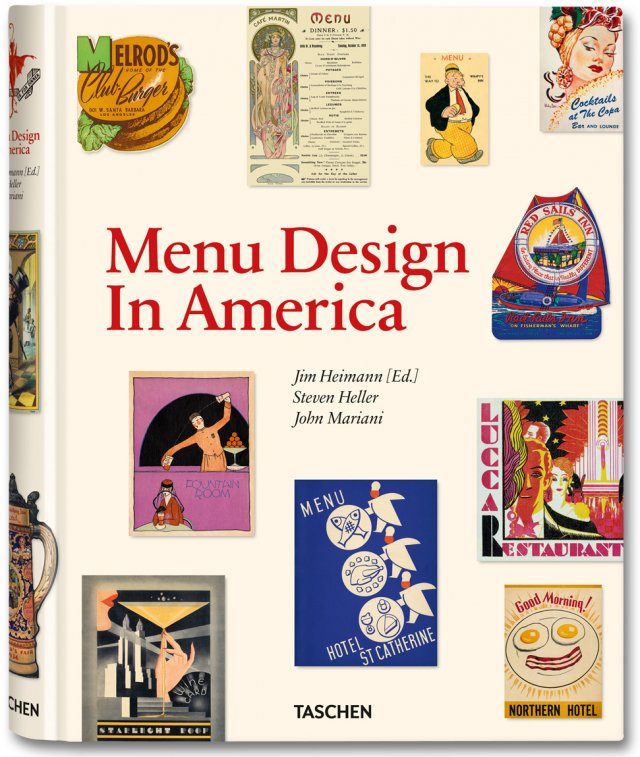
Menu Design in America, 1850–1985
Taschen, 9.8 x 12.5 in., 392

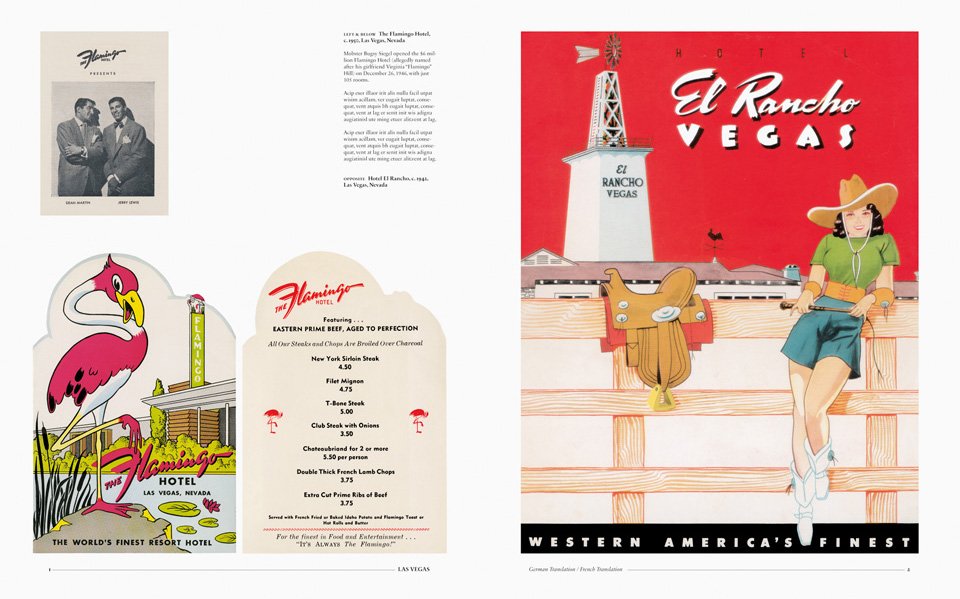
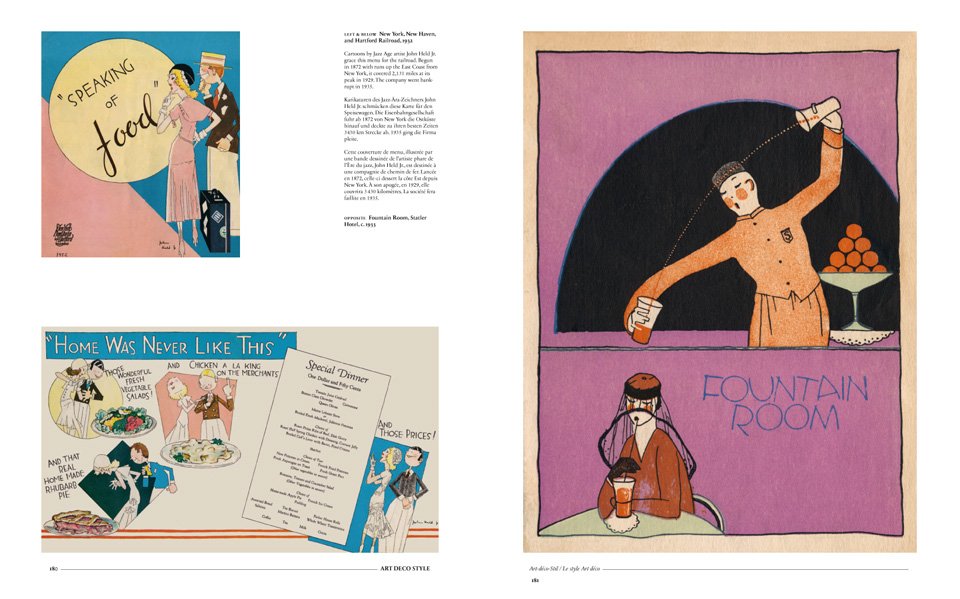
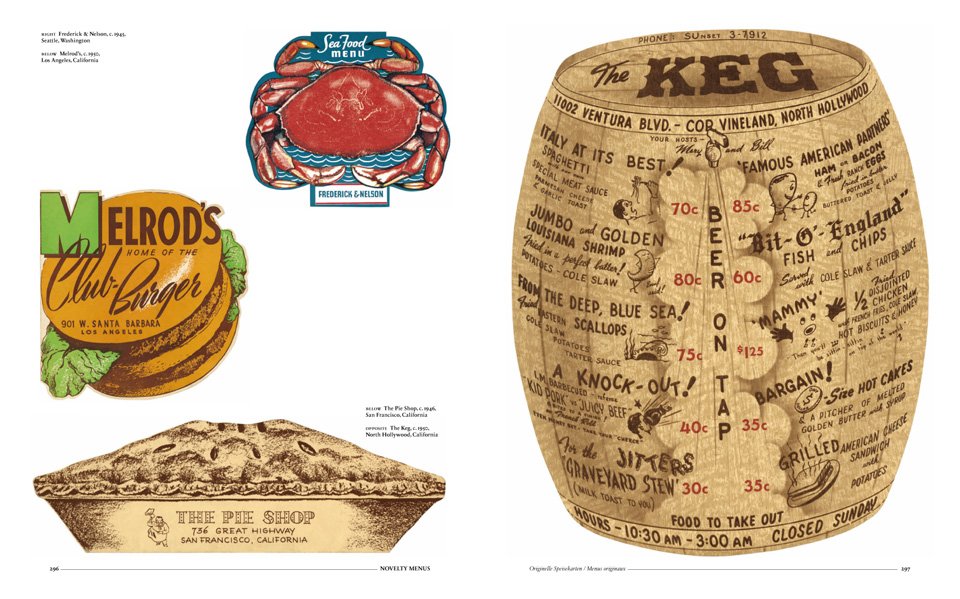
Taschen’s Menu Design in America is a fascinating collection of 130 years worth of American menus from restaurants and private parties. While the book is marketed more as an art and design book(Taschen’s primary focus), it’s also a great look at how American’s have eaten in public. The earliest menus are utilitarian and surprisingly large, offering often ten types of hot meat and as many cold meats, along with a little seafood, a couple vegetables  usually of the potato variety, and some deserts. By modern standards its both a surprising number of options with meat and a very limited vegetable offering. Moreover, meats were presented on menus in the manner they were cooked, rather than the preparation of the dish. Boiled as well as roasted beef seems to be on many of the early menus at the same time. As restaurants became more common and served a broader range of clientele, the number of offerings tended to slim down, although not always, especially in restaurants serving a thousand clients at a time (it is hard to imagine such a place today since that style of eating has gone out of style). However, the food stays essentially in the meat and potatoes form for quite some time, with the occasional addition of canned tomatoes, and corn. One tradition that would be interesting to see come back is how desert is handled up through the 20’s. Usually there were two categories: pastry which is what we commonly call desert now, and desert which was an assortment of fruits and nuts.

As you can see from these images, the art work reflects each era quite readily, often in its sexist and occasionally in its racist incarnations. Reading the menus form Chinese, Mexican and other ethnic restaurants will show just how much American dinning has changed as much of what is on those menus is no longer served any more. While all eras represented have an occasional use of whimsy, it is’t until the menus from less upscale restaurants of the 30’s and especially the post war period begin to appear that the humor and gimmickiness that has been associated with American eating of the second half of the 20th century appear. The earlier menus are much more refined, aimed at a wealthier group who excepted a refined experience, even if the food doesn’t seem it now. Where as restaurant eating became a much more common thing, the mid century exuberance for all things commercially inviting shows up in most of the menus. It makes for an intriguing contrast between the aspirations of both refined and common place of diners, and naturally with an American beset with foodies and celebrity chefs. It is a contrast that makes the foodie revolution just that more impressive.

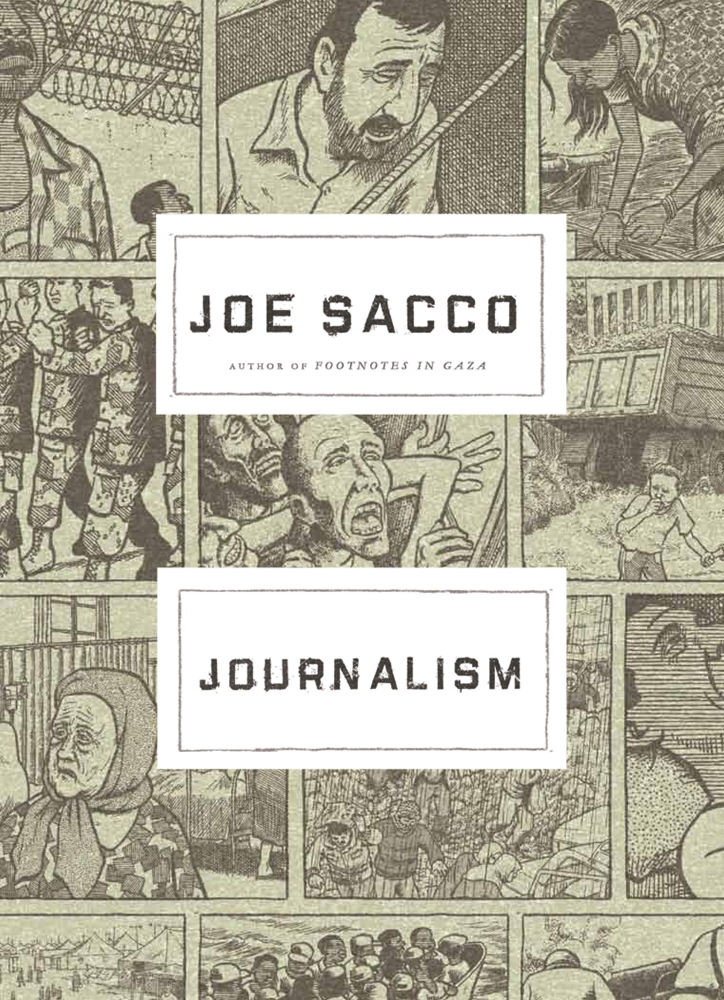
Journalism by Joe Sacco – A Review

Journalism
Joe Sacco
Metropolitan Books 2012, pg 192

Joe Sacco’s work has long been a fascination of mine. The comics medium has a lot of potential, but even the most serious work is unable to distance itself enough from its roots in either style or in content. Sacco’s work, on the other hand, opens up different directions for comics, not so much in style as he is still in a realist vein, but in subject. It is the content that shapes the power of his style rather than the reverse (here I’m thinking of a Charles Burns whose style is amazing, but the story isn’t as much). In his journalist works published to date (I’m not going to count Notes of a Defeatist which is very alt-comic) he has focused on telling long stories that dig into an issue, telling as best he can, different sides of the issue. Even works like the Fixer seem to come out of his larger work on Bosnia, Safe Area Grozny.  Journalism, on the other hand, is a collection of pieces written for various publications over the last decade or so, ranging from embedding with the Army in Iraq to a long report on migrants in Crete to an investigation on the lives of Dalits in India.  The publications range from Time magazine, which includes some of his only colored work, to a French magazine devoted to comic journalism. The wide ranging publication history leads to less consistent work, as Sacco points out in several of the introductions that follow each story. Still there are some gems in the collection, especially his report from Crete, India, Chechnya, and the story of embedding in Iraq. The first three are also the longest pieces in the book and, therefore, offer the fullest look at a particular subject, akin to a full length magazine feature. It is in the longer stories his trade mark style of interviews presented as a mix of close ups, dramatized scenes as the interviewee narrates the story, and Sacco as character asking the questions, although in these pieces he doesn’t seem to characterize himself so comically. Some of the stories seem old news, but they are still powerful. In the Chechnya story there is a hopelessness both with the situation of the refugees and the aid agencies that just cannot cope with. The story of the Dalits of India is as equally hopeless and one can not help but wonder if there is ever a way to lift the Dalits out of poverty. While the previous two stories seem the farthest away, the refuges from Crete (he is originally from Crete) offers a story that should both be familiar to Americans and Europeans, detailing the problems with unwanted migrants. Crete has received numerous migrants from Africa who want to go on to Europe. It is a small country that has been unavailable to adequately cope with them. Unsurprisingly, there are problems and nativist groups who want to chase them out. Sacco gives a well rounded treatment of the story and both the “what right do you have to come here” and the “what right do you have to keep me out” view points are given in depth treatment, which is all one can ask of a journalist.

The question after reading the journalistic pieces is does comics journalism work? Or more to the point can it be taken seriously? I think they definitely work, although not in the sense of a daily newspaper. What he is writing is long form journalism, which is what he is best at. (There is one opinion piece from the NY Times and it isn’t that great, which he admits). Writing takes time and drawing the detailed kind of narrative he does even longer. His body of work, as this book attests, shows a solid journalist whose commitment to a story is strong. Still, I can’t see his work in major media (whatever of that there is left) yet. Not for his faults, but because, as I have long thought, few authors have managed to blend narrative demands with artistic in a way that doesn’t leave the reader wondering if the art work was really necessary or a better writer should have been added to the project. Sacco avoids both problems. It is too bad the only comics journalism magazine that I know of is in French.

You can read  his story about the war crimes tribunal which appeared in Details (which caused no end of problems for him when interviewing the subjects)at the publisher’s site.


Milestones of Latin american Literature Before the Boom

El Pais has an interesting list of the important works of the 20th century from Latin America, before the boom. Like any list it is flawed but is an interesting starting point and a nice way to see that there was literature before the Boom.

1918 Los heraldos negros. César Vallejo

Cuentos de la selva. Horacio Quiroga

1920 El hombre muerto. Horacio Quiroga

1922. Trilce. César Vallejo

1924. La vorágine. José Eustasio Rivera

Veinte poemas de amor y una canción desesperada. Pablo Neruda

1926. Don Segundo sombra. Ricardo Güiraldes

El juguete rabioso. Roberto Arlt

Cuentos para una inglesa desesperada. Eduardo Mallea

God and Science: Return of the Ti-Girls by Jaime Hernandez – A Review

God and Science: Return of the Ti-Girls
Jaime Hernandez
Fantagraphic Books

I’ve never liked superhero comic books much. Even before I was a teenager I found them a little boring. Really, what happens in a superhero comic book? The hero spends his time moaning about their powers, or at least wondering if they’ll be strong enough to defeat the villain. The hero and villain run around chasing each other for the 30 pages or so, often the hero faces a set back, but then they overcome. While character development is a fine thing, comic books often suffer from the repeated analysis of their own heroic virtues. Yes, the very early comics were all plot, but at some time that switched and it was just tedious talking without even the littles bit of story telling. It’s harsh, and there are certainly quality examples of the superhero, such as the oft noted Watchmen. I’d rather read a Tin-Tin any day.

I mention all that because I finally read one of the Hernandez brother’s books. They have a great reputation among those who like graphic novels and it has long been over due for me to read one of their books. I know they write non superhero things, but I happened to pick up a superhero story. It has redeeming elements that take it beyond a superhero story. In the world of the Ti-Girls, only women are superheros and they have been fighting the good fight for many years. So many that the Ti-Girls are in retirement and are forced to come out of retirement when the most powerful woman in the universe goes into shock after loosing her baby and becomes a danger to Earth. While he has some nice touches playing with the stock elements of superheros the book, again, comes down to that same flaw. The heroes run around beating on each other. One side seems to get the upper hand, then the other, and in between they discus their powers and those of the mourning woman, and add in a little plot. Except for Hernandez’s reinvention of how superpowers are handed out, there isn’t too much difference between this and a Marvel or a DC comic. And I get it. Super powers are difficult to use, but it doesn’t mean that they have to be the center of every story. Super powers as a metaphor for identity  has been done, especially if you are writing for adults, which Hernandez  certainly is with his illusions to other superheros. The graphic novel has removed the constraints on comics, it is too bad that homages have to fall into the same traps.

The Children of the Boom Generation Talk About What it Means to Them

El Pais had a couple articles this week on the Boom. The most interesting were the brief quotes from younger writers reflecting on what the Boom has meant to them, good or bad. I like to see a few criticisms of the terms and celebrations of certain elements. (emphasis mine)

Damián Tabarovsky (Argentina, 1967)

El boom retoma la ilusión de que el escritor latinoamericano tiene que tener algo de for export, de very typical (Bolaño es el último avatar del boom) con algunas gotitas de denuncia social y pasteurización de tradiciones locales. A la vez, introduce la novedad de que para ser escritor, o aún peor, hombre de letras, hace falta tener a una Carmen Balcells, o alguien como Carmen Balcells, o a muchos como Carmen Balcells; expresa el momento en que Barcelona comenzó a volverse sede del poder económico editorial en castellano; informa sobre la necesidad del mercadeo de izquierda como paradigma de la figura mediática del escritor latinoamericano (García Marketing, como lo llamaba Fogwill). Lamentablemente no aprendí demasiado de esas cosas. O por la negativa, tal vez sí, mucho. Algo más: hace poco releí Pedro Páramo y Tratados en La Habana, casi antagónicos y ambos notables.

Yuri Herrera (México, 1970)

Quizá lo primero es lo que los mismos escritores del boom aprendieron de los modernistas: que la voluntad de estilo define la mirada sobre la realidad y la fuerza de su narrativa. Que la del boom, entre otras cosas, adolece de ser una lista compuesta casi exclusivamente por hombres. Que un fenómeno mercadotécnico a veces solo es eso, y a veces se aprovecha de algo evidente, como que la mejor literatura en lengua española ya se estaba escribiendo en el continente americano. Que un buen escritor no necesariamente es una autoridad moral: algunos de los que escribieron las mejores novelas del siglo XX también plagiaron el trabajo de otros, sostuvieron amistades con dictadores, justificaron invasiones injustificables y subordinaron sus opiniones políticas a las necesidades de sus patrocinadores. Que una buena novela sobrevive a las mezquindades de sus autores e inclusive a su propio éxito.

Andrés Neuman (Argentina, 1977)

Ninguna etiqueta explica la realidad, pero algunas la mutilan hasta volverla incomprensible. De eso que llamamos boom aprendí el abismo entre los rótulos y las obras. ¿Qué tiene que ver Lezama con Onetti? ¿Por qué García Márquez (1927) y Vargas Llosa (1936) sí, mientras Puig (1932) no? ¿Hasta cuándo maestros como Di Benedetto o Ribeyro seguirán fuera de la foto? ¿Por qué no figuran poetas, habiéndolos brillantes? ¿No resulta sospechoso que ni siquiera Elena Garro, Silvina Ocampo o Clarice Lispector aparezcan en tan viriles listas? De eso que llamamos boom admiro la ambición estética de sus autores, que me hace pensar en la infinitud de la escritura; y recelo de sus mesianismos políticos, que me hacen pensar en la patología del liderazgo. Entre tanta generalización, dos décadas de textos extraordinarios. Tan grandes que merecen ser leídos como por primera vez, desordenando los manuales.

Antonio Muñoz Molina has an interesting memory of meeting Onetti, a writer who is not usually listed in the boom.

And on the publication of Luis Harss’ collection of interviews,  Los nuestros, with Boom era writers, there is a lengthy profile and excerpt.

All the Boom one needs for the week.

Down the Rabbit Hole by Juan Pablo Villalobos – A Review

Down the Rabbit Hole
Juan Pablo Villalobos
Farrar, Straus and Giroux, 2011, 70 pg

The voice of a child has the power to undercut all the foolish tropes of adult life. Handled well it can reframe one’s perception of an idea, done badly and it can descend into cloying sentimentality that is no better than didactic moralizing. Juan Pablo Villalobos in Down the Rabbit Hole has taken on the tricky task of balancing a child’s voice against the violent world of the narco, attempting to find the absurd in a culture whose surreal violence and savagery has become come to dominate Mexican life.  Using the voice of a younger child (it is unclear how old he is and Villalobos has noted that was intentional), Villalobos narrates the story of a precocious son of a drug boss that is a once funny, ridiculous, and horrifying.

The power of the voice in Down the Rabbit Hole is that it takes what has become so common place and shocks one again with the freshness of its observations. Tochtli, the boy, is one part savant one part drug king pin. His wisdom, though, comes from his narco side, so he is given to constructing his world with narco ideas. The most absurd are his digressions on how people die because they have orifices. If you have a large orifice you will die, if you have a small one you might live. The orifices, naturally, come from guns, and the boy has theorized and a whole science of death without relying of ballistic terms. His strange way of describing the world comes from his isolation within his father’s mansion. He only talks about six people with any sense of closeness, although he states early on that he knows 13 or so people. Disturbingly he has seen close to 20 corpses and at least the last moments of a man who peed himself out of fear. His father never lets him see the actual killing, but the boy has been close enough that he thinks making orifices and feeding corpses to their pet tigers and lions is perfectly logical.

He is still a boy, though, and is full of boyish ideas. His favorite movie is the Way of the Samurai and he walks around the mansion in a dressing gown in lieu of  Japanese clothing and refuses to talk because a samurai is a figure of mystery and control. Throughout the book he talks about his desire for a Liberian pygmy hippopotamus. His father even takes him to Liberia to find one. It is the most absurd on the many absurd things the boy asks for. It makes perfect sense: in a world where there are no limits, how ridiculous can one’s desires get. Still, he also collects hats (pith helmets, sombreros and any other kind of useless hat), something simple that kids fixate on and wear at the most inappropriate times. Villalobos never misses a chance to contrast the child against the narco, and in one horrifying statement, Tochtli mentions that you shouldn’t wear your hat while creating orifices because you can get blood on them and they are hard to clean.

What runs throughout the book is parody of all the pop culture tropes that surround the drug lords. Villalobos turns every cliché into a a joke when Tochtli reinterprets what is supposed to be a macho culture of bling and power. Reinterpreted through Tochtli the drug lords don’t seem as powerful, but just ridiculous clichés. Everything that he and his father know seem to come from movies, whether they are samurai or gangster. They don’t live the life of gangsters so much, as imitate the life of gangsters. Where does the culture of the drug lords come from: within, without, or a reinforcing mix of popular culture and gang life? The elevation of these tropes to the level guide to life for small boys makes the whole culture absurd and horrifying. If all you have are these shallow images with which to build yours life, then you turn become a movie cowboy or samurai.

The book isn’t without it’s hard edges. Tochtli continually calls anyone who is week faggot and like Huck Finn it is a narrow line between art and stereotype, which Villalobos handles well. Similarly, the trip to Liberia could have been an occasion for easy charactures  of Africa. Since Tochtli’s world is so small, he has no chance to see beyond his father and friend. It keeps Liberia at a distance and the hipo hunt paints the narcos as just more outsiders coming to exploit Africa and return nothing. They are so consumed in their own world, they don’t see people, they see the bullet holes in buildings and spend their time counting them. It is Liberia that is father from violence than Mexico, yet the narcos think they are the enlightened ones. The contrast is forceful and pulling the narcos out of their mansion, weakens them and shows how unimportant they are away from their compounds.

Down the Rabbit Hole is one of those books that perfectly captures the absurdity of a way of life that has caused so much death and destruction. The humor and the voice are disarming, but they also have the power to avoid humanizing the gangsters. They are just creatures who act according to script. Villalobos has mentioned that he initially wrote the book from the point of view of the father, but it didn’t work. Had he done that he would have had a much more difficult task. Moreover, his book would have probably been subsumed in the tidal wave of naro literature instead of becoming a fresh and exciting novel.

Felisberto Hernández Profiled in La Jornada

I recently attended a reading by Juan Pablo Villalobos and unsurprisingly a question came up about his influences. He brushed aside the Boom writers, which he had read when he was younger. What he said interested him more were the less well known, and stranger fiction of writers from before the Boom generation. Of many of the authors he mentioned, Felisberto Hernández from Uruguay was one. Fortunately, Felisberto Hernández has been published in English so you can find his works rather readily. This week in a timely piece of publishing, La Jornada has several long and interesting profiles dedicated to his work.

Cuando murió Felisberto, en 1964, se evocaba el tamaño de su ataúd que no pasaba por la puerta. El “burlón poeta de la materia” del título de Ángel Rama era un señor apenas sesentón pero ya veterano para la época, gran comedor de papas fritas en platos enormes. “Felisbertote”, lo llamaba Paulina Medeiros en sus cartas de amor, atravesadas todas ellas por el erotismo y la infantilización. Es que el niño que quería “hacerle abedules al brazo de la maestra” no sólo no perdió esa condición asociativa y juguetona con el lenguaje, sino que la convirtió en el centro de su discurso literario. Ese narrador-niño también quería levantarle las polleras a las sillas, atisbar sus cuerpos y “entrar en relación íntima con todo lo que había en la sala”, “dispuesto a violar algún secreto”. El mayor encuentro entre la erotización infantil de la mirada y los objetos construidos está en Las Hortensias, donde el narrador se atreve a todo a partir de la teatralización de la serie de muñecas que son elaboradas para él y para su mujer, en un juego a lo Buñuel, a lo García Berlanga, en donde el individuo es derrotado por la realidad ficticia que él mismo creó.

Esa doble perspectiva: la realidad sensorializada hasta el extremo y la libertad asociativa y no culposa propia de un niño, constituyen el toque Felisberto, parte de lo que Italo Calvino consideraba una novedad sin antecedentes. No hay relato suyo, ni mínimo ni relativamente extenso, que no esté comandado por una perspectiva sensorial. El cuento “Nadie encendía las lámparas” es una muestra impecable de relato donde no pasa nada, todo hecho de climas, de cercanías mentales y de un abrupto final en el que queda suspendida la tenue acción de una tertulia y la imagen de una mujer de cabellos esparcidos cierra lo que para otros narradores realistas debería ser un comienzo: “Pero no me dijo nada: recostó la cabeza en la pared del zaguán y me tomó la manga del saco.” Zaguán, luz mortecina porque nadie encendía las lámparas, mujer recostada, silencio, leve contacto de aproximación: esto suena a tango, pero también a Robbe-Grillet, a Antonioni y a ensueño proustiano. Por esos años, Onetti había publicado La vida breve y Armonía Somers La mujer desnuda. Rastrear las cercanías y distancias entre los tres sería un buen ejercicio de comprensión comparada.

I found this piece of marketing at Amazon, but I think it does hint at where he comes from.

Lands of Memory presents a half-dozen wonderful works by Felisberto Hernández, “a writer like no other,” Italo Calvino declared, “like no European or Latin American. He is an ‘irregular,’ who eludes all classifications and labellings—yet he is unmistakable on any page to which one might randomly open one of his books.”

Andrés Neuman Interviewed on His New Book

ABC has an interview with Andrés Neuman about his new book, Hablar solos. It does sound interesting. The story is about a family (son, father, and mother) and how they deal with the limits of existence. He plays with ways in which loss is written about, alternating between happy and sad narrators, and one who cheats on the other. Each voice shades the other:

-Alternando ternura y crudeza, su novela se desplaza de la infancia a la perversión, de la familia al duelo. Una novela sobrecogedora que indaga en las relaciones entre Tánatos y Eros, planteando una pregunta de profundas consecuencias: ¿cómo afecta la enfermedad a nuestra forma de leer y de vivir el sexo?

-Es una novela en la que se mezclan voces muy festivas, la del niño Lito, con voces muy dolorosas, como la de Mario, que es la voz de alguien que agoniza. Pero, además, Elena, madre y esposa, es el personaje más conflictivo e importante de la novela, que cuida a un enfermo grave: su marido. A veces el conflicto de los cuidadores es tan o más complejo que el del enfermo. Se mezclan voces muy festivas, como la de Lito, con muy dolorosas y doloridas, como la de Mario, la voz de alguien que agoniza. Pero, además, hay un personaje, Elena, bella, que vive el placer y el dolor al mismo tiempo.

Alfonso Zapico Wins the Premio Nacional de Cómic for His Book on Joyce

Alfonso Zapico has won the Premio Nacional de Cómic forhis book on Joyce. It is a book that is about the significance of Joyce and his contemporaries in the avant guard. It is based on exhaustive investigations. You can read an excerpt in Spanish here (pdf).

Dublinés no es una biografía al uso y va más allá, asegura su editor Fernando Tarancón: “Zapico traslada allí lo que significó Joyce en su época y para la vanguardia. Él hizo una exhaustiva labor de investigación”. Además de Dublinés, Zapico ha publicado La ruta Joyce, un cuaderno de viaje por los lugares que recorrió Joyce. Se trata de un dibujante que bebe de la escuela francesa y en la obra ganadora utiliza un trazo más realista.

Según el crítico Álvaro Pons, Zapico se inmiscuyó en el mundo del cómic sin haber pisado un fanzine antes, “sin haber hecho nunca antes una historieta comercial, se lanzó a contar una historia con viñetas, a pelo y sin más armas que papel, lápiz y muchas, muchas ganas e ilusión. Una fórmula habitual en los que comienzan, pero que no suele estar acompañada del ansiado éxito”, escribió en marzo de 2011 en este periódico.