Inteview and Overview of Patricio Pron’s New Book of Short Stories

El Pais has a review/interview with Patricio Pron about his new collection of short stories. It sounds interesting:

Sea como fuere, la escasa creatividad de sus colegas es también el tema central de Un jodido día perfecto sobre la tierra, uno de los cuentos del libro. En ello, Pron relata la insoportable y autobiográfica experiencia de ser jurado de un concurso literario al que llegan solo textos casi idénticos: “Me juré que jamás volvería a hacerlo. En línea general falta originalidad. Es el resultado de un establecimiento de condiciones genéricas, literarias y narrativas que los autores normalmente no cuestionan”.

Portada de ‘La vida interior de las plantas de interior’.

El mercado, según Pron, también juega contra la innovación: “Muchos autores en este momento están escribiendo el mismo libro. Se debe en parte al negocio editorial pero también al deseo de ciertos escritores de producir algo que tenga éxito”. ¿Qué escritores? Todo lo que se obtiene es un “es bastante visible” y el ejemplo de “las novelas de la crisis”.

Con su personalísimo estilo, Pron también está teniendo mucho éxito. A sus 36 años ya cuenta con premios, aplausos de críticos y colegas y un CV literario donde lucen libros como El comienzo de la primavera y El mundo sin las personas que lo afean y lo arruinan. De hecho, a veces hasta se sorprende de sus resultados. “Estuve en México de promoción y tenía ocho entrevistas al día durante cinco días. Jamás pensé que había tantos medios allí y que tuvieran interés en lo que escribo. Creo que la charla número 40 era intercambiable con la 39 y la 38…”, recuerda Pron.

The Complete (More or Less) Stories of Javier Tomeo Reviewed at Cultura/s

I’ve been watching the press about Javier Tomeo’s Cuentos completos, de Javier Tomeo, for a few weeks now. He is a Spanish writer who sounds interesting and definitely different. Sergi Bellver has a good review of the book that gives a good idea of what kind of writer he is. (You can read an excerpt here)

Tres prodigios, Historias mínimas (1988) ―uno de los siete libros recogidos en el volumen de Páginas de Espuma―, y las novelas El castillo de la carta cifrada (1979) y Amado monstruo (1985), descubrieron una mirada al margen de la avalancha literaria de la época, saturada de realismo social, y consagraron el prestigio de Tomeo, avalado por Anagrama ―“inesperada colisión entre Kafka y Buñuel”, le llamaría Jorge Herralde―. Después llegaron adaptaciones teatrales, traducciones, reconocimiento a nivel europeo y hasta una campaña de las fuerzas vivas aragonesas en pro del Nobel para su paisano ―el sabio Tomeo utiliza en “El sueño del Nobel” a Ramón, su recurrente personaje especular, para ironizar sobre su propia obra, algo que repitió en Los amantes de silicona (2008).

Los cuentos de Tomeo filtran la realidad, la alteran y la perfilan en un mundo genuino y personalísimo en el que también viven las luces y las sombras del lector. Ese es el poder atávico de jugar con un imaginario de animales y monstruos, arquetipos que el autor convierte en psicópatas de poética anómala. Tomeo admira al Goya más sombrío, disfruta dibujando ―faltan sus ilustraciones de Zoopatías y zoofilias en estos Cuentos completos― y estudió Criminología para conocer la oscuridad humana, aunque no ha insistido en la novela negra, ni bajo el seudónimo de sus primeros libros alimenticios, “Frantz Keller”. Las iniciales recuerdan al abogado Kafka, como Tomeo, otro hombre de leyes dispuesto a hacer añicos las literarias. El autor estará ya tan harto como feliz de que le menten al checo, al que homenajea en su relato “Gregorio, el insecto”, pero del que le separa su humor, negro, fuerte y lento como un burro, un humor que cocea aún tras la lectura.

“An Unlucky Man” by Samanta Schweblin Translated at Contemporary Argentine Writers Blog

Update 1/30/2013

Schweblin’s has expressed interest in finding a forum for publishing the story. As such Bard has been asked to take the translation down for the time being. When ever the story is published I will be sure to let you know. Dario’s blog is still worth taking a look at.

Edited Post

The new and interesting blog Contemporary Argentine Writers has published a translation of Samanta Schweblin’s prize wining story An Unlucky Man. As anyone who has read this blog knows, I’m a fan of her work. A few of her stories have made it into English. Dario Bard has translated her recent prize winning story at his blog. It is a good translation and well worth reading.


You can see all my Schweblin coverage here.

Roberto Bolaño Short Stories Overview at the Guardian UK

The Guardian UK has a good overview of some of Roberto Bolaño’s short stories. (Tip: make sure you read through the comments. There is further suggestions of what to read from the author, Chris Power)

It is impossible to write about any one strand of Bolaño’s work in isolation, because nearly all of it inhabits one sprawling intertextual territory. Speaking in 1998 he said, “I consider, in a very humble way, all my prose, and even some of my poetry, to be a whole. Not only stylistically, but also as a narrative.” Enjoying contrariness, Bolaño rowed back from this statement elsewhere, but the recurrence of characters, themes and incidents in his work is undeniable. His alter ego Arturo Belano, for example, features in or narrates many of the short stories, as well as being a lead character in the novel The Savage Detectives, and the narrator of the novels Distant Star and – according to a note in Bolaño’s papers – 2666.

Bolaño’s stories take the form of fragments of memoir (“Sensini”, “The Grub”), unsolvable detective stories (“Phone Calls”), or anxious transmissions from a region between dream and reality (“The Dentist”). Sometimes, as in “Gómez Palacio”, they feel like all three at once. An account of a writer going to a remote town in northern Mexico to interview for a teaching post, the story establishes its strange air of lassitude and dread at once: “I went to Gómez Palacio during one of the worst periods of my life. I was twenty-three years old and I knew that my days in Mexico were numbered.” The narrator discusses poetry with the director of the art school, has bad dreams (Bolaño’s work is clotted with dreams), and stands in the room of his isolated motel “looking at the desert stretching off into the dark”. Parked at dusk in the desert in the director’s car, a situation with a vague sexual potential that perhaps neither party wants to realise, a man pulls in a few metres ahead of them. “It’s my husband, the director said with her eyes fixed on the stationary car, as if she were talking to herself.” The cars sit in silence. When the writer drives away the man in the other car “turned his back to us and I couldn’t see his face.” The director then tells the writer she was joking, that it wasn’t her husband after all.

A Thousand Morons by Quim Monzó – A Review

Thousand_Morons-frontA Thousand Morons
Quim Monzó
Open Letter, 2012,pg 111

Reading Quim Monzó’s short stories is always refreshing experience, a kind of cleansing of the palate after imbibing too many stories in the American vein. In Monzó there is little interest in the well written story and its obligatory finish with an apropos epiphany. His characters are seldom explored in strong emotional terms, instead they exist within the irrepressible march of time. In other words, events happen, characters perform their roles, but there is no reason why, it just is. The lack of explanation comes because Monzó and his narrators are always distant, keeping what is before them at arms length. It can feel cold, uncaring, but at his best it makes for a literature of perceptive descriptions and, surprisingly, empathetic stories that never loose his sense of humor, akin to that of Thomas Bernhard’s in the Voice Imitator.

While A Thousand Morons still has the touches of the comedic and the satiric, there is something more personal, too. In the first of the two sections, the stories are more personal, less distant from every day experience. There is still humor, but it is a humor that comes from contrasting a typically emotive subject against the absurdities of his telling. It isn’t that the injection of accessible experiences have weekend his work, it has allowed him to contrast play with the genre and retarget his humor at something new.

In the first story, Mr. Beneset, a son visits his father in a nursing home. The description is given in a dead pan third person that after the first paragraph which gives just the most minimal back story, becomes almost a dialog with stage direction. The father is a talker and performs a kind of elderly stream of consciousness, bouncing from one topic to another: the beauty of the Cuban aide, the thought of death, the deaths of his neighbors. These are not new ideas for a story. Monzó turns things around, though, because all the time they are talking the man’s father is dressing as a woman. It is mater of fact, as all things are in his stories. It doesn’t mater why he is doing it to the characters. They already know why. It puts the locus of exploration on the reader and opens up the story, moving it past the visit, to an alternate vision. The humor, which is surprising for Monzó, is moderated, and he uses the contrast of the father’s clothing to reenliven the dilemmas of old age and family.

The Coming of Spring mines similar territory, describing a man–there is no name–as he visits his parents in an old age home. It is a story of repetition: his visits; their problems; and the surprising ability of an old couple to survive so long. They survive as much by habit as by will and, the Monzós repetitive text underscores that. Many of the paragraphs that open the little sections all start with the phrase, A man… The habit of the elderly couple, is mirrored in the prose. The repetition lends a sense of melancholy as the man walks through the old apartment where the couple once lived and now stands vacant. A physical memory that has been left to deteriorate like the couple in the home. And like the couple it also continues on as if by habit. What makes the story so strong is the distance the reader feels between the characters. There is no comforting resolution here and it is in that distance, the separation of the son from the reader that the real emotional power resides.

While those two stories overpower the rest of the collection and give Monzó’s work, for the first time, a heavier, less comedic weight, the humor from his other works is evident throughout the collection. In Saturday, echoing Carver, a woman tries to erase her ex from her life. First its the photos. Next the furniture, until she attempts to destroy everything he has ever touched which is either impossible, or self destructive depending on how far one wants to take it. Of course the story is purely physical. There are no insights, just the illogical end of removing all physical memories of a lover. It is an unsettling idea.

For fans of Monzós more flippant and philosophical sides, there are still plenty of stories where the absurdity of an experience becomes an maddening experience. These are the typical Monzó story where the completely absurd, although often common place occurrence,  becomes an overwhelming experience. In Praise, an author makes a passing comment that he enjoyed an up an coming author’s book. Soon the the young author begins to hound the established author until the tables turn and the nice, off handed comment the established author gave, becomes his down fall. It is a typically Monzonian story in that something small can bring so many problems. It is the kind of story he excels at. It also underlies a kind of cynicism that pervades his work, as if what ever one does you will fail in some way. It is an idea I rarely see in American fiction, but in continental fiction it seems to show up quite often. On one hand, you have American optimism always finding a better tomorrow, even when everything is going to hell. And contrasting is a realism that seems cynical, but is really an outlook guided by precedent that knows how easy it is for the simple to turn into complete horror. Monzó is full of that idea, which is why this collection with its turn towards the personal seemed more startling.

Monzós stories deserve to be better known. His humor, cynicism and insight are a great antidote to short stories that can seem tiresome in their perfected resolution. With this collection, Monzó has show that the distant and skeptical stance can even be used in more personal settings.

You can read the story of A Cut (pdf) form Open Letter

The Best Spanish Language Short Stories of 2012 from Sergi Bellver

The Spanish writer and critic of the short story Sergi Bellver has published his list of the best short stories that appeared in Spanish. It is a long list and will give anyone reading it an insight into the art of the short story. In his list I’ve seen a couple authors that I’ve seen in a couple of other articles. One is Edmundo Paz Soldán a Bolivian writer, and Ignacio Ferrando a Spanish writer. Both had interesting collections come out this year. You can read the full article here.

Llama la atención la irrupción en 2012 de varios narradores latinoamericanos en el panorama editorial español del cuento. Tal vez la más llamativa sea la del excelente escritor mexicano Alberto Chimal, de cuya narrativa breve el crítico Antonio J. Morato seleccionó los relatos del libro Siete (Salto de Página). Otro de los hallazgos trasatlánticos del año ha sido la edición española, a cargo del sello aragonés Tropo, de Vacaciones permanentes, que la boliviana Liliana Colanzi había publicado con la editorial El Cuervo en su país.Precisamente su compatriota Edmundo Paz Soldán, a quien ya conocíamos por estos lares gracias a sus novelas,ha publicado en el último tramo del 2012 uno de los conjuntos de relatos más interesantes de la temporada, Billie Ruth (Páginas de Espuma). América sigue siendo un filón para el mejor relato, y de algunos ilustres cuentistas latinoamericanos que ya no están entre nosotros, como el original y desapercibido Francisco Tario (mexicano) con La noche, o el inigualable y genial Felisberto Hernández (uruguayo) con La casa inundada, la editorial Atalanta ha recuperado en 2012 sus mejores textos para la colección Ars Brevis. Pero no sigamos por esa senda, ni por la de los libros traducidos de lenguas extranjeras (porque entonces no daríamos abasto y tendríamos que empezar mencionando joyas tan singulares como los relatos de Peking by night, de Svetislav Basara, publicados por Minúscula), y regresemos a los autores españoles actuales, aunque me detendré antes en otro libro de cuentos en particular, uno de los mejores en el arranque de 2012: el convincente Un montón de gatos, de Eider Rodríguez (Caballo de Troya), autora vasca que escribe y publica primero en euskera y luego traduce al castellano sus relatos, pero que, hasta donde sé, revisa y edita a fondo sus textos en ese proceso, por lo que su propia traducción se convierte en todo un trabajo de autoría. Capítulo aparte (que dejaré para otro día, por sangrante) merece el cuento en catalán, en un año en el que los lectores en castellano han visto pasar de largo el centenario de un cuentista contemporáneo de talla europea como Pere Calders, ya que ninguna editorial ha considerado acometer la tarea de actualizar y presentar sus cuentos al lector en castellano, es decir, no sólo al español, sino también al hispanoamericano. Respecto al cuento escrito en gallego, en otoño de 2012 llegó la traducción al castellano de la Narrativa breve completa de Carlos Casares, por parte de la editorial barcelonesa Libros del Silencio.

Hi, This is Conchita and Other Stories by Santiago Roncagliolo – A Review

Hi, This is Conchita and Other Stories
Santiago Roncagliolo
Edith Grossman, translator
Two Lines Press, 2012, pg 176
(Publication Date: April 9, 2013)

Santiago Roncagliolo’s Hi, This is Conchita is a series of phone calls stripped of all narrative clutter. They exist just as voices as if one were listening to a wire tap, or as fits Conchita, voyeurs . It is a structure that served another Latin American writer, Mario Benedetti, well, and in the hands of Roncagliolo it makes for some humorous writing. It also shows Roncagliolo’s talent for comedy, which has not been as apparent in his works translated into English so far.

Composed of alternating phone calls, Conchita follows four characters in an unnamed city. Conchita is a phone sex worker and her first call opens the book with straight up porn. Within a couple lines she is already talking about how hot she is. Every imaginable cliché follows from there. Roncagliolo adds even more humor as Conchita’s clients break in mid fantasy to correct her descriptions of the act. For example, in the first call she says she is on his office desk and leaning on the coffee machine, and the caller corrects her and says the machine is across the room. From there they go back and forth negotiating what she really would be leaning on, before she returns to the act. The humor intensifies with each call because they all start the same way and have the same non sequiturs into details of the room, or what the caller looks like. For the callers, though, the illusion never fails and one caller continues to call back, falling in love with Conchita. It is a voice of loneliness that inhabits all to frequently the men who engage with phone sex. Roncagliolo does not make fun of the caller, but the situation and in the end he gives a power to change events that he does not know he has and may never realize.

Following on the humor of Conchita are the conversations of a hit man and his client. The hit man is a professional but he is also clumsy and has a philosophical outlook that leads him to question his client if he really wants to kill his lover. The client can’t stand the questions, but the hit man thinks affairs of the heart don’t need to be solved by killing. The conversations between the two are funny and create a dynamic between the passions of the client and the professionalism of the hit man that leave the reader with the impression that the hit man is of great skill. Yet when it comes to the actual hit the only thing professional about him is willingness to kill. And from that a series of humorous events ensue that tie the book together.

Two other callers are a self obsessed ex boy friend who leaves long and rambling messages on his ex’s answering machine. After the first call it seems obvious why she left him. However, Roncagliolo is playing with the reader here, because all one knows is his voice. She never speaks. All that is known is that they had something for sometime and like the Conchita’s callers he is lonely and pitiful. He’ as pitiful as the man who keeps calling the customer service agent and never gets help with what he needs. While the ex boyfriend is occasionally heavy handed, the customer service vignettes with their bureaucratic logic and employees who make one feel as if you are wasting their time, are the most common stereotype throughout the book. If it did not link in with the other stories as the book concludes it would have dragged the book down.

At first the calls are separate, unconnected, then as the story grows the characters begin to intersect. The calls between a man and his lover intersect between the hit man and his client, changing what had been the comedic episodes of two men, intrudes its true horror on the voice of a desperate woman who demands her lover respect her. Roncagliolo doesn’t tie all the stories neatly together, but they do all interrelate, if even lightly. The interrelations, though, expand the characters and adding a level of complexity to them that has not existed until then. Even the otherwise week customer service calls are reframed by the new relationships. It is this ability to shift how one looks at the stories and turns the humor from bright to dark that makes Hi, This is Conchita interesting.

Three stories are also included in the collection. While their is nothing particularly wrong with them, they are not really that noteworthy. For someone looking for a good short story, one should see the story included in The Future Is Not Ours. The stories are typical written in the realistic tradition, ones that populate so many collections of short stories that while well written, don’t really add anything new. However, if one has not read many short stories from younger Latin American writers, they will give an insight into how younger writers are looking at more international models and as such the stories can seem similar.

Hi, This is Conchita and other stories is a funny book from an up and coming star of Latin American fiction. A reader would do well to spend a little time with this short volume of freely rendered conversations.

FTC Notice: The publisher of the book provided me a copy of the book. For that I thank them.

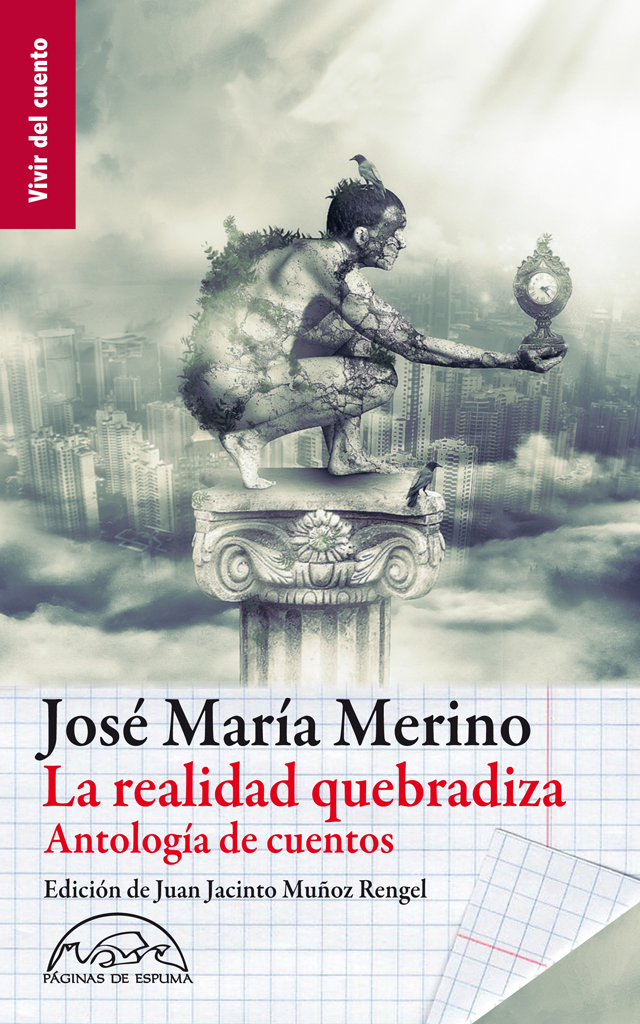
La realidad quebradiza: Antología de cuentos (The Fragile Reality) by José María Merino – A Review

cubierta_MERINO_IMPRENTALa realidad quebradiza: Antología de cuentos
(The Fragile Reality: An Anthology of Short Stories)
José María Merino
Páginas de Espuma, 2012, pg 262

José María Merino’s La realidad quebradiza: Antología de cuentos is an anthology of short stories from a writer who in his fiction has explored the fantastic as a way to break open the fragile reality surrounds and paradoxically for something so ephemeral traps us. While not particularly well known in the English speaking world, he has published a steady stream of fiction since 1976 including novels, short stories, and children’s books, and has won several awards, is a member of the Real Academia Española, and amongst fans of the short story is a respected figure. Although he has not exclusively focused on the fantastic, it is, perhaps, what he is best known for, with stories ranging in style from horror to science fiction to meta works that hearken to Borges, Kafka and Cortazar. With La realidad quebradiza: Antología de cuentos, Páginas de Espuma has put together a career spaning overview of his work amongst the short form that not only includes a large selection of short and micro stories, but a lengthy if rather strange introduction to his work from Juan Jacinto Muñoz Rengel, and a long interview with Merino that examine his approaches to writing short fiction. It is probably as a good an introduction as one could ask for.

The fantastic is difficult material to work with: too obvious and you have the literary equivalent of a Twilight Zone episode where the camera changes at the last second and you say, ‘oh, I get it now,’ but then never return to the episode because the shock has worn off; too subtle and it ventures into the purely symbolic (perhaps surrealistic), where nothing has any relation to reality. Merino’s own working definition of the fantastic would be helpful before going on much farther:

Coincido con una definición moderna de lo fantástico de Roger Caillois: una ruptura estrepitosa del orden habitual, textualmente <<una irrupción de lo inadmisible en el seno inalterable de la legalidad cotidiana>>. Otroa cosa sería lo maravilloso, en que lo aparentemente inadmisible resulta la regla general, como los cuentos de hadas o El señor de los anillos, pero sin duda no estoy dotado para ello, pues a la hora de escribir, la realidad está en mí demasiado al acecho.

I agree with Roger Caillois’ modern definition of the fantastic: a resounding rupture of habitual order of things, textually “a burst of the impermissible in the unalterable breast of the routine laws of everyday.” Something altogether different would be the marvelous where the apparently impermissible is the rule, such as in fairy tales or The Lord of the Rings, but without a doubt I’m not blessed with that skill because when it comes time to write, reality is lying in wait for me too much.

For Merino, the fantastic is that little explosion of unreality in an otherwise real world that opens new perspectives on reality. What it isn’t, is fantasy which is more concerned with its own fictive reality. It is an important distinction because the interplay between reality, which is often described in a realist tradition, and the fantastical can occasionally seem jarring. However, the shock of the rupture in the habitual that he mentions usually overcomes the Twilight Zone moment. And as you will see, there is a great fluidity in his writing that can make the occasional disappointment worth reading.

El niño lobo del cine Mari (The Wolf Child of the Mari Theater) is perhaps the best story in the collection in terms of a pure mix of a narrative and the fantastic. One day when an old movie theater is the process of destruction, the construction workers find a little boy amongst the ruins. It turns out he has been missing for 30 years yet has no aged a day since he disappeared. It is a mystery, but despite all pleas to tell his story the boy won’t explain what happened. In desperation, the doctor looking after the boy takes him to another theater. It would stand to reason he likes movies. The doctor watches him carefully at first, but caught up in the movie she doesn’t see him go behind the screen and enter the movie where he disappears again. Here, Merino mixes the two streams of reality, that of the everyday and that of the cinema, locating our dreams not just in the films themselves, but in the portals to them, as if they formed a kind of collective memory that lasts as long as the movie does. Moreover, he expands the idea of a fiction not as something that you only observe, but as something you participate in and extend. It is that extension of the story, or the bifurcation of the story into multiple paths, that reappears throughout the book.

You can see that bifurcation La casa de los dos portales (The House With two Entrances). In the story a group of boys break into an old abandoned mansion. After exploring the house they find a small passage way to an a room that has its own door to the exterior. They go through it and head to their respective homes. But nothing is right. Family members who were dead are alive or vice a versa; homes are not kept in the same ways. In short, it is a parallel world, one that is terrifying to the boys. That parallelism also links back to the idea of the double, of the other self, a classic trope in Spanish language fiction, but here it extends to a whole world.

Both stories come from his collection Cuentos del reino secreto (Stories from the Secret Kingdom) published in 1982. They show an interest in stories where the line between reality and the fantastic exists, but is not a commented on within the text. In his latter works, his short stories are much more open to direct introspection of the limits of reality. In El viajero perdido (The Lost Traveler) and Bifurcaciones (Bifurcations) he explores the way linear construction of reality is really a series of forking paths (to quote Borges) one takes, but are also mental paths one takes as they construct the narrative for themselves when they remember.  El viajero perdido follows a writer as he tries to create a story about a traveler who he stumbles on one night. The story though twists between what the writer struggles to write and the trip his wife is having. With each new strange encounter he comes up with it is mirrored in his wife’s world. As he brings the story to conclusion she comes closer to home. And with in the wife’s world she comes across the traveler that first promoted him to write the story, bringing the different bifurcations of story together. Merino leaves the story open as to what will happen, as if stories can never be finished.

In Bifurcaciones, a middle aged man is invited to a college reunion. He begins to wonder what ever happened to a girl, Pilar, he had once been infatuated with. He wanders down by where she used to live and he runs in to her. Feeling lucky, they spend some time together and he thinks his dreams have come true. Then she begins to ask him why he never wrote after ‘that summer?’ He has no idea of what has happened, but she creates a whole different life they led together. Yet he begins to believe it, rewriting his past. Yet when he finally goes to the reunion she’s not there and yet another bifurcations of the past occur. Merino places layer after layer of bifurcations so that man is rewriting his past and going through memories of events he never had. With each memory he recreates his whole history summed up towards the end of the story when he tries to make sense of the differing stories he is living.

Su esfuerzo por esclarecer la contradcción de aquellos veranos contrapuestos le hizo comprender que el encuentro en el vestíbulo era un misterioso punto de bifurcación, donde su memoria parecía titubear, aunque al cabo siguiese con más seguridad el camino que lo lleveaba a un período de angustiosa apatía, a sus primeros empleos, a la vinculaión con el bufete de su tío Jaime, en una ciudad del sur, al encuentro de Pilar y todo lo que, desembocando en el día que recibió la invitactión de Carlos Campoy, parecía formar la urdimbre verdadera de su vida durante aquellos veinticinoc años.

His effort to clear up the contradiction of those opposing summers made him understand that the meeting in the vestibule was a mysterious point of bifurcation where his memory seemed to hesitate, although after following with more certainty the road that took him to a period of agonizing apathy, to his first jobs, to his joining his uncle Jaime’s firm in a southern city, to the meeting with Pilar and everything that flowing from the day that he received the invitation from Carlos Campoy, seemed to form the true plot of his life during those twenty five years.

Finally, it would be remiss if a few comments about his language were overlooked. In more than a few stories the role of language itself is the center of story and even in one story when a man looses his ability not only to speak, but think in words, he disappears from reality. So for a writer with such wide ranging interests it would be natural that he prose have a certain power to it. In Papilio Siderum, a story that reworks Chuang Tzu’s story of the butterfly where a man dreams he is a butterfly then wakes as a man is unable to tell the distinction between the two. In Merino’s telling the story takes on a deeper and wider celebration of the paradoxes of memory and he captures both the transitory nature of memory, but the beauty in it to (sorry no translation; I’m out of time).

Intentaré empezar diciendo que, después de dejar la terraza, nos fuimos cada uno a nuestro cuarto, y que yo me encontraba desvelado, porque la presencia de Elisa haviía despertado en mí el enardecimiento de los veranos de la adolescencia, aquel tiempo en que hasta la propia luz y los olores del día eran capaces de provocar en mi ánimo una sucesión de impresiones indefinibles y hasta contradictorias, un tempr confuso la luz implacable del mediodía, que a su vez despertaba en los arbustos esos aromas secos tan estimulantes de la placidez, o cierta euforia la larga luz del atardecer, cuando sin embargo el olor humedo de los parados me incitaba a senir la congoja de alguna pérdida que no podía indentificar, y en cada momento y en cada paraje una conciencia tiubeante, que ya no tenía la capacidad de embeleso de la infancia pero que tampoco podía apoyarse en esas seguridades que al parecer eran privilegio de los adultos.

While every story in La realidad quebradiza: Antología de cuentos didn’t excite me as these did (a couple were too much in the ghost story vein, something I’m not much interested in), on the whole is a successful mix of the fantastic and reality, and the majority of the stories are fascinating reads. The selection of these short stories and micro stories, almost prose poems at times, which I didn’t even have a chance to discuss, leaves me wondering what other intriguing work remains in the volumes that these stories were selected from. Merino is definitely a maestro of the fantastic and Páginas de Espuma has put together an excellent collection to demonstrate that.

The Short Story, The Class Room, and New Directions Forward: Fakes Reviewed at LARB

The Los Angles Review of Books has an excellent review of David Shields and Matthew Vollmer’s Fakes: An Anthology of Pseudo-Interviews, Faux-Lectures, Quasi-Letters, “Found” Texts, and Other Fraudulent Artifacts. What is so interesting about (in addition to the book itself) is the author, Johannes Lichtman, goes into some detail about the foundational text books of the MFA scene, how they have shaped writing and how this book may too, for good and bad. As I’m always interested in how the short story is developed I found it quite interesting. I’m less and less inclined to like the MFA experience of teaching writing. I didn’t get an MFA, but I can remember my undergrad days and the heavy Carver influence running through the whole thing.

AS MOST PEOPLE KNOW, it’s not easy to make money writing. Young writers read of a mythical past when aspiring authors could work for “newspapers” in exotic locales like Kansas City, but even if there is still a newspaper operating out of some soon-to-be-abandoned warehouse on the banks of the Missouri, I bet it isn’t hiring. The BFA/MFA track has become one of the last refuges for young writers before they start fighting their way into the welfare state of grants and fellowships, and even if we remain undecided on the question of whether writing can be taught — if I have to read another essay asking that question I may run away to Kansas City myself — we have definitively declared that the teaching and learning of creative writing can be a good way to make money (or at least to postpone the need to do so).

For this reason, contemporary fiction anthologies have never been more proliferant than they are now. Classroom texts — most often either the Scribner Anthology of Contemporary Fiction edited by Lex Williford and Michael Martone or the Vintage Book of Short Stories edited by Tobias Wolff — are where many undergraduate writers (weaned on high school classics, Stephen King, Stephanie Meyer, and Chuck Palahniuk) get their first doses of modern short fiction. These books answer the burning question: what are real writers writing today?

Which makes it such a shame that the two most popular anthologies offer such limited answers. The Vintage and Scriber collections feature eleven writers in common, but more importantly, they draw from a common aesthetic. Both favor a kind of story that generally relies on a first page/first sentence hook, a second page circling back to explain how we came to this interesting place, and, after the necessary information has been dumped on the reader, a series of events that lead to some sort of change in the protagonist: a change which usually takes place epiphanically, when the story has, to paraphrase Stuart Dybek, shifted from the narrative to the lyrical mode.

There’s nothing wrong with writing stories in this manner; some of the best American fiction follows just such a traditional blueprint. But the Vintage anthology — which, published in 1994, is starting to feel a bit dated — suggests that this is pretty much the only way to write a story. While the Scribner book offers more ethnic diversity than the Vintage anthology, it likewise doesn’t put much effort into diversity of narrative approach. To the latter’s credit, it does include work by Junot Diaz, A.M. Homes, and Daniel Orozco, but woefully absent from its pages are David Foster Wallace, Lydia Davis, and Dave Eggers, three of our most stylistically influential authors. As such, the Scribner anthology is pretty much the worst fiction anthology out there. Except for every other anthology.

I’ll also point you to another review of the book that is quite positive. The entirety is below:

David Shields and Matthew Vollmer, eds., Fakes: Shields’ ongoing project to smash the support beams of conventional fiction (or maybe just expose them; hard to tell sometimes) clearly led him to help assemble this collection, which is largely made up of parodies of everyday forms of writing. (Jack Pendarvis’ “Our Spring Catalog” brilliantly sends up publishing-speak.) But fiction can’t survive on satire alone—one hopes—and the best stories here thrive on taking their artificial formats and making something sincere from them: Charles Yu’s “Problems for Self-Study,” Charles McLeod’s “National Treasures,” Caron A. Levis’ “Permission Slip.”

Samanta Schweblin Recieves the Juan Rulfo Prize for the Short Story

Samanta Schweblin one of the short story writers I mention here with some frequency received the Juan Rulfo Prize for the Short Story. What’s interesting is that she won for a story that really isn’t in her typical fantastical and absurd style. Instead, she won for a short story that is mostly autobiographic and realistic. “Este cuento tiene algo especial con respecto a todos mis anteriores, pues hasta la mitad es prácticamente autobiográfico y súper realista, mientras los anteriores se centraban mas en lo anormal o lo absurdo”, revelo Schweblin sobre el relato premiado.

You can read the story in Spanish here.

Running an All Short Story Press in Spain: an Interview with Juan Casamayor at Revista Ñ

Revista Ñ has a good interview with Juan Casamayor, the editor of Páginas de Espuma an all short story press in Spain. I think it is is a great press and I’m still amazed it exists (and Menos Cuarto for the mater). I don’t know of any all short story presses in English. Please let me know if there are any. He is a dedicated fan of the short story even when publishers don’t support them enough and makes the market week. He does have a point, that if more publishers published short stories there would be a better market for all short stories. (via Moleskine)

-Se suele decir que el cuento no se vende, que no es negocio, que la gente busca novelas. ¿Cuánto hay de mito y de verdad en esta afirmación? 
-Cuando empezamos, se nos dijo y repitió que “el cuento no vende, el cuento no vende”. Trece años después, casi 250 títulos después, contestamos con ironía que “vivimos del cuento”. La existencia de una editorial como la nuestra demuestra que era posible levantar una editorial independiente cuya línea de ficción sólo incluye cuento. Que el cuento vende menos que la novela, por supuesto. No obstante, la decisión y la voluntad de comercializar el cuento en el mercado por parte de los editores ha sido mínima o nula. El cuento como trampolín, como descanso de novelista, como cláusula de contrato. Sinceramente, creo que esto está cambiando, aunque sea despacio. Nosotros hemos logrado diseñar un catálogo que se comunica entre sí, con autores, cuya obra posee gran número de lectores, y otros que están definiendo su público. La experiencia, por lo tanto, no puede ser más positiva. No puedo dejar de decir que nuestra labor con el cuento es la que ha dado a nuestra editorial su viabilidad y su visibilidad.

-Pero, ¿por qué cree que el cuento, específicamente, es menos buscado por los lectores?
-¿Le puedo dar la vuelta a esa pregunta? ¿Por qué el cuento específicamente es menos ofrecido por los editores? Esa sin duda es una de las causas, si no la más sobresaliente. No veo ninguna razón literaria para justificar por qué el lector se decide por uno u otro género. El mecanismo editorial está orientado por sus políticas hacia la novela y esto crea en el público lector una reacción de consumo y gusto. Las editoriales apuestan su comercialización, su distribución, su promoción a la novela y esto ha dejado, engañosamente, en otro plano al cuento. Porque el cuento vende. Ahí están todos esos grandes long sellers, ahí están algunas sorpresas editoriales, o, por qué no, un proyecto como Páginas de Espuma, que casi es testimonio de la existencia de un lector que va aumentando.

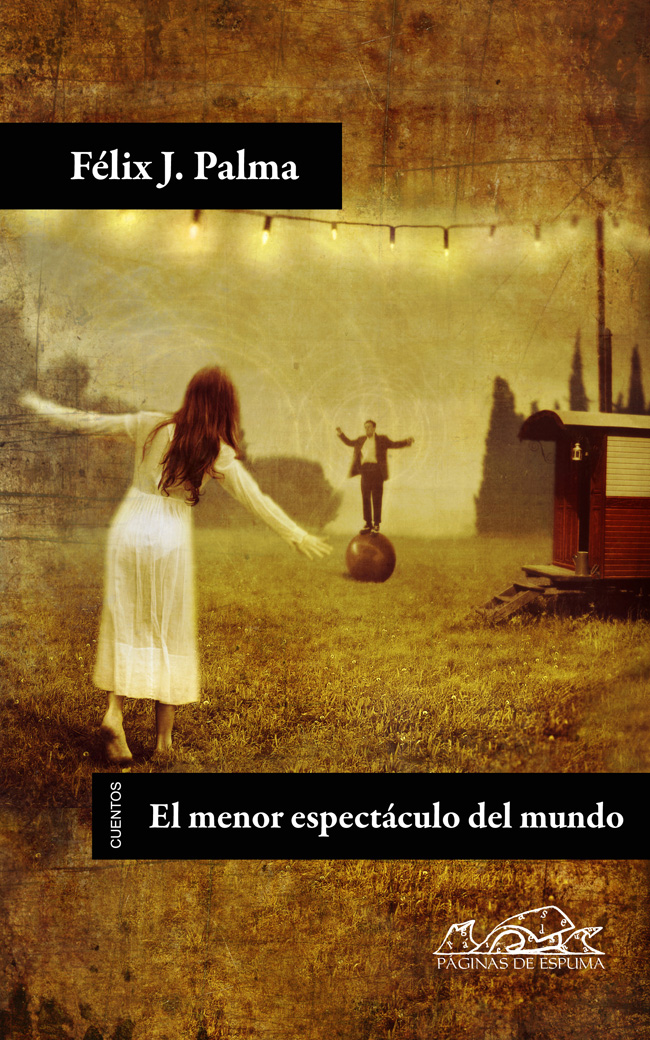
El menor espectáculo del mundo (The Smallest Show on Earth) by Félix J. Palma – A Review

El menor espectáculo del mundo (The Smallest Show on Earth)
Félix J. Palma
Páginas de Espuma, 2010, pg 203

Félix J. PalmaThe Spanish novelist and short story writer Félix J. Palma is probably best known as a thriller/sci-fi/fantastical/historical fiction writer who’s The Map of Time spent some time on the NY Times best seller list. I’m not sure if how well any of those categories work in describing him, but his 2010 collection of short stories El menor espectáculo del mundo (The Smallest Show on Earth) is in a different vain, focusing on the little details of life, the smallest show on earth. However, that smallest show tag is a little misleading because several of the stories are adventures that are just confined to a small space. Still, Palma is attentive to the disappointments and unsaid despair that surround his characters and command of language, expressed in elegant sentences and solid images mark him as a skilled writer.

His skills as a writer are apparent from the opening story, El país de lasMuñecas (The Country of Dolls):

A aquellas horas de la noche, el parque infantil parecía un cementerio donde yacía enterrada la infancia.

At that time of the night, the playground looked like a cemetery where childhood had been buried.

It is an arresting image that begins a story of a girl who looses her doll and her father, like Kafka, writes the daughter a letter each day as if he were the doll. His reinvention of the doll story parallels the story of his failing marriage and the fable for the girl becomes not only the dream that will never be realized for the child, but it is an illusion the father would like to have also. But the doll story is just a story and the narrator can only wish for what he cannot have. It is a typical strategy for Palma to show the illusion of these little shows and then leave the characters aware that those illusions are not real. While The Country of Dolls blends his power of language and his appreciation for literary culture, it also ends disappointingly as the narrator, in crime fiction fashion, destroys the destroyer of his illusions and kills his wife.

Palma also has a good sense of humor which he shows quite well in Margabarismos. The narrator is a looser who has taken to spending his time in  La Verónica a dive bar near his home that his wife will never search for him in. One day, he sees a note on the bathroom wall that says he will be hit by a car. He doesn’t believe it, but as he leaves the bar a car hits him. He wakes to see his wife waiting for him and he realizes they have grown apart and he would like her back. Once he gets out of the hospital he returns to the bar’s bathroom to look for the message. It has changed, though, and the writer is his late uncle who has the power to see the future six months of the narrator. They hatch a plan to win his wife back and each step displays a humor based on the clumsy desperation of a man who wants his wife back and has to depend on an unreliable ghost. Without the humor–the idea of finding messages in the bathroom–the story would be flat. Again, Palma takes the desperation of the lonely man and turns a comic ghost story into a moment to explore relationships.

He develops that same theme in Una palabra tuya a story that starts with the narrator’s wife’s last words before leaving the house: can you fix the lamp. When he goes into the closet he gets trapped and through a series of events his daughter ends up being the captive of the desperate upstairs neighbor. Ultimately, he performs his role as a father and saves the child. When his wife returns she says, couldn’t you have fixed the lamp? Of course the joke is he has scaled a wall, saved his daughter, and evaded a crazy woman, just like a superhero. And like the smallest show on earth, the narrator has gone unnoticed.

The best story of the Bibelot  takes that hidden heroism of the every day and gives it a less adventurous spin. An encyclopedia sales man finds himself mistaken for the son of an old woman. He doesn’t want to play the role but when she said he hasn’t been by for her last few birthdays he relents. He knows he’s making her happy until her daughter calls. She tells him to leave immediately because her son is dead. He agrees and apologizes and on his way out he meets a neighbor who tells him the daughter also died. Here, again, he has a character doing a simple act, one that is inconsequential to everyone but the old woman. In this story it is not just one person participating in these little shows. It is the most successful story because it avoids the episodic feel that some of the earlier mentioned stories. It also has an excellent ending that is neither a twist or a joke. It is his most humane story.

All of Palma’s stories have excellent writing and show a good story teller in action. His ability to show the human failures that go unnoticed, although occasionally hit with a misplaced levity, is strong. With these strong stories it would be great to see more of his non “genre” writing.

Interview with Juan Casamayor Editor of Páginas de Espuma at Página 12

Página 12 has an interview with uan Casamayor Editor of Páginas de Espuma, one of my favorite publishers right there with Open Letter. They specialize in short stories and have published some great works by some of the best in short stories (see my reviews of Navarro and Neuman). The interview talks about the press, its history, and the craziness of the publishing industry, which functions in Spain much like it does in the US.

–Un latiguillo frecuente, dicho por muchos editores, es que los libros de cuentos no venden. ¿Qué diría para desmontar este “mito” o prejuicio?

–El primer hecho incontestable es que trece años después una editorial que empezó partiendo de una pareja que decide buscar un hueco muy especializado ya no es una editorial pequeña por facturación. Páginas de Espuma está facturando en torno a los 800 y 900 mil euros; es una facturación fuerte. Las cifras son públicas. Los libros de cuentos se venden. Otra cosa es que se quiera vender cuentos. Si partes de la filosofía que el libro de cuentos es un descanso de novelista o una cláusula de un contrato, el posicionamiento ya no comercial sino editorial es endeble para vender el libro. Yo hago giras en España por catorce ciudades con un libro de cuentos. Además tenemos un premio de 50.000 euros al mejor libro de cuentos que compite con cualquier premio de novela. Claro que para esto me busqué a alguien que tuviera la plata para poder financiarlo. Ribera del Duero está muy contenta con este premio porque ha posicionado su marca de origen de un vino en un mundo cultural que les ha interesado mucho. No tengo otra vía de ingresos. Aunque mis padres son médicos, soy un poco espartano. Y si bien me dieron un poquito de dinero para arrancar con la editorial, vivo exclusivamente de lo que dan los libros. Algo tiene que vender el cuento para mantener Páginas de Espuma, ¿no?

Quim Monzó Story at Guernica

Guernica magazine has short story form Quim Monzó called One Night. It is a racy take on Snow White.

Plum in the center of the room, the prince can see the body of the girl, who is sleeping on a litter of oak branches and wrapped round in flowers of every color. He quickly dismounts and kneels by her side. He takes her hand. It is cold. And her white face, too, like a dead girl’s. Not to mention her thin, purple lips. Conscious of his role in the story, the prince kisses her lovingly. He knows this is the kiss that must bring her back to life, the kiss the princess has been waiting for forever, since the witch’s curse put her to sleep. The prince leans his head backwards so he can gaze at her when she lifts her eyelids and opens those large, almond eyes.

The Odditorium: Stories by Melissa Pritchard – A Review

The Odditorium: Stories
Melissa Pritchard
Bellevue Literary Press, 2011

The Odditorium is just that: a collection of strange and odd curiosities that don’t really have any purpose being together except to titillate. An item could be strange, ugly, beautiful, but that oddness is the key to its existence within the collection. But is oddness in of itself interesting? Perhaps, but what is probably more interesting is the juxtaposition with the expected that leads one not only to see the odd as a curiosity but reflection on what one takes for granted. Oddities, like freak shows, though, can also become little more than facile rushes to exploitation. The shocking becomes little more than that its momentary surprise that fades into the background. While it’s true that Pritchard’s stories don’t fall into the trap of  creating the exploitively strange, the stories in The Odditorium are all more interested in their strangeness than finding something deeper or more compelling within them. There are certainly more than enough stories about crappy marriages, and that isn’t what I’m asking for here, but stories that do something with her obvious power as a writer. With each story it was obvious she had fallen in love with her characters, all historical figures, and she wanted to get closer to them, understand who they were. Unfortunately, she mistakes detail for depth and the search becomes and irritating failure.

Take the story Watanya Cicilia which describes the relationship between Sitting Bull and Annie Oakley and how they bonded, becoming father and daughter. In some ways she does describe it, but in others it is so lifeless that it doesn’t seem if there is a story there. It isn’t that she doesn’t flesh out the characters, or give us a new reality, it’s that the story is caught up in its own fragmentary nature, as if the broken pieces of narrative about two 19th figures mimics disjointedness of history. Yet it fails even that task. What it shows is how good Pritchard is at creating moments that overflow with sensory detail. Strip that away and the characters are nothing.  Characters aren’t necessary the only measure of a successful story, but since she focuses on them so much it is fair to ask if they serve more purpose than to be a tapestry for her descriptive skills. After finishing Watanya Cicilia, one could be forgiven for thinking, I used to care about Annie Oakley now she just bores. It is a shame because her early evocations of Annie’s life had some potential.

Again in Captain Brown and the Royal Victoria Military Hospital, perhaps the most interesting of the stories (really a novella), one gets the sense that she falls into the trap of the historical novelist who cannot let go of historical details because they are so fascinating. Unfortunately, it makes for tiresome reading. The story starts interestingly enough, following an American Captain as he prepares a military hospital for the coming D-Day invasions. He is a dedicated officer and she gives the reader an insight into the tedium of his life, one that he enjoys. In some ways she breaks from her interest in the strange and goes towards the boring. Nothing of note really happens and one could see the story as just the minute examination of a man, but there are also hints at a ghost and at an infatuation with a young French woman. It is a baggy piece and the subtle look at lonely man’s life is there, but she overlays it with hints of the fantastic that what might have been her strongest work, is derailed with needless diversions. She cannot resist the strange and the odd. She even puts a museum of the odd in the hospital so the reader can see how odd everything really is.

At the beginning of each story she leads the reader to think there is going to be something that is going to realize her full skills. The Hauser Variations is a perfect example. It is structured as a song which describes incidents in the life of Casper Hauser as told by different characters. It is a playful mix of her descriptive skills and a floating narrative. It is more an impressionistic piece, given to throwing snatches of song or the occasional bit of religious nonsense into the piece. The effect lends itself well to describing a mysterious man who had spent his early years away from all human contact. Yet time and again one gets the impression she is just too in love with the sound of her own voice. In a book of these kind of stories it is too much and it shows the games and trickery as little more than that.

Variation 2
With poetic sobriety.

I had twe pley horse, and such redd ribbons where I horse decorate did.
-Fragment from Kasper Hauser’s First Autobiography,
November 1828, Nuremberg

Dank grub, cabbage vermin, white, hairless, altrical slug. It scarcely flourished in its cradle plot its solitary necropolis, neither living nor dead, its budded tongue a fleshy club, its legs fwumped and futile.

It’s at times like these that I’m reminded of an essay by Lionel Trilling. He was writing about the flaws in the work of William Dean Howells. The one flaw that has always stuck with me is that Howells was not into the strange and that we are in the age of the strange. While I’m not asking for the reincarnation of the Howells or naturalism for that matter, strange for the sake of strange some times can just lead to a dead end. She has the language down, now go beyond that to something that really touches.


A Complaint

Pritchard has nothing to do with the blurbs on her book, but are some of these people really serious? Some of this stuff is egregious.

In this thrillingly protean collection of stories, Melissa Pritchard has done something profound. By imagining her way into historical moments and illuminating their shadows, she amplifies the music of history so we hear beautifully strange, wondrous notes we never knew were there. These stories resound with a fierce yet playful intelligence and a rare, magnificent generosity.

–Maud Casey

Please answer me this: how are stories generous? (More words per story) I really need to stop looking at these things. They are so silly especially when you completely disagree.

Merino, Fernández Cubas, Shua, Peri Ross, Hidalgo Bayali and Marsé on the Best Short Story Writers

El Pais has an article where short story authors Merino, Fernández Cubas, Shua, Peri Ross, Hidalgo Bayali and Marsé discuss the best short story writers of today, including those in Spanish. Perhaps it could be a more insightful article, but it does have a few points of interest.

“Poe, Maupassant, Kafka, Borges, Cortázar… ¿Cómo elegir? Y, sobre todo, ¿por qué elegir, si puedo tenerlos todos?”, responde Ana María Shua a la pregunta sobre su clásico básico. Prolífica autora de cuentos y microrrelatos, con títulos como la colección Que tengas una vida interesante (Emecé), la escritora argentina acaba de cruzarse con la obra de tres autores que, en breve tiempo, han sido capaces de imprimir una huella en su memoria: “Edgar Keret, el israelí loco que inventó otra manera de contar; Alice Munro, una vieja canadiense que se cree que un cuento se puede contar como si fuera una novela, ¡y lo consigue!, y Eloy Tizón, el cuentista español que toma al lector de sorpresa y lo derriba en cada párrafo”. Entre los jóvenes talentos que despuntan en lengua castellana, señala dos nombres: “En España, Isabel González, sin duda, con su libro Casi tan salvaje, escrito a estocadas salvajes sin el casi. En Argentina (pero publicada también en España), Samanta Schweblin, una genio, no se la pierdan, nieta literaria de Dino Buzzati. Con menos de 35 años, las dos ya son más que promesas”.

Interviews with Spanish Short Story Writer José María Merino (Spanish Content)

El Pais among other newspapers have some interesting interviews with José María Merino on the occasion of the publication of an anthology of his writing by Páginas de Espuma. He is a short story writer I’ve been looking forward to reading soon. Last year his book El libro de las horas contadas was given high praise and end up on some best of the year lists. The interview from El Pais is interesting. It was especially gratifying to hear a short story writer say there are only so many short stories one can read in a sitting, something for all the short stories I read, I find to be true.

-¿Y que hay de los microrrelatos?

-Hay gente que los desdeña, pero es como si un pintor desdeñase el soporte de óleo o el soporte de madera. En ellos puede haber cosas estupendas o cosas deleznables, exactamente igual que en la novela. Para mí, como escritor, lo que aporta es que puedes decir cosas que no podrías decir de otra manera.

-¿Son estos capaces de satisfacer el hambre literaria?

-Sería absurdo comparar un minicuento con Ana Karénina, pero son sabores que pueden resultar más intensos, pueden dar un matiz diferente. El problema es que no puedes leer demasiados minicuentos seguidos, porque te empachan. Pero pueden despertar ideas interesantes y divertirte mucho.

You can read the introduction of the anthology here. It will give a good sense of his work. And if you are looking for a few more interviews the publisher has a few links here, here, here.

The Future is Not Ours: New Latin American Fiction – A Brief Review

The Future is Not Ours: New Latin American Fiction
Diego Trelles Paz, ed
Open Letter, 2012, 254 pg

I won’t say too much about the book since I will be reviewing it for the Quarterly Conversation. It was a good book. As with any collection of short stories there were a few stories that didn’t interest me much, but the over all quality was good. Reading stories that come from outside the American tradition is always nice because I don’t have to be bothered with the craft of the story, since the authors tend to have different interests in writing. I did find the introduction slightly annoying, mostly because it promised something that the stories did not deliver: reactions to the recent past. The editor notes how important that the connections to the history of dictatorships, etc is in their work, but that is rarely mentioned in the stories. It is the fault of the introduction not the writers, for advancing that idea. Also his effort to locate the book  in the context of a new Latin American writing that has gone past the Boom and the McOndo of Alberto Fuguet, doesn’t quite work. Many of these stories have a Fuguet quality and don’t seem so distant from the his McOndo style.

All of these are quibbles, since the stories, on the whole, are good. I will leave it at that until the review comes out.

Cuentos para el andén Number 7 Out Now

Cuntos para el andén, the free magazine of short stories from Spain is out with its newest edition. It includes a couple of pieces of short fiction from Juan Jacinto Muñoz Rengel. I’ve been interested in reading something of his ever since I read La familia del aire a few weeks ago. He uses the fantastic in his writing. Also there is one from Francisco Umbral who I don’t know, but have heard his name a few times.

La furia de las pestes (The fury of plague) by Samanta Schweblin – A Review

La furia de las pestes
Samanta Schweblin
Fondo Editorial Casa de las Americas, 2008, 111 pg

For readers of Spanish language literature in translation Samanta Schweblin’s name is slowly getting a little more notice. She has appeared in Words Without Borders, the Granta 22 best Young Writers in Spanish, and will appear in the forth coming The Future is Not Ours from Open Letter. However, with such spotty coverage it is hard to get a good sense of this writer’s work, a writer who has earned the respect of many of contemporary Spanish Language short story writers.It is a shame because her reputation as a short story writer to watch is deserved.

La furia de las pestes is Schweblin’s second book and won the Casa del las Americas short story prize in 2008. A couple of the stories have been translated into English: Conservas, which appeared in Words Without Borders (where I first encountered her work), and En la estepa, which is in The Future is Not Ours. Both of these stories are marked by the fantastic and show her at her best. Conservas is the story of a woman who reverses her pregnancy over the course of months, slowly shrinking it down until there is nothing left of it. Ultimately, it is a bitter sweet moment when she realizes that what she wanted so badly is perhaps not quite for the best. It nicely turns what easily could have turned into a didactic story on women’s rights, and gets at a more emotionally wrenching truth that there is no answer to such dilemmas. En la estepa (On the Stepe) is a fantastic story, yet one where the fantastic is only alluded to and like here best work, plays on customs most people would know, but are just a little strange and call into question those very customs. Throughout the story the characters keep mentioning some sort of creature that all want and that the lucky ones have found on the stepe. The first time I read it I thought it was just a story about a beast (and uninteresting at that), but when you look at the language everything the characters says are the words one uses when expecting a child. Used in a different context they sound abusive, selfish and it makes one question exactly what one is talking about when talking about children.

Those stories are available in English. But what about the rest of the stories? One thing that is obvious is that she is not tied to the fantastic. In two stories Papa Noel duerme en casa (Santa Claus Slept at My House) and Mi hermano Walter (My Brother Walter), she uses depression as a form of the fantastical. In each the characters loose contact with an accessible reality and their actions, naturally, seem strange. Interspersed with in stories of the fantastic, it underscores the strange nature of depression. The depression is not treated lightly and Papa Noel duereme en casa has a troubling vision of a marriage coming to an end and narrated by a young girl. Or in a story called Cosas que se tiran (The Things That Are Thrown), where a the narrator’s partner throws all their possessions into the shower before leaving, there is just a glimpse of something dying (the story is only 2 pages long). It forms a recurring theme of loss that leaves a dull ache for the unobtainable and at the same time a mater of fact sense of attachment to those losses, as if the narrators are so accustomed to them there is nothing one can do. That sense is most evident in El hombre sirena (The Merman), about a woman who meets a merman who is sitting on a dock. He offers her something different, but she doesn’t take him up on it. Or at least that is the suggestion, because she drives away with her brother to the waiting doctor. Is this another depressed person? She is obliviously anxious when she gets in the car to drive away. And like so many of her stories, the narrator says, perhaps tomorrow there will be another one waiting for me. The unspoken future is mostly likely not too much better.

The title story is a nice nod to Juan Rulfo about a man who goes to a forgotten village and tries to get the people to say something. It is one of those lost villages out of The Burning Plain (El llano en llamas) where everyone stays in their stone homes when a stranger comes to town. The twist her is when he tries get the people to talk and offers them something he thinks will help, it only reminds them of what they don’t have.

Finally,Cabezas contra el asfalto (Heads Against the Asphalt) is dark story about art. It opens with the shocking lines

Si golpeás much la cabeza de alguien contra al asfalto–aunque sea para hacerlo entrar en razón–, es probable que termines lastimándolo.

If you hit someone’s head a bunch of times against the asphalt–even though you are doing it for their own good–you’ll probably end up hurting it.

From there it follows a narrator who from time to time gets angry and beats people’s heads against the asphalt. As a child it gave him power because bullies would leave him alone. At other times it terrified people. However, he is able to channel the anger into painting. He becomes famous painting pictures of heads beat against the asphalt. His paintings sell for millions of dollars. All that matters is the frame of reference and beating someone’s head against the asphalt is perfectly acceptable. The narrator is completely detached from what is acceptable and it throws into relief which beatings are acceptable and which are not. The story ends with the ultimate taboo, but as far as the narrator is concerned it was just another beating. It didn’t matter who the person was, he just made him angry and he had to beat him. Unfortunately, for him reality is not self constructed.

Samanta Schweblin’s stories can be deceptively simple, but when she is at her best the stories open up new realities from ones that surround us every day. He ability to turn the language of child rearing into something dark, or reimagine a fairytale like the Little Mermaid as a series of indecisive acts, make one of the more interesting writers coming from Latin America.