Alejandro Zambra Interviewed in El Pais – How the Cost of Books Shape His Desire for E-Books

El Pais has an interview with Alejandro Zambra on the publishing of his book of criticism, No leer, in Spain. What is interesting about the article, especially in context of some recent articles questioning the structure of the publishing industry in the Spanish speaking world, is that he says he read most of his books in photocopied editions because they were too expensive otherwise. And due to all this, he is looking forward to the e-book which will reduce the cost of the book (although, there is a cost to entry in that you have to have a reader, but I suppose he takes that for granted).

“Muchas grandes obras que fueron importantes para mí las leí en fotocopia. Los libros en Chile son objetos de lujo, carísimos. Parecen diseñados como para que la gente no lea. Las fotocopias me recuerdan los tiempos que uno le pasaba sus poemas a la amiga que estabas conociendo y hacías como un libro, o cuando un amigo fotocopiaba Guerra y paz, de 30 en 30 páginas. Por eso me interesan los e-books. Si finalmente puedes pagar mucho menos por un libro, ¿por qué no? El libro es solo un producto, lo importante es el texto. Y a la vez soy hiperfetichista de los libros. Me interesan todos los formatos. También me gustan mucho los audiobooks, porque creo que un buen texto debiera uno poder escucharlo en voz alta. La prosa tiene que tener ritmo. Y ese ritmo tiene que sorprenderte, provocar efectos específicos. No hay que olvidar que así era la literatura. La costumbre de leer en silencio es relativamente nueva. En las ventas del Quijote se lee una novela para que varios la escuchen”.

Essay from Javier Marías (in English) at Five Dials

Five Dials has an Essay from Javier Marías (pdf) of The Leopard from Giuseppe Tomasi di Lampedusa.

There is no such thing as the indispensable book or author, and the world would be exactly the same if Kafka, Proust, Faulkner, Mann, Nabokov and Borges had never existed. It might not be quite the same if none of them had existed, but the non-existence of just one of them would certainly not have affected the whole. That is why it is so tempting – an easy temptation if you like – to think that the representative twentieth-century novel must be the one that very nearly didn’t exist, the one that nobody would have missed (Kafka, after all, did not leave just the one work, and as soon as it was known that there were others, as well as Metamorphosis, any reader was then at liberty to desire or even yearn to read them), the one novel that, in its day, was seen by many almost as an excrescence or an intrusion, as antiquated and completely out of step with the predominant ‘trends’, both in its country of origin, Italy, and in the rest of the world. A superfluous work, anachronistic, one that neither ‘added to’ nor ‘moved things on’, as if the history of literature were something that progressed and was, in that respect, akin to science, whose discoveries are left behind or eliminated as they are overtaken or revealed to be incomplete, inadequate or inexact…

New Words Without Borders: Writing from the Indian Ocean – Plus Etgar Keret

The May issue of Words Without Borders is out now, featuring writing from the Indian Ocean. It also has a story fro perennial favorite, Etgar Keret.

This month we spotlight writing from the islands of Mauritius, Reunion, Madagascar, and Mayotte.  Francophone writing in the region dates back to the eighteenth century; the coexistence of French with the area’s other languages (Creole, Malagasy, Arabic, and Hindi), and its relationship to French colonialism, inflect writers’ thematic, stylistic, and syntactic choices.  See how J. William Cally, Ananda Devi, Nassuf Djailani, Michel Ducasse, Boris Gamaleya, Alain Gordon-Gentil, Carpanin Marimoutou and Françoise Vergès, Esther Nirina, Barlen Pyamootoo, Jean-Luc Raharimanana, and Umar Timol imaginatively engage with this complex heritage. And guest editor Francoise Lionnet provides an illuminating introduction. Elsewhere, Mauritian writer Nathacha Appanah joins Etgar Keret and Wojciech Jagielski in writing from cities not their own. And we deliver the third installment of Sakumi Tamaya’s “The Hole in the Garden.”
By Françoise Lionnet
Francophone writing in the Mascarene region dates back to the eighteenth century. more>>>

Ludwig and I Kill Hitler for No Particular Reason

By Etgar Keret       
Translated from Hebrew by Miriam Shlesinger
“Adolf, it’s you, I didn’t recognize you at first without the ridiculous mustache.” more>>>

The Best Short Story Collections in Spanish Over the Last 5 Years

The ever excellent blog El sindrome Chejov recently polled a series of Spanish language short story authors about what they thought were the best collections of short stories to be published over the last five years. It is a broad ranging list that includes authors English speakers would probably be familiar with, such as Alice Munro and Lydia Davis. Of interest to me were the books originally written in Spanish (I’m already sufficiently familiar with the English speakers). Some of these I’ve heard of and in a few cases I’ve even read some of the books. I certainly agree with some of the choices and am looking forward to finding some new authors.

The three most cited authors were Juan Eduardo Zúñiga, Alice Munro and Ángel Olgoso. However, I saw many references to Javier Sáez de Ibarra, Andres Neuman’s Hacerse el muerto (read my review), and Smanta Schweblin’s Pajaros en la boca, a book that I am looking forward to reading soon. Miguel Ángel Muñoz’s list is of particular interest especially since he has read 250 collections over the last 5 years. I also thought Miguel Ángel Zapata’s was interesting because it listed the writers and their approaches which gives you a little context. Lest the embarrassment of riches make you think things are all rosy over there, Muñoz does end his survey with a complaint that could be easily leveled here in the states:

Buenos libros y buena labor editorial. Mejora sensible en la atención de los medios. …Y pocos lectores. En un país con desesperantes bajos índices de lectura -disfrazados por la atención mayoritaria a unos pocos libros populares- pero con una media de cuatro horas diarias ante la televisión, el cuento, que requiere de un predisposición particular y una educación del gusto para disfrutar de sus resortes narrativos, tan distintos a los de la novela, no puede salir bien parado. Aun así, sigo pensando que el cuento posee un poder que nuestro sistema educativo no ha sabido aprovechar. Aún. Confío en centenares de profesores de bachillerato que van descubriendo, y difundiendo, las posibilidades que el relato corto ofrece para introducir a los alumnos en el placer de la literatura y, todavía más, en el mejor conocimiento y explicación de materias distintas de las estrictamente literarias. Historia o Filosofía, para empezar (¿se sigue estudiando eso en Bachillerato?).

From Zapata’s comment:

En la última década, el cuento español abandona las trincheras incómodas del gueto y comienza el lento acomodo en las mesas de novedades y en las reseñas de los diarios nacionales. Eso es un hecho; lento y a gotas, pero un hecho: llueve. Ya se ha apuntado muchas veces antes la labor encomiable y de zapa de editoriales especializadas en el género como Menoscuarto, Páginas de Espuma, Salto de Página, Tropo, Traspiés o Cuadernos del Vigía. Pero cabe anotar igualmente la proliferación de espacios en la blogosfera que promueven la expansión de los géneros breves y su rápida recepción por un público silente aunque masivo tras la pantalla del ordenador. En cuanto a las direcciones que asume el cuento actual, es precisamente la heterogeneidad de propuestas la clave para entender su auge: el terror contemporáneo entreverado de cierto apego a la sobriedad realista del cuento norteamericano en la obra de Jon Bilbao, la relectura del fantástico desde posiciones especulativas o metafísicas (en tres maestros del género en su estado más puro: Ángel Olgoso, Juan Jacinto Muñoz Rengel, Manuel Moyano), la experimentación formal en la renovación que parte del fantástico hacia territorios que lindan con lo telúrico (la portentosa cuentística de lo inaudito plausible que desarrolla David Roas), la orfebrería impresionista de altísimo octanaje literario (Óscar Esquivias, Jesús Ortega), lo cotidiano transfigurado (Miguel Ángel Muñoz, Andrés Neuman y Ernesto Calabuig, que hacen virtuosismo genuino de la lectura entre líneas y la fuerza emocional de las historias), el lirismo surreal (Juan Carlos Márquez en su estupendo “Llenad la tierra”, todo un despliegue talentoso de recursos y técnica)… Si a ello sumamos el trabajo de fondo de maestros contemporáneos que siguen trabajando el género aportando periódicamente nuevas obras de impronta clásica y generosos ejercicios de estilo (Merino, Calcedo, Aramburu, Díez, Aparicio, Fernández Cubas, Peri Rossi…), da la sensación de políptico generacional completo, de relevo asegurado y estupenda salud del género, como certifica el análisis que hizo del cuento en 2011 el artículo del crítico Ricardo Senabre para el último número del “El Cultural” el año pasado. Otra cosa, por supuesto, es la flexibilidad de mercado, distribuidores y librerías en el sostenimiento de títulos suficientes de un género que siempre supone un quebradero de cabeza para las editoriales que funcionan con la calculadora y la cuenta de resultados ante la mesa. Mientras siga chispeando…”

If you are interested in the short story, these 7 posts are worth skimming through.

  1. First
  2. Second
  3. Third
  4. Fourth
  5. Fifth
  6. Sixth
  7. Seventh

Is The Center of Spanish Language Publishing Returning to Latin America?

El Pais had an article recently about La Feria del LIbro de Buenos Aires and a group of Latin American authors who gave their thoughts on where the power base of Spanish publishing is. Historically it has gone back and forth. While Spain was under Franco Latin America was the publishing center. When Spain became a democracy and Latin America had its own problems the center of publishing moved to Spain. Now the question is, is it about to change? Many of the authors consulted hoped it would, pointing out it is silly that to get books published they have to go to Spain, and that if they only publish in their home country their book probably won’t leave their home country. Ebooks, of course, were touted as one of the solutions but it is uncertain if that is going to be as liberating as might be hoped for. Given that Spain refused to put in a large presence in the book fair do to a squabble with Argentina, things are certain to change.

Vale, no hay un nuevo Gabriel García Márquez en Latinoamérica. Ni “rayuelas”, ni “conversaciones en la catedral”. No hay millones de personas en el mundo esperando a que salga el último libro de la porteña Claudia Piñeiro, o de su compatriota Marcelo Cohen, premio de la Crítica en Argentina por su novela Balada. La gente no abarrota las salas donde habla la mexicana Guadalupe Nettel, ni se detiene el tráfico cuando cruza un semáforo con su mochila al hombro el chileno Alejandro Zambra o el colombiano Tomás González. Y sin embargo, a todos ellos les va bien dentro y, a veces, fuera de sus países. La Feria del Libro de Buenos Aires también goza de excelente salud: desde el 19 de abril y hasta el 7 de mayo se espera la asistencia de 1.250.000 personas que pagarán el equivalente a 4,5 euros por entrar en un recinto casi tan grande como cinco campos de fútbol lleno de libros. Los cinco novelistas se dieron cita el viernes en la Feria para hablar ante una audiencia de unas 200 personas no sobre sus propios libros, sino de sus experiencias como lectores. Muy pronto surgió la cuestión de España: ¿Por qué se depende tanto de las editoriales españolas para encontrar a los buenos autores de Latinoamérica? ¿Por qué siguen llegando los libros de otros idiomas traducidos al español de España?

José Ovejero Wins the 40º Anagrama Prize for the Essay

José Ovejero has won the 40th Anagrama Prize for the Essay. It is a work about cruelty in art, such as the work of Cormak McCarthy or Onetti.You can read the full post at El Pais.

Si bien Ovejero (Madrid, 1958) aborda ese aspecto en ámbitos como el cine y el teatro (como la obra de Peter Handke Insultos al público), es el peso de esa crueldad en la literatura donde disecciona con mayor profundidad. Para ello, escoge siete novelas que serían a su entender paradigmáticas de esa crueldad necesaria, como son El astillero (Juan carlos Onetti), Meridiano de sangre (Cormac McCarthy), Auto de fe (Elías Canetti), Historia del ojo (Georges Bataille), Tiempo de silencio (Luis Martín Santos) y dos obras de la Nobel Elfriede Jelinek: Deseo y La pianista.

¿Dónde está la crueldad de estas obras? “Son diferentes; está la de la sexualidad oscura de Bataille a la del relato sangriento de McCarthy, de esas horas de hombres de frontera que dan una nueva mirada sobre la historia de EEUU; o la crueldad más psicológica de Onetti y que demuestra que la literatura cruel no tiene por qué ser sangrienta sino que puede despojarnos de la fe y esperanza que nos hemos construido para creernos felices; Onetti desengaña al lector y lo confronta, como Jelinek desguaza la sociedad austríaca y sus mentiras”.

The Women of the Boom – Why Is It Only Men Are Mentioned

Ivan Thays has a recent article in El Pais about the forgotten writers of the Boom, especially the women. I have mentioned many times before in the pages of this blog about the seeming paucity of women in the best of lists and various literary pantheons that exist. Here Thays contemplates some reasons why the names of the Boom are all men, especially a certain four: Garcia Marquez, Fuentes, Vargas Llosa, and Cortazar. As he mentions the times and the authors were at least somewhat sexist, but it was also the image of the male writer as self assure, committed and hegemonic writer that gave little room for women writers. While that image is probably true, recent lists by Spanish speaking critics have shown that there is still a long way to go before that phenomenon has abated. (for more see the Letras Libres failure).

Esta semana en el FB de Andrea Jeftanovic, estupenda escritora chilena, se discutió el tema. Ella, además del nombre de Clarice Lispector, soltó el de la mexicana Elena Garro como otra olvidada del Boom. Sostuvo además que “siempre hay redes de poder en la legitimación y visibilidad” cuando se elabora un canon. Y por supuesto, el Boom es un canon absolutamente masculino por más que sus autores (pienso en las colaboraciones de Julio Cortázar con Carol Dunlop o en la admiración que siente Vargas Llosa por Nélida Piñón, a quien le dedicó La guerra del fin del mundo) no desprecien necesariamente a las escritoras. Más que el machismo de los autores, la ausencia de mujeres en el Boom es producto de la ideología de esos años en los que la escritura femenina ocupaba en América Latina un lugar marginal y opacado por una imagen del escritor masculino, comprometido, seguro de sí mismo, hegemónico. Cuando veo la serie Mad Men identifico a Don Draper con la imagen del escritor latinoamericano del Boom, exitoso, convincente, trajeado y encorbatado, fumando o bebiendo whisky, hablando de negocios, de arte o de política, mientras a su alrededor orbitan mujeres vulnerables.

El Boom fue un fenómeno comercial y un hito histórico instalado en su tiempo. Pero ajeno a este, la literatura latinoamericana permanece en movimiento y en discusión constante. Una prueba innegable de ello es la importancia que ha adquirido un autor que logró ingresar al Boom, aunque nunca fue muy bien considerado por sus pares, como Manuel Puig, quien en las últimas décadas se ha convertido en el principal referente de la literatura latinoamericana. El brillo de algunos nombre y libros concretos del Boom, en cambio, ha ido desluciéndose con el paso de los años. Todo puede ser replanteado a través de nuevas lecturas y, en especial, siguiendo el rastro que los escritores dejan en la obra de los autores posteriores. Por ello, Clarice Lispector (como quizá algún día Elena Garro) ocupa hoy un lugar excepcional en la literatura latinoamericana, más allá del detalle anecdótico de si perteneció o no al Boom.

Five New Argentine Novels (in English!) – Via Argentina Independent

The Argentina Independent has a list of five new Argentine novels that have come out in English recently. I have heard of two of the authors, Sergio Chejfec and César Aira and I am currently reading Andrés Neuman’s Viajero del siglo (Traveler of the Century). Hopefully, Ill finish it soon. It is enjoyable if a little long. A Full review will be forth coming. I trust the list will get peek your interests. (via)

Friends of Mine by Ángela Pradelli
For loyal readers of this series, Ángela Pradelli needs no introduction. An excerpt from her novel ‘Amigas Mías’, translated expertly by Andrea G. Labinger, helped us launch as our first installment a year ago. Now, after much anticipation, the full-length novel from which that excerpt was taken will be released in English from the Latin American Literary Review Press. Called ‘Friends of Mine’, and also translated by Labinger, the novel tells the story of a group of women living in the Buenos Aires province, who meet once a year on 30th December to eat dinner, celebrate the New Year, and reflect on the strange, difficult and wonderful passage of time. Structured in short, lucid fragments, the novel reads like a coming-of-age tale for a group of friends, a neighborhood, and an era of life in middle-class Argentina that has as much resonance today (and outside of Spanish) as it did when it was first published in 2002 and was awarded the Premio Emecé. Re-read our interview with Pradelli for more context, or peruse the sample we published last year. Then head over to the LALRP website to buy a copy for all your friends — after all, that’s what the novel is about.

The Islands by Carlos Gamerro
When we spoke to Carlos Gamerro last year, two of his acclaimed novels were in the process of being translated into English, both by his friend Ian Barnett (who also translated ‘The Peronist Princess’ by Marcelo Pitrola). Last year, the first of those books, ‘An Open Secret’ (Pushkin Press), was released to a critical consensus: The Economist — a publication not known for effluvient rhetoric — declared that Gamerro’s novel had “the makings of a classic,” and the Independent called it “haunting and disturbing.” This isn’t news to us; we’ve been enjoying Gamerro’s brand of darkly comic prose since we published his story ‘Bad Burgers’ in August. Now English-reading fans of his fiction will have another reason to cheer: this May, And Other Stories, a new British publishing concern, will release a translation of Gamerro’s first novel, ‘The Islands’. Like the spiralling narrator of ‘Bad Burgers,’ the protagonist of ‘The Islands’ chases his own trauma down a rabbit hole when he discovers that, despite the passage of ten years, the Falklands/Malvinas War is still raging — a reality he’s not quite ready to confront. Written with Gamerro’s trademark muscularity, we’re certain this new addition to the English-language cannon will only swell his growing fanbase. Head over to the And Other Stories site to pre-order a copy.

Fernando Iwasaki’s Newest Collection of Short Stories – Papel Carbón – With Excerpt

The Peruvian author Fernando Iwasaki has release a new book of short stories which collects his early works in one volume. The stories were written between 1987 and 1993 and published in two volumes. The ever interesting Paginas de Espuma has just reissued them. An excerpt from the publisher is available here. The story, in many ways, shows themes that he has mined since, especially in España, a parte de mi estés premios. It is about a Peruvian of Japanese descent who is given a Samurai sword that belonged to his grandfather, the last of the great Samurais. He uses the fabulistic and pop cultural images  of Japan to tell an emigrant’s story. For what I’ve read of Iwasaki, he tends towards the comical and plays with perceptions in his writing, avoiding the more realistic, something that can be refreshing.

You can also listen to an interview with him on El ojo critico and read about his method of writing short stories. He generally writes thematic collections, but the ones in these volumes are more disparate. (Via Moleskine Literario)

El escritor Fernando Iwasaki saca a la luz sus primeros relatos en el libro Papel carbón, en el que incluye los volumenes Tres noches de corbata y A Troya, Elena, en los que se incluyen los cuentos que el autor escribió entre 1987 y 1993. Este libro responde a “una época en la que acumulaba los cuentos que escribía y después decidia si tenía el número suficiente para reunirlos en un volumen”, ha explicado este lunes, en declaraciones a Europa Press.

Por tanto, a diferencia de lo que hace ahora, no tenía un “plan” establecido. “Era un método un tanto maternal: estaba de siete cuentos e iba a tener un libro”, indica. Según explica el autor, se trata de relatos que escribió entre los 22 y 32 años. “A esa edad no te ha pasado nada especialmente importante, las cosas relevantes ocurren en la adolescencia y después de los 40”, subraya.

The Crime Novel Boom In Latin America

El Pais had a short little bit on the crime novel in Latin America. Unsurprisingly, it is now a field of academic study. While I haven’t followed all the developments within the genre I have found it interesting to see the books develop a following. I don’t believe as I’ve heard some crime writers say that the crime novel is really the only type of novel that describes reality. However, they do capture something fascinating.

El escritor y periodista cubano Leonardo Padura -creador del teniente Mario Conde, protagonista de cuatro de sus novelas, todas ambientadas en La Habana- defiende la pujanza de la literatura policiaca iberoamericana. “Con autores como Rubén Fonseca o [Manuel] Vázquez Montalbán no puede ser considerada un género menor”, explica. Sin embargo, Padura no comparte en absoluto que esas obras puedan leerse en clave transatlántica, independientemente del lugar en el que estén ambientadas. “Son novelísticas nacionales. Cuando lees a [Henning] Mankell estás leyendo literatura sueca, cuando lees a Manolo [Vázquez Montalbán] lees literatura española. La novela policiaca, como se asienta tanto en los prototipos nacionales, en las estructuras nacionales, es marcadamente nacional”.

Sea como sea, no existe consenso acerca de si el género policiaco debe ser entendido en función de la idiosincrasia de los lugares donde acaece o debe abordarse desde la interculturalidad. Si bien, entre los ponentes que, además, son escritores, son muchos los que, como Padura, sostienen que el fin último de la novela negra es escrutar la sociedad, promover una mirada crítica sobre ella, por lo que la conexión entre el crimen y el ámbito en el que se comete es insoslayable. “Si no entiendes México, no entiendes la novela de Ignacio Taibo”, señala Rubén Varona, escritor colombiano de 32 años.

Etgar Keret Short Story Like Bats at Asymptote Journal

Asymptote Journal has a short story from Etgar Keret. I’m not sure what collection it is from, certainly not the newest one, Suddenly, a Knock on the Door, or any of the others as I recall. You can read some of his other stories here.

Sometimes I think about him, and then I miss him terribly. Especially at night. I can’t fall asleep. I’m too hot in the summer and cold in the winter. It’s never exactly right. Some animals don’t sleep either. They go out to hunt at night, but at night I don’t even get out of bed to pee. At night, I don’t even get up to go to the refrigerator. I once told him I was afraid of roaches. After that, the whole summer, every time we had sex, he’d hoist me on his back and take me to the shower or the bathroom like a taxi. I’d wrap my arms around his back and go wherever I wanted. Mom says that’s why he left me.

Eraclio Zepeda’s New Chiapan Tetralogy Profiled in La Jornada

La Jornada has an interesting write up of Eraclio Zepeda’s last installment of in his  tetralogy of Chiapas. I’m unfamiliar with his work but if you are interested in family/historical epics this sounds perfect.


Algunos años antes de terminar el siglo, Zepeda ya tenía en mente la escritura de una saga chiapaneca y sabía que abarcaría buena parte del siglo XIX y del XX, y serían cuatro libros y cada uno representaría uno de los cuatro elementos. Para fortuna de la literatura, se dedicó con afán y desvelo a la escritura de la tetralogía; sólo falta una que tiene como elemento el viento.

Ubicada en el cambio de siglo, entre fines de la década de los ochenta del XIX y fines de los años diez del XX, desde la segunda reelección de Porfirio Díaz al período presidencial carrancista, Sobre esta tierra, publicada hace unas semanas por el FCE, tiene como centro del mundo Los Altos de Chiapas, o más específicamente, Pichucalco y La Zacualpa, finca situada en las montañas cerca de la ciudad. En La Zacualpa pasa de hecho toda la novela, hasta la meticulosa destrucción que hacen de ella los carrancistas.

Las tres novelas publicadas hasta ahora nos parecen como una parte de una historia de México no contada, o de otro modo, como una historia que pasara aparte casi de nuestra historia. Como si de alguna manera Chiapas hubiera sido un país dentro del país.

Mexican Novelist Juan Villoro’s New Novel Profiled

Mexican novelist Juan Villoro has published his newest book and El Pais has a profile of the book and author, and a review. The Profile is the much more interesting piece of the two. Juan Villoro is not too well known in the English speaking world, but is well respected for his writing that often revolves around crime writing. You can see that in the recent Words Without Borders issue on the drug war in Mexico and the recent book of non-fiction about Latin America that he edited. His work looks interesting and perhaps with the interest in crime fiction in Mexico he’ll be translated into English.

En el origen de los relatos de Juan Villoro (México, 1956) suele ocultarse una imagen o un sueño detenido. En Arrecife (Anagrama), el núcleo argumental básico se corresponde con una postal paradisiaca, en un hotel de descanso en el Caribe, como hay tantos en México, pero en el lateral, una situación, que no se identifica si es de juego o de violencia, altera el paisaje. Esa arista perturbadora tiene que ver con la búsqueda de emociones fuertes y el contexto de violencia en que se mueve México, con cuerpos que aparecen decapitados en lugares imprevistos, como Acapulco, antaño edén turístico. “Me gustó poner en tensión ambas cosas. El narco y los clientes de un resort ansiosos de peligros controlados”, cuenta Juan Villoro, en su piso del Eixample barcelonés, decorado en un estilo minimalista, con los muebles justos y espacio para moverse. El escritor, uno de los autores de culto de su país, acaba de regresar de México. Vive entre los dos continentes. Ha gestionado la entrevista por su cuenta, sin agentes ni editores de por medio. Sobre la mesa de la cocina reposa el ordenador encendido. Escribe por las mañanas, en lo que denomina un horario bancario, regado con café. En un rato, saldrá para la Universidad Pompeu Fabra, donde imparte clases de literatura.

Con los alumnos debatirá sobre la importancia del cuento en América Latina, pero esta mañana su interés se centra en la violencia de los narcos y cómo han convertido los asesinatos en mensajes, según las distintas maneras de matar; unos los envuelven en mantas y otros practican la llamada corbata colombiana (sacar la lengua por la garganta). A través de ese discurso de la violencia se identifica a los autores de manera que las víctimas se conviertan en mensajes del horror y así matan dos veces. La situación suena escalofriante. Hasta ahora, los mexicanos vivían en dos mundos diferenciados, el de la violencia y el de la vida común, pero el crimen organizado se ha convertido ya en otra normalidad. En algunas regiones del país funcionan escuelas para narcos, hospitales donde son atendidos, clubes deportivos donde están inscritos e iglesias para ellos. “La vida mexicana transita del apocalipsis al carnaval y en ocasiones mezcla las dos categorías”, como su nueva novela.

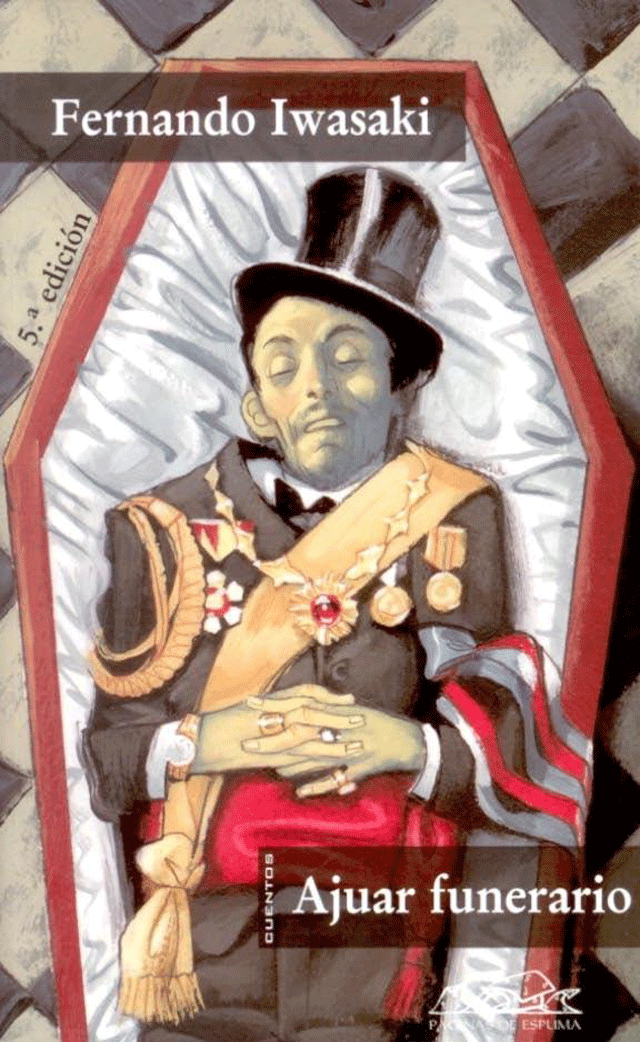
Fernando Iwasaki’s Ajuar funerario (Funeral Dress) Profiled in El Pais

El Pais has a profile of Fernando Iwasaki’s Ajuar funerario, a collection of short stories that has sold the relatively phenomenal 60,000 copies over multiple printings. The stories are in the horror genre, but with Iwasaki there is always humor, and so I doubt the stories are particularly gruesome. If his España, a parte de mi estes premios is any indication the book aught to be rather funny.

Ahí va un ejercicio para los lectores. Imaginen a un escritor latinoamericano, peruano de nacimiento, japonés de origen, sevillano de facto (casado desde hace veinticinco años con una sevillana), director de una fundación de arte flamenco, que escribe un libro de microrrelatos de terror con retrogusto de humor y que se vende como churros en las dos orillas de Atlántico. Es Fernando Iwasaki y su Ajuar Funerario, de la editorial Páginas de espuma, un longseller que lleva más de 60.000 ejemplares vendidos desde 2004 sin perder el ritmo, y acaba de lanzar su séptima edición. ¿El secreto del éxito de sus microrrelatos? Contienen historias… de miedo.

“Empecé con este género de minificción hace años, cuando me encargaron lecturas y conferencias para la universidad. Verdaderamente me sentía incapaz de leer textos míos de ocho o diez páginas, el público no merecía que le aburriese, así que decidí escribir estas pequeñas historias. Pero para que sean microrrelatos tiene que haber historia, y si no lo hay entonces podrá ser un poema en prosa, una anécdota, un aforismo estirado como un chicle… Pero no un microrrelato”. Iwasaki afirma que vivimos en un mundo invadido de ficción aunque no nos demos cuenta. “Ficción son los currículum vitae, son las esquelas de los periódicos, son los anuncios por palabras… Esa persona que publica: ‘Licenciado, 42 años, culto, encantador, desearía conocer señorita…’ ¡Eso es ficción!, ¿Cómo es posible que nadie haya llegado a esa situación de abandono a los 42 con todas esas cualidades?” Bromea el escritor.

My Little War by Louis Paul Boon – A Review

My Little War
Louis Paul Boon
Dalkey Archive, 2010 125 pg

This scant book is one of the more interesting ways to write about war I have read. It is also what makes it difficult to capture. My Little War is a series of 1-3 page episodes and little paragraph length moments that are tacked to the end of the episodes without any real relationship. They are just more noise of war. All of it is narrated by a person claiming to be the author. I mention this because while the style is consistent, one has the impression that multiple voices are at work. Nevertheless, each of the episodes describes the chaotic lives of the Flemish during World War II. The stories aren’t related and do not create a narrative arc that ties the lives of the characters together, giving the reader much of a connection to the characters. Boon is not creating great heroic stories of the resistance or of the pathos of the long suffering. Instead, he shows a world that in many ways has always existed and which during the shifting power structures of the war force to the surface. In story after story he shows the Belgians stealing and lying to survive. At other times the fascist sympathizers parade around town, finally powerful, only to change their stripes when the allies come. It’s a vision of pettiness that makes some of the Belgians look anything but heroic. That view is part of his larger point about the war. Those who lived  through it were surviving each day lacking any information of what was going on or any power to control it. It is not a sympathetic view, but it is effective and the voices of the episodes that seem anonymous in their brevity begin to suggest one thing: what was it all for?

But all the poets who wrote so enthusiastically about the Eastern front peeked out cautiously in their socks, back to writing poems about the stars and their solitude and God–God for God’s sake–after having pissed right onto Christ’s loincloth.

Eugenia Rico – New Collection of Stroies plus excerpts in English

The Spanish author Eugenia Rico has published a new book of short stories from Páginas de Espuma called El fin de la raza blanca (The End of the White Race). Not having read the whole book, the title is a little off putting for how loaded a term it can be. You can read an excerpt here. I wasn’t too impressed, but you can also read an English translation of part of one of her novels here. There are also some links to videos, etc.

She has one of the more interesting book trailers I’ve ever seen, one that doesn’t try to use a text genre in a visual genre.

A brief interview about here book is also here.

Chapter from New Enrique Vila-Matas Book Aire de Dylan

El Pais post a chapter from the newest Enrique Vila-Matas book a few weeks ago. I’ve been a little late on getting it up, but you can read it here. The book came out last week (3/14). Here is a brief overview:

Uno de los mayores fracasos puede ser fracasar en el empeño de fracasar. Otro podría ser el vivir pareciéndose a alguien, imitándolo y propiciando la impostura. Con esta idea comienza Enrique Vila-Matas su nueva novela Aire de Dylan (Seix Barral). Una obra que se publicará el 14 de marzo pero cuyo primer capítulo avanza hoy EL PAÍS en exclusiva.En ella, el joven Vilnius, que explota su parecido con el cantautor estadounidense, asiste a un congreso literario sobre el fracaso, mientras cree que su difunto padre le empieza a traspasar sus recuerdos.

El anonimato, la máscara, la impostura, la búsqueda y sus alrededores están presentes en Aire de Dylan. El joven Vilnius protagoniza estas páginas en las que el escritor barcelonés despliega sus mejores armas y elenco literarios con humor, ironía o sarcasmo pero siempre desde el conocimiento del mundo de la creación literaria. A partir de ahí, la novela se va transformando en un homenaje al mundo del teatro y una crítica al posmodernismo.

Th Oprah Book Club: not so good for new literature

The TNR has a post about how effective the Oprah Book Club in promoting reading and literature. It looks as if it didn’t make new readers out of non readers. It did get readers to switch from crappier books to more literary. But that had the effect of actually hurting the publisher’s bottom line. The law of unintended consequences rears it head again: (via)

The bad news is that the profits that help support publication of less lucrative, more high-minded books depend on the sale of a lot of crap. And at least when it came to fiction, Garthwaite found that the net result of Oprah’s endorsements was to reduce aggregate sales. The reason was the one Franzen articulated back in 2001: Winfrey often selected books that posed a challenge for her TV audience. In practical terms, that meant that Oprah Book Club books took longer to read than the crap her viewers would otherwise read. That, in turn, meant that publishers ended up not only selling less crap, but also, in the aggregate, selling fewer books overall. Which probably meant (and I’m extrapolating here from Garthwaite’s findings) that these same publishers were correspondingly less able to publish literary fiction.

Macedonio Fernández Profiled in La Jornada

A couple weeks ago La Jornada had several long articles about the Argentine author Macedonio Fernández one of Borges great friends and mentors. He was quite a character and his literary ideas are still unique. Open Letter Press brought out his The Museum of Eterna’s Novel a few years ago. It is called a novel, but it is full of prologues and is quite strange. Any ways, the La Jornada articles are definitely worth reading.

En un cuaderno inédito, hacia 1939, Macedonio Fernández anota: “Artistas: el inventor de colmos de Importunación –El extremador de redondeces.” En arte, según esto, habría dos posibilidades: a) importunar, perturbar inventando algo nuevo; b) agradar perfeccionando lo ya inventado. Dos extremos, dos programas para el arte: la ética de la invención, la estética del pulir y redondear. Claro que esos extremos –inventar, redondear– en cierto modo se dan en toda obra de arte. Por un extremo, la obra de arte se aproxima a lo “ilegible”, corre el riesgo de inventar hasta el punto de hacerse invisible, al diferir al futuro sus condiciones de inteligibilidad; por el otro, se expone a la redundancia, a agotarse en la nitidez de lo que meramente agrada en el presente. En las letras latinoamericanas (y más allá de ellas) pocos se entregaron al extremo de la invención de manera tan colmada de futuro como Macedonio Fernández.

Guillermo Cabrera Infante – The Collected Works Vol I Overview at El Pais

El Pais has an overview of the first volume of Guillermo Cabrera Infante’s collected works. The first volume of 1500 pages has his journalism and screen plays. It is expected to be a long project as he wrote under many pseudonyms and was a prolific journalist. However, for the Cabrera Infante fans it certainly will be welcomed. One thing I like to see are the scripts that novelists have written. I know I have the silent scripts of some of Isaac Babel’s works in his complete short stories.It gives a different dimension to see how they approach such a different form.

A Guillermo Cabrera Infante le gustaba definirse a sí mismo como “un periodista que escribe novelas”. Lo que parecía casi una broma más del autor de Tres Tristes Tigres, que entendíamos como la reivindicación de su aparición continua e iluminadora en la prensa escrita, porque lo habíamos leído primero como novelista, tiene ahora significados nuevos: vocacionales y estrictamente profesionales. Efectivamente, Guillermo Cabrera Infante fue un periodista, un crítico y un informador, y de primerísimo nivel. Este primer tomo de las Obras Completas (Galaxia Gutenberg / Círculo de Lectores), que es también el primero de los tres dedicados al cine —si incluyen finalmente sus guiones—, rescata, en torno a Un oficio del Siglo XX, la infinidad de críticas, reportajes, entrevistas y artículos sobre cine, más de 1.500 páginas en total, que G. Caín, uno de los seudónimos del joven Cabrera Infante, firmó en la revista Carteles, entre 1954 y 1960. Es decir, cuando Guillermo Cabrera Infante era un “periodista profesional”. Y aparece exactamente cuando se cumplen siete años de su muerte.