Results of Book Shopping in Barcelona: Sada, Moya, Palma, Abirached, Munoz, Ndongo, Letelier

I had the luck to have a couple of days to do some book shopping in Barcelona and came back with 7 books. It was hard to limit myself because I recognized so many authors that I’d seen on El Publico Lee. And when I found the display of books from Paginas de Espuma on my last day I was tempted to buy a couple more books. In the end I settled on the following, a mix of Latin American, Spanish, African and Lebanese books. I normally don’t buy books translated into Sanish but Zeina Abrached’s books are unavailable in English so I could justify it.

  • Felix J Palma -El menor espectaculo del mundo
  • Miguel Angel Munoz – Quedate donde estas
  • Zeina Abrached – El juego de las golondrinas
  • Zeina Abrached – Me acuerdo Beruit
  • Daniel Sada – Ese modo que colma
  • Horacio Castellanos Moya – Con la congoja de la pasada tormenta
  • Hernan River Letelier – El arte de la resurrecction
  • Donato Ndongo – Las Tinieblas de tu memoria negra


Ilan Stavans and The Norton Anthology of Latino Literature at Huffington Post

The Huffington Post has an interesting interview with Ilan Stavans about the publication of The Norton Anthology of Latino Literature, one of those massive door stops that only students in literature classes seem to read. While I find the Huffington Post trashy, this interview has merit. Ilan Stavans also makes it sound more interesting than Rolando Hinojosa when I saw him give a presentation on this at the University of Washington.

Don’t expect to pick it up with one hand. The anthology is over 2,600 pages long, a treasure trove of stories, poems, song lyrics and various detours along unexplored paths of American history. Stavans says he had no interest in producing a standard collection of tales from celebrated Latino writers. His anthology does contain pieces from a few modern masters — Isabel Allende, William Carlos Williams, Octavio Paz — but the scope of his vision is far greater than them. The collection begins in the year 1539, with a letter written by Spanish explorer Hernando de Soto, continuing on through César Chávez’s rousing political speeches, Junot Díaz’s biography of a sci-fi-obsessed dork, the cartoons of Gus Arriola, Broadway-style hip hop from Lin-Manuel Miranda, even club lyrics from Ricky Martin and the Spanglish rap of Cypress Hill.

That breathtaking span is one reason the Norton Anthology feels less like a book and more like a magic carpet ride through time and space, with Stavans’ hand on the rutter, introducing every author with a crisply written biography, explaining every political and cultural reference with an ongoing series of footnotes. Through it all, you can almost hear the happy bounce of Stavans’ fingers on the keyboard, a joy I first noticed 14 years ago as his student at Amherst College, where he is the Lewis-Sebring Professor of Latin American and Latino Culture.

Stavans and I reconnected recently to discuss his new anthology, the clash of high and low culture in the collection, how his father shaped his literary outlook, and what exactly makes him qualified to decide who is in and who is out of the Latino literary canon.

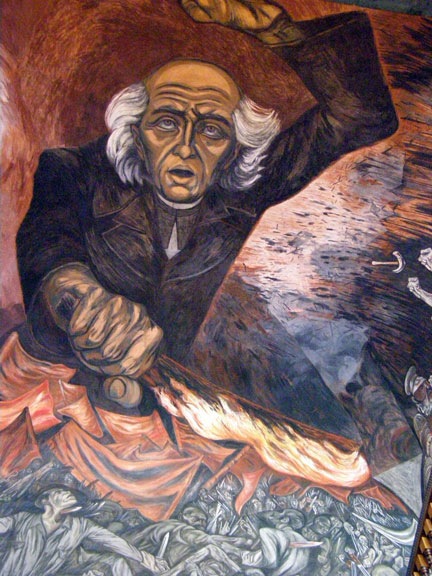
Happy Mexican Bicentennial of Independence

200 years ago today, September 16, 1810, Dolores Hildago began the revolution that led to Mexican Independence.

Jose Clemente Orozco's Dolores Hidalgo

More About Bioy Casares Brazilian Journal

El País has a short and positive review of Adolfo Bioy Casares´journal of his trip to Brazil in 1960. Essentially, if you like his diary/biography of Borges, which hasn´t come out in English yet, you will probably like this book because it is filled with the same humor and wry observations that fill borges.

Si el posible lector de esta reseña tuvo el privilegio de leer Borges, parte del diario de Bioy Casares (Destino, 2006), recordará que entre el 21 de julio de 1960 y el 31 del mismo mes, hay un vacío. (Recuérdese que este diario sólo habla de la relación de Bioy con Borges). Pues bien, Unos días en el Brasil llena ese vacío. El autor de La guerra del cerdo fue invitado a un congreso del PEN Club celebrado en Brasilia en aquellos días. Bioy Casares suspende su diario, pero abre otro de pequeño formato para comentar solo sus impresiones del congreso (editado en una tirada no venal de 300 ejemplares, en 1991, para ser obsequiado a los amigos del escritor). El sucinto diario mantiene vivo el tono irónico de su autor. Durante el congreso conoce a Moravia (de quien escucha palabras nada amables de la obra de Giorgio Bassani), conoce a su mujer (a la que llama señora Moravia, porque no se acordaba que era Elsa Morante). Como está en Brasil, Bioy Casares elabora una teoría del patriotismo muy interesante: hay patriotas negativos (a los que se les eriza la piel cuando alguien critica a su país) y los patriotas positivos (los que hacen algo útil por su patria). Si uno recuerda su Borges, tendrá presente el constante aliento irreverente de sus páginas, su humor devastador. En Unos días en el Brasil, se mantiene constante esa característica, guardando siempre una educación exquisita ante quien se hace merecedor de algunos gramos de su sarcasmo. Escucha con suma atención a quienes tienen algo interesante que comunicarle sobre el modo de ser de los brasileños. Oye decir que hay un racismo muy soterrado extendido en todo el país, sobre todo respecto a los negros. Y luego no puede disimular su condición de seductor irrefrenable, sus tentaciones enamoradizas que no oculta. No tienen desperdicio sus opiniones sobre Brasilia, sobre la injustificada necesidad de crear una nueva capitalidad. En fin, ha sido un inmenso placer volver a leerlo señor Adolfo Bioy Casares.

New Adolfo Bioy Casares Book Apearing in Spain

For the Adolfo Bioy Casares completists Spain’s Páginas de Espuma is publishing a book of photos and a diary he kept during a 1960 trip to Brazil. I don’t know what the photos are like, but you can read the publisher’s press release.

La mirada de un viajero, Adolfo Bioy Casares en Brasil
El 6 de septiembre se realizará su lanzamiento mundial y se inagurará en Madrid una exposición que recoge las fotografías del libro

Madrid.- El próximo 6 de septiembre se realizará el lanzamiento mundial del libro Unos días en el Brasil (Diario de viaje), del escritor argentino Adolfo Bioy Casares, y con posfacio del editor y traductor Michel Lafon. El libro será publicado simultáneamente desde Argentina y España por las editoriales La Compañía y Páginas de Espuma, que suman de este modo un título más a su labor en común. Fruto de esta colaboración, en septiembre títulos como Lady Susan, de Jane Austen, o Nabokov y su Lolita, de Nina Berberova estarán disponibles en las libreráis españolas, mientras en las argentinas lo estarán El último minuto, de Andrés Neuman o Tres por cinco, de Luisa Valenzuela.

Las páginas prácticamente inéditas de Unos días en el Brasil (Diario de viaje) recogen el diario de un viaje en 1960, motivado por la invitación que Bioy Casares recibe de la organización del congreso del PEN Club en Brasil. Unos días en el Brasil recorre aquellos días de 1960 que Bioy estuvo entre las ciudades de Río de Janeiro, São Paulo y una incipiente Brasilia, de la que se celebra su 50º Aniversario como capital de Brasil. Testimonio de uno de los autores claves de la literatura en castellano del siglo XX, este diario se completa con una serie de fotos inéditas de este viaje. Coincidiendo con el lanzamiento, se celebrará una exposición titulada Basilia 1960. Fotografías inéditas de Adolfo Bioy Casares en la Galería Guayasamín de Casa de América en Madrid del lunes 6 de septiembre al domingo 19. La construcción de la ciudad comenzó en 1956, siendo Ludo Costa el principal urbanista y Oscar Niemeyer el principal arquitecto. En 1960, se convirtió oficialmente en la capital de Brasil. Junto con Putrajaya (la capital administrativa de Malasia) y Naypydaw (la nueva capital de Birmania) es una de las ciudades capitales de más reciente construcción en el mundo. El 8 de septiembre a las 20 horas será la presentación del libro en Casa de América. El acto contará con la presencia de Eduardo Berti, Juan Casamayor y muy especialmente del editor, traductor y ensayista francés Michel Lafon, que esos días concederá entrevistas. Según palabras recogidas en su posfacio, el diario tiene un cometido íntimo y personal del autor “para seguir transformando cualquier día de su vida en un viaje y una aventura, cualquier lugar del mundo en una isla encantada, donde todo se vuelve posible, e incluso deseable”. Lafon mantiene que Bioy ” no sabe por qué aceptó la invitación, no tiene nada que decirles a los otros invitados, rechaza las amistades obligadas y los ejercicios impuestos, odia la retórica vacía, no quiere hablar en público”. Aun así, Lafon acaba preguntándose: “Viajar para escribir, escribir para olvidarse de que uno está viajando, y para recordarlo después. ¿Y si Bioy fuera el mayor diarista del continente?”.

Lit Podcasts: 9/2/10: John Williams, Adam Langer, James Mauro, Ayelet Waldman

Leonard Lopate and Morris Dickstein, Distinguished Professor of English and Theatre at the CUNY Graduate Center, discusses John Williams: author of the 1965 novel, Stoner.

Novelist Adam Langer talks about his latest work, The Thieves of Manhattan, which serves as: a comical literary caper, an exploration of authenticity and fakery, and a tribute to books.

James Mauro discusses the 1939 World’s Fair, which took place at an important turning point for America—the window of time between the Great Depression and World War II (at Leonard Lopate).

Ayelet Waldman talks about her latest novel, Red Hook Road. (at Leonard Lopate)

This is a little old, but interesting. Colin Marshall (mp3) talks to Chris Wickham, Chichele Professor of Medieval History at Oxford University, Fellow of All Souls College and author of The Inheritance of Rome: A History of Europe from 400 to 1000, the latest in Penguin’s sprawling History of Europe series.

Ricardo Piglia, Almudena Grandes, Mario Vargas Llosa and Others on Their New Books

El Pais has an article about the new books that are coming out from Spanish language authors this fall. Among works by Ricardo Piglia, Almudena Grandes, Mario Vargas Llosa there will also be a book by Adolfo Bioy Casares that compiles his photos from a trip to Brazil in 1960. Mostly the article is authors talkinga bout their works, but interesting none the less.

1. ¿Por qué ha elegido ese tema o argumento para el nuevo libro?

2. ¿Cuándo y cómo fue el momento de inspiración para escribir sobre eso?

Ricardo Piglia

Blanco nocturno (Anagrama)

1. En el origen estuvo la figura de Luca y la leyenda familiar; pensé la novela centrada en un héroe enfrentado al destino y trabajé una trama con muchos personajes secundarios y varios conflictos. Traté de buscar un registro digamos épico. ¿Cómo sería hoy escribir una historia épica? Ese fue para mí el desafío del libro.

2. Imaginé la historia hace mucho tiempo, antes de publicar Prisión perpetua. Escribí una primera versión y la dejé, luego la retomé y la reescribí y la volví a dejar… Me gusta -aunque no lo recomiendo- ese modo de escribir porque las historias cambian, como si -al decantarse- encontraran su propia inspiración.

Almudena Grandes

Inés y la alegría (Tusquets)

1 y 2. No estoy muy segura de haber escogido el tema de Inés y la alegría. Más bien, la invasión de Arán me escogió a mí. Cuando leí que un ejército de cuatro mil hombres había invadido el valle en otoño de 1944, y que lo había ocupado durante nueve días a la espera de un apoyo aliado que nunca llegó, me costó trabajo aceptar que semejante episodio permaneciera en el olvido. Averigüé algo más sobre el origen y las características de aquella aventura, y descubrí a un personaje irresistible, Jesús Monzón, moviendo los hilos de una trama más fascinante que cualquiera que yo hubiera podido inventar.

Urdu Fiction from India – Words Without Borders September 2010

Words Without Borders’ September 2010 issue features Urdu fiction from India.

This September we’re treated to the finest in new Urdu fiction from India. Curated by distinguished translator Muhammad Umar Memon, this stunning collection is the perfect primer on the fantastic and varied forms of contemporary Urdu writing. Naiyer Masud, master of the Urdu short story and Saraswati Samman award winner, follows the travails of a young runaway given refuge by a mysterious stranger. Celebrated fiction writer Qurratulain Hyder tracks the fortunes of a young woman who jettisons family and home on an intercontinental romp, with the past hot on her heels. Trailblazing feminist writer Ismat Chughtai gives an unsparing account of the goings-on in a maternity ward, while Anwar Khan’s protagonist discovers the comforting solitude of a shop window. Award-winning journalist Sajid Rashid sorts through a train explosion in a tale told by a severed head, and Siddiq Aalam listens in on two grumpy old men in a Kolkata park. Rounding out the issue, Sahitya Akademi Award winner Rajinder Singh Bedi gives a lesson in the art of erotic statuary, while Zakia Mashhadi recounts a troubled saga of marriage, love, and religion, and Salam Bin Razzack paints a picture of a Mumbai under siege.

Also this month, Askold Melnyczuk extols the virtues of speaking more than Amerikanisch, Avrom Sutzkever recites an ode to the dove, and Najem Wali describes a visit to the morgue.

Short Stories From Ines Mendoza, Ronaldo Menendez, Javier Saez de Ibarra (Spanish Only)

A few more short stories from Spanish authors (in Spanish only) . Javier Saez de Ibarra won the first International Prize for Short Stories Ribera del Duero in March of 2009.

Debutantes, Javier Saez de Ibarra

Mohr, la que huye de la luz, Ines Mendoza

Paralelamente, Ronaldo Menendez

Writing the Spanish Civil War: Field of Honor by Max Aub – a Review

Field of Honour
Max Aub
Verso ( 2009), pg 253

Political novels, especially those written in the heat of the moment, can suffer from didacticism, that need to explain, justify, or apologize which when read latter makes conversation that was once so important seem stiff, bereft of context. At best it can read as a time capsule, but often the need to explain over powers complexity. Moreover, as history progresses those ideas that were so worth devoting pages to are no longer that important. Sure, they are relevant to a specialist, but they cannot go beyond their moment because the ideas no longer inform the current moment.

Written in 1939, the year of the Republican defeat, Max Aub’s Field of Honor falls into this trap and despite moments of brilliance the book is mired in conversations about the need for communist, anarchist, flangeest (a mix of Catholicism and fascism) and Carlist (a form of monarchism)  solutions to the problems of Spain. The conversations are more fragments of ideas than cogent argument, which is perhaps fitting its timeliness, and they do show a certain side of the coming troubles, but they neither make an interesting argument, or really convey the experience of the times. He is effective in showing the different ideas that were being discussed, but in of themselves they are not particularly compelling.

It is unfortunate the weakness of the political arguments distract so much, because the other elements are very well written. The book follows Rafael Lopez Serrador a poor youth from a small village in Spain as he goes from young man to revolutionary, struggling against industrialists, switching to fascist side, and ultimately finding what he really is. In one way it is a coming of age story as Serrador learns about sex, the avarice of man kind, and confronts violence. As a coming of age story, even one of political awakening, Aub captures a world, an impression that out lasts the times. Aub’s strength is to capture a communal experience and he can convey what a town or a battle is like in a way that goes beyond just a historical description, and gives one the sense of the times. His description of the fire bull (a bull with burning pitch on its horns) is not only an effective symbol of Spain on the edge of war, but an excellent depiction of small town life. His quick, imagistic sentences serve his expansive, summary approach, and the result is a sweeping view of the end of Republican Spain.

Ultimately, Field of Honor has moments of brilliance but is slowed by the political discussions. Since it is part of a cycle it would be interesting to see if he is able to use more of the good parts and avoid the conversational fragments.

Lit Podcasts 8/27/10: David Mitchell, John Brandon, Louis Couperus, Yasunari Kawabata, Martin Amis

A short list this week. It seems like I listened to more than these.

David Mitchell on Bookworm from KCRW. This is one of his best interviews in the recent past.

A little old but interesting: Todd Shimoda on the Marketplace of Ideas.

John Brandon on his novel Citrus Country at the Leonard Lopate Show

Leonard Lopate discusses Louis Couperus

Leonard Lopate discusses Yasunari Kawabata

Martin Amis talks with Leonard Lopate

Short Stories From Andres Neuman, Fernando Iwasaki, Hipólito Navarro, Clara Obligado, Patricia Esteban Erlés

For your end of summer reading pleasure: short stories from Andres Neuman, Fernando Iwasaki, Hipólito Navarro, Clara Obligado, and Patricia Esteban Erlés. These are all in Spanish and unfortunately I doubt Google translate will help. All of these links are via the publisher Paginas de Espuma.

Fernando Iwasaki in  El País titled Emmanuelle Allen: http://www.elpais.com/articulo/revista/agosto/Emmanuelle/Allen/elpepirdv/20100814elpepirdv_6/Tes

Hipólito G. Navarro (El pez volador) in Público:. http://www.publico.es/culturas/331534/vuelta/dia

In Público by Clara Obligado: http://blogs.publico.es/libre-2010/2010/08/03/el-azar-por-clara-obligado/

In El País by Andres Neuman: http://www.elpais.com/articulo/revista/agosto/pequenas/perversiones/elpepucul/20100716elpepirdv_9/Tes

In Público by Patricia Esteban Erlés: http://www.publico.es/culturas/330839/your/name/relatos/verano

Spanish Short Stories – The Forgotten Greats and the New Voices

El Pais has an excellent article on short story writers from the 20th century and beyond, with special emphasis on the forgotten during the post war and the new young writers. If you are interested in short stories the article is a must. What is fascinating from my own reading and notes of the author is the interest in playing with reality. Despite the oft cited interest in Americans like Carver, there is a definite interest in authors like Poe, Borges and Cortazar.

One could spend a year reading all these books:

Para estar al corriente de los tiempos que se avecinan, Gemma Pellicer y Fernando Valls nos proponen Siglo XXI (Menoscuarto), subtitulado Los nuevos nombres del cuento español actual. Siguiendo la pauta de un libro anterior a cargo de F. Valls y J. A. Masoliver, Los cuentos que cuentan (1998) (con el que este reciente volumen dialoga), se recoge aquí también una breve reflexión sobre el género firmada por cada uno de los autores escogidos. Sin ánimo de entrar a debatir algunas de las afirmaciones vertidas en la presentación del volumen ni matizar el tono de regusto canonizante que preside esta gavilla de relatos, sí quiero apuntar un par de cuestiones. Al margen de la fecha de publicación de los relatos aquí reunidos (todos posteriores a 2000, en efecto), a menos que admitamos que el siglo XXI empezó en 1989, aproximadamente la mitad de estos “nuevos nombres” pertenece al último tramo del XX, no sólo por haber empezado a publicar a principios de los noventa sino por su específica filiación literaria; en este sentido, faltan autores incontestables. Por eso del subtítulo me sobra el “los” y cuestiono la pretendida novedad, aunque es cierto que la nómina de autores de trayectoria más breve y reciente está más equilibrada, destacando la justa y merecida presencia de escritoras como Berta Vias Mahou, Elvira Navarro, Berta Marsé o Cristina Grande.

Esta última publica Agua quieta (Vagamundos): 36 narraciones próximas a la intensidad y el lirismo de la prosa poética, que apuntan el latido cotidiano del presente al modo diarístico (una breve escapada a Escocia o la lectura sosegada de la vida de Chéjov según Natalia Ginsburg), o se desplazan en el tiempo evocando historias de familia y los juegos y paisajes de la niñez.

Al modo de novela de formación o aprendizaje podría leerse Conozco un atajo que te llevará al infierno (e.d.a. libros), del valenciano Pepe Cervera: dieciocho estampas que atraviesan la adolescencia, juventud y primera madurez de Andrés Tangen, de las cuales en Siglo XXI se recoge la penúltima, ‘Como un hombre que sobrevuela el mar’.

Una de las autoras-revelación incluida en Siglo XXI es Patricia Esteban Erlés, que publica su tercer libro de relatos, Azul oscuro (Páginas de Espuma), cuentos de un gran despliegue imaginativo en los que la realidad o la vida cotidiana queda alterada por la irrupción de un elemento extraño, de un acontecimiento tan inesperado como incomprensible o de un comportamiento ingobernable. Algunos textos alcanzan grados de condensación casi poéticos y por lo general ocultan más de lo que dicen, con finales abiertos, tan inquietantes como sugestivos, o un cierre sorpresivo en el mejor estilo de Poe. Destacaría el que da título al libro, ‘Azul ruso’ -donde encontramos a la nueva Circe Emma Zunz, que “fue convirtiendo en gatos a todos los hombres que cruzaron la puerta del viejo edificio con aires de teatro cerrado donde vivía”- y ‘La chica del UHF’ -protagonizado por Antonio Puñales, un “técnico en pompas fúnebres” que se desvive por crear amor y belleza allí donde dominan el horror o la avaricia.

The Best Short Stories of the 20th Century-the View from Spain

El Pais had a brief take on some of the best short stories of the 20th Century. It is a very anglophone list, but interesting as a view from the other side of the Atlantic.

Raymond Carver
Cathedral (1983)
James Joyce
The Dead (1914)
Henry James
The Beast in the Jungle (1903)
Juan Rulfo
No oyes ladrar a los perros (1953)
Julio Cortázar
Graffiti (1981)
Ramón del Valle-Inclán
El miedo (1902)
Truman Capote
Deslumbramiento (1982)
Jorge Luis Borges
El espejo y la máscara (1975)
J. D. Salinger
The Laughing Man (1953)
Francis Scott Fitzgerald
Return to Babilonia (1929)
Ingeborg Bachmann
Problems, Problems (1972)
Katherine Mansfield
The Fly (1922)
Ring Lardner
Champion (1924)
Medardo Fraile
The Album (1959)
Flannery O’Connor
A Good Man Is Hard to Find (1955)
Katherine Mansfield
In the Bay(1921)

Cristina Fernandez Cubas Profiled in El Pais

El Pais has a short profile of Cristina Fernandez Cubas this week. She is an excellent short story writer, one of those I wish would be translated into English. I’m still reading her stories, but they all are excellent. You can also see what her study looks like here.

Ha escrito también novela, memorias y teatro, pero son los relatos los que han convertido a Cristina Fernández Cubas (Arenys de Mar, Barcelona, 1945) en la cuentista de cabecera de toda una legión de lectores. Si entraran en su casa les parecería que está llena de vestigios. De su biografía, por supuesto, pero también de las inquietantes historias que explica en sus libros. En la puerta de la cocina, por ejemplo, hay una pequeña pintura de un entrañable demonio con rabo, el regalo de una amiga que sabía de su afición por estos seres que sobrevolaban Parientes pobres del diablo, y en un frasquito guarda un puñado de arena del teatro de Mérida que recogió el día del estreno de la Orestiada en la versión que adaptó su marido, el fallecido escritor Carlos Trías. De su afición a la tauromaquia da cuenta un “belén eterno” en el que, en lugar de pastores ha situado dos toreros, un elefante y tres nazarenos. Al inicio ha comentado que tiene dudas razonables sobre cuál sería “su rincón” en este agradable ático del Eixample de Barcelona, con terraza a un patio de manzana en la que reinan unos tímidos cactus. “Es que mi rincón es toda la casa”, aclara. “No sólo se trabaja cuando se está escribiendo, a veces mientras me balanceo es cuando se me aparece lo que después voy a desarrollar”. Y lo demuestra sentándose en un cómodo balancín repintado varias veces al que, explica, le costó encontrar su lugar hasta que se varó en esta salita en la que lee y escucha música. “De hecho, podríamos haber hecho la foto en un tren porque lo utilizo mucho, siempre que puedo, y allí leo, me invento cosas, escribo …”.

No será por falta de estudios. Tiene dos, que utiliza de manera indistinta, pero la foto se hace en uno pequeño, junto al salón, en el que va dando forma a esa “novela llena de cuentos” de la que sólo adelanta que es un trabajo difícil de definir, que aún está en gestación. “Será un paréntesis respecto a lo que hacía ahora, pero estoy muy animada porque es algo muy creativo y extraño”. No tiene fecha -“la libertad y la falta de presión es lo más importante para escribir”- y, mientras, espera ilusionada que a principios del próximo año Tusquets, que en 2008 recopiló sus relatos en Todos los cuentos, recupere Cosas que ya no existen, las memorias que publicó hace ya casi una década. También fue una aventura, una mezcla de géneros en la que se adentra de tanto en tanto. Aunque lo suyo, reconoce, es el cuento, este género “misterioso” y “falsamente breve” que, advierte, “no se acaba con la palabra fin”.

Saving Us From Grammarians: Roy Peter Clark’s The Glamour of Grammar @ NYT

I dislike the prescriptive grammarians who, for a writer, stifle creativity with misplaced criticisms. Yes, good writing has rules, but worrying about prepositions at the end of sentences is tiring. I for one can not get enough of these kinds of books.

Via the NY Times

Most striking is that unlike many traditional grammar books, Clark’s reserves its scolding not for students of writing, but for teachers who harbor unduly restrictive views — “members of the crotchety crowd” who “tend to turn their own preferences about grammar and language into useless and unenforceable rules.” Linguistic insecurities and peeves, once they take hold, are exasperatingly difficult to shake. Even though the first edition of Fowler’s book, released way back in 1926, unequivocally states that the proscriptions against ending sentences with prepositions and splitting infinitives are absurd, we’re still arguing about them today, in 2010.

Clark wholeheartedly endorses breaking the commandments that make no sense, as long as in the breaking, the writing still holds up. “Prescriptive critics may condemn my recommendation that writers politely ignore the ‘crotchets’ of purists who insist on . . . rules that have little influence on the making of meaning,” he writes; those “who profess that these are violations must face the counterevidence produced in the classic works of some of our most distinguished writers.”

Although this statement is true, if you were to point out that even Shakespeare was known to split his infinitives (“Thy pity may deserve to pitied be”), end his sentences in prepositions (“I will wear my heart upon my sleeve for daws to peck at”) and even on occasion begin them with “but” or “and” (“But love is blind and lovers cannot see the pretty follies that themselves commit”), you’d be more likely to annoy the prescriptivists than you would be to convert them.

Alfredo Bryce Interview Video (In Spanish Only)

Canal-L interviewed Alfredo Bryce about his new book and the Cuban Revolution. It can be petty hard to understand as Bryce acts drunk, a legacy, I think, of his love of the high life.

Independent Books In Argentina at Literary Saloon

The Literary Saloon links to a couple of articles about independent publishing in Argentina. You are unlikely to find any of these authors in your typical Latin American collection.Worth a look if our are interested in other Latin American authors.

From the literary Saloon:

Argentinian indie ‘Hot 20’

In the Buenos Aires Herald Ana Laura Caruso writes that ‘Independent publishers showcase their best books in select bookstores this week’ in Hot 20, as:

In Buenos Aires, until next Sunday, indie publisher association Alianza de Editores Independientes de la Argentina (EDINAR) presents a Hot List with what’s hot in the indie literature world. EDINAR, which comprises 30 publishing houses, was created in 2005 in order to defend diversity in the publishing environment. This time, 20 publishers chose one book each from their catalogues to be part of a Hot List, available and prominently displayed at different bookstores – these are not their best sellers, but the books that they feel deserve more of the spotlight than they’re currently getting. The Hot List comprises a great variety of genres such as novels, short stories books, poetry, and essays.

Caruso runs down all twenty titles in English, but see also the EDINAR hotLIST page; authors include Macedonio Fernández, Ricardo Piglia, and … Gary Snyder
And Caruso notes:

Perhaps the best writing of today is being published through small presses, who are keeping the independent spirit of literature alive. New small publishing houses are born every month but they can die out easily due to financial problems. There’s a lot of new things shimmering right now, so let that best-seller book drop off your hand and get to know what’s hot today in Argentine literature.

Sounds good — and, with Argentina the guest of honor at the Frankfurt Book Fair this fall — see my recent mention — I hope they’ll be well-represented. 

The Millions on César Aira

The Millions has a good over view of the work of Argentine author César Aira. While he is not necessarily new to English, he is lesser known and the article reviews each of his four books. I’m not sure which one intrigues me most, perhaps Ghosts. Which ever one I choose they all sound interesting.

Ghosts shares Episode’s preoccupation with the visible world, if in a less frenzied key.  The entire action takes place over the course of a single day, New Year’s Eve, in and around a Buenos Aires construction site.  The night watchman, a Chilean immigrant, and his family live in the unfinished building as squatters.  The father, Raúl, is a good worker, but a bit of a drunkard.  His wife, Elisa, is a levelheaded housewife, “that anomaly, not nearly as rare as is often supposed: a mother immune to the terrifying fantasy of losing her children in a crowd.”  Their daughter, Patri, quiet but philosophically “frivolous,” spends the day wandering through the empty structure.  All of them see the ghosts which haunt it: portly naked men covered in fine cement dust whose members stretch like accordions.  The ghosts float between floors and sit on the satellite dishes “on which no bird would have dared to perch.”  Raúl uses them to refrigerate his wine; inserting a bottle into the ghosts’ thorax not only cools the wine, but also transmutes it into an “exquisite, matured cabernet sauvignon.”  Elisa does her best to ignore them.  But Patri is drawn to them by a strange attraction, and they to her, swarming around her head in a “luminous helix.”  Toward evening, they invite her to their midnight feast, though without mentioning the price of admission.

Between hauntings, Ghosts is filled with Aira’s beautifully precise observation of the texture of everyday life.  Most of the novel is occupied with the description of a workday, the preparations for a lunch, the problem of getting change in a grocery store, the difference between Chilean and Argentinean hair styles, laundry.  Elisa uses an inordinate amount of bleach in her washing, with the result that her family’s clothes “were so faded and had that threadbare look, humble and worn, yet beautifully so.  Even if an article of clothing was new, or brightly colored when she bought it, for the very first wash (a night-long soak in bleach) it took on the whitish, delicate and somehow aristocratic appearance that distinguished the clothes of the Viñas family.”  Viewed from this close, ordinary existence opens out to other dimensions.  Aira is a master at pivoting between the mundane and metaphysical.  In the middle of Ghosts, Patri takes a nap during the siesta and dreams of her unfinished building.  Her dream turns into a disquisition on the problem of the unbuilt in the arts, on the philosophical underpinnings of architecture in different cultures, and finally, a blueprint for Aira’s brand of literature, “an art in which the limitations of reality would be minimized, in which the made and the unmade would be indistinct, an art that would be instantaneously real, without ghosts.”

Tin House Summer 2010 – A Quick Review

I picked up the summer issue of Tin House because, a. I was at writers conference and I felt bad for the person selling them, b. it had an interview with Etgar Keret, someone whose work I really like, and c. I got two issues for the price of one. The Keret didn’t disappoint, although, is probably not worth the price alone of the Tin House. Also included is an interview with David Shields, but it was quickly uninteresting to me as I find his stance tedious (you can read the article on line here). What was a welcome change was the quality of the fiction. I had never read a issue before and I was unsure about the quality of the work. Over all the whole magazine was quite good. There were several stories worth noting.

Snow White, Red Rose by Lydia Millet was a solid set of twisting revelations from a narrator who befriends two girls. The questions, naturally, is what is going to happen. She holds the suspense well, but as often happens when you are heading into criminality, the ending suffers because the crime is always so mater of fact is undoes all the excitement you had with the suspense.

The White Glove by Steven Millhauser reminded me of some of Cristina Fernandez Cubas short stories. Both deal with events that seem supernatural, or threatening, but are never quiet revealed to be as horrid as you might think. It is as if the author plays with the tension to let you imagination get away with you even as you are reading. A narrator tells of his enchantment with a girl in his class and her family. The family is perfect, yet she wears a mysterious white glove and he is uncertain why she seems so shy about it. Is it abuse? What could be happening?

The Wheelbarow from Sophie McManus’ story of a vet just back from a war zone showed great comfort with slang and in its economy made for a taught story rich with details. It was a good change to have to puzzle out some of the expressions; it invigorates the writing.