Javier Cercas on Spanish Politics and Catalan Nationalism

I don’t usually cover political subjects on this blog because there are more than enough blogs that do have that covered, even Spanish politics in English. However, with the coming publication of an Anatomy of an Instant in English in February, the following editorial that appeared in El Pais this weekend is a good way to get a sense of his writing style, especially the first paragraph, his rhetorical instincts, and his politics.  You can read the full essay at El Pais.

El fracaso de la izquierda en Cataluña

El fracaso del título no es el inédito fracaso electoral del Partido Socialista en las últimas elecciones catalanas: es un fracaso más amplio y anterior a él, y que en parte lo explica; no es un fracaso político: es un fracaso ideológico. Este fracaso podría resumirse así: desde hace muchos años la izquierda catalana ha entregado la hegemonía ideológica al nacionalismo, de tal manera que a veces se diría que en Cataluña, en la práctica, no es posible no ser nacionalista: o se es nacionalista catalán o se es nacionalista español; también puede resumirse así: asombrosamente, en Cataluña es posible ser a la vez nacionalista y de izquierdas. Se trata de dos disparates complementarios. No solo es posible no ser nacionalista -nacionalista catalán o español o moldavo-, sino que es indispensable, al menos si uno se reclama de izquierdas, dado que el nacionalismo es, aquí y en Moldavia, una ideología reaccionaria, incompatible con los principios más elementales la izquierda. ¿Cómo se explica que haya arraigado ese disparate en Cataluña? ¿Y cómo se explica que lo haya hecho tan profundamente y durante tanto tiempo?

Javier Marías Has Won the Italian Premio Nonino

Javier Marías Has Won the Italian Premio Nonino (8,000 euros). I’ve never heard about it, but the jury is filled with famous names so apparently it must be important, or so says the author of the announcement in El Pais.

El acto de entrega tendrá lugar en Ronchi di Percoto, en la región de Friuli-Venezia Giulia, al noreste de Italia. Nonino es una de las grandes marcas de grappa (el aguardiente italiano), de ahí que la ceremonia tenga lugar en la sede de su destilería. Javier Marías y el arquitecto Renzo Piano, otro de los premiados este año, pasan a engrosar un palmarés del que también forman parte Claude Lévi-Strauss, Norbert Elias, Jorge Amado, Henry Roth, Edward Said y Leonardo Sciascia. Entre los autores hispanos galardonados anteriormente están Álvaro Mutis, Jorge Semprún, Raimon Panikkar y Julio Llamazares.

Review of Matute’s Celebration in the Northwest at Imagined Icebergs

Imagined Icebergs has a review of  Ana Maria Matute’s Celebration in the Northwest. Since her work is more or less out of print it is good to see a review of her work. She won the Cervantes prize last year so she is getting some deserved reappraisal.

The most enjoyable thing about this book is Matute’s rather twisted but beautiful descriptions and comparisons. Here, for example, is part of protagonist Juan Medinao’s perception of his mother when he is a child: “The black beads of her rosary, like a caravan of ants on a business trip to her soul, looped over her wrist where her blood pulsed erratically.” Or, on first encountering a young priest: “As he watched him, Juan experienced a feeling similar to that which came over him before he ate a baby partridge.”

Anatomy of a Moment (Anatomia de un instante) by Javier Cercas – A Brief Review

I just finished reading Anatomy of a Moment (Anatomia de un instante) by Javier Cercas and I was impressed. I can’t say much yet since I’m writing a review for The Quarterly Conversation, but aside from the story, his approach has a few interesting questions about how we perceive history and what makes a novel a novel. Cercas certainly doesn’t like the king and is obsessed about Suarez. Fortunately for people who read this blog, it is coming out in English from Bloomsbury. I read the Spanish version and then will be reading the English version for the review. It is the first time I’ve done this and will be curious to see how it works out. It will also give me a little bit of time to research some of the events described so I can judge better his take.

Graphic Novel About Writing Comics in Franco’s Spain

Paco Roca, the winner of the National Prize for Comics (Premio Nacional de Cómic, 2008), has published a new book about publishing comics during the height of the Franco regime in the 1950s. The review in El Pais likes the book quite a bit. The book is based on a true story and detailed research and sounds interesting.  You can read the first 18 pages and even if you don’t understand Spanish decide if his style is interesting. Excerpt.

Todo lo que cuenta el autor es real, todos los personajes existen o existieron, lo que se describe es fruto de una minuciosa investigación. Cuando termina El invierno del dibujante, después de volver a algunas de sus viñetas, de perderse un rato por sus páginas para disfrutar de nuevo de las composiciones y de los dibujos, al lector le vienen muchas preguntas a la cabeza y muy pocas respuestas y, quizás, una certeza: que la aventura de un grupo de dibujantes por sacar adelante una revista en la que tuviesen más derechos y fuesen más libres en la España franquista mereció la pena. Que Vázquez se equivoca, que David puede derrotar a Goliat solo por intentarlo. Porque, aunque se pierda, aunque uno salga derrotado una y otra vez, siempre merece la pena luchar por la dignidad.

Blogs in English About Spanish Language Literature

I’ve come across a couple new blogs that focus on Spanish language literature. One is caravana de recuerdos whose reviews often feature comparisons between the Spanish original and the English translation. It is usually quite informative (a sample after the jump. The other is Books on Spain, which as its name suggests, is about books from Spain. The author is well informed about publishing trends and is worth taking a look at.


From caravana de recuerdos writing about a Quevedo translation.

Even though I had some problems understanding La vida del Buscónin Spanish (the combination of Quevedo’s frequent puns and the characters’ criminal slang, while amusing, was truly difficult at times) and then felt swindled by Michael Alpert’s unreliable English translation of the work, I’d like to second Amateur Readerin acknowledging that the experience of reading the Buscón [TheSwindler] in any language is well worth the effort.  It’s just scandalously funny.  With that in mind, I’d like to wrap up this little miniseries on the Spanish classic with a look at some examples of its edgy humor.  In Book II, Chapter 3, for example, the swindler Pablos comes awfully close to committing blasphemy in telling  the story of how, against all expectations, a hermit cheats him and a soldier out of all their money in a game of cards: “Our cards were like the Messiah–since they never turned up, and we were always waiting for them” (83).*  In Book III, Chapter 3, the sacrilegious tone continues with the description of an impostor who earns a living by pretending to be a penitent in search of alms: “He wouldn’t raise his eyes to look at women”, Pablos writes, “but their skirts were another matter” (123).**  Elsewhere, Pablos flirts with the boundaries of good taste by describing how a “good conscience in a merchant is like virginity in a streetwalker since it’s peddled without being possessed” (85) and follows it up with a remark about how he’s sure that his mother–imprisoned by the Inquisition in Toledo–will “make sparks fly” at the stake (95)!***  Although Quevedo has been criticized by some modern scholars for the anti-Semitic and misogynistic elements in this novel, I think it’s important to remember that nobody gets off unscathed in Pablos’ crude vita of an unrepentant 17th century criminal ready to ship off for the New World.  Hilarious.

From Books on Spain

So these two books are both by the Spanish journalist, writer and diplomat Isabel Oyarzábal Smith de Palencia (Malaga, 1878 – Mexico City, 1974): I Must Have Liberty (1940) andSmouldering Freedom (1945). As you can probably tell from her unusual collection of surnames, Oyarzábal was half Spanish (with Basque roots) and half British (with Scottish roots); she was brought up bilingual in Spanish and English, which is why the two books I’ve just acquired, like several of her others, were written directly in English. I knew a little bit about Oyarzábal already, mostly because of her Anglo connection, which brings her into the orbit of my interest in Anglo-Spanish relations since the 19th century, but also because she began publishing during the 1900s and so is one of the women included in my database project Spain’s Women Intellectuals, 1890-1920but the books are throwing up all sorts of fascinating connections.


Andres Barba (A Granta Best Under 40) On El Publico Lee

Andres Barba one of Granta’s best young Spanish novelists is going to be on El Publico Lee to discuss his newest book, Agusto, octobre. I’m not sure when it is going to be on the web, but it broadcasts November 21. Usually, it takes a week or so to get onto the web. You read about the show here and when ever the show is published you can see it here.


New Short Stories from Spain: Pequeñas resistencias 5 Out Now

The ever excellent Páginas de Espuma has release Pequeñas resistencias 5, its latest collection of short stories by authors under 50. The collection contains works by 40 authors most of whom focus on the short story. Andres Neuman, who is the editor and one of the Granta under 40, noted in interview on Ojo Critico that the book is focused on the stories. Many times collections like this come out and it is focused on getting well know authors, who write short stories but are mainly novelists. His goal is to find the specialists.

At 500 pages I’m sure it has some interesting work. A description from El Pais:

El cuento ha ganado espacio entre editores y lectores a base de argumentos ingeniosos y calidad narrativa. Un buen ejemplo: la historia de un desdichado que se dedica a responder los spam para aliviar los agujeros dejados por una soledad mal llevada. Este y otro puñado de relatos, firmados por 40 escritores nacidos después de 1961, se incluyen en Pequeñas Resistencias 5, Antología del nuevo cuento español, presentada ayer bajo la mirada escrutadora de una veintena de autores en el salón Borges de la Casa de América de Madrid.
Los escritores de esta edición, entre los que se encuentran Mercedes Cebrián, Elvira Navarro, Espido Freire, Berta Marsé o Ricardo Menéndez Salmón, no pertenecen a una misma generación ni tampoco pueden ser encasillados dentro de una corriente estética. Se trata, simplemente, de autores de distintas edades que han publicado al menos un libro de cuentos desde 2001.
El encargado de la presente edición fue el argentino Andrés Neuman, quien explicó que la selección se ha basado en la diversidad estética y en las propuestas de calidad. “En esta sociedad de la hiperabundancia”, dijo, “un libro de estas características sirve para ofrecer una síntesis al lector”.
Estados Unidos y América Latina tienen una tradición cuentística más arraigada que la de España. Páginas de Espuma asumió hace diez años el desafío de llenar esa “fisura de manera casi quirúrgica”. Para “celebrar” esos diez años dedicados a “vivir del cuento”, también se editó un libro con retratos del argentino Daniel Mordzinski -o “fotinski” como le llamó Andrés Neuman-.
El primer tomo de Pequeñas resistencias salió en 2002, dedicado al nuevo cuento español. El segundo reunió textos de autores centroamericanos; un tercero se dedicó a la nueva literatura suramericana, y el cuarto recopiló textos de Norteamérica, México y el Caribe. “Es una herramienta muy útil porque sirve para entender por qué caminos va el cuento en nuestro idioma y por dónde puede ir en el futuro. Como brújula funciona muy bien; es una antología que corrobora el buen momento que vive el cuento en español”, indicó el escritor Eloy Tizón, prologuista del tomo, que cuenta con 505 páginas.
Juan Casamayor, director de la editorial, y condecorado de manera simbólica con un pin de Edgar Allan Poe, repasó las andaduras del sello editorial desde febrero de 2000, cuando apareció en las librerías el primer título, Escritos de Buñuel. A juzgar por el interés creciente de los lectores, ha quedado claro que los libros de cuentos ya no suelen ir a parar a la basura.

Ana Maria Matute Interview in El Pais

El Pais has an interview with An Maria Matute. Since she isn’t going to write a memoir this is probably the closest you are going to get in the way of auto biography. Naturally, people are speculating if she will win the Cervantes prize next week.

Pregunta. Tenía 17 años cuando escribió la novela Pequeño teatro y un par de años más cuando la llevó a Destino. ¿Cómo logró vencer su timidez?

Respuesta. Iba a por todas. He escrito desde los cinco años. Pensé que Destino era la mejor editorial. Fui tres o cuatro veces, pero el director, Ignacio Agustí, siempre estaba ocupado. Un chico joven que trabajaba en la editorial me dijo “ven tal día y a tal hora y te haré pasar”. Fue la confabulación de los jóvenes. Yo temblaba como un flan, pero Agustí fue muy amable. Me dijo que la pasara a máquina y que la leerían. Yo la llevé escrita a mano en uno de esos cuadernos con tapas de hule negro que se utilizaban entonces.

P. Supongo que la mecanografió a toda pastilla.

R. A toda velocidad. La llevé a la editorial y dos semanas después me encontré en la calle con Ignacio Agustí. Me llamó “señorita Matute” y me dijo que estaban asombrados. “¿Cuántos años tienes?”, me preguntó. “Diecinueve”, dije. “Pues ven con tu padre para que firme la autorización”. En aquellos años los padres o los maridos tenían que autorizarlo todo. También me pidió que le llevara algún cuento para darme a conocer literariamente en la revista Destino.

P. ¿Se lo publicaron?

R. Sí, enseguida. El primero que apareció fue El chico de al lado. Me emocioné tanto que compré cuatro ejemplares del semanario. En 1948, Los Abel quedó finalista del Premio Nadal. Agustí me dijo que la veía más madura que Pequeño teatro. Ganó Delibes con La sombra del ciprés es alargada. Quedar finalista detrás de Delibes fue todo un honor. El Nadal fue una bomba para lanzar autores y se lo inventó Ignacio Agustí.

P. ¿Qué pasó con Pequeño teatro?

R. Me la llevé a casa y al cabo de unos años la presenté al Planeta, en 1954. Ganó.


When Translators Go To Far – Caravana de Requerdos on The Swindler

Over at Caravana de Requerdos (it is in English despite the title) there was an interesting discussion on how much the translator should try to help the reader understand a book, even to the extent they are adding elements that were not originally in the book. I can see why the translator added an element to his book, but it doesn’t do a service to the book. You can be overly faithful, but adding things is going to far. I still would like to read the book as I am not very familiar with that period of Spanish Literature.

At the beginning of Chapter Twelve in Alpert’s translation of The Swindler, we find the rascally narrator Pablos on the road to Madrid in the Castilla-La Mancha region in Spain.  “But to get back to my journey,” he writes, “I was riding on a grey donkey like Sancho Panza and the last thing I wanted was to meet anybody when, in the distance, I saw a gentleman walking along with his cloak on and his sword by his side, wearing light breeches and high boots” (147).  This gentleman, whose appearance, manners, and hard luck may superficially remind some of Don Quixote, will then fall in with Pablos for a spell in what looks like it could be a send-up of an adventure from Cervantes’ recent runaway best-seller.  So what’s the problem with such a tantalizing metafictional scene? It doesn’t appear this way at all in my Spanish version!  At least, there’s no mention of Sancho Panza in my Quevedo–just the detail that Pablos was riding on a “rucio de la Mancha” [gray horse from La Mancha] (II, 5, 95 in the Spanish text).  Is Alpert trying to embellish the Don Quixote-like “cameo” for English readers, using a variant text, or just making shit up?  It’s hard to say.  While there are at least threeBuscón manuscripts known to scholars in addition to various printed versions of the novel, Alpert never once mentions which version of Quevedo’s text he’s used as the source for his translation.  Kind of a big problem there, no?

Stay Where You Are – Quédate donde estás by Miguel Ángel Muñoz – A Review

Quédate donde estás / Stay Where You Are
Miguel Ángel Muñoz
Páginas de Espuma, Madrid, 2009
154 pg

Miguel Ángel Muñoz’s Quédate donde estás is a playful work from an author who takes the art of the short story very serious and has created a work that both relishes the act of reading a well written story and the act of writing it. The stories shift between two themes: what it is to be a writer and what it means to face a loss, whether that loss is a fabulistic extra set of arms or Kafka losing his ideal place to work. While I find stories about writing sometimes tedious (even if you are a writer it never sounds that interesting), Muñoz injects a humor and insight that makes his works clever and perceptive. While the styles and themes clash at times and I’m not sure if all the micro stories between the larger stories create a cohesive work, Muñoz shows himself as a skillful cuentista (short story writer).

The first story of the collection Quiero ser Salinger (I Want to Be Salinger) is kind of a misleading opening, yet it is idea Muñoz returns to continually: how does life inform the writer. He is not interested in platitudes, but a question to reveal the art. In Quiero ser Salinger, the narrator wants to be a writer, a Salinger and for him it is taking on all the gestures of Salinger, his isolation, his strange habits. It is a Borgesian question about what creates the writer, the circumstances that one lives in, or something else? Would living as Salinger in Spain really make you a writer like Salinger?

The question is indicative of the questions Muñoz finds in the lives of the writers he explores. In the story Hacer feliz a Franz (Making Franz Happy), he creates a fictional bet between Franz Kafka and Jakob Blod, where Blod bets Kafka he could not stand to be a locked in a cell without human contact and just write for even a week. Naturally, Kafka loves the writing and he finds the need to leave the cell when the bet is over not a relief but a loss, as if his relation with the power of words has been disabled. He’s a man who seeks the ultimate isolation where words are more interesting than people and its the power in themselves, not the communication they facilitate that is most interesting.

In a more humorous vein is Vitruvio (refers to Da Vinci’s famous drawing of the proportions of a man). It is the story of a writer who under goes a transplant operation and has 3 extra sets of arms attached to his body so that he can be a more productive writer. It helps greatly as one pair of hands is incessantly scribbling notes in notebooks and he begins publishing at a feverish rate, becoming a great success. His personal life also improves, including his sex life: eight hand are better than two, it turns out. But one day he receives strange letter that says he has something that belongs to someone. He makes a journey to the address to find the original owner of the arms waiting for him. What ensues returns again to the question of what makes a writer, in this case the hands, or the mind? But what happens after you loose the power in the source? Muñoz treats writing not mystically, but fantastically, almost surprised that the power exits. His use of the fantastic as a way to get at the question is intriguing, something I see quite often in Spanish language writers, and adds not only a bit of humor, but a more nuanced way to get at the question. Having to bother with reality can be so limiting.

His wonderment at the power, though, doesn’t stop him from writing the more traditionally realistic El reino químco (The Chemical Rein). In El reino a young boy goes with his parents to visit his grandfather who he has no memory of ever seeing. His father hates his grandfather so until this one summer they have never met. From the start the visit is mysterious and plagued with troubles, the car breaks down and when they arrive he wakes up from a long nap and all he sees are stars, as if the whole world had disappeared. Quickly, though, the boy sees that the real problem is in the strained relationship of the grandfather and dad, which can’t even bear a week long visit. After an argument, of which the origins are never clear, the father demands they leave right away. The grandfather, taking his only opportunity to really get to know the boy, takes him to a secluded cove on his property where he has a little roller coaster suspended over the water which dumps the passenger into the water at the end of the ride. The boy at first says he’ll do it, then he struggles and fights, afraid to go down the track. When the grandfather is knocked into the water during the struggle the boy thinks he has killed him. Instead, the grandfather stands up and says, you’ve got more balls than you father. You’re alright. The strange reaction of the grandfather is what makes the story so interesting. Too often when a character is domineering any deviation from his rules is a weakness, but when they grandson says no, he is congratulated. What, then, did the son do that he hates his father so much? It is that open question that makes it one of the better stories in the collection.

Finally, I should touch on Muñoz’s style, which is clear and analytical, especially in his third person stories. However, he can shift styles as he does in Quédate donde estás, the eponymous story, where he shifts to a stream of conscious-like narration to examine the decisions a young makes when his girlfriend is found to have skin cancer just as he is leaving for university. The way he obfuscates, and reveals the story so that what ever decision he makes, is sure to be painful, if not wrong, is impressive.

Miguel Ángel Muñoz’s Quédate donde estás is a solid collection of stories, ranging from the funny to the painful to the intriguing. All of his stories are clever and well written and I hope to read some more of his work sometime. In the meantime I will continue to read his blog avidly. Hopefully, someday a few of his stories will make it into English.

You can read an interview in Spanish with him about Quédate donde estás.

Women Dominate the Spanish Bestsellers Lists – Except for Ken Follett

Moleskine Literario has a post pointing to an article in the Spanish news paper ABC that says that women are on top of the best sellers list, except, for good or bad, Ken Follett, who reigns supreme.  The authors are María Dueñas, Almudena Grandes, Julia Navarro y Elvira Lindo. The Dueñas is a historical novel, as is the Grandes, who, with this book, plans to publish a cycle of books that trace the last eight years of Spain, starting with the Civil War. She is attempting to write a 6 or 7 chronicle like Benito Pérez Galdós’ Episodios nationales. Elvira Lindo’s book takes place during the Movida in the early 80’s (I should know more since I watched an hour long interview with her to weeks ago, but I can’t seem to remember much more than that). She is also the wife of Munoz Molina (I don’t necessarily like to say who’s married to who since it lesson’s one’s role as a writer, but since she is little known in the US, I’ll break the rule).

María Dueñas, Almudena Grandes, Elvira Lindo y Julia Navarro no se han encontrado nunca codo con codo, pero en las listas de los más vendidos sí lo están. Hace semanas que han desbancado a los hombres -salvo al invencible Ken Follett– de la cabecera de los superventas en España, y lo han hecho a fuerza de trabajo, porque ninguna de ellas es una debutante.

Para la directora de la agencia literaria Pontas, Anna Soler-Pont, que estas maestras de la literatura coincidan en las listas “no es una casualidad. ¡Tenía que llegar este momento!“.Augura, así, que “en unas décadas” no se hablará de fenómenos como éste porque habrá “igualdad plena en todo tipo de listas, y no por las cuotas”.

Repaso a las listas

Según la lista semanal de La Casa del Libro, los más vendidos después de Follet son Dueñas, con El tiempo entre costuras (Temas de Hoy), Grandes, con Inés y la alegría (Tusquets) y en el puesto 13 Lindo, con Lo que me queda por vivir (Seix Barral).

En la Fnac la escritora española más vendedora ha sido Dueñas (en cuarto lugar), seguida por Grandes (quinto) y Lindo (décimo).El top ten de El Corte Inglés está copado de mujeres del tercer al sexto puesto en este orden: Dueñas, Grandes, Carmen Posadas -uruguaya, pero afincada en Madrid desde que tenía doce años- con Invitación a un asesinato (Planeta) y Julia Navarro, por su novela Dime quien soy (Plaza & Janés).

En ninguna de las tres listas las supera en ventas un autor español, y tan sólo el ex publicista John Verdon, con su opera prima Sé lo que estás pensando (Roca Editorial), y David Safier con su divertido Maldito Karma (Seix Barral) se atreven a sobrepasarlas en la lista de la Fnac.

Some Spanish Language Authors You May Not Know and Are in English Including Javier Cercas

Jessica Crispin at PBS had a brief list of Spanish language authors (from the translator Anne McLean) you might have heard about, but should look into. It is a brief list but definitely worth looking at. One I’m looking at is Anatomy of a Moment by Javier Cercas. It was a huge hit in Spain and occasionally controversial. I was happy and surprised to learn it was going to be published in English. As a Spanish fried asked, are English speakers going to understand it? I’m not sure, but if you like history and different ways of writing it, the book will be worth the read.

“Anatomy of a Moment”
by Javier Cercas
(will be released February 2011 by Bloomsbury)

“Three of the writers I translate are actually favorites of Vargas Llosa’s,” McLean wrote me, including Javier Cercas. McLean has translated Cercas before, and this latest is “about the 1981 attempted coup in Spain, which won the National Prize for Narrative the day after the Nobel was arrived.”

The Wrong Blood by Manuel de Lope – A Review

The Wrong Blood
Maunel de Lope
Other Press, 2010, 288 pg

What strikes one when reading The Wrong Blood, Spanish writer Manuel de Lope’s first book to be translated into English, is the movement through time. It is a book that reveals itself if in concurrent glimpses of the past and the future, where even as the underlying story is revealed, Lope is constantly seeding the pages with little moments of the future that explain just enough lured you on. It is a difficult balancing act that can easily descend into over powered winks at the reader: you see what I know. It is a fitting style, though, for what has become the emblematic topic of Spanish writing over the last few decades—the Spanish Civil War—and the slow, confused, uncertain mystery of remembrance that often doesn’t completely explain what happened to the participants. The question for readers, though, is does the book work with the materials of history to get at something that addresses the Civil War, or does it just use the past as a backdrop for a well told story?

Most of the action of The Wrong Blood takes place in a small section of the Basque country on the border with Spain and follows two women, Maria, a poor, uneducated girl of 17 whose family owns a rural inn, and Isabel, an upper class woman who lives in a large home and is the young bride of an army captain. The story begins just as the Spanish Civil War starts and the two sides are rushing to put together armies and militias. It is a confusing time and the geography of the war is changing quickly. The young girl is abandoned at the inn when her parents run away from advancing fascist soldiers. The soldiers move into the inn and she works as a servant. Most of them are young militia men and have an ominousness presence. However, it is the sargent, separated his wife during their wedding anniversary, who rapes her. It isn’t a violent moment, he just expects her to because she understands she has no choice. The soldiers will move on and she will live the inn, but the rape, the third one in her short life, marks her with a great distrust and mixed with a rural sensibility, she is becomes a secretive woman.

Marrying on the eve of the war, Isabel has but just a brief honeymoon with her husband before the war starts. It is a moment of great hope, and like many novels that open with a wedding it is doomed from the start. From the beginning de Lope juxtaposes the wedding with the war:

It was the month of may, or the month of June, in any case summer was near, and within only a few weeks the war would break out, although nobody knew this at the time, and those who had premonitions couldn’t go so far as to believe them, because fear rejects what the intuition accepts, and they wouldn’t have been able to convince anybody anyway. And so it was the month of May, or the month of June, in wedding season.

It is an inauspicious moment, as one of the wedding guests has a stroke in the bathroom of Maria’s inn during a stop on the way to the wedding. From there the problems only continue. The region they live in is initially Republican (anti-fascist) but quickly falls and Hondarribia, the small town where she lives which is tantalizingly across the river from France, becomes occupied territory, filled with soldiers guarding every town, summary executions, and privation. And her husband, the only one of his army comrades to join the Republican forces, is captured and executed just months after the war begins.

But even before he describes much of the war, he moves into the future, sometime in the 1960s, when the grandson of Isabel comes to stay at the family home. Yet the house is no longer in the family. Instead, Isabel had willed in to Maria, who is now an old woman. It is unclear why an upper class woman would give a home to a poor country girl, and even more, why the country girl would let the woman’s grandson stay at the family home for a few months. It is the first of many mysteries that begin permeate the story. The above history of the war is not even clear at this point, yet de Lope leaves a feeling that something dark has happened. He is a master at revealing the mystery slowly. Even though the old doctor who lives in the house next door knows the whole story, his hesitation, his doubts about what to reveal and to who, only add to the tension.

Despite the the well written nature of the novel, the strange relationship between the doctor and the grandson, where the doctor wants to reveal all, and the grandson wants to escape the pesky only man, provides the only interesting commentary on the passage of the time and who owns the right to secrets. Is the doctor right to want to explain what happened, or does he just want to make himself feel better? These kinds of questions swirl around the doctor. De Lope is obviously interested in the way ideas are transmitted. For example, in this representative sample of his style, the kind of intra-sentence refinement that works out its ideas through constant use of counter images.

But nobody appeared to be paying any attention to this enigmatic vision, and with the passage of the years, when recalling a wedding celebrated so long ago, it may all seem grotesque, strange, or simply unread–a memory of playing with figures decked out in wedding finery amid flowers and balustrades, or ow wandering in a labyrinth of bushes, or of seeing the bust of a horseman above a garden wall as he rode by during the magic moments when twilight was galling–for real life had offered one of those sequences that would never be repeated except in the theaters where what were then still called talkies were shown. In the end, memory adopts images that originated in films.

When getting at memory he is at his best. He has a good eye for the images that make up a moment and a way of describing them that is concrete and lush at the same time. Reading this book will surely overwhelm one with images and sensations that seem to pop off the page.

Yet, I can’t help but return to the question first asked: are his ample skills at evoking the time, simply used to dress up a mystery? I ask this because the central mystery of the book, which I’m not going to spoil, doesn’t seem far fetched, but feels as if it isn’t explored as well as it could be. Instead, de Lope seems to sidestep the central issue, the real pain it would have caused. And in describing the emotions of that pain he obscures with such strong descriptions, what should by its very weight, its existence, be powerful and reveal the depths of the character’s thoughts that would bring to life the past.

The Wrong Blood is a solid book, well written, and it is not for nothing that Garcia Marquez and Isabel Allende give him high praise of the book jacket. Considering how little from Spain is translated into English, it is worth a read. However, despite the perfection of the story and the writing, I think he could have reached just a little father and found something even more humanly revealing in his characters.

FTC note: The publisher sent me this book. For that I thank them.

Gasoline by Quim Monzo – A Review

” target=”_blank”>Gasoline
Quim Monzon
Open Letter Press, 2010, 141 pg

I’m not sure if Gasoline is a funny book or an annoying one. Knowing that Quim Monzo is a bit of a joker (reading one of his weekly columns in La Vnguradia made that obvious), should help me conclude the former. But that is outside of the book and doesn’t really make me desire to conclude the later. Gasoline is a relatively brief read, both in pages and complexity, and the actual experience of reading it was not unpleasurable, but for much of the meandering obsessions and love affairs that fill the book I had one thought: who cares. Perhaps if I was a painter I would have enjoyed it, found a way to relate to the characters, that popular, though limiting, mechanism of evaluation. Yet after each episode where one or the other of the Catalan doppelgangers stalks someone, or drinks too much, or has an affair with someone, all the while the art world sings his praises, all I can think is, yes, artists can live messed up lives; point taken. If Monzo wanted to take down modern art he would have done better to follow Michel Houellebecq’s bit from Platform.

So what about the book? What was it that caused me such consternation? The story follows Heribert Julia as he tries to paint new paintings for an upcoming a new exhibition.  Caught in some sort of painter’s block he spends his time sleeping, drinking, and finding obsessions. He does everything except paint. For a while he stalks his wife, convinced she is having an affair. In perhaps the funnest part of the book he creates a disguise one store at a time as he follows her, eventually dressing as some sort of strange clown that makes him completely recognizable as he passes her. In one brief section he decides to buy collectible stamps, spending thousands on them. Then pages latter he changes to rare coins, spending even more, and then as he did with the stamps, he places them in the closet. Between the drinking and shopping he plots his next sexual conquest. His marriage is a disaster and it never seems like they are interested in being together or even care if one has disappeared for a few days, as if their lives have taken divergent paths and they live together out of habit. His undoing, though, is when he starts a new affair and in a moment of passion in a museum he knocks a bronze statue on his himself and ends up in the hospital days latter. He certainly will not be finishing the paintings for the shows, and one can only assume his role as the most important Catalan painter in New York is over.

The second part of the book follows Humbert (most of the characters have first names that start with H), a younger Catalan painter who has taken the New York art world by storm. Humbert is also married to Heribert’s wife. Obviously, the two painters are meant to be opposites and reflect different creative processes. Humbert keeps  six or seven note books with different ideas and is constantly writing them down. Often they can be pretty pedantic: “Still life of different types of glasses and mugs;”or “The city, by night, as seen from the air: millions of tiny white, blue, and yellow dots.” Humbert is always working or going to the gym. He is obsessed with movement and avoiding the traps of Heribert. Eventually, though, he begins to have an affair with his wife’s friend’s daughter. They travel around, staying in hotels, drinking, all the while Humbert worries that he isn’t going to keep up the pace of work. The book ends with Humbert getting into bed with his lover on New Years Eve.

The book feels unfinished, a collection of incidents put together, but without any good reason for writing them. Sure the art world can be messy, but the book doesn’t really help me understand that. At the same time Monzo eschews psychological insights, which is fine, watching a collection of actions is not a bad approach and too much pschologizing can get tedious. But the insights the book itself leaves you with are just as flat as the character’s lives: I do this, then I do that, and then I might get obsessed about this; who knows, life is just one long collection of unconnected events. Unfortunately, it is not so much a tedious assemblage, for some how the book wasn’t painful to read, but it seems to want to dispense with something that isn’t that important to begin with, the art world. And Monzo is dispensing, too, with the idea of psychological insight, but his replacement, a light, episodic comedy falls flat. Monzo makes me long for Bernhard, where nothing really happens, but at least you know there is something behind it all. In Gasoline Monzo is just the class clown who has to be funny by compulsion, not because he has something fascinating to say.

If someone can point me to another work of his to convince me otherwise I will give him another try, but for now Quim Monzo’s Gasoline is the end of the line.

Gasoline
Quim Monzon
Open Letter Press, 2010, 141 pg

I’m not sure if Gasoline is a funny book or an annoying one. Knowing that Quim Monzo is a bit of a joker (reading one of his weekly columns in La Vnguradia made that obvious), should help me conclude the former. But that is outside of the book and doesn’t really make desire to conclude the later. Gasoline is a relatively brief read, both in pages and complexity, and the actual experience of reading it was not unpleasurable, but for much of the meandering obsessions and love affairs that fill the book I had one thought: who cares. Perhaps if I was an a painter I would have enjoyed it, found a way to relate to the characters, that popular, though limiting, mechanism of evaluation. Yet after each episode where one or the other of the Catalan doppelgangers stalks someone, or drinks too much, or has an affair with someone, all the while the art world sings his praises, all I can think is, yes, artists can live messed up lives; point taken. If Monzo wanted to take down modern art he would have done better to follow Michel Houellebecq’s bit from Platform.

So what about the book? What was it that caused me such consternation? The story follows Heribert Julia as he tries to paint new paintings for an upcoming a new exhibition.  Caught in some sort of painter’s block he spends his time sleeping, drinking, and finding obsessions. He does everything except paint. For a while he stalks his wife, convinced she is having an affair. In perhaps the funnest part of the book he creates a disguise one store at a time as he follows her, eventually dressing as some sort of strange clown that makes him completely recognizable as he passes her. In one brief section he decides to buy collectible stamps, spending thousands on them. Then pages latter he changes to rare coins, spending even more and then as he did with the stamps, he places them in the closet. Between the drinking and shopping he plots the next affair he can have. His marriage is a disaster and it never seems like they are interested in being together or even care if one has disappeared for a few days, as if their lives have take divergent paths and they live together out of habit. His undoing, though, is when he starts a new affair and in a moment of passion in a museum he knocks a bronze statue on his himself and ends up in the hospital days latter. He certainly will not be finishing the paintings for the shows and one can only assume his role as the most important Catalan painter in New York is over.

BabeliAmérica Spain-Latin America On-line Literary Conference Starts Monday

Babelia y El Pais have created an on-line conference that will from Monday October 4 to 10. It will feature authors and artists from Latin America. Babelia will have interviews, profiles, conversations, and other digital means of getting to know the invited artists from Latin America as they discuss the different paths of culture in Latin America. Those participating are the film makers Claudia Llosa (Perú), Marcelo Piñeyro (Argentina), Paz Fábrega (Costa Rica) y Óscar Ruiz (Colombia); the folk singer Jorge Drexler (Uruguay);  the writers Martín Caparrós (Argentina), William Ospina y Héctor Abad Faciolince (Colombia), Iván Thays (Perú), Élmer Mendoza y Jorge Volpi (México); Wendy Guerra (Cuba); the artists Carlos Garaicoa (Cuba) y Miguel Calderón (México); the historian Felipe Pigna (Argentina) and the Puerto Rican Band Calle 13. Carlos Fuentes will open the proceedings.

Except for the time zone issue, it looks like a good conference:

BabeliAmérica. Maloca cultural-virtual es un escenario digital multimedia e interactivo a través del cual invitamos a todos los internautas a disfrutar y vivir, del 4 al 10 de octubre, dos eventos clave en la capital española: VivAmérica, organizado por Casa de América, y Ágora. América Latina, 100 voces diferentes. Un compromiso común, organizado por la Fiiapp (Fundación Internacional y para Iberoamérica de Administración y Políticas Públicas).

Con una programación propia y variada, por BabeliAmérica pasarán más de veinte personajes que están marcando los derroteros culturales y artísticos de América Latina. Entre ellos los cineastas Claudia Llosa (Perú), Marcelo Piñeyro (Argentina), Paz Fábrega (Costa Rica) y Óscar Ruiz (Colombia); el cantautor Jorge Drexler (Uruguay); los escritores Martín Caparrós (Argentina), William Ospina y Héctor Abad Faciolince (Colombia), Iván Thays (Perú), Élmer Mendoza y Jorge Volpi (México); Wendy Guerra (Cuba); los artistas Carlos Garaicoa (Cuba) y Miguel Calderón (México); el historiador y experto en el bicentenario Felipe Pigna (Argentina) y la banda de música puertorriqueña Calle 13.

BabeliAmérica te acercará a todos estos y más personajes y a sus obras a través de vídeos, entrevistas, conversaciones, encuentros digitales, crónicas, diarios de la jornada, álbumes fotográficos, reportajes y una mesa redonda basada en las preguntas que ustedes formulen a los invitados, en la sede madrileña de EL PAÍS, y que podrán seguir desde sus computadores en vivo y en directo; o en el lenguaje del medio: en streaming. Será el viernes 8 de octubre y el nombre de los tres invitados lo revelaré mañana.

Como ya he dicho, la inauguración de esta fiesta en la Maloca cultural-virtual corre por cuenta de Carlos Fuentes desde Nueva York. Un día antes de que el casi centenar de creadores y otras tantas actividades entre exposiciones, foros y mesas redondas invadan Madrid. Pero antes, a las 11 de la mañana, ELPAIS.com lanzará en la Red ese escenario cultural y digital, donde se presentará toda la programación propia que llevaremos hasta sus computadores, basados en la oferta de los eventos madrileños. También se explicará en que consiste cada una de las seis secciones o salas previstas cada día, con sus respectivos horarios, que se irán llenando de contenido a medida que avance la semana, y que usted podrá consultar cuando quieran. Esas secciones son Autorretrato, Protagonistas, La cita, Diario del anfitrión, Encuentro digital y Sesión Eskup América.

Sólo basta entrar en ELPAIS.com o en este blog de Babelia, Papeles perdidos, a partir de mañana, para conocer las diferentes actividades y vivirlas desde cualquier lugar del mundo.

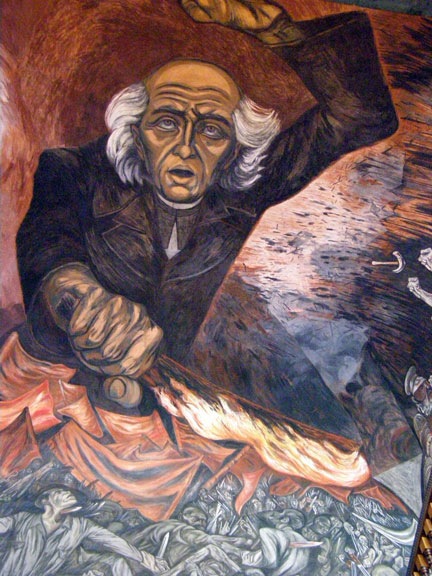
Happy Mexican Bicentennial of Independence

200 years ago today, September 16, 1810, Dolores Hildago began the revolution that led to Mexican Independence.

Jose Clemente Orozco's Dolores Hidalgo

New Adolfo Bioy Casares Book Apearing in Spain

For the Adolfo Bioy Casares completists Spain’s Páginas de Espuma is publishing a book of photos and a diary he kept during a 1960 trip to Brazil. I don’t know what the photos are like, but you can read the publisher’s press release.

La mirada de un viajero, Adolfo Bioy Casares en Brasil
El 6 de septiembre se realizará su lanzamiento mundial y se inagurará en Madrid una exposición que recoge las fotografías del libro

Madrid.- El próximo 6 de septiembre se realizará el lanzamiento mundial del libro Unos días en el Brasil (Diario de viaje), del escritor argentino Adolfo Bioy Casares, y con posfacio del editor y traductor Michel Lafon. El libro será publicado simultáneamente desde Argentina y España por las editoriales La Compañía y Páginas de Espuma, que suman de este modo un título más a su labor en común. Fruto de esta colaboración, en septiembre títulos como Lady Susan, de Jane Austen, o Nabokov y su Lolita, de Nina Berberova estarán disponibles en las libreráis españolas, mientras en las argentinas lo estarán El último minuto, de Andrés Neuman o Tres por cinco, de Luisa Valenzuela.

Las páginas prácticamente inéditas de Unos días en el Brasil (Diario de viaje) recogen el diario de un viaje en 1960, motivado por la invitación que Bioy Casares recibe de la organización del congreso del PEN Club en Brasil. Unos días en el Brasil recorre aquellos días de 1960 que Bioy estuvo entre las ciudades de Río de Janeiro, São Paulo y una incipiente Brasilia, de la que se celebra su 50º Aniversario como capital de Brasil. Testimonio de uno de los autores claves de la literatura en castellano del siglo XX, este diario se completa con una serie de fotos inéditas de este viaje. Coincidiendo con el lanzamiento, se celebrará una exposición titulada Basilia 1960. Fotografías inéditas de Adolfo Bioy Casares en la Galería Guayasamín de Casa de América en Madrid del lunes 6 de septiembre al domingo 19. La construcción de la ciudad comenzó en 1956, siendo Ludo Costa el principal urbanista y Oscar Niemeyer el principal arquitecto. En 1960, se convirtió oficialmente en la capital de Brasil. Junto con Putrajaya (la capital administrativa de Malasia) y Naypydaw (la nueva capital de Birmania) es una de las ciudades capitales de más reciente construcción en el mundo. El 8 de septiembre a las 20 horas será la presentación del libro en Casa de América. El acto contará con la presencia de Eduardo Berti, Juan Casamayor y muy especialmente del editor, traductor y ensayista francés Michel Lafon, que esos días concederá entrevistas. Según palabras recogidas en su posfacio, el diario tiene un cometido íntimo y personal del autor “para seguir transformando cualquier día de su vida en un viaje y una aventura, cualquier lugar del mundo en una isla encantada, donde todo se vuelve posible, e incluso deseable”. Lafon mantiene que Bioy ” no sabe por qué aceptó la invitación, no tiene nada que decirles a los otros invitados, rechaza las amistades obligadas y los ejercicios impuestos, odia la retórica vacía, no quiere hablar en público”. Aun así, Lafon acaba preguntándose: “Viajar para escribir, escribir para olvidarse de que uno está viajando, y para recordarlo después. ¿Y si Bioy fuera el mayor diarista del continente?”.

Ricardo Piglia, Almudena Grandes, Mario Vargas Llosa and Others on Their New Books

El Pais has an article about the new books that are coming out from Spanish language authors this fall. Among works by Ricardo Piglia, Almudena Grandes, Mario Vargas Llosa there will also be a book by Adolfo Bioy Casares that compiles his photos from a trip to Brazil in 1960. Mostly the article is authors talkinga bout their works, but interesting none the less.

1. ¿Por qué ha elegido ese tema o argumento para el nuevo libro?

2. ¿Cuándo y cómo fue el momento de inspiración para escribir sobre eso?

Ricardo Piglia

Blanco nocturno (Anagrama)

1. En el origen estuvo la figura de Luca y la leyenda familiar; pensé la novela centrada en un héroe enfrentado al destino y trabajé una trama con muchos personajes secundarios y varios conflictos. Traté de buscar un registro digamos épico. ¿Cómo sería hoy escribir una historia épica? Ese fue para mí el desafío del libro.

2. Imaginé la historia hace mucho tiempo, antes de publicar Prisión perpetua. Escribí una primera versión y la dejé, luego la retomé y la reescribí y la volví a dejar… Me gusta -aunque no lo recomiendo- ese modo de escribir porque las historias cambian, como si -al decantarse- encontraran su propia inspiración.

Almudena Grandes

Inés y la alegría (Tusquets)

1 y 2. No estoy muy segura de haber escogido el tema de Inés y la alegría. Más bien, la invasión de Arán me escogió a mí. Cuando leí que un ejército de cuatro mil hombres había invadido el valle en otoño de 1944, y que lo había ocupado durante nueve días a la espera de un apoyo aliado que nunca llegó, me costó trabajo aceptar que semejante episodio permaneciera en el olvido. Averigüé algo más sobre el origen y las características de aquella aventura, y descubrí a un personaje irresistible, Jesús Monzón, moviendo los hilos de una trama más fascinante que cualquiera que yo hubiera podido inventar.

Short Stories From Ines Mendoza, Ronaldo Menendez, Javier Saez de Ibarra (Spanish Only)

A few more short stories from Spanish authors (in Spanish only) . Javier Saez de Ibarra won the first International Prize for Short Stories Ribera del Duero in March of 2009.

Debutantes, Javier Saez de Ibarra

Mohr, la que huye de la luz, Ines Mendoza

Paralelamente, Ronaldo Menendez