Amazon Moves into Spain And A Conversation of the State of eBooks in Spain

TechFlash reports that Amazon has opened an online presence in Spain with and fitting Spain’s multi-language society, Spaniards can buy books in Spanish, Catalan, Galician and Basque. Books are not discounted (it is illegal), but DVDs, software and appliances are. No Kindle yet, though.

And from you can watch (I would recommend just listening to it) the 30 minute conversation. It is interesting especially since Javier Celaya the Spanish expert suggests the Kindle won’t be as big a player. It will be more the tablets. There are some sad statistics about home many people read books in Spain: 50% say no, and another large portion buy 3 to 4 a year.

Los Tigres Albinos (The Albino Tigrers) By Hipolito G Navarro – A Brief Review

Los Tigres Albinos (2001) is the second of the three books of short stories collected in Los Últimos Percances and is further evidence shown in El AburrimientoLester (1996), the first book of the collection, of Navarro’s masterful command of the short story medium. His stories are always inventive, seeking to stretch the short story form. I’m not sure if I could pick a favorite out of the collection, since there are so many interesting stories. He can be quite funny too and many of his stories turn on the humors desperation of solitary characters. I don’t want to say too much more since I’m writing a review article for a different site, but it is a shame he’s not available in English.

Patricio Pron Interview on Canal-L – Spanish Only

Canal-l recently interviewed Patricio Pron. It is one of their drier interviews but, interesting to some degree.

New Short Story Collections from Juan Carlos Márquez, Óscar Esquivias, Daniel Gascón Reviewed in El Pais

El Pais has a review of some new short story collections which sound interesting. I have read a story by Juan Carlos Márquez, which is mentioned in the article and it is funny and well written (I have a link in this post to the story). The Daniel Garzónsounds interesting as he writes about 30 somethings who are college educated with jobs that are precarious or outside their field of study, an all too common problem in Spain and other countries.

Narrativa. Al reseñar Pequeñas resistencias, 5 (Antología del nuevo cuento español, 2001-2010), uno de los nombres que destaqué fue el de Juan Carlos Márquez (Bilbao, 1967), por su habilidad para conjugar microscopia cotidiana y surrealidad, valiéndose de un lenguaje tan incisivo y preciso como brillante en el empleo de imágenes reveladoras. Este rasgo esencial (verdadero nudo gordiano de su narrativa), “cierto desplazamiento de qué hacia el yo”, como lo denomina el autor, sustenta prácticamente todos los relatos del último libro de Juan Carlos Márquez, Llenad la tierra, que trata de lo que sucede a partir del día en que un padre aparece en el umbral de casa “con el corazón en un puño”, de la (espeluznante) vida de un hombre solitario que vive cerca de los contenedores de un hospital cuyos restos y desechos lo alimentan, del odio histórico que revierte sobre el guardameta de la selección alemana de fútbol, de los delirios de un padre ante los hipotéticos peligros que amenazan a su hijo, de un viejo mercenario que mata para sobrevivir y cuenta cómo actúa “llegado el momento”, o de los subterfugios de vida que ocultan las barras de los bares. En otros relatos, breves y a modo de sketches o escenas dialogadas, la presencia de lo absurdo en una situación anodina opera como revulsivo (hilarante): la anciana madre que recita a Neruda, la pareja ante la tarta de aniversario, el imposible “orden integral” en la cola de un supermercado o la “mecánica popular”: espléndido ejercicio mezcla de equívocos, nonsense e ignorancia.

New Lucía Puenzo Novel Reviewed in el Pais Shortest Review Ever

El Pais has a review, or perhaps a description is a better word for it, of Lucía Puenzo’s latest book. You can see the complete review below. What perhaps the most interesting is the statement that it is her 4th book but the first to be published in Spain, which only goes further illustrate the phenomena in Spanish language publishing where authors don’t make it out of their home country.

Narrativa. “El que pierde tumba al rey”, le dice Razzani, un exitoso empresario, a su hijo de 11 años. Es el último partido de ajedrez entre ambos y el primero que el niño puede llegar a ganar. Prófugo de la justicia y de otros poderes menos conspicuos, Razzani está llegando al final de la imposible carrera por mantener el control de sus múltiples negocios tras perder lo más apreciado en ese mundo: el anonimato. Sin embargo, el protagonista de La furia de la langosta, cuarta novela de la escritora argentina Lucía Puenzo (1976) y primera publicada en España, no es Razzani sino su hijo, Tino, un niño que madura a golpes cuando otros le revelan a él -y a todos- la vida secreta de su padre. “A Tino se le cruza por la cabeza una idea insoportable: que todas las acusaciones contra Razzani son ciertas (y otra aún peor: que aunque todo sea cierto, no dejará de quererlo)”. Más de algo excesivo hay en esa familia donde los abogados, los guardaespaldas y las criadas son tan parte de ella como los hermanos de Tino y su madre, una familia que prolifera casi tanto como las propiedades que Razzani acumula en la vasta geografía de su país. Aunque el retrato de la corrupción en la sociedad argentina es acerado e inmisericorde, el corazón de la novela está en otra parte, está en ese niño que crece y aprende de la manera más dura a leer el mundo desde la pérdida de la inocencia.

72 Migrantes Artists and Writers Remember the Murdered 72 – Includes Work from Volpi and Poniatowska

72 Migrantes is a site dedicated to the memory of the 72 immigrants murdered in the desert in northern Mexico. Each of the 72 are remembered by a photographer and writer.The photos can be disturbing, but show the realities of the dangerous journey not only crossing the American border, but moving through Mexico from Central America. I’m not familiar with all the writers, but both Jorge Volpi and Elena Poniatowska have contributed pieces. Poniatowska has long been a journalist and advocate against violence. It is a very interesting site. The only thing is the way you find a particular writer’s work is by cycling through the all the stories. A little annoying.

From the piece by Poniatowska

Quién sabe cuanto faltará pero otros han cruzado a Estados Unidos y han encontrado trabajo y hasta mandan traer a su familia. No soy el único en atravesar, soy el 57 de 72, pero no caminamos juntos los 72, llamaríamos demasiado la atención. Caminamos a buen paso, cada quién con su pensamiento, caminamos de sol a sol, caminamos sin detenernos casi, otros lo han hecho. Seguro, ya pasó lo más duro. Tamaulipas suena a flor, a tulipán, a buena sombra. A pesar de los huizaches se puede caminar, claro que cuesta trabajo llegar pero se llega. A los demás no los conozco y se me hace más fácil platicar con las mujeres, sobre todo en la noche, cuando andamos con un pocillito caliente en la mano e intercambiamos unas cuantas palabras. No muchas, las indispensables. Son como catorce las mujeres pero apenas si levantan los ojos. Guardan todas sus fuerzas para el camino. Son anónimas. Toda la vida, conviene ser anónimo. Mejor no tener nombre, allá me lo voy a hacer, allá lejos de El Salvador y Honduras, lejos de Ecuador y de Brasil, lejos de la favela y la inundación, de las aguas negras y del techo caído, lejos de la intemperie y las armas de fuego, los rifles, las carabinas, los cartuchos y los cargadores, lejos de la policía y de los cárteles. […]

From the piece by Volpi

soy nadie mi nombre es nadie mi nombre no yace sepultado junto a mi cuerpo mi única pertenencia lo única único que tenía robado arrancado por la fuerza vuelto jirones como mi piel como mis vísceras sepultado aquí en este lugar que tampoco tiene nombre o no lo tiene para mí o nunca lo tuvo llegar aquí desde tan lejos a este lugar sin nombre para terminar sin nombre sepultado en esta tierra idéntica a toda la tierra a la tierra que dejé atrás a la tierra que perseguía a la tierra prometida caminar en mi vida sólo supe caminar nunca hice otra cosa andar desde niño con las botijas de agua al cuello andar con los adobes con los terneros con los pollos caminar por el lodo hacia el riachuelo caminar del riachuelo hacia la casa caminar cuatro kilómetros a la escuela caminar cuatro kilómetros de la escuela a la casa caminar las jornadas a la milpa caminar la milpa de arriba abajo con las semillas en la mano sobre la tierra sin agua esa tierra tan parecida a esta tierra sin nombre donde me hallo sepultado a esta tierra donde me fue arrancado el nombre como quien arranca una muela caminar siempre supe caminar nadie camina como yo caminar de la niñez a la juventud de la juventud a la madurez con eso basta caminar bajo la sequía y la tormenta[…]

Michael Hart Founder of Project Gutenberg – RIP

Michael Hart the founder of Project Gutenberg has died. He in many ways is the enventor of the e-book, which for good or bad, has become a definining media of our time. But his interest was in giving free access to e-books and Project Gutenberg is pretty cool, if a bit uneven. I’ve read a few books via  Project Gutenberg, most recently a book on Posters from World War I. It is one of those noble, ideas that seemed to come from the early days of computing. If you’ve never been to Project Gutenberg you should check it out.

From Geekwire

Tacoma native and electronic book pioneer Michael S. Hart has died at the age of 64. Before Kindle, Nook or iPad entered the lexicon, Hart was tinkering with electronic books.

In 1971 at the University of Illinois at Urbana-Champaign, Hart created Project Gutenberg with the goal of making electronic copies of books available to the public. It became his life’s work.

After starting with the Declaration of Independence, Hart spent spent the bulk of his career working on ways to make electronic versions of books accessible to people. Today, there are more than 36,000 free eBooks available through Project Gutenberg, allowing customers titles to the PC, Kindle, Android or iOS devices.

New Words Without Borders – From the Spainish Works from Slavko Zupcic, Guadalupe Nettel, Eduardo Halfon

Words Without Borders released its September 2011 edition which includes three short stories from Spanish Language writers and a review of Sergio Chejfec’s newest book, among other things. I wasn’t familiar with any of the writers included in this edition. Slavko Zupcic is from Venezuela and wrote what I thought was the strongest story of the bunch about a man who steals books only to have the author die a day latter. The Mexican author Guadalupe Nettel’s story was OK, about the breakup of a relationship via gardening. It had its moments until he decided he was a cactus, which should have been funny but became tedious. I skimmed Eduardo Halfon’s story before giving up quickly. I don’t like stories about writers and writer’s conferences. Maybe I should have given it more time, but I have no patience for that.

New Quarterly Conversation Issue 25 Featuring Translation of Juan Francisco Ferré

A new Quarterly Conversation  is out and this one features a translation from Providence (2009). I don’t know the author, and honestly the description makes doubt I’ll like it (to much sci-fi), but it is worth a look. Also of noteis a translation of Belgian Fabulist Yves Wellens, a defense of reading Antonio Lobo Antunes, reviews of The Seamstress and the Wind by César Aira, From the Observatory by Julio Cortázar amongst many others.
From the introduction:

Providence (2009) is Juan Francisco Ferré’s most ambitious novel, his longest and more complex fictional work to date. Written during one of his stays at Brown University, Providence, as much as Ferré’s previous books, is a deeply erotic, abrasively satirical, gargantuan fiction dealing with both contemporary American culture and Spanish literary tradition. But rather than focusing on cultural differences, Ferré investigates the common literary roots of the new global culture, producing a true “transatlantic” fiction—in some sense. Providence could be considered as much a Spanish novel about America as an American novel written in Spanish.

Providence is a haunting glimpse into a labyrinth of imaginary spaces assembled together by, among many other things, the spell of H.P. Lovecraft, the remembrance of Alain Resnais homonymous film, a personal interpretation of Spielberg’s Jaws, and the sexual drive and misguided efforts of the Spanish independent filmmaker Álex Franco. After being lured by a mysterious female producer, Franco travels to Rhode Island with the purpose of writing a script about “Providence.” However, like in a wicked Cronenberg-inspired bio-game, “Providence” starts mutating to become something quite different from what he expected. Forced to confront a new set of otherworldly relationships he can no longer dismiss, Álex will find himself trapped in a surreal multiverse of fictional/mythical “Providences” made up by Lovecraftian secret societies evolving from steampunk into cyberpunk; from The Age of Mechanical Reproduction to the Age of Digital Simulation. The adventures of Álex Franco constitute a metaphor of the ongoing transition from reproduction technologies that render external sophisticated representations (Pro videns) to embodied simulation technologies “happening” through our flesh (Providenz).

Sergio Ramírez Wins the José Donoso Prinze

Nicaraguan writer (and ex-vice president) Sergio Ramírez won the José Donoso Prinze, reports El Pais.

El escritor nicaragüense Sergio Ramírez ha ganado el Premio de Letras José Donoso, establecido para reconocer el trabajo, originalidad y calidad en la trayectoria literaria de un autor iberoamericano. El galardón fue instituido el año 2001 por la Universidad de Talca (Chile) en memoria del destacado escritor José Donoso, vinculado por sus raíces familiares y culturales a la Región del Maule. Esta institución ha dado a conocer el fallo mediante su perfil en la red social de Internet, Twitter.

He has an interesting life story for a writer. I have no idea what his writing is like. Has any one read him?

New Directions Publishing Evelio Rosero, Good Offices – Novel Excerpt Link

New Directions is publishing the Colombian writer  Evelio Rosero’s novel Good Offices. Honestly, I don’t know much about him, or the book, but with a 13 page excerpt you can at least get a basic idea of what the book is about. Read the excerpt here.

From New Directions write up:

Tancredo, a young hunchback, observes and participates in the rites at the Catholic church where he lives under the care of Father Almida. Also in residence are the sexton Celeste Machado, his goddaughter Sabina Cruz, and three widows known collectively as the Lilias, who do the cooking and cleaning and provide charity meals for the local poor and needy. One Thursday, Father Almida and the sexton must rush off to meet the parish’s principal benefactor, Don Justiniano. It will be the first time in forty years Father Almida has not said mass. Eventually they find a replacement: Father Matamoros, a drunkard with a beautiful voice whose sung mass is spellbinding to all. The Lilias prepare a sumptuous meal for Father Matamoros, who persuades them to drink with him. Over the course of the long night the women and Tancredo lose their inhibitions and confess their sins and stories to this strange priest, and in the process reveal lives crippled by hypocrisy.

Recent Additions to the Pile

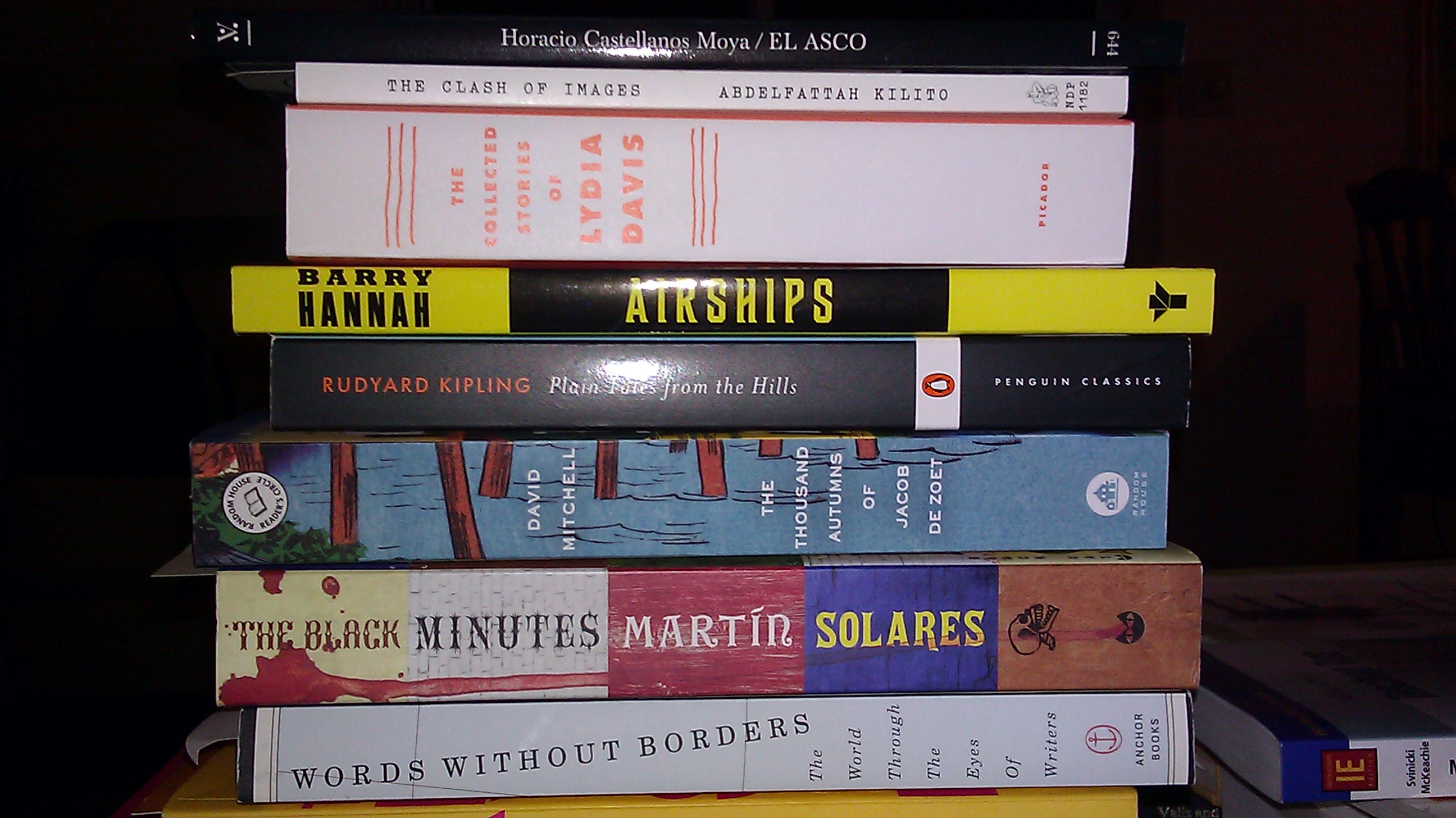
This summer it has been a little bit busy here around the fire light, for varying reasons. But never fear I have been stocking up for when the nights are longer, taking advantage of a trip through Portland tip buy a few books at Powells, a sale at my local indie Elliot Bay Book Co, and my first Associate Reward from Amazon. Below you can see the fruits of my labors.

Ana María Shua – New Book of Short Short Stories Profiled in El Pais

El Pais has a profile of the Argentine short story writer Ana María Shua and her book of micro relatos (short, short stories). I don’t know much about her, but she is published by Paginas de espuma, a press dedicated to short stories which has published some very good books in the past (I’ve read 3) so she sounds interesting. You can read a few of the stories here. (pdf)

Un simple truco con el que Shua golpea al lector en un máximo de 25 líneas. Sin tiempo para la descripción del personaje -poco se sabe de la suerte de ese espectador devorado- ni para el punto y aparte, pero con la compañía del espacio en blanco que rodea a cada texto: “Un hecho físico que corresponde al tiempo que cada microrrelato necesita para asentarse y ser cabalmente comprendido”. Una vez se ha cruzado el umbral del circo, el espectáculo no se desarrolla de una vez. Después de los malabaristas y antes de los tragafuegos es necesaria la pausa. “Se trata de darle a cada texto el tiempo que necesita y merece, no por ser cortito hay que pasarlo rápido”, avisa la autora.

Este ejercicio sobre la cuerda floja da aún más vértigo cuando al mirar hacia abajo aparece una trayectoria de más de mil microrrelatos, muchos de los cuales se publicaron hace dos años en un volumen único, Cazadores de Letras. La escritora comenzó a parcelar su mente en micro y macro a mediados de los setenta. Desde entonces ha desarrollado la habilidad de sentarse a escribir cada mañana con “la brevedad incorporada, nunca me ha resultado trabajoso sintetizar”, asegura.

Miguel Ángel Muñoz, Andrés Barba, Elvira Navarro Writing About Summer in Letras Libres

Letras Libres has a series of reflections on summer by several authors I am familiar with, including Miguel Ángel Muñoz, Andrés Barba, and Elvira Navarro, the last two part of the Granta youngsters edition. Miguel Ángel Muñoz is a short story writer and owner of the blog, El síndrome Chejov (you can see my review of one of his books here). Each piece is a specie of reflections on youth in the summer.

From the Muñoz

¿No ocurrió todo durante el verano? Entendí muy pronto que “verano” no significaba viaje o vacaciones. Nadie me lo explicó, pero fue fácil saberlo. Durante aquellos meses, los hábitos se rompían para los mayores y solo para ellos. Los niños nos abanicábamos con los descubrimientos de la brillante rutina. En cada gesto, en las conversaciones, en las visitas que hacíamos o recibíamos, en cada minuto de cada día del verano daba la hora un reloj parado, con los mecanismos sumergidos en gozo. Pero no nos mientas, porque algo así ocurría siempre. En realidad, en cada minuto de cada día del año la infancia se desarrollaba ante un telón continuamente descorrido. Con ustedes, la vida, aunque no la conozcan y se presente sin avisar.

Y, sin embargo, recuerdas el verano como un resumen o una máquina que condensara en figuras de plastilina lo que ocurrió entonces. Si es verdad que en los meandros neuronales del cerebro perviven intactos aquellos recuerdos que ya han desaparecido, a la espera del invento que los ponga de nuevo ante nosotros a voluntad, quizás algún día explote otra vez aquella felicidad que hoy recuperas a retazos.

From the Navarro

Mi padre tenía una agencia de viajes. Lo que acabo de decir es inexacto; sin embargo, de pequeña creía que la sucursal de Cemo en Valencia pertenecía a mi padre, puesto que era el único que trabajaba en un despacho y daba órdenes fulgurantes, y además entre las ideas que por aquel entonces tenía yo de los quehaceres de un jefe estaban las conversaciones interminables con clientes, unos ojos entrecerrados que enfocaban un punto imposible de alguna orografía recóndita, el cigarro manchando el esmalte dental y mis idas y venidas por el suelo resbaloso, que se aceleraban cuando la vacilación y las palabras arrastradas se volvían fugaces: tenía que darme prisa para pedir el dinero de la merienda. Acechaba la siguiente llamada. Por otra parte, me digo ahora, un padre no puede sino ser jefe, y las frases generan obligaciones que hay que respetar. Si, por ejemplo, yo hubiera empezado esta narración con: “Mi padre era el gerente de la sucursal de Viajes Cemo en Valencia”, algo fundamental en la génesis del texto se habría roto, y me resultaría imposible escribir una sola palabra sobre mis vacaciones y los viajes. La expresión inexacta es la semilla, y también la llave, del ritmo con el que el magma incierto al que doy el nombre de “recuerdos” se ordena en oraciones.

Aunque solo era el gerente, Miguel Navarro se encargaba de los itinerarios de los viajes del Imserso, y se hacía acompañar, cómo no, de su oficio en las presentaciones,

Horacio Castellanos Moya – An Interview and a Review of Tyrant Memory

The magazine Revista N has a brief interview with Horacio Castellanos Moya about what inspires his writing and how in some ways he is asking a similar question that Vargas Llosa asked about Peru: when did El Salvador become fucked? The article goes on to wonder how that has influenced his newest novel and how it might try to de-fuck El Salvador.

Parafraseando a Vargas Llosa, ¿cuándo cree que “se jodió” El Salvador? ¿Hay algún otro territorio posible para sus novelas? El Salvador siempre estuvo jodido. En estas últimas dos décadas, ha hecho esfuerzos por “des-joderse”, pero la situación sigue siendo muy precaria. Ciertamente El Salvador ha sido el núcleo territorial de mis novelas, aunque se expandan hacia el centro de México, por el norte, y hacia Costa Rica, hacia el sur. Ocurren en lo que algunos antropólogos llaman Mesoamérica. No sé si saldré de ese territorio. Hasta ahora me he movido a mis anchas ahí.

¿Por qué en “La sirvienta y el luchador” la tragedia aparece tan encarnada entre el bien y el mal? La novela sucede en un momento de extrema polarización social y política. A las condiciones extremas de afuera, corresponden estados extremos internos, emociones y pensamientos extremos dentro del ser humano. Pero los personajes tienen sus gradaciones.

For the English speakers, the NY Times has a good review of Tyrant Memory, his newest book to appear in English.Having read it in Spanish when it first came out, I can concur with the review.

In his latest book to be translated into English, “Tyrant Memory,” Castellanos Moya strikes a different note. Written in three parts, it is based on real events: the 1944 military coup against El Salvador’s Nazi-­loving dictator general, Maximiliano Hernández Martínez, which failed to oust him but was followed by a general strike that did. The book begins with the diary of a housewife, Haydée, whose husband, Pericles, is in prison for criticizing the government. Its plainspoken chattiness alternates with the more farcical and outlandish narrative of what happens to her eldest son, Clemen, and his cousin Jimmy as they seek to flee the country (both played a role in the coup). A brief coda, set decades later, is contemplative, even melancholic in spirit. While all parts are not equal — it is Haydée’s story we are most eager to hear — “Tyrant Memory” remains Castellanos Moya’s most ambitious novel to date.

If most of Castellanos Moya’s novels register a kind of ideological exhaustion, “Tyrant Memory” traces the slide toward disenchantment. Clemen, a capricious, womanizing newscaster, is a classic Castellanos Moya antihero — slightly ridiculous, self-­obsessed, propelled by romantic notions — but it is the naïve and warmhearted Haydée who sets the tone. Castellanos Moya’s sharp urban ironies give way to the rhythms of life in a provincial Latin American capital. It is a town as García Márquez might have imagined it were he to visit coups and counter-­coups instead of endless rains and butterfly swarms upon its citizens.

A Short Story From Hipólito G. Navarro – Jamon En Escabeche

Just in time for you Labor Day is a short story from Hipólito G. Navarro that I ran across on the blog El Laberinto de Noé. Jamon En Escabeche is from his 2000 book Los tigres albinos. It is a brief story so even if your Spanish isn’t that strong you may want to give it a try. He is one of the best short story writers in Spain today I would recommend his work if you can read Spanish (little of it exists in English).

Edith Grossman on the Problems of Translation in the English Language Market

Publishing Perspectives has a profile of Edith Grossman discussing the problems of publish translations in the English speaking world. She lays it out quite accurately and you might say depressingly. I find it amazing any time I open a Spanish language literary magazine, book review, or go into a bookstore in Spain and see the mounds of translations, often of books I can’t believe they would be interested in. It is very timely article for me as I’m about to start a review essay on Spanish short story writers who are unpublished in English (if translations get little respect, translations of short stories get even less).

In her book, Grossman mentions the well-known fact that only three percent of the books published in the United States, Great Britain and Australia are translations, while in Europe and Latin America this percentage number fluctuates between 25% and 40%. “We English-speakers are not interested in translations,” says Grossman. (An interviewer infected with translators’ jargon would have commented that Grossman said this “with a sigh”, or “shaking her head.“) “I don’t believe that this will change soon, since almost all publishers are part of large corporations and make their decisions under enormous pressure to be profitable.”

I mention then that a few small and medium US publishers have recently published translations of books by César Aria, Alejandro Zambra and Juan José Saer. “I love these publishers, and they have good people working there,” she says. “But they are too small, they have a lot of trouble getting adequate distribution and good publicity or reviews in the media.”

In spite of everything, in the English-language world new translations of classical works sometimes get the same attention given to new novels. Grossman’s Quixote was a major event in the world of letters, just like Lydia Davis’s new translation of Madame Bovary was last year. A few months ago, Julian Barnes wrote a long review of Davis’s version, comparing it with half a dozen earlier translations. In Barnes’ view, translations in the last few decades have become more accurate but also more cumbersome and less fluid. Barnes said that new translators, wanting to reflect in more detail the author’s original intention, had forgotten how to write well in their own language.

The ever interesting Three Percent has thoughts from a small press publisher which puts her comments in greater context.

Well, OK. I was going to complain here about how difficult it is getting books into bookstores where the buyers won’t even take a call because “that sort of stuff doesn’t sell here on Manhattan’s Upper East Side.” (Or in Nebraska, the Mountain & Plains states, or wherever.) And I was going to point out that Juan Jose Saer’s Sixty-Five Years of Washington sold out its first print run and was reviewed in the New York Times and The Nation among other places. But whatever. She’s right.1 Even at our best, the lousiest piece from crap from Corporate Publisher X will get more penetration into the marketplace, which is the slow sick sucking part of the business, and I’m not sure it will ever really change.

Obviously, Internet retailers have leveled the field a bit—all of our books are just as available through Amazon as anyone else’s—but in that case, when a reader is faced with an overwhelming number of choices (approx. 3 million new ones each year, including tons and tons of $.99 entertainments), it’s tricky for an unknown author from Peru to make it through. Ideally, when everything’s available, people would try new things and find some niche tastes, but in reality, we search for what we already know we want to find, and bust the Bieber while reading Twilight. But that’s a subject for another post and/or book . . .


Spanish Publishing Going Digital – At Publishing Perspectives

Publishing Perspectives has an interesting article on the state of digital publishing in the Spanish language world. The article notes that up until now the publishers have been using a form delaying tactics, but now are beginning to embrace the changes. I had no idea that Barnes and Nobrl had a library of 40,000 titles in Spanish (of course, I would need a Nook). But I hope these developments will make it a little easier to get hold of some of the titles at a more reasonable price. Since I don’t have an e-reader, though, it may be cheaper just to buy the paper books. I hope the smaller publishers, too get in on this. I would love to have more access to some of the smaller ones. I also wonder if this will help with the phenomenon where Spanish language writers aren’t published outside their home country (see my comments on it here). It shall be an interesting few years.

Following an initial phase, known in the sector as the Libranda Era, which attempted to slow down changes in the sector by maintaining the current ecosystem in the book world, many book professionals in Spain believe that we will be entering a much more dynamic second phase, one I’ll dub the Internationalization Era. This new era is characterized by increasing interest by the main international players  — Amazon, Google, Apple, Barnes & Noble, TheCopia.com, Kobo, Yudu, among other — to enhance their platforms with content in Spanish from Spain and Latin America.

Spanish is the third most spoken language in the world after English and Chinese, and the revenue potential from a market made of 500 million Spanish speakers will not be overlooked. As we all know, the Internet has no frontiers and, therefore, once the English content market consolidates, the main international players will enrich their catalogs with content from other potential markets, especially the Spanish one. Barnes & Noble has already initiated this race towards globalization by aggregating more than 40,000 Spanish titles from various Spanish and Latin American publishers and offering them for sale online — an approach that will soon be imitated by the rest of the international players.

The upcoming academic year (2011-2012) will see the gradual arrival of each of the aforementioned players in the Spanish markets, which will undoubtedly accelerate the digital race. Spanish publishers, booksellers and librarians will have their hand forced and will henceforth need to make strategic decisions in reaction to the arrival of these international competitors.

Carlos Fuentes’ Latest Book – The History of the Latin American Novel – and His Top Ten of the 20th Century

Carlos Fuentes has published a new book on the history of the Latin American novel (La gran novela latinoamericana). It is composed of lectures, reviews and essays that trace the history of the Latina American novel to the present day. Fuentes is usually interesting when it comes to literary history, although I’m not sure if he is completely up on new writers as his list seems a little mid century focused. Nevertheless, it is a good starting point for thinking about the Latin American novel.

El Pais has an article form Fuentes outlining his vision of the best writers of the Latin American novel (outline is the correct word, too, because it is very name centric). And he has a list of his top ten of the 20th century and the 21st century. Considering that we still have 90 years left of this century, I’m not going to put much stock in that list, but here is his list for the last century. Bonus points if you can name the glaring omission.

  • El Aleph-Jorge Luis Borges
  • Los pasos perdidos-Alejo Carpentier
  • Rayuela-Julio Cortázar
  • Cien años de soledad-Gabriel García Márquez
  • Paradiso-José Lezama Lima
  • La vida breve-Juan Carlos Onetti
  • Noticias del imperio-Fernando del Paso
  • Yo el supremo-Augusto Roa Bastos
  • Pedro Páramo-Juan Rulfo
  • Conversación en La Catedral-Mario Vargas Llosa
  • Santa Evita-Tomás Eloy Martínez

Finally, El Pais also has a review of the book, which notes that it is a little uneven, but has moments of real interest.

Este volumen tiene algo de recapitulación y de regreso a viejas lecturas centrales del autor y también de los múltiples seguidores de literatura en español. Quizá incluso algún afortunado lector reconozca en lo que es una imprecisa primera parte (hasta la página 300, más o menos) los materiales de algún curso universitario, aunque no se indica en el texto: da igual, porque en todo caso el tono y el formato tiende a ser el de un curso de novela latinoamericana escrito con la fluidez, la amenidad y la ausencia de los habituales enredos gremiales y verbales.

La segunda parte está más cerca de la reunión de reseñas y artículos breves sobre la narrativa más reciente -es decir, en torno a los últimos cuarenta años- y pierde también algo de la personalidad lectora que exhibe Fuentes en la primera, cuando se concentra en una sola novela o un solo autor por extenso, con originalidad, con incursiones frecuentes y jugosas en su autobiografía civil y cede incluso a la confidencia lujosa: su determinación de no conocer a Borges personalmente para preservar “la sensación prístina de leerlo como escritor”, la felicidad de conocer a un desarmante Juan Carlos Onetti o las múltiples alusiones a Alfonso Reyes que aparecen en el texto (aunque algún último lector del manuscrito en la editorial debió advertir las repeticiones de anécdotas y hasta frases divertidas, como la de Philip Roth).

The Singapore Grip by JG Farrell – A Review

The Singapore Grip
J.G. Farrell
New York Review Books Classics, 568pg

The Singapore Grip is the third book of J.G. Farrell’s Empire Trilogy, a series of books though unrelated in terms of characters, charts the rise and fall of the British Empire during the 19th and 20th centuries. The previous books, The Troubles, and the Siege of Kaishpoor, were about Ireland and the uprisings, and British India, respectively. In each, he mixes history with fiction to dive deeper into the Empire, the thoughts of the leaders, people, occasionally the subjects, and doses it with historical research that while not obsessive, can read as history more than fiction.

The action of The Singapore Grip begins in Singapore of the 1930’s and concludes as the Japanese enter the city in February 1942. The novel revolves around the Walter Blackett a rubber baron who is the epitome of the British imperialist, smug about the great civilizing mission of Britain, certain the subject peoples appreciate the British, and too greedy to see any harm in exporting all the profits to Britain. His sole goal is to increase rubber profits and make sure the company he has built continues on. To that end he spends most of the book trying to marry his daughter, Joan, off to the Mathew the son of his late partner. Mathew, though, is an idealist who used to work at the League of Nations promoting peace. He doesn’t know much about his father’s business and Walter tries to lead him into an appreciation of the importance of the rubber trade, but seeing how Singapore is run, and especially spending time with Monty, Walter’s son who is the ultimate imperialist playboy, he turns against the colonial enterprise.

These economic concerns fall to the background after the Japanese begin their invasion—well, for almost everyone, because Walter continues to scheme to increase the price of rubber which the allies need, and at one point even tries to figure out a way to work with the Japanese after the occupation starts. All the other characters, though, turn to war work and goes into great detail about the Japanese offensive, following the battle from both the Japanese and British side. Those who are not solders help in other ways, and Mathew joins the firefighting brigade. Some of Farrell’s best writing follows the fire brigades. While Mathew fights fires he also falls in love with Vera a half Chinese, half Russian woman who his father in the great tradition of British eccentrics used to pay to do naked exercises on his estate.

Farrell uses these elements well to create a society in which the colonials live in imperious privilege, unaware or uninterested in what is happening around them. He is an inventive story teller whose novelistic touches are impressive. His account of the Japanese attack is rich with detail and full of action. The account of the Great World, a pleasure center in Singapore, is quite impressive, with its dingy and smokey atmosphere, the multi-racial mix of clients, and the dark undertones of such mixing in what was a divided city. And in one of his best bits, he shows the history of British occupation in South East Asia through a series of paintings that Walter is all too proud to show first time guests to his mansion. It is these moments that make the book breathe and give life to his large cast of characters.

Yet, even with all those elements,  The Singapore Grip can seem a little uneven, as if Farrell’s interest were taking him in too many directions. The first problem is the novel starts with long internal monologues on the problems of the rubber trade. While it does help characterize Walter, business intrigues and strategies seldom make for fascinating reading at length. His use of the previously mentioned paintings was a much more interesting way to get the history and characterization across. The same applies to Mathew who spends the early part of the novel talking politics and theory. Fortunately, Farrell is a good novelist and often leaves Mathew talking to himself amongst a group of disinterested people, but it still a little tiresome to have the conversations go on for pages. His desire to delve deeply into history leads him to spend many chapters examining General Percival’s thoughts and actions. While interesting, those sections break up those of his characters. The same is true for the Japanese solder he follows for 40 pages during the attack. If this were a pastiche novel, mixing fragments from here and there, it wouldn’t seem so odd. It is a shame, then, that he lets characters he builds up so carefully stay in the background for long sections. But this makes sense when the book is about the Empire.

In the end Singapore, like the British colonial enterprise,  is doomed and all the characters are dispersed to the winds to survive, if they are lucky, the war. Naturally, as be fitting a wealthy man, Walter escapes into the night as the empire collapses, leaving the rest to their fate and him to enjoy his wealth. It is a fitting end for a novel of a lost empire.