A Short Tale of Shame by Angel Igov – A Review

A Short Tale of Shame
Angel Igov
Open Letter, 2013 pg 145

Angel Igov is a young Bulgarian writer and is a recent winner of the Contemporary Bulgarian Writers Contest. A Short Tale of Shame follows four characters as they drive from Bulgaria to the Aegean Sea in a journey that explores the damage that a friend and daughter, Elena, has done to them all. Each character, Boris a former rock star, and three hitchhiking friends, Maya, Sirma, and Spartacus, alternates in narrating their journey and the past as each of their lives slowly intersect. The journey is unexpected: Boris starts out one day in his car with no particular goal. He is alone, unattached to anything, just a man, a car, and his credit cards. He is not even sure why he is driving. He sees three young people on the side of the road and decides to pick them up. They turn out to be friends with his daughter Elena which gives them instant rapport with Boris. They are going to the Aegean Sea and he decides to take them. Spartacus recognizes him as a former rock star and peppers him with questions for much of the journey in a charming bit of hero worship. As the journey continues they all remember Elena.

It should be said at this point that Elena is a disturbing young woman, more interested in being wild and leading her friends into problems. And her father is the least of her worries. At the same time, Elena has an outsized presence with in the novel that seems to animate the characters, but whose power is ultimately undeveloped. While we are viewing Elena through the eyes of four different witnesses and there is a limit to what we can know about her, the narrators don’t explain well enough what it is about here that is so problematic. So when we read of Boris’s listlessness now that his wife has died, and that he feels somewhat responsible, the effects on Elena are tenuous, not quite there. With the three youngsters, who have formed a love triangle for protection from her memory, it is more clear who wild she was, but even less clear the emotional damage she caused. There is something there but not fully realized.

They all make it to the sea and there is a moment of release for them all. For Boris, the youngsters have become a form of surrogate Elena. For the youngsters, the trip has released them from their defenses, as if life by the sea is open, unimpinged by friendships. Yet as they found themselves on some Greek Island I couldn’t help but thinking, what about Elena? Perhaps they have no more idea than we do, but she seemed to hang in the background. The sea may cleanse as Igov suggests, but it doesn’t forget and the resolution of their journey seemed only a pause, or the beginning. Maybe beginnings are enough, but it was not a satisfying conclusion.

Igov’s writing, translated by Angela Rodel, was enjoyable and portends to a bright future and made the book if not wholly satisfying, interesting. I leave you with a sentence that caught my eye and gives one a sense of his style.

And yell at your kids, Krustev (Boris) added, I’, sure it would be more fun if I could swim, but in any case I never learned, but back in the day going to the seaside and sitting on the beach for at least half a day, that was our idea of a vacation, I’m talking about when I was five or six, that was something new for my parents, I don’t know if they really even liked it or just went along with the trend, we’d rent an apartment on the seaside and go to the beach with our own umbrellas so we wouldn’t have to pay for them, that was an option back then, all this hysteria about hotels and private beaches hadn’t yet begun or was just beginning, I had fun, all kids surely have fun at the beach, and later, of course, whole crowds of us would go, huge groups with tents, guitars, girls and some more dubious things as well; we took Elena to the seaside ever since she was born, that’s how much sense we had, but be that as it may, I’ve got a fair amount of experience with camping, never mind that it was a while ago, true, back then we didn’t insist on having electricity and running water, at least not before Elena was born, so he’d seen her in the mirror, Sirma though, he had seen her smirk when he asked whether there was electricity and running water at the campground and she felt a little ashamed, maybe this person had actually had a much wilder youth than they had.
Interview with Andrés Neuman at Revista de Letras

There is a short but interesting review with Andrés Neuman, a favorite of this blog, that is worth a read over at Revista de Letras:

Su primera novela, Bariloche (1999), publicada cuando contaba 22 años, fue finalista del premio Herralde. Con El viajero del siglo (2009), obra que obtuvo, entre otros, el Premio Alfaguara y el Premio de la Crítica, le llega el reconocimiento definitivo. Escritor en toda la extensión del término, Andrés Neuman figura entre los autores más versátiles de las lenguas hispanas, con más de 20 títulos publicados, entre poesía, cuento, novela y ensayo. Conversamos con él sobre géneros y creación literaria.

Me gustaría empezar la entrevista hablando de géneros. Salta a la vista que pareces hallarte igualmente cómodo escribiendo poesía, ensayo, cuento o novela. Has practicado, también, el aforismo, género poco habitual en las letras hispanas. ¿Cuál crees que pueda ser el motivo de contar con tan pocos autores en éste género?
Más que cómodo, al saltar de un género a otro intento quizá sentirme voluntariamente incómodo. O sea, en estado de tensión lingüística. No comparto la idea de dominar el oficio literario, si entendemos por ello la adquisición progresiva de una experiencia mediante la cual escribir sería cada vez más fácil. A mí escribir me parece algo cada vez más raro. Me siento literalmente un principiante: alguien enamorado del principio de la escritura, cuando es una mezcla de incertidumbre, entusiasmo y miedo. En ese sentido el aforismo parece un terreno particularmente propicio, porque pasa de la nada a la idea, del vacío a la música en una sola línea. Tiene algo abismal. Y te enfrenta de manera inmediata con tus errores y tu puntería. Es cierto que la tradición del aforismo ha abundado en otras culturas, más proclives quizás a la unión de poesía y pensamiento y, en definitiva, históricamente más ligadas a la Ilustración

José María Merino Won the Premio Nacional de Narrativa with ‘El río del Edén’

José María Merino has won the Premio Nacional de Narrativa with ‘El río del Edén’. José María Merino is  a short story writer and novelist. Earlier this year I reviewed the collection La realidad quebradiza and on the whole was interesting. El Pais has some coverage of the victory:

El río del Edén (Alfaguara), de José María Merino, se ha alzado con el Premio Nacional de Narrativa, concedido por el Ministerio de Cultura, Educación y Deporte. “Es la novela más realista de las que he escrito hasta ahora y en ella tanto los personajes como el escenario en el que se desarrolla la trama cobran vital importancia. En el cuento — género en el que se ha prodigado— el sueño o el ensueño está muy paliado por la realidad”, explicó Merino (A Coruña, 1942), en una entrevista con este diario.

Read more at:

El novelista gallego obtiene el máximo galardón concedido a una obra por el Ministerio de Cultura

L’Amour by Marguerite Duras – A Review

L’Amour
Marguerite Duras
Open Letter, 2013 pg 109

Marguerite Duras’ L’Amour is a fascinating experiment in style and story telling. Functioning almost as a film script, the novel eschews typical approaches to narrative and distills the book into dialog and simple descriptions of action. The lean writing is fragmentary, as if the reader were the camera eye, making the reading disorienting, as the narrative starts, stops, repeats itself as the images are overlay-ed on themselves. The effect  is a powerfully transitory exploration of three lives rendered in as objectively physical terms as any piece of fiction can be.

The story follows a traveler who comes to the town S. Thala. It is not clear why he is there at first, he just roams at the edge of the scene. Then slowly he enters to talk with the woman who sits on the beach mysteriously. They interact in short fragmentary conversations that are illusive and return to a past that is never clear. Between the fragmentary conversations and the fleeting scenery, memory plays itself out as something elusive yet physical. As the traveler goes farther into the past that he has shared with the woman there is a clarity, not so much in the relationship, but in the impossibility of memory to create a well rounded explanation of events. Story fails.

The traveler, of course, is only moving through time, reconstructing what once had shape. He fails, though, to construct an overarching narrative. Or better said, he fails to construct one for the reader and, instead, finds himself reconstructing the little scenes of a story. Duras posits a cinematographic vision of memory, or grasps the only metaphor possible in the age of cinema. Again, it makes for disorienting reading, a disorientation that is pleasurable as the traveler moves from the beach where he first meets the woman, towards the hotel where the deeper anxieties of relationships once played themselves out. The shore is calm, soothing; the hotel is terrifying with hints of tragedy and fracturing love.  S. Thala is not a place where one wants to return.

The notion of a place of unwilling memories is evident, too, in Duras’ writing style.

It is the beginning of the afternoon. They pass by.

He, along the edge of the sea. She, on the boardwalk.

The traveler is on the boardwalk.

Shed does not see him. She does not see anything.

They walk toward the sea wall. Disappear behind it.

Perhaps they are preparing for the birth of the child, over there, behind the wall of the cry of S. Thala.

They come back that night. The seagulls screech. She walks bent slightly forward, almost heavily: its seems as if the birth of the child is imminent.

Doesn’t call them.

Everything is elusive. What is the relationship between the three people? Why the fragments of narration? The memories come but in uncertain pieces that cannot even place the birth of her child, which opens a new mystery. Who would no the woman so intimately, but not remember when the child was born. Even the construction of the sentences is fragmentary, built of simple sentences as if these memories have been suppressed, as if the rationalizations that come from long, introspective explanations have never taken place.

It is that elusiveness that enchants but also keeps the reader at a distance, always returning to the memories that resurface and collapse like the waves the characters spend so much time looking at. There is no closure for the traveler, as there should not be. Memory does not end, it is just reworked. So just as the traveler is left on the beach with his memories, so too is the reader left with uncertainty that can never quite be resolved. It makes for an effective and haunting way to end a novel of memory.

Clara Sánchez Wins the Planeta Prize

Clara Sánchez has won the Planeta Prize. I’m not familiar with her work at all, but it is a comedy. Here is the general outline of the book:

“Stendhal decía que somos detalles”, suele decir Sánchez (Guadalajara, 1955), que ha cargado siempre sus personajes de alta densidad psicológica y que en El cielo ha vuelto, la obra con la que ha obtenido los 601.000 euros del galardón, sigue indagando bajo esa premisa, aquí a partir de una modelo de pasarela de éxito que durante un viaje en avión es alertada por una vidente de que alguien desea matarla. Saberlo hará que se replantee toda su vida y vuelva a mirarlo todo con otros ojos, en un paradójico crecimiento personal. La idea le surgió cuando, hojeando una revista de moda en una peluquería, le “ pareció ver en la típica imagen de una modelo lánguida una mirada de espanto”. Y ahí arrancó la historia de una joven que “lo tiene todo, pero en la que se instala la duda y la desconfianza”. Una desconfianza, dice Sánchez, “que se ha generalizado en toda la sociedad, por lo que quería indagar si ella nos lleva a la crueldad o la lucidez”.

Eloy Tizón’s Técnicas de iluminación Reviewed in El Confidencial

Eloy Tizón has published a new book of short stories Técnicas de iluminación from Páginas de espuma. I thought Paparados was an excellent book and enjoyed it immensely. I’ve been looking forward to reading his new one ever since I heard it was coming out. The review makes it sound interesting.

Los mecanismos narrativos que Tizón propone para esta aventura son los habituales en su trabajo: la excelencia del idioma y ese tono medido, que jamás cae en el patetismo ni en la humorada, y que se asoma a la tragicomedia que es la vida con una feliz ausencia de retórica. En ese sentido, el primer relato del conjunto, el memorable Fotosíntesis, una (re)creación maravillosa y maravillada de Robert Walser y su universo deambulatorio, constituye la puerta de acceso idónea a un libro que confirma a Tizón como poseedor de una voz propia e innegociable, tan alejada de esa prosa de concurso que adorna a buena parte de los cuentistas españoles, y que lo reubica junto a los mejores cultivadores del género en nuestro país, caso de Cristina Fernández CubasLuis Magrinyà o Fernando Aramburu.

Escritor ajeno a la grafomanía, cuyo arco narrativo se ha venido moviendo con absoluta naturalidad entre la estampa veloz y la exigente y hermosa distancia de la nouvelle, Tizón regresa con Técnicas de iluminación al lugar que por derecho propio le pertenece, el de uno de los escritores más importantes de su generación, tanto por lo que cuenta como por el modo en que lo hace. Algo que, por sí solo, sería ya motivo de regocijo, pero que tras la lectura de este libro notable y sugestivo adquiere rango de noticia capital para nuestras letras.

Alice Munro Wins The Nobel Prize For Literature

This is great news for lovers of the short story, Alice Munro has won the Nobel prize for literature. I think it was deserved as much as anyone deserves it. I would hope this raises the profile of the short story for a while. You can read the NY Times announcement here.

Three Short Stories from Edmundo Paz Soldán at the Boston Review

The Boston Review has three short stories from Edmundo Paz Soldán. He is a Bolivian writer with a fairly long oeuvre of short stories and books. He first came to my attention last year when his short story collection Billy Ruth was published to glowing reviews in Spain. I haven’t ready any of his work but this is a great opportunity to read a writer who is well respected.

Dictator and Cards
In this one, anyway, the dictator Joaquin Iturbide owned a greeting card factory and held the monopoly on card sales in the country, and one day decided to declare June 26th Friendship Day, and the cards made for this day had such unexpected success with the public, creating such spectacular gains for the company, the dictator declared August 14th Jealousy Day, which was a success as well. Of its own volition, success bred success, and in less than five years every day of the year had been taken—there was Bitterness Day and Unfaithful Girlfriend Day and Great Grandparents Day, Loving Husbands Who Actually Hate Day and Onan Enthusiasts Day, the Day of Those Who Sleep with the Help, the Day of Readers of Marquis de Sade, and the Day of They Who Dream About Centaurs…

October Words Without Borders is out

The October Words Without Borders is out now featuring the work of women writers from Africa. It also has several poems by Neruda.

This month we present work by women writing in indigenous African languages. In these stories and poems translated from Gun, Hausa, Luganda, Runyankole-Rukiga, Tigrinya, and Wolof, writers depict characters struggling with poverty, isolation, the oppression of women, the devastation of war, and the long tradition of political corruption. Haregu Keleta’s teenage girl flees an arranged marriage to join the Eritrean People’s Liberation Front in the war against Ethiopia. In two tales from Uganda, Glaydah Namukasa explores three generations of a family ravaged by alcoholism, while Hilda Twongyeirwe’s disaffected bureaucrat finds his loyalty at odds with his ambition. In an excerpt from her sprawling novel, Nigeria’s Rahma Abdul Majid tracks the harsh lives of women in the remote villages. And Marame Gueye reveals the slyly subversive lyrics of traditional wedding songs in Senegal. In our special feature, Pablo Neruda’s biographer Adam Feinstein introduces five odes by the great poet, appearing in English for the first time in Ilan Stavans’s lovely translations.


Eudora Welty Interview in The Virginia Quarterly

The Virginia Quarterly has a long interview with Eudora Welty that was a series of conversations compiled by William Ferris. It goes over a lot of themes and is a genial interview (she seems to have liked everyone she met and they were all very nice). Nevertheless, there are some interesting parts. She does talk about writing some which was interesting, if the number of people who violate her ideas.

The ability to use dialogue, or the first person, is just as essential as the knowledge of place in a story. Dialogue has special importance because you use it in fiction to do subtle things and very many things at once—​like giving a notion of the speaker’s background, furthering the plot, giving a sense of the give-​and-​take between characters. Dialogue gives a character’s age, background, upbringing, everything, without the author’s having to explain it on the side. The character is doing it out of his own mouth. A character may be telling a lie, which he will show to the reader, but not to the person to whom he is talking, and perhaps not even realize himself. Sometimes he is deluded. All these things come out in dialogue. You get that, of course, by your ear, by listening to the rhythms and habits of everyday speech. I listen all the time. I love it. I do not do it because I have to, but because I like to.

I do not think you can transfer anything as it is spoken onto the page and have it come out at all convincingly. What comes out as a sound is not what the speaker thinks he said, or, really, what he did say. It has to be absolutely rewritten on the page from the way it happens. But if you did not know how it happened, you could not start. It is a matter of condensation and getting his whole character into speech. It is a shorthand. It is like action. It is a form of action in a story. People do not talk that way. You have got to make it seem that they talk that way. You are giving what seems to be reality, but it is really an artistic illusion. You have to know that, just the way you have to know other things in a story to make them seem believable. They are not duplicates of life, but a rendition of it—​more an impression, I guess.

Color is different from dialogue. One comes through the eye, and the other through the ear. Color is emotionally affecting to me, and I use it when I write. I may not use it exactly as I see it. I use it as I think it ought to be in my story to convey a certain emotion—​just as I would use a time of day or a season of the year. Color is part of that. It gives the sense of a real place and the time of it. Life does not happen in monochrome. It happens in color. So it belongs in the story.

Travesía americana: De San Francisco a Nueva York por Carretera (American Journey) by Manuel Moyano – A Review

Travesía americana: De San Francisco a Nueva York por Carretera
(American Journey: From San Francisco to New York by Highway)
Manuel Moyano
nausícaä, 2012, pg 118

Manuel Moyano is a Spanish novelist and short story writer who drove across the United States during the late summer of 2013 with his wife and two teenage children. It was the journey a non journalist makes moving from one American icon to the next, soaking in the best and worst of America, its fast food, its national parks, all the while looking for the America seen in so many films and TV shows. Moyano has not written a journalist’s account of modern America, nor has he engaged in some sort of stunt. He has simple kept a detailed record of a trip across the United States that on the face of it is quite average, but he is an honest commentator and what he describes is not just the common place experiences of driving through suburbs and strip malls, but what he expected—wanted—to see. Given his outsider status, too, he brings a fresh eyes to what an American might already think is common place.

They start out from San Fransisco and in the first few pages you have the general flow of the book. In one part they go to Fisherman’s and have a nice day there. Following that they go to rent a car where Moyano is disappointed to learn that the big cars he’s seen in so many movies, TV shows and other pieces of America’s cultural detritus that’s been spread around the world are no longer that popular and most cars driven in America are smaller. Curiously, he notes that the rental car agency was very pushy about tire insurance, something I’ve never heard of. This led the Moyanos to fear American roads, which, naturally, must be terrible if tire insurance is required. The fear of blowouts would return more than a few times and while a justified fear in the middle of the Rockies or the Great Plains seems a little funny. Also rather humorous was his instance on telling the rental agent he didn’t know how to drive an automatic (automatics are less common in Spain).

A constant source of amazement were the laws about alcohol. He couldn’t understand why a state park, Hurst Castle, would not sell beer. Nor did he understand why on the Hopi reservation he could not buy beer. His understanding of Native American history was a little lacking here and did not understand why in a place without alcohol, he could find a drunk on the streets at 11 am. It was one of his few misses when observing the US. He quickly noticed that in their trip through Arizona, Utah, Idaho and Wyoming they had not seen an African American until Rapid City, South Dakota.

When talking of patriotism he is probably the most aware. He spends several lines describing the patriotic aspects of a Wallmart in Idaho Falls. And in Washington DC he sees a collection of veterans from different wars and writes:

Por todas partes pululaban cientos de veteranos de la Segunda Guerra Mundial y de guerreras mas recientes. Habían acudido allí en grupo, algunos en compañía de sus familiares procedentes de estados como Iowa, Georgia o Illinois. La mayoría eran de edad muy avanzada, y muchos se desplazaban en sillas de ruedas. Tal vez necesitaran darse un baño de patriotismo para convencerse a si mismos de que merecía la pena haber matado y haber arriesgado la vida en nombre de su país.

There were hundreds of veterans from the Second World War and more recent wars wandering around everywhere. They had come in a group, some with family members, from states like Iowa, Georgia or Illinois. The majority of them were very old and many were in wheel chairs. Perhaps they needed to bathe in patriotism to convince themselves that it was worth while to kill and risk their lives in the name of their country.

(Emphasis mine) I believe what he stumbled on was an Honor Flight. Whoever was sponsoring it, it is strong stuff to stay in a country where the local Wallmart has pictures of all the soldiers from a given county. I’m not sure I agree that the soldiers needed a bath of patriotism, but I do think the civilians sponsoring it seem to. It also reflects an author who comes from a county where this kind of patriotism has had a very dark past.

On the charming side, though, is his literary pilgrimages. He goes in search of London, Hemingway, and other writers, but especially H.P. Lovecraft. He goes so far as knocking of the door of Lovecraft’s last home, which is in private hands. Much to his surprise the owner allows him to look around the house and talks to him for some time. It is the highlight of his journey into America to see part of his literary hero’s life.

Ultimately, Travesía is an interesting read. Occasionally, his descriptions of the towns he passes through feel perfunctory, more along the lines of a chamber of commerce description. Not that it isn’t interesting, but the book’s real fun is in the way he lives American culture. He has no fixer to put him with locals of interest. He travels like the rest of us, going from hotel to hotel, eating breakfasts of hotel carbs, and driving through strange cities looking for a place to say or a place to eat. Even in 2010 he could, I suppose, have had a smart phone to help navigate, but Moyano avoids that trap and is wonderfully at the mercy of what one finds. You will not find the dark underbelly of America here, just a journey through common place that is easy to miss.

Ginés Sánchez Won the Tusquets Prize

Ginés Sánchez Won the Tusquets Prize. This is one of the prizes the major publishers in Spain have every year. I’d kind of like to see the English language presses do this, but it probably would be a disaster.

“Hay una bacteria de esas desconocida que crece en la profundidad de unas cuevas y que hace una fotosíntesis extraña que acaba devolviendo ácido sulfúrico; mis personajes también hacen cierta fotosíntesis, lo extraen todo de la condición humana, la retuercen y acaba surgiendo una flor extraña; son como huracanes que lanzan sulfuro puro”. Esos personajes “retorcidos y que no he querido contener en su maldad”, que se cruzarán en una noche de cálido verano murciano, son Jacinto, un guardaespaldas mexicano, María, una quinceañera dispuesta a pasar la noche más loca que pueda y al precio que sea para romper amarres con la familia y, Ginés, en principio su misterioso y retraído vecino. Ellos protagonizan, con su diabólica personalidad, Los gatos pardos, apenas la segunda obra de Ginés Sánchez (Murcia, 1967), con la que esta mañana ha ganado en Barcelona el 9º premio Tusquets de novela, uniéndose a nombres como Élmer Mendoza y Fernando Aramburu y llevándose 20.000 euros.

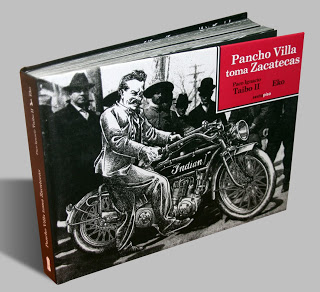
Pancho Villa toma Zacatecas (Pancho Villa Takes Zacatecas) by Paco Ignacio Taibo and Eko – A Review

Pancho Villa toma Zacatecas (Pancho Villa Takes Zacatecas)Pancho villa toma zacatecas 01
Paco Ignacio Taibo and Eko
Sexto Piso illustrado, 2013, pg 305

Paco Ignacio Taibo and Eko’s graphic novel Pancho Villa toma Zacatecas (Pancho Villa Takes Zacatecas) is a fictional retelling of Villa’s campaign against Zacatecas during the Mexican revolution. The Zacatecas campaign was the middle phase of the war when Villa, Zapata, and Carranza were all allied against Huerta and his federal forces. Zacatecas was the last big northern strong hold for the federal forces and its defeat would pave the way for the eventual invasion of Mexico City.

Paco Ignacio Taibo, the script writer, uses Colonel Montejo as his entry point into the story. It is he who narrates the events of the march to the city, the siege, and the eventual victory against the federal forces arrayed amongst the hills of Zacatecas. Montejo is a brave leader, wise, and intemperate. As stories go, there isn’t much to say. Villas forces take the city. The only real issue at hand is the brutality of the war. It is a brutality that has no room for missteps and plays heavily on personality. Montejo’s eventual fate only serves to show how brutal the war was, even amongst supposed allies.

The real focus of the book is the art. The jacket describes the  drawings as work inspired by German expressionism, the graphic socialism of the New Masses, the Mexican populism of the Taller de la Grafica popular, and the drawings of the calaveras. All of it is true. The two strongest influences seem that of the work of Franz Masereel and those of Mexican folk art most often associated with the work of Posada. Printed against black paper the drawings come to you as negative images that reveal everything as a shadow. Drawn with rough and strong lines the elements of the drawings seem to emerge out of a fantastical dark, where movement and being are quick and elemental. It is a style that emphasizes movement, and the momentum of war. It also turns each image into an iconic moment that is less about the precision of a picture and its complexity, but its bold presentation of an image. The iconic nature makes the book much more interesting and its story telling is as much in line with the works of Lynd Ward and Masereel.

My only criticism of the book, as is often the case with graphic novels, the actual story seemed a little light. For all the work that goes into such a book, there is always a feeling of let down when it comes to the briefness of what I’m reading, as if it can’t quite hold up to the drawings. Sometimes words are not enough.

What ever the case, it is a beautiful book that must be read.

Pancho villa toma zacatecas 04

Álvaro Mutis Has Died – Goodbye Maqroll

Álvaro Mutis died last week at the age of 90. Since I had a cold I didn’t have the interest in writing anything at the time. It has been years since I’ve read his Maqroll (pronounced Mac Roy, I believe) stories, but I still remember them quite well, which is not always the case with books I read. They were great adventure stories that had a literary quality to them whose telling I found fascinating. I would definitely recommend you read one if you haven’t yet. He was also a poet, but I’m not familiar with any of his poetry.

I, naturally, am not the only one who has the same thought. The excellent blog, El sindrome chejov has a collection of memorable phrase from his Maqroll books. My favorite of them is

El cuerpo acabó de caer con un ruido sordo mientras el zumbido del ventilador se abría paso por entre el silencio que organiza la muerte cuando quiere indicar su presencia entre los vivos.

The body had just fallen with a mute sound while the buzzing of the ventilator opened the way for the silence that death arranges when it wants to indicate its presence amongst the living.

A remembrance from  Dario Jaramillo at El Pais.

And an appreciation from Javier Wimer at La Jornada.

La novela de aventuras recrea un género que conoció sus mejores momentos durante el siglo XIX y que mantuvo un alto grado de popularidad hasta el triunfo del cine y de los cómics. Sólo que, en este caso, el relato no se agota en la pura descripción de los acontecimientos sino que esconde una reflexión continua sobre el destino del hombre.

Se apoya la narración en dos seguras vertientes simbólicas: el viaje como imagen del tránsito temporal y como imagen de la evolución interna del ser. Ambas son metáforas de legitimidad y de eficacia inobjetables, como lo prueba ese “Ulises salmón de los regresos” que puede ser indistintamente el héroe griego o el héroe de Joyce, quien hizo de su Dublín nuestro universo.

El mérito mayor de Mutis es haber encontrado la forma estilística apropiada para hacer funcionar un argumento que encubre otro argumento y para construir personajes que tienen el peso, la densidad y la textura de verdaderos seres humanos. Así ha creado un ciclo novelístico que evoluciona por cuenta propia y cuya siguiente entrega esperan con avidez sus lectores.

Este homenaje para Álvaro Mutis coincide con la plenitud de su oficio de hombre y de escritor. A sus espaldas deja, con provecho la infancia de un príncipe, las tentaciones bucólicas y las tentaciones urbanas, la inevitable travesía por el desierto, los titubeos y las encrucijadas vocacionales. Enfrente tiene años de trashumancia y de reposo, de imaginación creadora, de páginas y libros que exigen ser escritos, y que un día serán frutos redondos, perfectos y deslumbrantes sobre su mesa de trabajo.

60 Years of The Burning Plain by Juan Rulfo

El Pais reminded me that it has been 60 years since The Burning Plain (El llano en llamas) was published If you have not yet read Juan Rulfo’s collection of short stories (or his novel Pedro Parama) it is something you must do. All these years later I still love his work. Even in translation, which is how I first read him, it his work has great power from economy and stories that seem as dry and strange as the barren landscapes they describe. He, along with Fuentes, Yañez, and Azuelo, was my entry in to Spanish language authors and he has remained the one who has remained as intriguing as ever, someone who’s work you would like to return to over and over. For good and bad he only published those two books (there are some film scripts, too). I’ve always wanted more, which is the best way a writer should leave a reader. What I didn’t know, is that in 1970 he added two stories to the collection. I’d be curious which they were as the article didn’t mention them.

“Descubrí a Juan Rulfo en orden inverso. Llegué a él por Pedro Páramo y me dejó asombrada. Luego leí el llano en llamas, y fue como una prolongación del entusiasmo que había tenido con su novela”, dice Cristina Fernández Cubas.

“Con los cuentos logró una nueva representación del campo mexicano y la miseria en la que viven sus personajes. De manera emblemática, uno de los relatos lleva el título de ‘Nos han dado la tierra’. La herencia que reciben no es otra cosa que un montón de polvo. Los ultrajes y la violencia de estos relatos revelan una realidad devastada por la injusticia social. Lo peculiar es que Rulfo narra estas desgracias con hondo sentido poético. Sus cuentos están escritos en un doble registro: las acciones son vertiginosas y la vida mental de los personajes es demorada, de una reflexiva intensidad. Esto establece una peculiar tensión: lo que sucede es rápido y su efecto es lento. En estos cuentos, Rulfo renovó el lenguaje de México. Ningún campesino ha hablado como sus personajes pero ninguno ha sonado tan auténtico. Un milagro de la autenticidad que sólo puede ser literaria”, explica Juan Villoro.

The Three Percent Translation Database for 2013 is Up

I’ve always found the Three Percent Translation Database fascinating and a great resource for what is coming out in English for the year. Perusing the list is always an interesting and daunting thing to do. I was pleased to see a book from Marcos Giralt Torrente, a writer I’ve always been interested in reading. This year there are 49 Spanish fiction titles most from authors I don’t know, which is a good thing and there are even a few books I’ve already reviewed in these pages. Any way, it is worth a look.

Literary Map of the Pinochet Coup

On the 40th anniversary of the Chilean coup by Pinochet El Pais ran a literary history of it. It is a long article with plenty of names and worth a perusal.

Quien mejor abordó el horror que de inmediato se instaló en Chile tras el golpe es Roberto Bolaño en Estrella distante, a través de un personaje inolvidable, Carlos Wieder, infiltrado en un taller de poesía que cultiva una siniestra forma de arte a partir de la tortura y la desaparición de detenidos. Tiempo que ladra, de Ana María del Río, es una interesantísima novela de formación —que desgraciadamente no ha sido reeditada— estructurada por la relación entre la protagonista y su padre, que llega a ser ministro del Gobierno de Allende y sufre luego la brutalidad de la represión. De amor y de sombra, popular novela de Isabel Allende, establece un relato coral de los efectos de la dictadura tras los primeros años del golpe. No es gran literatura, pero tiene el mérito de narrar un momento histórico con un estilo cercano a muchos lectores.

En crónica, destaca Golpe, de los periodistas Margarita Serrano y Ascanio Cavallo, libro que reconstruye, con nuevos testimonios —la primera edición es de hace diez años—, “las 24 horas más dramáticas del siglo XX” en Chile. Cavallo es coautor también de otro libro crucial para entender la dictadura, La historia oculta del régimen militar, junto a Manuel Salazar y Óscar Sepúlveda. Una reciente publicación más académica, Ecos mundiales del régimen militar, editada por los cientistas políticos Patricio Navia y Alfredo Joignant, recoge textos aparecidos en la prensa extranjera y escritos por destacados historiadores como Eric Hobsbawm.

Las mil y una historias de Pericón de Cádiz (The Thousand and One Stories of Pericón de Cádiz)

Las mil y una historias de Pericón de Cádiz
(A Thousand and One Stories of Pericón de Cádiz)
José Luis Ortiz Nuevo
Barataria, 2008, pg 270

Pericón de Cádiz (1901-1980) was a flamenco singer from Cadiz. He was one of the better known singers of the era and although not considered one of the greats, is still well respected. He was known for his association with the family of Enrique el Mellizo one of critical artists at the end of the 19th century. Pericón was also known as a story teller and spinner of tall tales. In the early 70’s José Luis Ortiz Nuevo, a young flamenco oficinado (super fan who understands not only the music but the traditions is probably the best translation) recently discharged from the military, collected the oral history of Pericón and published the book in 1975. Although the book is divided up into five sections, they all take place in or around Cadiz and follow Pericón as he makes his life as a flamenco singer. What makes him funny and a teller of tall tales is he tells many stories about the strange people and events he has seen. Many seem impossible and have the flavor of some one pulling your leg.

The first part of the book, perhaps of the most interest to non flamenco fans, covers his youth, marriage at the age of 22 and his early career. What a reader is most likely to take away is the poverty in Cadiz. Leaving school at a young age because he didn’t like it, he became a kind of street tough around the age of ten. Eventually it turned out he could sing and he began going form cafe to cafe where flamencos would hang out and either perform or wait for men who wanted music for a juerga (an all night party that might last for a few days). This was the most interesting aspect of the book, showing what life was like for flamencos before the advent of the peñas (clubs that support flamenco) and the festival circuit that is common place now. It was a very haphazard way to make a living as a singer would have to wait for a patron, often having to move between cafes until something came up. Once they found someone who wanted to pay, though, they would earn a little money, eat and drink wine all night. Often they just got in a patron’s car and sang in the car. It must have been a hard life and no wonder man of the greats who made their lives from flamenco died early.

Despite his ability to earn money, he never had much money. During the civil war, in 1936, when Cadiz fell to the fascists, he enrolled his son in a young fascist organization, not for political reasons, but so he would be given food and clothing and at least his boy would have something to eat. In one of his funnier stories, he relates how after enrolling the boy in the group, the flange came to his door. It was a terrifying thing to have happen. He didn’t know what to do. He  wasn’t political. He had his wife open the door for him. When she comes back she has the little uniform for the fascist youth. The flange only wanted to drop it off. Eventually, he went to Madrid to sing in the tablos (restaurants with flamenco shows) and gained a bit more financial stability and fame.

After the historical portion, he describes the people of Cadiz and all their strange behaviors. More than a few stories take place during carnival, something Cadiz is well known for, and are indicative of the kind of humor and stories he likes to tell. In one he describes a man dressed as a magician who says he going to show every one the most famous element in the world. He stands in the street under his robes, makes a few gestures, then walks away. Where he was standing is his excrement. In another he describes María Bastón who walks around Cadiz calling strangers to her as if she is in need. They approach and she asks them for tram fair. After the person leaves, she does it to the next. In another, an oficianado would ask him every night after singing, to sing a few fandangos for his cat. Since the man had not paid he had no option. After doing this a few times he realized that when the dawn came if he said I’m ready to sing for the cat he could finish the evening earlier. In another he describes a man who would put turkeys in cages and heat the bottom and call them dancing turkeys. Naturally, the turkeys wouldn’t last long and every two weeks he had to get a new one.

Interspersed between this kind of slapstick comedy he has brief and fascinating descriptions of flamencos who never became famous but who were great performers. In one a construction worker who apparently was very good refused to sing at fiestas for for any one and would just get together with other construction workers and sing. In another he mentions Rosa La Papera who, again, didn’t like to sing for money and did not go to fiestas. Instead, one had to go to her house to listen to her. It is when he describes the music and what it was like to be a singer is he the most interesting. His description of Tomas Pavon, one of my favorites, was great and gave some insight into his rather slender recording output.

Las mil y una historias de Pericón de Cádiz is for two kinds of readers: the flamenco fan, which I am, or some one interested in the history of Cadiz and Andalusia. At times the humor wasn’t that funny. I don’t do slap stick so well and often I didn’t see the point of the joke. When he talks of the people he knew and the life he lived, though, the book really comes alive. Fortunately for English readers the book has also been translated by John Moore, a professor of Spanish and a flamenco oficianado. I haven’t ready it, but would be curious to see if he tried to emulate Pericón’s  Andalusian accent which lends a flavor to the book that is quite distinct.


The Quarterly Conversation – Issue 33 – Fall 2013 – Out Now

The Quarterly Conversation – Issue 33 – Fall 2013 is out now with an always interesting mix of articles. These are the ones that caught my eye:

A Library of Unlimited English Books

By Morten Høi Jensen

A groundbreaking new volume published by New Directions, Professor Borges: A Course on English Literature, offers unprecedented insight into the writer’s lifelong relationship to the English language, as well as an affecting portrait of the Argentine master as lecturer. These twenty-five classes on English literature were recorded by a small group of students in 1966 and later edited by two leading Borges scholars, Martín Arias and Martín Hadis. They have now finally been rendered into English by the incomparable Katherine Silver.


The Jáchym Topol Interview

Interview by Alex Zucker

But back to Belarus and how I wrote The Devil’s Workshop. So at about four in the morning, a taxi driver was taking me from my hotel to the airport in Minsk. Unfortunately he was pretty drunk, so as soon as we got out of the city he asked me to take over. I refused, since due to my psychopathic history I still don’t have a driver’s license. He didn’t understand, so we got into this huge argument, and by the time I finally convinced him to keep going—I said if he wouldn’t drive, we might as well just go lie down in a snow-filled ditch by the side of the road—I saw my plane lifting off into the clouds over the little airport out on the tundra.


From Three White Coffins by Antonio Ungar

Translated by Katherine Silver

One thing led to another, and that was just the beginning. I’m talking about the head resting in the plate of cannelloni. Heavy, still, and deaf, and attached to Pedro Akira’s compact body by a strong and manly neck. Oblivious to all the consequences this stillness began to unleash outside the Italian restaurant, in other heads and along other streets, more primary than secondary. Consequences transformed into actions that now, seen from here, from this requisite distance, seem like terrified ants running away from each other, ants fleeing from their own shadows. But that came later, five hours after the first memorable event of the day already briefly described—the breaking of the string on my double bass—which doesn’t seem worth mentioning but really is, and the reason shall soon be seen by those who are listening to this.


The Ingenious Gentleman and Poet Federico García Lorca Ascends to Hell by Carlos Rojas

Review by Scott Esposito

Most visions of the afterlife entail some kind of deliverance from the burdens imposed by memory—after all, what heaven could be more fitting than one where we transcend our Earthly failures? Spanish author Carlos Rojas ingeniously shows us the arch obverse of that in The Ingenious Gentleman and Poet Federico García Lorca Ascends to Hell: the inferno as an eternity with our regrets. Here, the titular poet is found in a hell that resembles an infinitely long spiral where each soul exists in a sort of solitary confinement with his or her own memories projected onto a personal stage, complete with rows of seats for the lonely spectator.


The No World Concerto by A.G. Porta

Review by Eric Lundgren

The No World Concerto, Spanish novelist A.G. Porta’s first novel to be translated into English, is a complex fictional riff on games, possible worlds, and the art of fiction itself. Porta is best known among English-language readers as an early collaborator with Roberto Bolaño, and, like Bolaño, he pays tribute to the innovations of the high modernists without exactly emulating them. The No World Concerto is structured as a Matryoshka doll, or as a hall of mirrors, fuguing seamlessly between authorial narration, third-person reportage, and inner monologue, a structure that becomes head-clutchingly complex when you consider that its two protagonists are writers with fictions in progress. The novel is set in Paris, but a Paris that resembles a half-constructed film set, referred to throughout as “the neighboring country’s capital,” with even the tactile pleasures of the place-names stripped away. Getting lost in this novel is a more dire possibility than the phrase usually implies.

Lucía Puenzo (Granta in Spanish under 40) Profiled in El Pais

Lucía Puenzo, one of the Granta in Spanish under 40, was profiled in El Pais last weekend. If you have read that edition of Granta you should take a look at this article. The writer points out that her story Cohiba in the Granta edition has nothing to do with her style of writing.  She’s much more interested in the fantastic and the unreal. The more I think about that Granta book the less I like it.

Nada de lo que conocemos de Puenzo se parece a Cohiba, una reveladora anomalía en su obra, el único de sus relatos protagonizado por alguien de su mismo sexo, edad y profesión. Puenzo suele tomar más distancia de lo que narra. Las novelas se alejan del realismo, alternan lo fantástico con lo caricaturesco y practican la misantropía de un modo más indirecto pero tal vez más contundente: sus protagonistas no son felices, no están adaptados, son transgresores que no se plantean dilemas éticos. La obra literaria de Puenzo está hecha de historias extremas y abigarradas que sugieren un destilado, un refinamiento del melodrama televisivo con sus personajes unidimensionales, tramas retorcidas y pasiones desbordantes. Puenzo hace un uso alto de un material bajo, en la corriente que en la literatura argentina se atribuye a Manuel Puig y su escritura opera como una máquina de narrar alimentada con guiones televisivos que se transforman en literatura.

Todo lo que ha hecho Lucía Puenzo tiene que ver de algún modo con el abuso infantil, con chicos a merced de la locura, la lujuria y la vileza de los adultos; pero si hay una ley en su narrativa es que los chicos abusados sobreviven y nunca se entregan del todo.