Libro de mal amor by Fernando Iwasaki – Reviewed at La Jornada

La Jornada has a review of the Mexican republication of the Libro de mal amor by Fernando Iwasaki. The book was originally published in Spain, where Iwasaki lives, in 2001. Iwasaki can be quite funny and I have read one of his more recent books, España, aparte de mi, estes premios. This book sounds funny and interesting.

Fernando Iwasaki (Lima, 1961) es un autor que no goza de la fama que merece. Tal vez porque siempre ha escrito lo que le ha venido en gana sin afán de satisfacer a los lectores. Él mismo nos dice que “no cree en la escritura como texto de representación, sino como texto de presentación”.

[…]

Primero: cada una de las diez veces Fernando se enamoró de la mujer más bella del mundo. ¿Hay forma de que no sea así? Enamoradizo a más no poder, el personaje y narrador siempre supo entregarse por completo. Para ello requería ser seducido por una mujer que valiera la pena. Cada una de ellas lo valía por completo. ¿Se puede amar de otra forma? Parece ser que no.

[…]

La lista continúa. Pero la suma de las virtudes de este libro sólo sirve para evidenciar algo: reírse de uno mismo sirve para hacer literatura, para desmitificar el amor y para, en una de ésas, lograr presentarlo como sólo las palabras lo pueden hacer.

Recent Acquisitions – More Spanish Short Stories and a Little History for Good Measure

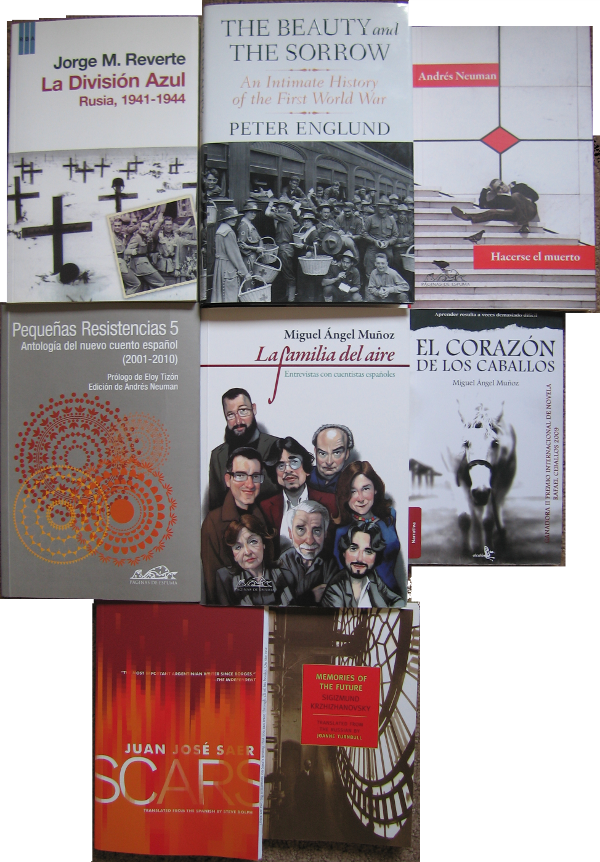
Christmas always means books to me and this year, between what I bought myself and a few gifts, my to read stack grew nicely. I continue with my reading, or should I say study, of the Spanish short story. And since I like history but don’t read it enough I picked up a few interesting titles. I can’t wait to read start reading them.

I forgot one:

Literary Resolutions 2012

For the last few years running I’ve been making a few small literary resolutions. This years are much like last years, read things I already own and get some fiction published. Simple right? Well if I look back on how well I did from last year, the first item wasn’t too bad. The main problem with the first is I keep adding to the items that I own, but that just shows my enthusiasm (my next post will be evidence of that phenomenon). The second, though, did not happen at all. I wrote, but sending things to publish is such a bore and eats time I could be writing or reading or doing something much more interesting. I guess that is just the way it is.

Last year I believe I said I wanted to read more in Spanish. I think I fulfilled that requirement. And for the year that comes I don’t think I’ll have a problem with that since quite a bit of what I bought this year was in Spanish, so if I’m reading what I own, in theory, I’ll be reading in Spanish.

Any one else have literary resolutions?

The Best Fiction From Spain According to El Mundo and El Pais

Last week I mentioned the El Pais best of 2011 list with its unsurprising selection of Javier Marias’ newest book, Los enamoramientos. You can see their list here and read about why they picked the book here. El Mundo, one of El Pais’ competitors has an all Spanish list which you can see here.  Their number one was Yo confieso by Jaume Cabré, a novel that mixes moments from the middle ages to now as a the narrator with Alzheimer remembers in fragments the various scenes that beak and interweave with each other. Of course,  Javier Marias is 3rd on the list and Issac Rosa’s La mano invisible is number 8. The Rosa’s book looked interesting. I saw him on El publico lee earlier this year and the way he wrote the book and its structural elements sounded interesting, along with the story. Their write up is below.

En una vieja nave industrial,un albañil levanta un muro para demolerlo y comenzar de nuevo; una teleoperadora persigue a posibles clientes, un mecánico demonta un motor para montarlo de nuevo, desmontarlo, y volver a empezar, mientras una costurera trabaja sin descanso con metros y metros de tela… Lo que todos y cada uno de ellos soñaban que sería su vida laboral hace tiempo que se ha diluido en el fracaso, la derrota y la frustración. O el miedo al innombrable paro. Implacable, Isaac Rosa (Sevilla, 1974), retrata en esta ambiciosa novela nuestro mundo actual. Sin compasión.

Daniel Sada Appreciation from Fransisco Goldman

Franisco Goldman has a nice Appreciation of Daniel Sada in the Pairs Review. It is an insightful piece and I think Almost Never is going to be the big book of next year.

http://www.theparisreview.org/blog/2011/12/19/daniel-sada/#.Tu9eCLHG0hU.twitter

Bolaño compared Sada’s baroque writing style to Lezama Lima’s, by way of making the point that because the Cuban Lezama’s baroque reflected the crowded natural effulgence of the tropics, Sada’s baroque is a more impressive verbal invention, a baroque of the desert. It, too, came only from “the efficacy of words.” In Porque parece mentira la verdad nunca se sabe (Because it seems like a lie the truth is never known), Sada’s huge, dense masterpiece (a novel routinely referred to as Joycean, with 650 pages and 90 characters, narrated almost entirely in alexandrine, hendecasyllabic, and isosyllabic verse-prose), the desert and its sparsely populated towns teem with all the political turbulence, corruption, and violence of modern Mexico. Sada is to Juan Rulfo—author of only one, hundred-page novel, the Mexican desert ghost-town masterpiece Pedro Páramo, voted by readers of Spain’s most important newspaper, El País, as the greatest Spanish-language novel of the twentieth century—what Beckett was to Joyce, only inverted. Beckett’s minimalism was his response to Joyce unsurpassable maximalism. Sada’s maximalism was his response to Rulfo’s unsurpassable minimalism.

Los enamoramientos from Javier Marías its El Pais’ Best Book of the Year

El Pais has announced their best if 2011. Javier Marias latest book is their best of the year. You can see the whole list here. http://blogs.elpais.com/papeles-perdidos/2011/12/los-enamoramientos-de-marias-mejor-libro-de-2011.html

Javier Marías desvela en este vídeo parte del proceso de creación de su novela Los enamoramientos (Alfaguara), elegida, por Babelia, como el mejor libro de 2011. La elección es el resultado de una encuesta con 57 críticos y colaboradores de la revista cultural de EL PAÍS. La edición anual y especial de Babelia con los mejores libros del año y los cinco más destacados en ocho géneros y categorías saldrá mañana, y no el sábado como es habitual, debido a las fiestas navideñas. Tras Los enamoramientos, las obras más votadas son (cada una tiene un enlace a una entrevista o crítica publicada este año en Babelia

The Return of the Mexican Revolution – El jefe máximo by Ignacio Solares – Reviewed in La Jornada

It has been years since I’ve read the many of the founding works of fiction about the Mexican Revolution. Still on my list is La sombra del caudillo, de Martín Luis Guzmán, but otherwise I’ve read and loved these fictional explorations of the Revolution through the stories of the big boss. Now Ignacio Solares has a book about about the assassination of Alvero Obregón through the end of the Cristeros war. It sounds interesting, although, perhaps already covered somewhere.

Podemos distinguir dos momentos fundamentales en la novela de la Revolución mexicana: un principio mítico donde podemos encontrar las obras de los participantes y testigos. En esta primera etapa destacan Los de abajo, de Mariano Azuela; Vámonos con Pancho Villa, los cuentos de Nellie Campobello y, entre muchas de sus obras, La sombra del caudillo, de Martín Luis Guzmán. La segunda etapa, siguiendo al gran especialista francés Georges Dumézil en su libro Del mito a la novela, se abandona el mosaico del mito, con sus caudillos, asesinos y titanes, y se construye una etapa novelística cuyo imaginario aún hoy sigue vigente. A este repertorio pertenecen obras como Al filo del agua, de Agustín Yáñez; Pedro Páramo, de Juan Rulfo; La muerte de Artemio Cruz, de Carlos Fuentes, para sólo mencionar unas cuantas y, por supuesto, la novela que hoy comentamos: El jefe máximo, de Ignacio Solares, quien ya nos había entregado una obra maestra anterior. Me refiero a Madero el otro, novela fundamental sobre el iniciador de la Revolución mexicana.

Como afirma Rafael Tovar y de Teresa, El jefe máximo comienza justo donde termina La sombra del Caudillo, de Martín Luis Guzmán, el período que hoy conocemos como el maximato, que abarca desde la muerte de Obregón y la entronización de Plutarco Elías Calles, la guerra cristera y el nacimiento del pnr, la matriz de la que surgiría el Partido Revolucionario Institucional, una de las maquinarias políticas más eficaces de dominación que gobernó al país durante setenta años, la dictadura más larga de la era moderna, superando al Partido Comunista de la Unión Soviética, a la dictadura de Franco y a muchos otros gobiernos totalitarios. 

Christmas Stories from Letras Libres – Featuring Najat El Hachmi, Patricio Pron and others

Letras Libres has a collection of stories about Christmas. A few of the authors I am familiar with such as Patricio Pron and Najat El Hachmi. I liked the Najat El Hachmi (I haven’t finished the rest). It was about a young Muslim girl experiencing her first Christmas in Spain.

Navidad entre escépticos
Por Guadalupe Nettel

Plantas aéreas
Por Pilar Adón

Algo de nosotros no quiere ser salvado
Por Patricio Pron

Navidades musulmanas
Por Najat El Hachmi

Ventanas
Por Emiliano Monge

Navidades en rojo
Por Yoani Sánchez

Intercambios
Por Juan Pablo Villalobos

Najat El Hachmi‘s story.

Sabiendo la respuesta, consulté con el imán. ¿Podemos celebrar la Navidad? No, por supuesto que no, eso es haram. A menos que te conviertas, claro. ¿Pero puedo cantar los villancicos en la clase de música? Tampoco, fíjate en lo que dicen las letras, que ha nacido Jesús hijo de una virgen y de Dios. Nuestro Isa no era más que otro profeta de la larga lista de profetas que el Misericordioso nos mandó para conocer sus deseos. Nadie puede ser hijo de Dios porque Dios no es humano, no tiene hijos. Pero hay villancicos que no hablan de Jesús. ¿Puedo por lo menos unirme al resto de la clase cuando la canción no tenga nada que ver con eso? ¿Como por ejemplo la parte del fum, fum, fum? ¿O la canción del trineo? Esa no habla para nada de ninguna virgen. No, niña, todo eso forma parte de “su” celebración. Nosotros no formamos parte de eso y no vamos a formar nunca. A mí por un lado me dio rabia que entre tantos marroquíes que casi no entendían ni catalán ni castellano ese precisamente tuviera conocimientos tan detallados sobre el tema, y por otro empezó a parecerme algo absurdo que por sutilezas tan insignificantes como si Jesús era hijo o no de Dios yo tuviera que cantar los villancicos por dentro. Porque una cosa sí era cierta: no podía evitarlo, por muy culpable que me sintiera, por horrible que me pareciera, escuchar las primeras notas de cualquier estrofa navideña era empezar a entonarla sin más. La música en general me provocaba un placer íntimo y alegre, pero sobre todo en los villancicos encontraba una belleza sin igual. Algunos me parecían tristes, otros alegres, pero todos pegadizos. Mi mortificación llegó al punto máximo cuando, en clase de música, para no llamar la atención y al mismo tiempo no dejar de mantener mis principios, movía los labios pero sin voz, disimulando entre el resto de niños. Y cuanto más contenía la voz, más ganas tenía de alzarla por encima de todas las demás, expandir el pecho y dejar que saliera con toda la fuerza. Pero nunca pasó.

Death and the American Dream by Daniel Cano – A Review of an LA Novel

Death and the American Dream
Daniel Cano
Bilingual Press, 2009, pg 232

Death and the American Dream is a novel of politics, intrigue and race set in the Los Angles of 1915-1922. It tells the story of Pepe Ríos, an Mexican revolutionary who flees to LA to avoid the war and prosecution for the murder of a rail road official in Texas. He gets a job as a reporter with a Spanish language paper in LA and begins to learn his trade under the crusty editor Ángeal Durón, a 40 something pipe smoking hard bitten journalist who knows the whole city and is cynical enough to know who not to touch. Pepe grows as a reporter, slowly learning that those he works for as well as those who claim to be helping the Mexican workers are only interested in working with rich white people to enrich themselves. Despite the past that should have made him go into hiding, he’s a committed radical who questions the constant police abuse of Mexican laborers. As the novel unfolds his sense of fair play leads Durón to invite him to work with the Mexican Liberal Party (MLP) headed by the Magon brothers. Pepe isn’t sure at first if he wants to help, because his real interest is in finding out if his friend Seferino was murdered when the police arrested him the year before he started working for the paper. As the novel Pepe’s involvement with the MLP grows, Pepe grows closer to the Magon brothers, Durón and other supporters, such as radical unions, and Clarence Darrow. As the revolution the Magon brothers fought to achieve falls apart and they are arrested, it becomes increasingly clear that the Mexican government, California politicians and businessmen, and the wealthy Mexican Americans are only too happy to exploit Mexican immigrants. They use the power of the police to crush any resistance and even when the immigrants can organize, it is only a temporary victory. It is a world where they are subjected to racism, bad working conditions, and arbitrary forced evictions as LA grows. Ultimately, Pepe, who strangely is able to avoid prosecution, is taken in by the police and beaten. He is grilled until he tells what he knows. During the beating, though, he finally given the answer to the mystery of Seferino. As the novel closes he continues on with his muck racking journalism, refusing to write for the larger La Opinion and sticking with the smaller presses, his life of intrigue over, his commitment to the rights of the dispossessed as strong as ever.

As a novel of LA  Death and the American Dream has a certain charm. Cano is fairly effective in describing the WWI era LA, an LA that looks nothing like the one that took shape in the 30s and 40s and which set the template for modern LA. In his LA, Santa Monica is still a little town with unpaved streets and near by farms. It is an enchanting thought to imagine LA as it was once as a kind of Eden. Cano, too, likes to use that as a reference point to a larger one: LA was different 100 years before when it was part of Mexico and the land that is so easily divided up once belonged to others. It is from this interest he writes of the intermingling of international politics, muck racking journalism, and radical politics. He is obviously fascinated by the histories that converge in the city, especially the ones that have been hidden or lost. For many, the great rise of LA in literature comes in the 30s with noir and the golden age of Hollywood. Death and the American Dream is an extension of that literature.

As a novel, though, Death and the American Dream leaves a few things to be desired. Historical fiction is always tricky because it often seems to subordinate characters to events and personalities. Here Cano isn’t egregious but there is quite a bit of historical back ground given and it tends to weigh down the story. Perhaps if the book was a bit longer it wouldn’t have been a problem, but at 232 pages Death and the American Dream is a short book. That brevity effects the characters, especially Pepe, who doesn’t feel really present. It’s as if he were just floating along and things happen. There is not enough volition from him: events happen and then Pepe happens. It’s too bad because he has the sketch for an epic story filled with family life and the forgotten histories of that LA. Instead, the story seems to wander between politics and family life without a strong enough narrative thread. Finally, the writing is solid, what I would like any student of English to be able to do. However, it isn’t a powerful language and the use of journal entries as a story telling device particularly bugged me (in general I don’t think they are a good strategy).

Death and the American Dream is a valiant attempt at the LA novel. For someone obsessed with that literature it might be worth a read.

Quarterly Conversation #26 Out Now

Quarterly Conversation #26 is out now and always it has some fine things in it. Just about everything was interesting so hopefully these will wet your appetite:

(from Conversational Reading)


The Moving Tide of Abundance: Petersburg by Andrei Bely

The Moving Tide of Abundance: Petersburg by Andrei Bely

By Malcolm Forbes

It is Petersburg for which Andrei Bely is best remembered. It appeared in English in 1959 and has stayed in print ever since. This Penguin reissue features David McDuff’s masterful 1995 translation and a new introduction by Adam Thirlwell. Both offer loving praise for their subject, praise which has been slow in coming in Bely’s native land. Considered decadent by the Soviets, the novel first appeared with major cuts and was later banned for being incommensurate to the idealised standards of Socialist Realism. Bely suffered at the hands of the critics, too; the Russian Formalists, though grudgingly commending his inventiveness, essentially deemed the Symbolists en masse irrelevant to the study and advancement of literature. Bely was only properly rehabilitated in the ‘80s and is now rightly lauded as one of the last century’s great literary talents.


Mapping Michel Houellebecq: A Retrospective

Mapping Michel Houellebecq: A Retrospective

By Michelle Bailat-Jones

Controversial authors are more interesting when the source of their controversy does not simply rest on the outer surfaces of their art but lies within its very structure. The French author Michel Houellebecq is not controversial because of what he writes or says—dozens of writers have said many of the same things about women, people of other cultures and religions, and contemporary society. Houellebecq creates debate because it is difficult to settle upon an ultimate interpretation of his work. Looking over his five novels in succession reveals a real movement toward resolving this metafictional ambiguity and goes far to explain the near unequivocal critical praise he is now receiving for The Map and the Territory.


In Translation

From Fiona and Ferdinand by Josef Haslinger

From Fiona and Ferdinand by Josef Haslinger

Translated by Eugene Sampson

On the day of Bachmaier’s funeral there were two messages from my mother waiting for me on the answering machine. In the first one she asked me to call her back, in the second she said that the village was in an uproar: I was to come at once. Calls from my mother were rare.


Reviews

The Iliad translated by Stephen Mitchell

The Iliad translated by Stephen Mitchell

Review by Steve Donoghue
Poet and translator Stephen Mitchell, whose reconstructed Gilgamesh and elegantly translated Tao de Ching routinely out-sell all competing versions, and whose Duino Elegies did about as much to bring Rilke into the general awareness of the non-German populace as it’s possible to do, has now given readers a 21st century English-language translation of Homer’s Iliad, in a solid and aesthetically pleasing new hardcover from Free Press.


Joseph Brodsky: A Literary Life by Lev Loseff

Joseph Brodsky: A Literary Life by Lev Loseff

Review by Cynthia L. Haven

A martyr is not necessarily a saint, in any case, and those who knew him didn’t turn to him for saintliness. He was spellbinding, an electrical jolt for the psyche. An encounter with him, as a colleague or as a mentor, could be life-changing and endlessly rewarding. Warts and all, the real man carries far more interest than the photoshopped one Loseff gives us. The portrait that emerges on these pages has lost its sizzle. One does not taste a single spoonful of borscht, or feel the nip of a single Russian snowfall.


Varamo by César Aira

Varamo by César Aira

Review by Paul Kerschen
The sixth of César Aira’s eighty-odd brief books to appear in English translation, Varamo takes the form of a parable, or an extended joke, on the nature of writing. The setup is a riddle: one night in 1923 the title character, a Panamanian civil servant, conceives and writes what will become a canonical poem of the Latin American avant-garde, though he has never before shown any literary inclination or talent. The narrative purports to give a historical account of the hours leading up to the poem’s creation. No particular attempt is made to maintain the historical disguise, which by the middle of the book has warped into the deadpan assertion that every detail of the narrative, “down to the subatomic level and beyond,” has been rigorously deduced from the text of the poem alone. The result is a novel that, despite its own claims to avant-gardism, goes after familiar game: the relations between art and artist, production and reception, the made or found artifact and the attendant circumstances of life.


In Red by Magdalena Tulli

In Red by Magdalena Tulli

Review by Daniel Green
In Red is Tulli’s most conventional novel—which is not to say it could finally be described as a conventional work of fiction. Still, to the extent it does offer individuated characters, some degree of plot “movement,” and a strongly delineated setting, readers hesitant to commit to one of the novels that seems formidably experimental might find In Red a more comfortable introduction to Tulli’s fiction. But while the novel does provide somewhat more of the familiar elements of conventional fiction, it nevertheless doesn’t allow the reader to retreat altogether to conventional reading pleasures.


The Dandelion Clock by Daniel Tiffany

The Dandelion Clock by Daniel Tiffany

Review by Andrew Wessels
Daniel Tiffany’s The Dandelion Clock is a poetic-punk fusion of Middle English, contemporary spoken English, and lyric meditation in the form of six short lines set near the center of each page. The poems blend fragments of Middle English into Tiffany’s own lyric mode, using the fragments to serve, as Tiffany explains in a prefatory note, “as a kind of grace note for the poem it summons, calling forth and harmonizing with other idioms and dialects.”


Leaving the Atocha Station by Ben Lerner

Leaving the Atocha Station by Ben Lerner

Review by Chris Fletcher

For the duration of Leaving the Atocha Station, Ben Lerner’s protagonist, Adam Gordon, is in Spain on a fellowship. If anyone asks, he is writing poetry about the Spanish Civil War. A non-experience of art is the first of Adam’s disconnections in the book. Disconnect is the wrong word, even though Adam and I use it, because we never see Adam disconnect from anyone or anything. Unconnected is more like it. As in the passage with the crying man, throughout Leaving the Atocha Station Adam feels like a perceptive viewer annotating a screenplay.


1Q84 by Haruki Murakami

1Q84 by Haruki Murakami

Review by Scott Esposito

The publication of 1Q84, Haruki Murakami’s biggest, most ambitious novel to date, seems to have brought his career full-circle. This is not simply because the book has widely been posited as Murakami’s Brothers Karamazov—that is, an attempt to write a meganovel summing up his life’s writing—but even more because of the trajectory Murakami has taken as a writer. Now that we may read Murakami’s serious follow-up to Wind-Up Bird, the question is whether or not it is a worthy successor.


Assumption and Erasure By Percival Everett

Assumption and Erasure By Percival Everett

Review by Rone Shavers

The author of 18 previous works of fiction, Percival Everett is perhaps best known as a writer of highly ironic novels which address such topical landmines as American race and class relations (Erasure), celebrity culture (I Am Not Sidney Poitier), and even the role of critical theory in American arts and letters (Glyph). However, in his newest work, Assumption, he writes about something completely different. Though the book is listed as a novel, Assumption actually consists of three linked novellas, each a separate mystery (and mysterious) in its own right; so yes, trite as it sounds, nothing here is as it seems. In fact, Assumption is not so much a satirical takedown of a large, American bugbear as much as it is a literal exploration, a meditation on the nature of truth, violence, and the human propensity for denial and deception, self-inflicted and otherwise.


The Truth About Marie by Jean-Philippe Toussaint

The Truth About Marie by Jean-Philippe Toussaint

Review by Jeff Bursey

What we have in this attractive novella, then, is a picture of two essentially uninteresting people; but fortunately Toussaint has given the narrator the gift of thinking in delicious prose, describing, in detail: what first responders do; what the narrator believes happened the night of Jean-Christophe’s incident; what a scared horse running around an airport does as men struggle to capture him; and the sight and effects of a forest fire. Toussaint keeps well away from the parsimonious dictates of realist fiction, despite the detailed how-ness of certain activities, and appeals to us, through his exquisite breath control, on the level of the long, sinuous sentences that at times transform into grand passages. What’s attractive here is the solo performance of the narrator’s thoughts, and the easy control Toussaint exhibits.


Learning to Pray in the Age of Technique by Gonçalo M. Tavares

Learning to Pray in the Age of Technique by Gonçalo M. Tavares

Review by Gregory McCormick
Someone once noted that it’s easy to have virtue when facing adversity but the real test of character comes when one is given power. To test this aphorism, one need look no further than Gonçalo M. Tavares’ novel Learning to Pray in the Age of Technique for evidence of how power corrupts and attracts the corrupt. Tavares is a prolific writer from Portugal who at age 41 has won many prestigious European writing and book awards and has been published in several languages, including French, Hebrew, German, and Spanish.


Vertical Motion by Can Xue

Vertical Motion by Can Xue

Review by Natasha Soobramanien
The writer and translator Lydia Davis, in a preface to her story sequence, Swimming in Egypt: Dreams While Awake and Asleep, explains how she reprised a project undertaken by the Surrealist Michel Leiris in his Night as Day, Days as Night. Davis too decided to record her dreams and her dreamlike waking experiences, but unlike Leiris, did not identify which were which. Vertical Motion reads like a similar project, with the stories subject to an esoteric categorization withheld from the reader. Some read like accounts of dreams, others replicate the chaos and bizarreness of the dream state, while others, which feature characters having actual dreams, stray so far from logic and narrative coherence in their waking action that they require the accession of the dream to root the reader in the story’s surreal reality.


Selected Poems by Jaan Kaplinski

Selected Poems by Jaan Kaplinski

Review by Nicole Zdeb

Though sometimes referred to as a Modernist, Kaplinski’s poetry often has the feel of a classical, and older, poetics. The poems have a gravitas; they do not mock, toy, or play with the reader. They invite the reader to eavesdrop on the thoughts, remembrances, and philosophy of a person as they flicker and flow. This contemplative, philosophic strain is present in much of the work, but not all. History and politics appear and punctuate the air. This is not surprising since Kaplinski was a member of the post-Revolution Estonian parliament (Riigikogu) from 1992-1995, and has written extensively on politics and society. What is mildly surprising, perhaps, is how infrequently the poems turn outward and invite the world onto the page. When they do, the effect is often illuminating and vaguely threatening.


The Keats Brothers: The Life of John and George by Denise Gigante

The Keats Brothers: The Life of John and George by Denise Gigante

Review by Patrick Kurp
Most of the poems for which John Keats is remembered were composed in a single volcanic year—we know it familiarly as “The Great Year”—starting in late 1818, a little more than two years before his death. Nearly all of his incomparable letters, surely the finest in the language, were written within a four-year span amounting to not quite one-sixth of his truncated life, which ended less than four months after his twenty-fifth birthday. We can usefully gloss Keats’s life and death with numbers because they are so mournfully modest and impressive. Keats makes Rimbaud, another famed early starter, look like an underachieving slacker. The Frenchman, at least, didn’t die until thirty-seven. Early death has conferred on Keats a sentimental martyrdom to art and sensitivity.


Self-Portrait of an Other by Cees Nooteboom and Max Neumann

Self-Portrait of an Other by Cees Nooteboom and Max Neumann

Review by Colin Marshall
As hard as you look at it, Max Neumann’s paintings don’t reveal much about his method, but two recent English-language publications imply that he must enjoy collaborating with luminaries of world literature. AnimalInside, reviewed in The Quarterly Conversation’s issue 25 by Christiane Craig, brought Neumann together with László Krasznahorkai, the prestigious Hungarian novelist only now building up a substantial reputation in the Anglosphere. In that book, Neumann’s images, a series built around the silhouette of a jumping dog, entered into a sort of conversation with short pieces by Krasznahorkai. They tag-teamed it, with the artist’s work inspiring the novelist’s work, which would in turn shape the next stage of the artist’s, and so on.


Ordinary Sun by Matthew Henriksen

Ordinary Sun by Matthew Henriksen

Review by Ellen Welcker

Ordinary Sun at times feels like listening to confession in a parallel universe, a world with all the guts displayed on the outside, and the underworld on top. Make no mistake though: there is no otherworld. Henriksen’s world is this world. Who doesn’t recognize her own kind in lines like these, from “Corolla in the Midden”: “I do not dream. I just watch / fields burn, or ride // in cars that won’t get anywhere.”


Is That a Fish In Your Ear? by David Bellos

Is That a Fish In Your Ear? by David Bellos

Review by Susan Harris
As director of Princeton’s Program in Translation and Intercultural Communication and a brilliant translator from the French, David Bellos has shaped and inspired a generation of literary translators. With his new book on translation, he now opens class to the nonspecialists. Grounded in a lifetime of teaching, thinking about, and creating translations, Is That a Fish in Your Ear? Translation and the Meaning of Everything is that marvelous rarity, a book by a specialist that can be enjoyed by general readers.


An Ermine in Czernopol by Gregor von Rezzori

An Ermine in Czernopol by Gregor von Rezzori

Review by Joshua Lustig

Gregor von Rezzori’s fictitious city Czernopol exists at the edge of civilization, on the border of memory and invention, lying “somewhere in the godforsaken southeastern part of Europe.” In reality it is Czernowitz, in the region known as the Bukovina, ceded by the Ottoman Empire to the Austro-Hungarian Empire in 1775, then after World War I part of Romania, annexed by the Soviet Union in 1940, and now within the borders of Ukraine. Von Rezzori spent his childhood there, as readers of his other autobiographical volumes, Memoirs of an Anti-Semite and The Snows of Yesteryear, will know. An Ermine in Czernopol is the only volume of the trilogy that’s an old-fashioned novel, rather than a set of connected novellas or portraits. It transfigures Czernowitz into Czernopol, seen from a child’s perspective with elements of fairy tale exaggeration.


Show Up, Look Good by Mark Wisniewski

Show Up, Look Good by Mark Wisniewski

Review by Nick Ripatrazone

Early in Show Up, Look Good, Mark Wisniewski’s second novel, newly single Michelle meets up with an old friend, Barb, from the Midwest. Michelle has already been portrayed as a woman who attracts all variations of awkwardness and bad luck: she’s awakened to find her ex, Thom, “having his way, well, with a marital aid,” agreed to bathe an old woman as part of her rental contract, and experienced a blown transmission on her way to sell her Plymouth Reliant. Barb’s statement feels both prescient and prophetic: “Everyone in Kankakee . . . knows you won’t last in this city. In fact, quite a few of us are making bets about when you’ll be back.”

New Words Without Borders – December 2011 – The Fantastic

The December Words Without Borders is out now. This month’s theme is the fantastic. I have grown more interested in the fantastic recently, especially with my readings of Cristina Fernandez Cubas and Samanta Schweblin. From the Spanish there is one by Miguel de Unamuno, but of course Words Without Borders is full of interesting workings from around the world.

This month we’re traveling in the land of the fantastic. Routine situations turn surreal and the otherworldly becomes the norm, as inanimate objects come to life, the dead coexist with the living, and the laws of physics are defied and overturned. In a more realistic vein, we present work by three Iranian writers.

We’re also launching a new feature this month, The World through the Eyes of Writers, where we’ll publish writing by new and emerging international writers recommended by established authors. In our first installment, the celebrated Chinese writer Can Xue introduces Zheng Xialou’s eerie “Festival of Ghosts.”
The Navidad Incident 

By Natsuki Izekawa

Translated from the Japanese by Alfred Birnbaum 

Right at the peak of the afternoon heat, a bus strolled into the local general store. more>>>

Orkish Cornbread 

By Ranko Trifkovi ć 

Translated from the Serbian by Ranko Trifković

But remember, the cornstalks are so gigantic you’ll need the help of seasoned Goblin lumberjacks. more>>>

The Red Loaf 

By André Pieyre de Mandiargues 

Translated from French by Edward Gauvin

I began the laborious ascent of the loaf. more>>>

The Map 

By Nazli Eray

Translated from the Turkish by Robert P. Finn

It’s a General Map of Man with a special interpretation. more>>>

Dustland 

By Naiyer Masud

Translated from the Urdu by Muhammad Umar Memon

During the red and yellow storms I even went out and watched the landscape changing color. more>>>

The Man Who Buried Himself 

By Miguel de Unamuno

Translated from the Spanish by Emily Calderwood Davis

There are no words to express it in the language of men who die only once. more>>>

At Livia’s Bar 

By Pierre Mejlak 

Translated from the Maltese by Antoine Cassar

Whenever she’d finish a city or an island, she would lift it in the air. more>>>

The Ghosts are Schrödinger Cats 

By Maja Novak

Translated from the Slovene by Nina Dolgan and Kristina Zdravič Reardon

It wasn’t an accident that her head was not attached to her body. more>>>

Writing from Iran

Lamb 

By Elham Eshraghi 

Translated from the Persian by Elham Eshraghi

Before he could reach for his abacus to add up the total, Tooba Khanum opened the folds of her chador to produce a rooster. more>>>

The Mirror 

By Soheila Beski

Translated from the Persian by Assurbanipal Babilla

When the Bolsheviks took over, Tsar Nicholas summoned my father. more>>>

An Iranian Metamorphosis 

By Mana Neyestani 

Translated from the Persian by Ghazal Mosadeq

“Write why you drew that cartoon and why you chose a Turkish word.” more>>>

New Book of Interviews with Spanish Short Story Writers

Páginas de Espuma, the short story only press in Spain, has published a book of interviews with Spanish short story writers, La familia del aire. These interviews are all available on the blog of Miguel Ángel Muñoz, El Sindrome Chejov. I have read many of them and if your are interested in the New Spanish short story they are a great collection and insight into the short story writers in Spain today.

An Army of Phantoms: American Movies and the Making of the Cold War by J. Hoberman – A Review

An Army of Phantoms: American Movies and the Making of the Cold War
J. Hoberman
The New Press, 2011, pg 383

I once proposed in an massive paper of 120 pages written during my third year of college that you could see a causal relationship in American attitudes towards the Cold War and the Military Industrial Complex by looking at the films of World War II. For a third year paper the oversimplification of the thesis is forgivable. But ever since the months of wading through the ins and outs of the Office of War Information and its film unit, the Bureau of Motion Pictures (BMP), I have been interested in the shaping of not only those wartime films with their BMP approved messages, but the post war period where the films reflected not only attitudes that were shaped during the war but also reflect those of the dark period the second great Red Scare. J. Hoberman’s An Army of Phantoms: American Movies and the Making of the Cold War investigates just that topic, mixing film history and American history as a method to look not only at the culture of the 1940s and 1950s, but the development of Cold War and how movies and the people who made movies were part of the political intrigues that mark the times.

The book opens with a quick summary of wartime movies and politics which were shaped by new dealers and the necessity to sell Russia as a ally. These two narratives would become create troubles once the war was over. The New Deal had stressed the idea of the common man and many of the movies from the war stressed these themes, usually by highlighting the heterogeneous nature of the soldiers fighting and praising the common soldier. These ideas, straight out of the BMP guidelines, show up in all manner of films, particularly the combat films such as Back to Bataan or Sahara. Films like Mission to Moscow or the North Star, focused on the Russians and painted a sentimental picture of a reliable ally who could be relied on after the war. Many of those involved in the production were either Communist Party members or belonged to the Popular Front, which was an anti-fascist group that was not communist, but had a certain taint as Moscow had directed party members to ally with it starting with the Spanish Civil War. It isn’t the most thorough introduction and one would do well to read Clayton R. Koppes and Gregory D. Black’s Hollywood goes to war : how politics, profits and propaganda shaped Word War II movies. The other issue that will plague the book is his writing style is his strange associative writing style, where he drops seemingly unrelated names and events in the same paragraph without explaining what they are doing together, other than quite often the simple coincidence of taking place on the same day.

Once Hoberman moves into the post war period the book moves a long much better. He describes of the immediate post war period as it became obvious that the Soviets would not be long term allies as one of turmoil. The members of the Hollywood left who expected that the political climate that had taken shape during the New Deal would continue, were slow to see the changes of the coming Red Scare and its often hysterical reaction. For example, the movie Crossfire which dealt with antisemitism was considered suspiciously red, because those involved making the film had left and communist associations, the Daily Worker praised the film, and the film posited a fascist threat from within the US (criticizing fascism was often used as an indicator of communist sympathies ever since the Spanish Civil War). As in the so many cases, the House Un-American Activities Committee (HUAC) and the FBI were suspicious of anything that even slightly criticized the US. With Crossfire it was the suggestion that American soldiers could hate and kill anther soldier because he was Jewish.

Initially, left leaning Hollywood put up a defense with big fundraisers and assemblies, but soon dissent and the weight of the US government lead to the splintering of resolve. Some of those with Communist party links, whether real or not, went to jail, some became friendly witnesses, and others left the country. Those on the right such as John Wayne and Robert Taylor were only to do their part to counter the menace, lending their support to the Republican party. And the studios? They tried to make a fast buck as always and came out with movies like My Son John, I Married a Communist, and The Next Voice You Hear, all of which contrasted the comically evil red conformity against American virtue.

With the coming of communist China and the Korean war Hollywood found itself under even more attack and it turned to the western and the sci-fi movie as allegory. Hooberman is best here, giving a detailed read of the movies Fort Apache, Rio Grande, and High Noon. While they have come down as classics Rio Grande can be read as a fascistic allegory, and High Noon an attack on the cowardice of the American people, which even in its day raised eyebrows and angered John Wayne intensely (he does not come off particularly well in the book). The preoccupation with communism led the studios to create the biblical epics that were so popular in the 50’s. They were partly designed to battle with television, but they were also an attempt by Hollywood to inject romance and adventure into what otherwise might have been tame biblical history. As in so many cases, Hollywood took advantage of what ever cover they could to make entertainment. Which doesn’t mean people like Cecil B. DeMille were not earnest in their faith, attaching written or spoken prologues to their movies to let moviegoers know how important the film was.

It is this kind of detail placed along side the politics of the time that make the book so interesting. However, as I mentioned earlier he tends to drop little facts into the midst of otherwise well written sections. For example, writing about Cecil B. DeMille’s Ten Commandments comes the following paragraph.

Even as Hollywood projects Egyptian splendor, wondrous new pleasure domes are under construction. The Nevada desert has already been transformed into an air-conditioned mirage of Babylonian hanging gardens and Roman bathtubs, while in the sleepy town of Anaheim, Walt Disney is building a $17 million wonderland, ballyhooed by Life as the “most Lavish amusement park on earth.”

While that is all true, it breaks up the flow and doesn’t really say anything specific. Is he trying to say Vegas and Disney Land doomed movies? Or did he just find something interesting to tell us? Except for these strange interludes and his occasional switch to present tense, the book is a welcome addition to the film studies.

Karaoke Culture By Dubravka Ugresic – A Review

Karaoke Culture
Dubravka Ugresic
Open Letter Press, 2011, pg 323

To even write this review is to participate in the Karaoke Culture the Dubravka Ugresic criticizes. To be one of the voices the mass experiment in democratic culture is only one more example of a worldwide culture that is collapsing into parodies of itself as we all become yet another karaoke singer demanding our moment and adding nothing. It is a hard criticism, but Ugresic has little patience for us off key singers. She has a point.

For Ugresic, the problem stems from the whole concept of Karaoke. It is not about creating something new, nor even paying homage to the artist whose work you are singing, instead it is about becoming one the artist represents. The act, though, is not transformative , it is submissive. The participant becomes a facile representation of the artist, attempting to become the artist and, worst of all, surrendering to the celebrity culture that has spawned it.

Karaoke-people are everything but revolutionaries, innovators, or people who will change the world. They’re ordinary people, readers of Pride and Prejudice and Zombies, consumers and conformists. All the same, the world changes and ordinary people have their part to play.

The very foundation of karaoke culture lies in the parading of the anonymous ego with the help of simulation games. Today people are more interested in flight form themselves than discovering their authentic self. The self has become boring, and belongs to a different culture. The possibilities of transformation, teleportation, and metamorphosis hod for more promise than digging in the dirt of the self. The culture of narcissism has mutated into karaoke culture—or the latter is simply a consequence of the former.

To illustrate this she investigates the sub cultures of sci-fi and fantasy, hardcore gamers and strange creations such as Abba world in London. In each she see people who are escaping from reality into worlds that don’t offer any freedom, but make them docile. Her greatest vitriol, though, is for the inhabitants of the former eastern block. She often sees them as trashy fools who have traded the enforced worship of the state idols, for the unthinking idol worship of all the worst of consumer culture. Creating needle point rugs that show scenes from porn movies is not art, but just loss of any kind of objective standards. But who needs standards when we are all creating culture, our own culture that is just a pale shadow of the original. And it is in that so called freedom that we loose ourselves in our own excitement that we too are stars, and loose our ability to think critically.

For her, fan fiction is the worst of all things. It is indicative of a world in which the writer is not the creator, but at the beck and call of the fan. The writer must please like a trained seal. Writing is no longer about high and low culture, the only thing that is important is “the fact that we’re producing.” She doesn’t see any saviors, either.

Criticism has changed. Today no one dares set out the differences between master and amateur, between good and bad literature. Publishers don’t want to get involved; they are almost guaranteed to lose money on a good writer, and make money on a bad one. Critics hold heir fire, scared of being accused of elitism. Critics have had the rug pulled out from under them in any case. No longer bound by ethics or competence, they don’t even know what they’re supposed to talk about anymore. University literature departments don’t set out the differences–literature has turned into cultural studies in any case

The freedom we thought we gained with the internet and participatory culture has actually destroyed culture.

Those are strong words, but Ugresic has seen the damage that slavish and unthinking adherence to one cultural ideal can do. The rest of the book is filled with short little essays that detail her encounters with such a world. The pieces look as if they were written as newspaper columns, although the book doesn’t say, and have the conversational feel of a newspaper essay. Over and over again she encounters the paradoxes of the west, for example, describing the lives of Filipino maids serving western families in Hong Kong and living in puny little closets. Or she takes aim at the states of the former Yugoslavia, where once the people all proclaimed they were one, but at the first opportunity they turned on each other. Where ever she turns, she sees people proclaiming one thing and living another, and she can’t stand it.

Ugresic, can be funny when she makes these observations. Her experiences in the Balkans are fascinating and the stories are great. In one she describes a Serbian thug who became part of the government and has created his own folk village, one that is run on almost fascistic terms and whose purpose is really to celebrate the thug. At the same time, the man is an environmentalist interested in preserving the forest around his creation. The paradoxes amongst nationalists she describes are disturbing, a bit terrifying, and comic because there is no alternative.

Unfortunately, despite her insights, she can also sound like Andy Rooney. If I have to see another sentence that uses freshman English constructions such as, now days…, I will have to throw the book down. Her criticism is breezy and reads well, but you constantly have the feeling that shes just complaining because the world has passed her by. I don’t think it is necessarily true, but if  when you keep up with the “kid these days” type of criticism, you end up sounding that way. Often times you have the idea that she doesn’t really even know the subject that well. It’s as if she heard about it on the news and is now giving her opinion, rather than first hand experience. It might be a little unfair and first had experience is not required for every criticism one makes, but that sense of the detached outsider doesn’t always work. The other draw back of the book is the short pieces that make up at least half of the book. The essay Karaoke Culture is around a hundred pages and sustains an argument, but the occasional pieces are tedious after a while. Fortunately, towards the end of the book she has some longer pieces that make for more compelling reading.

It is too bad the book has these defects because I was looking forward to reading her essays and although I think the essay Karaoke Culture is interesting, the book as a whole suffers. Nonetheless, I look forward to reading more of her work at some point, as I think it is a great lens for looking at Europe and the world, neither left nor certainly right.

You can read an interview with her at Kirkus.

Market Place of Ideas Investigates Mexico City and Talks With Writer David Lida

The Market Place of Ideas has been focusing recently on Mexico City and has an interview with writer David Lida about his new book and his blog that focus on Mexico City. It sounds like an interesting listen. He also did an interview with Daniel Hernandez, author of Down and Delirious in Mexico City (Listen to it here The Marketplace of Ideas ) which I would recommend. Here are the show details:

The Marketplace of Ideas goes to Mexico City

Urban observer David Lida kicked off the new wave of books on el D.F.

This week on The Marketplace of Ideas, recorded live on location in Mexico City, I talk to David Lida, author of First Stop in the New World, Las llaves de la ciudad, Travel Advisory: Stories of Mexico, and the blog Mostly Mexico City. A native New Yorker, Lida moved to Mexico City in 1990 — a year considered by many to have been the megalopolis’ absolute nadir in terms of crime, crowding, and pollution — and hasn’t looked back, becoming the best-known English-language chronicler of el Distrito Federal in the 21st century.

The way I see it, one can’t help but get fascinated by Mexico City right now. My own fascination boiled to the point that I had no possible choice but to pay a visit to el Distrito Federal myself. You can read about my exploration of the city at colinmarshall.org (specifically under the “Mexico City” category), but you’ll do even better if you pick up the books I read in preparation for the trip: Rubén Gallo’s The Mexico City Reader, Daniel Hernandez’s Down and Delirious in Mexico City (be sure to catch him here on The Marketplace of Ideas too!), John Ross’ El Monstruo, and absolutely everything David Lida has written. Whether he’s using English or Spanish, whether he’s observing grand or minute urban phenomena, or whether he’s discussing something beautiful, frightful, or simply bizarre, he’s looked at Mexico City from the angle you want.

Chilean Poet Nicanor Parra Wins the Cervantes Prize

Chilean poet Nicanor Parra won the Cervantes Prize. El Pais has a write up.

El poeta chileno Nicanor Parra, de 97 años, ha ganado el Premio Cervantes 2011. Es el escritor más veterano en recibir esta distinción. La ministra de Cultura, Ángeles González-Sinde, ha anunciado en la sede del ministerio el fallo del galardón más importante de las letras hispanas, dotado con 125.000 euros. Parra (San Fabián de Alico, Chile, 1914), creador de la corriente llamada antipoesía, es hermano de la célebre cantautora Violeta Parra, fallecida en 1967. Académico chileno, matemático y físico, había sonado para el Cervantes varias veces en los últimos años. Precisamente, el próximo número de Babelia, que se publica este sábado, lleva en su portada un perfil de Parra escrito por Leila Guerriero. En él afirma el autor: “Siempre he pescado cosas que andaban en el aire”.

[…]

Parra ha ejercido enorme influencia, entre otros, en el fallecido novelista Roberto Bolaño, quien le consideraba a la altura de Jorge Luis Borges y César Vallejo. “Escribe como si al día siguiente fuera a ser electrocutado”, dijo de él. Bolaño afirmó también que, “el que sea valiente, que siga a Parra”. El chileno representa la adaptación a la lengua española de lo que el crítico Julio Ortega llamó “el dialoguismo civil de la moderna poesía inglesa”, más cercana al lenguaje hablado y de la conversación que la elevación lírica y a veces épica de su compatriota Neruda.

La vida ausente (The Absent Life) by Ángel Zapata – A Brief Review

La vida ausente
Ángel Zapata
Paginas de Espuma, 2006, pg 98

Again, I can’t say too much about the book, as it is the last of the four I’m reading for an article on Spanish short story writers. That said, this is one crazy book, filled with surrealistic stories that veer from one contrasting image to another and leaves you on first read wondering what just happened. In one story for example, there are fish headed people, dancing corkscrews and tops, flying egg plants, and great belly button in the sky that every one mistakes as God. If my favorite passage in the book, the belly button appears in the sky and the people say, it’s God. Instead, God drives up in his Porsche and says, that’s not God, word. And the people say, the word of God. At times his story takes on the touch of Fellini, at others it is a touching sentimental piece with father and son that twists strangely. Interspersed between are little fragments of juxtapositions that read like something out of Tender Buttons. And yet, the first 30 pages are the most nostalgic piece about late 70s early 80s Madrid I have ever read. La vida ausente is an intreging book.  I can’t wait to read the interview with him at El sindrome Chejov to see what he has to say about this work.  I can’t wait to write more about him for the article. It should be a lot of fun.

Granta Best of Young Spanish Language Novelists – A Review (Part II)

I learned something in reading this collection: with certain exceptions, I find novel excerpts irritating. Either they are too short to say anything, or just when they get going they stop. I also relearned that my antipathy for best of youth collections seldom live up to the word best. That is unavoidable, of course, with any collection, but with youth comes promise and it is the let down that makes it worse. That said, of the works remaining works that I had left to read (see my review for the other authors), and those that I did not skip because they were novel excerpts and I’d rather just read the novel (this is especially the case with Zambra, Roncagaliolo, Oloixarac, and Navarro), I found some of these works readable, and occasionally intriguing, but on the whole uneven.

The Andrés Neuman short stories showed some real inventiveness and suggest he has quite a range as a short story writer. I should say, he was someone, who before I had read the stories, I was interested in reading. His work seems to have an expansiveness to its approaches and breaks out of of certain story telling traps. I did find, however, that the story about the nun was perhaps a bit cliched. Still his portrait of a nun who in having an affair with a womanizer, turns his world into a hell without her. It has that kind of religious story flipped that still leads to the same result. Instead of the man going to hell just by his acts, or realizing it through a sermon, the religious figure leads the man into hell. It has a touch of that Issac Babel’s story in the Red Calvary where Jesus sleeps with a woman on her wedding night, because if her wedding is not consummated, she will be killed.

Frederico Falco’s story about a girl who has a summer crush on a Mormon doing missionary work was perhaps the funniest story of the collection. In it Falco creates a precocious teenager who announces she is an atheist to her grandmother, who of course finds the thought horrifying. Shortly after two Mormon missionaries come to the door and she is taken with one. She invites them in for the first of many visits to talk over the Mormon faith. She thinks if she keeps bringing them along, fainting interest in the religion, she’ll have more time with the cute one. But every time she tries something she finds that the boys are too committed to the faith and that even simple gestures of friendship are filtered through the mission. It isn’t a tragic end, because she doesn’t care. She’s just using them, and the boys are so committed that they just move on to the next mission. It is a warm and yet distant story, that doesn’t so much as sympathize with the girl who is looking for a little fun, but toy with the irreconcilability of two such opposing points of view.

Sonia Hernández, much like Samanta Schwiblin and to some extent like Andres Neuman, belongs to the tradition of the fantastic or perhaps surreal that seems to surface often in Spanish language short stories. Her piece about a mysterious wall with a newly installed door, is probably the most allegorical of anything in the collection. At first it isn’t clear why the organization installed the door, or even why there is a wall. The only thing you know is that people complained about the noises from the other side. Is this a social comment about unwanted immigrants? But then the story takes a turn as the narrator says a friend of hers has left and this has caused the leadership of the building to get upset. The question becomes, is this some sort of prison and those on the other side are free? Hernandez, though, has more complications as the residents of the building are mute. They speak but no one can hear them. The missing friend, who is dead, has returned and is begging the narrator to go with her and keeps talking with her but is inaudible. Is this perhaps after all, some sort of purgatory, or just a closed society where the laws of existence are so defined you cannot act freely? Of course, each of those readings leads to tyranny against the individual. Either way, the story ends ill at ease, leaving little hope for the inhabitants of the building: …ese es el castigo a su soberbia (this is the punishment for her pride).

Structurally speaking, Rodrigo Hasbun’s short story that constructs a story through constant revisions of itself had potential. But like many of the works in the volume it tended to be interested too much in writing. The same thing happened with Patricio Pron’s short story which was obviously written for the collection and suffered for its cleaver nods to Granta. I’m certainly not above reading about writing or meta fiction (see my countless posts on Hipolito G. Navarro), but the pieces in hear often seemed to be afflicted with the young writers syndrome, where the only thing the writer knows is writing so they write about writing. I once took a class where we had to write a novella in one quarter. We all accomplished the task, but the majority of the works were about either writers or some other type of artist. I wrote about a guitarist, since I also play guitar. And reading these pieces reminded me about that class which as far as I know didn’t produce any great works.

Those inconsistencies in the works are why the collection was quite uneven. Having read it, I would like to ask the editor how she picked these authors. Since, really, the collection is a reflection of the editor as much as anything. The focus on youth I think is a little misplaced sometimes. The Guadalajara book fair’s focus on unknown writers seems a little more productive.

Andrés Neuman Narrates Short Films Based on His Latest Book of Short Stories

Andrés Neuman’s publisher Paginas de Espuma has put together two readings of stories from his new collection of short stories. In each of these he narrates the stories. The first is a bit more produced, but both are interesting.