Fernando Iwasaki’s Newest Collection of Short Stories – Papel Carbón – With Excerpt

The Peruvian author Fernando Iwasaki has release a new book of short stories which collects his early works in one volume. The stories were written between 1987 and 1993 and published in two volumes. The ever interesting Paginas de Espuma has just reissued them. An excerpt from the publisher is available here. The story, in many ways, shows themes that he has mined since, especially in España, a parte de mi estés premios. It is about a Peruvian of Japanese descent who is given a Samurai sword that belonged to his grandfather, the last of the great Samurais. He uses the fabulistic and pop cultural images  of Japan to tell an emigrant’s story. For what I’ve read of Iwasaki, he tends towards the comical and plays with perceptions in his writing, avoiding the more realistic, something that can be refreshing.

You can also listen to an interview with him on El ojo critico and read about his method of writing short stories. He generally writes thematic collections, but the ones in these volumes are more disparate. (Via Moleskine Literario)

El escritor Fernando Iwasaki saca a la luz sus primeros relatos en el libro Papel carbón, en el que incluye los volumenes Tres noches de corbata y A Troya, Elena, en los que se incluyen los cuentos que el autor escribió entre 1987 y 1993. Este libro responde a “una época en la que acumulaba los cuentos que escribía y después decidia si tenía el número suficiente para reunirlos en un volumen”, ha explicado este lunes, en declaraciones a Europa Press.

Por tanto, a diferencia de lo que hace ahora, no tenía un “plan” establecido. “Era un método un tanto maternal: estaba de siete cuentos e iba a tener un libro”, indica. Según explica el autor, se trata de relatos que escribió entre los 22 y 32 años. “A esa edad no te ha pasado nada especialmente importante, las cosas relevantes ocurren en la adolescencia y después de los 40”, subraya.

The Crime Novel Boom In Latin America

El Pais had a short little bit on the crime novel in Latin America. Unsurprisingly, it is now a field of academic study. While I haven’t followed all the developments within the genre I have found it interesting to see the books develop a following. I don’t believe as I’ve heard some crime writers say that the crime novel is really the only type of novel that describes reality. However, they do capture something fascinating.

El escritor y periodista cubano Leonardo Padura -creador del teniente Mario Conde, protagonista de cuatro de sus novelas, todas ambientadas en La Habana- defiende la pujanza de la literatura policiaca iberoamericana. “Con autores como Rubén Fonseca o [Manuel] Vázquez Montalbán no puede ser considerada un género menor”, explica. Sin embargo, Padura no comparte en absoluto que esas obras puedan leerse en clave transatlántica, independientemente del lugar en el que estén ambientadas. “Son novelísticas nacionales. Cuando lees a [Henning] Mankell estás leyendo literatura sueca, cuando lees a Manolo [Vázquez Montalbán] lees literatura española. La novela policiaca, como se asienta tanto en los prototipos nacionales, en las estructuras nacionales, es marcadamente nacional”.

Sea como sea, no existe consenso acerca de si el género policiaco debe ser entendido en función de la idiosincrasia de los lugares donde acaece o debe abordarse desde la interculturalidad. Si bien, entre los ponentes que, además, son escritores, son muchos los que, como Padura, sostienen que el fin último de la novela negra es escrutar la sociedad, promover una mirada crítica sobre ella, por lo que la conexión entre el crimen y el ámbito en el que se comete es insoslayable. “Si no entiendes México, no entiendes la novela de Ignacio Taibo”, señala Rubén Varona, escritor colombiano de 32 años.

Etgar Keret Short Story Like Bats at Asymptote Journal

Asymptote Journal has a short story from Etgar Keret. I’m not sure what collection it is from, certainly not the newest one, Suddenly, a Knock on the Door, or any of the others as I recall. You can read some of his other stories here.

Sometimes I think about him, and then I miss him terribly. Especially at night. I can’t fall asleep. I’m too hot in the summer and cold in the winter. It’s never exactly right. Some animals don’t sleep either. They go out to hunt at night, but at night I don’t even get out of bed to pee. At night, I don’t even get up to go to the refrigerator. I once told him I was afraid of roaches. After that, the whole summer, every time we had sex, he’d hoist me on his back and take me to the shower or the bathroom like a taxi. I’d wrap my arms around his back and go wherever I wanted. Mom says that’s why he left me.

Eraclio Zepeda’s New Chiapan Tetralogy Profiled in La Jornada

La Jornada has an interesting write up of Eraclio Zepeda’s last installment of in his  tetralogy of Chiapas. I’m unfamiliar with his work but if you are interested in family/historical epics this sounds perfect.


Algunos años antes de terminar el siglo, Zepeda ya tenía en mente la escritura de una saga chiapaneca y sabía que abarcaría buena parte del siglo XIX y del XX, y serían cuatro libros y cada uno representaría uno de los cuatro elementos. Para fortuna de la literatura, se dedicó con afán y desvelo a la escritura de la tetralogía; sólo falta una que tiene como elemento el viento.

Ubicada en el cambio de siglo, entre fines de la década de los ochenta del XIX y fines de los años diez del XX, desde la segunda reelección de Porfirio Díaz al período presidencial carrancista, Sobre esta tierra, publicada hace unas semanas por el FCE, tiene como centro del mundo Los Altos de Chiapas, o más específicamente, Pichucalco y La Zacualpa, finca situada en las montañas cerca de la ciudad. En La Zacualpa pasa de hecho toda la novela, hasta la meticulosa destrucción que hacen de ella los carrancistas.

Las tres novelas publicadas hasta ahora nos parecen como una parte de una historia de México no contada, o de otro modo, como una historia que pasara aparte casi de nuestra historia. Como si de alguna manera Chiapas hubiera sido un país dentro del país.

Mexican Novelist Juan Villoro’s New Novel Profiled

Mexican novelist Juan Villoro has published his newest book and El Pais has a profile of the book and author, and a review. The Profile is the much more interesting piece of the two. Juan Villoro is not too well known in the English speaking world, but is well respected for his writing that often revolves around crime writing. You can see that in the recent Words Without Borders issue on the drug war in Mexico and the recent book of non-fiction about Latin America that he edited. His work looks interesting and perhaps with the interest in crime fiction in Mexico he’ll be translated into English.

En el origen de los relatos de Juan Villoro (México, 1956) suele ocultarse una imagen o un sueño detenido. En Arrecife (Anagrama), el núcleo argumental básico se corresponde con una postal paradisiaca, en un hotel de descanso en el Caribe, como hay tantos en México, pero en el lateral, una situación, que no se identifica si es de juego o de violencia, altera el paisaje. Esa arista perturbadora tiene que ver con la búsqueda de emociones fuertes y el contexto de violencia en que se mueve México, con cuerpos que aparecen decapitados en lugares imprevistos, como Acapulco, antaño edén turístico. “Me gustó poner en tensión ambas cosas. El narco y los clientes de un resort ansiosos de peligros controlados”, cuenta Juan Villoro, en su piso del Eixample barcelonés, decorado en un estilo minimalista, con los muebles justos y espacio para moverse. El escritor, uno de los autores de culto de su país, acaba de regresar de México. Vive entre los dos continentes. Ha gestionado la entrevista por su cuenta, sin agentes ni editores de por medio. Sobre la mesa de la cocina reposa el ordenador encendido. Escribe por las mañanas, en lo que denomina un horario bancario, regado con café. En un rato, saldrá para la Universidad Pompeu Fabra, donde imparte clases de literatura.

Con los alumnos debatirá sobre la importancia del cuento en América Latina, pero esta mañana su interés se centra en la violencia de los narcos y cómo han convertido los asesinatos en mensajes, según las distintas maneras de matar; unos los envuelven en mantas y otros practican la llamada corbata colombiana (sacar la lengua por la garganta). A través de ese discurso de la violencia se identifica a los autores de manera que las víctimas se conviertan en mensajes del horror y así matan dos veces. La situación suena escalofriante. Hasta ahora, los mexicanos vivían en dos mundos diferenciados, el de la violencia y el de la vida común, pero el crimen organizado se ha convertido ya en otra normalidad. En algunas regiones del país funcionan escuelas para narcos, hospitales donde son atendidos, clubes deportivos donde están inscritos e iglesias para ellos. “La vida mexicana transita del apocalipsis al carnaval y en ocasiones mezcla las dos categorías”, como su nueva novela.

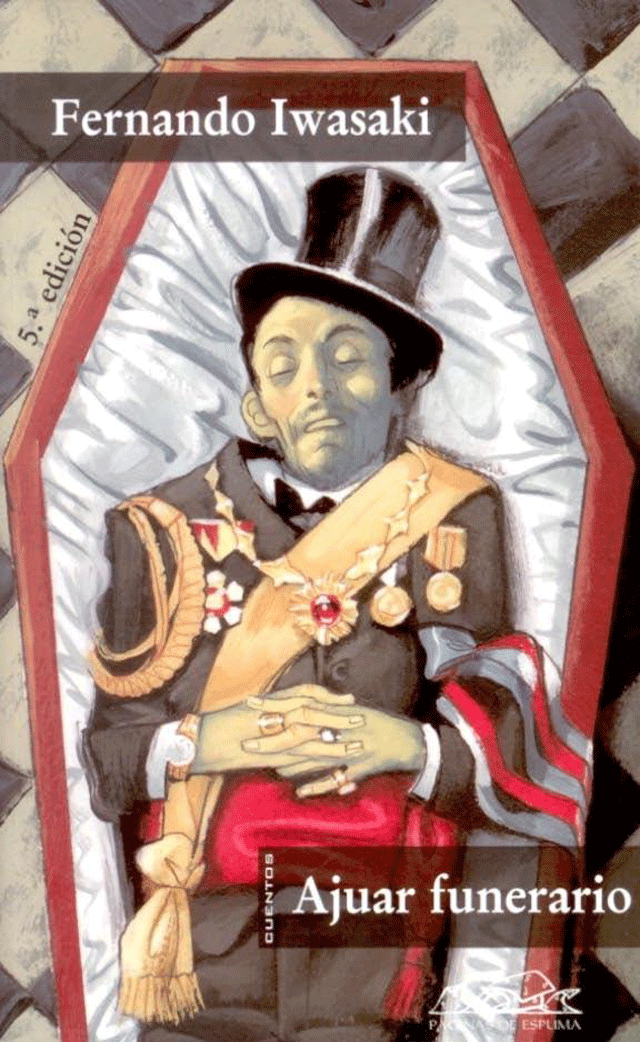
Fernando Iwasaki’s Ajuar funerario (Funeral Dress) Profiled in El Pais

El Pais has a profile of Fernando Iwasaki’s Ajuar funerario, a collection of short stories that has sold the relatively phenomenal 60,000 copies over multiple printings. The stories are in the horror genre, but with Iwasaki there is always humor, and so I doubt the stories are particularly gruesome. If his España, a parte de mi estes premios is any indication the book aught to be rather funny.

Ahí va un ejercicio para los lectores. Imaginen a un escritor latinoamericano, peruano de nacimiento, japonés de origen, sevillano de facto (casado desde hace veinticinco años con una sevillana), director de una fundación de arte flamenco, que escribe un libro de microrrelatos de terror con retrogusto de humor y que se vende como churros en las dos orillas de Atlántico. Es Fernando Iwasaki y su Ajuar Funerario, de la editorial Páginas de espuma, un longseller que lleva más de 60.000 ejemplares vendidos desde 2004 sin perder el ritmo, y acaba de lanzar su séptima edición. ¿El secreto del éxito de sus microrrelatos? Contienen historias… de miedo.

“Empecé con este género de minificción hace años, cuando me encargaron lecturas y conferencias para la universidad. Verdaderamente me sentía incapaz de leer textos míos de ocho o diez páginas, el público no merecía que le aburriese, así que decidí escribir estas pequeñas historias. Pero para que sean microrrelatos tiene que haber historia, y si no lo hay entonces podrá ser un poema en prosa, una anécdota, un aforismo estirado como un chicle… Pero no un microrrelato”. Iwasaki afirma que vivimos en un mundo invadido de ficción aunque no nos demos cuenta. “Ficción son los currículum vitae, son las esquelas de los periódicos, son los anuncios por palabras… Esa persona que publica: ‘Licenciado, 42 años, culto, encantador, desearía conocer señorita…’ ¡Eso es ficción!, ¿Cómo es posible que nadie haya llegado a esa situación de abandono a los 42 con todas esas cualidades?” Bromea el escritor.

My Little War by Louis Paul Boon – A Review

My Little War
Louis Paul Boon
Dalkey Archive, 2010 125 pg

This scant book is one of the more interesting ways to write about war I have read. It is also what makes it difficult to capture. My Little War is a series of 1-3 page episodes and little paragraph length moments that are tacked to the end of the episodes without any real relationship. They are just more noise of war. All of it is narrated by a person claiming to be the author. I mention this because while the style is consistent, one has the impression that multiple voices are at work. Nevertheless, each of the episodes describes the chaotic lives of the Flemish during World War II. The stories aren’t related and do not create a narrative arc that ties the lives of the characters together, giving the reader much of a connection to the characters. Boon is not creating great heroic stories of the resistance or of the pathos of the long suffering. Instead, he shows a world that in many ways has always existed and which during the shifting power structures of the war force to the surface. In story after story he shows the Belgians stealing and lying to survive. At other times the fascist sympathizers parade around town, finally powerful, only to change their stripes when the allies come. It’s a vision of pettiness that makes some of the Belgians look anything but heroic. That view is part of his larger point about the war. Those who lived  through it were surviving each day lacking any information of what was going on or any power to control it. It is not a sympathetic view, but it is effective and the voices of the episodes that seem anonymous in their brevity begin to suggest one thing: what was it all for?

But all the poets who wrote so enthusiastically about the Eastern front peeked out cautiously in their socks, back to writing poems about the stars and their solitude and God–God for God’s sake–after having pissed right onto Christ’s loincloth.

Eugenia Rico – New Collection of Stroies plus excerpts in English

The Spanish author Eugenia Rico has published a new book of short stories from Páginas de Espuma called El fin de la raza blanca (The End of the White Race). Not having read the whole book, the title is a little off putting for how loaded a term it can be. You can read an excerpt here. I wasn’t too impressed, but you can also read an English translation of part of one of her novels here. There are also some links to videos, etc.

She has one of the more interesting book trailers I’ve ever seen, one that doesn’t try to use a text genre in a visual genre.

A brief interview about here book is also here.

Chapter from New Enrique Vila-Matas Book Aire de Dylan

El Pais post a chapter from the newest Enrique Vila-Matas book a few weeks ago. I’ve been a little late on getting it up, but you can read it here. The book came out last week (3/14). Here is a brief overview:

Uno de los mayores fracasos puede ser fracasar en el empeño de fracasar. Otro podría ser el vivir pareciéndose a alguien, imitándolo y propiciando la impostura. Con esta idea comienza Enrique Vila-Matas su nueva novela Aire de Dylan (Seix Barral). Una obra que se publicará el 14 de marzo pero cuyo primer capítulo avanza hoy EL PAÍS en exclusiva.En ella, el joven Vilnius, que explota su parecido con el cantautor estadounidense, asiste a un congreso literario sobre el fracaso, mientras cree que su difunto padre le empieza a traspasar sus recuerdos.

El anonimato, la máscara, la impostura, la búsqueda y sus alrededores están presentes en Aire de Dylan. El joven Vilnius protagoniza estas páginas en las que el escritor barcelonés despliega sus mejores armas y elenco literarios con humor, ironía o sarcasmo pero siempre desde el conocimiento del mundo de la creación literaria. A partir de ahí, la novela se va transformando en un homenaje al mundo del teatro y una crítica al posmodernismo.

Leopoldo Brizuela Wins the Alfaguara Prize with a novel about State Terrorism in Argentina

El Pais reports that Leopoldo Brizuela has won the Alfaguara Prize with a novel about State Terrorism in Argentina.

En Una misma noche, Brizuela, nacido en La Plata, capital de la provincia de Buenos Aires, en 1963, ha hecho una inmersión en el terrorismo de Estado de su país iniciado en 1976, con el golpe de la Junta Militar que gobernó hasta 1983. El escritor ha creado como hilo conductor de la novela a un autor en la cuarentena, con una madre viuda, que vio de niño cómo en 1976 la casa de uno de sus vecinos era atacada por las fuerzas del orden. Tres décadas después, un hecho parecido en la misma casa le hace rememorar el pasado y el papel que jugó su padre en todo aquello. A partir de ahí, Brizuela levanta un mapa de una de la épocas más nefastas de la historia latinoamericana con una larga estela en la vida social, política, psicológica y cotidiana.

Th Oprah Book Club: not so good for new literature

The TNR has a post about how effective the Oprah Book Club in promoting reading and literature. It looks as if it didn’t make new readers out of non readers. It did get readers to switch from crappier books to more literary. But that had the effect of actually hurting the publisher’s bottom line. The law of unintended consequences rears it head again: (via)

The bad news is that the profits that help support publication of less lucrative, more high-minded books depend on the sale of a lot of crap. And at least when it came to fiction, Garthwaite found that the net result of Oprah’s endorsements was to reduce aggregate sales. The reason was the one Franzen articulated back in 2001: Winfrey often selected books that posed a challenge for her TV audience. In practical terms, that meant that Oprah Book Club books took longer to read than the crap her viewers would otherwise read. That, in turn, meant that publishers ended up not only selling less crap, but also, in the aggregate, selling fewer books overall. Which probably meant (and I’m extrapolating here from Garthwaite’s findings) that these same publishers were correspondingly less able to publish literary fiction.

Macedonio Fernández Profiled in La Jornada

A couple weeks ago La Jornada had several long articles about the Argentine author Macedonio Fernández one of Borges great friends and mentors. He was quite a character and his literary ideas are still unique. Open Letter Press brought out his The Museum of Eterna’s Novel a few years ago. It is called a novel, but it is full of prologues and is quite strange. Any ways, the La Jornada articles are definitely worth reading.

En un cuaderno inédito, hacia 1939, Macedonio Fernández anota: “Artistas: el inventor de colmos de Importunación –El extremador de redondeces.” En arte, según esto, habría dos posibilidades: a) importunar, perturbar inventando algo nuevo; b) agradar perfeccionando lo ya inventado. Dos extremos, dos programas para el arte: la ética de la invención, la estética del pulir y redondear. Claro que esos extremos –inventar, redondear– en cierto modo se dan en toda obra de arte. Por un extremo, la obra de arte se aproxima a lo “ilegible”, corre el riesgo de inventar hasta el punto de hacerse invisible, al diferir al futuro sus condiciones de inteligibilidad; por el otro, se expone a la redundancia, a agotarse en la nitidez de lo que meramente agrada en el presente. En las letras latinoamericanas (y más allá de ellas) pocos se entregaron al extremo de la invención de manera tan colmada de futuro como Macedonio Fernández.

Guillermo Cabrera Infante – The Collected Works Vol I Overview at El Pais

El Pais has an overview of the first volume of Guillermo Cabrera Infante’s collected works. The first volume of 1500 pages has his journalism and screen plays. It is expected to be a long project as he wrote under many pseudonyms and was a prolific journalist. However, for the Cabrera Infante fans it certainly will be welcomed. One thing I like to see are the scripts that novelists have written. I know I have the silent scripts of some of Isaac Babel’s works in his complete short stories.It gives a different dimension to see how they approach such a different form.

A Guillermo Cabrera Infante le gustaba definirse a sí mismo como “un periodista que escribe novelas”. Lo que parecía casi una broma más del autor de Tres Tristes Tigres, que entendíamos como la reivindicación de su aparición continua e iluminadora en la prensa escrita, porque lo habíamos leído primero como novelista, tiene ahora significados nuevos: vocacionales y estrictamente profesionales. Efectivamente, Guillermo Cabrera Infante fue un periodista, un crítico y un informador, y de primerísimo nivel. Este primer tomo de las Obras Completas (Galaxia Gutenberg / Círculo de Lectores), que es también el primero de los tres dedicados al cine —si incluyen finalmente sus guiones—, rescata, en torno a Un oficio del Siglo XX, la infinidad de críticas, reportajes, entrevistas y artículos sobre cine, más de 1.500 páginas en total, que G. Caín, uno de los seudónimos del joven Cabrera Infante, firmó en la revista Carteles, entre 1954 y 1960. Es decir, cuando Guillermo Cabrera Infante era un “periodista profesional”. Y aparece exactamente cuando se cumplen siete años de su muerte.

Profile of the Editor of Anagrama at El Pais

El Pais had a profile of the editor of Anagrama last week. It is interesting how their focus has changed more to the literary. Initially they were publishing political non fiction that was against the dictatorship, but once Franco was gone and democracy had returned they grew tired of political essays.

Cualquiera lo habría dicho en 1969, cuando Herralde fundó el sello: la ficción no estaba entre sus prioridades. En aquellos tiempos heroicos, publicaba esencialmente ensayos en la colección Argumentos o los famosos Cuadernos, textos con los que apuntalaba utopías y alimentaba el fuego de la revolución que había de llegar pero que nunca llegó.

“La primera década de Anagrama fue precaria, pero tolerable”, recuerda, “me parecía importante publicar lo que publicaba y me divertía, pero entonces se combinó la precariedad con el llamado desencanto, que en el ámbito político se materializó con la victoria de Adolfo Suárez, con la que desaparecen todas las ilusiones revolucionarias de la ruptura, del hombre nuevo y de todo lo demás”

De pronto, la creación literaria ya no era algo frívolo para evadirse de las condiciones objetivas. En los ochenta Anagrama reduce drásticamente la publicación de ensayos — “porque yo mismo me canso de leer textos políticos”— y busca una salida en la narrativa, un antiguo amor de su juventud: “la buena literatura”.

My Favorite Book Podcasts

Some one was asking me recently what my favorite book podcasts are and I thought I’d put together this list. If any one has any more suggestions I’d be happy to include them. They are in general order of interest.

  1. La Estaction Azul – A Spanish language podcast from Spain.
  2. Writers and Company – A Canadian author interview program that has a lot of in depth with conversations with international authors.
  3. The Guardian Books podcast – from the Guardian UK. My window onto the UK.
  4. Book Worm – Once and a while the host’s questions are a little long, but he always has interesting things to say.
  5. Three Percent Podcast – This is the podcast from Open Letter books. It can go completely off topic and sound like grad students doing their own podcast, but it’s fun and usually insightful. Quite a bit about the industry.
  6. Writer’s Cast – Half of the shows are about the book publishing industry, the others are interviews with authors. In general they are all quite interesting.
  7. The Next Chapter – A Canadian books podcast. Not as good as Writers and Company which is more literary, but nice look out side of the US.
  8. NY Times books podcast – I don’t care much about the best sellers section at the end, but it has its moments.
  9. Scotts Whay Hae! – I haven’t listened to this one much yet, but it’s about Scottish books.
  10. PRI’s World in Words – Another recompilation of public radio stories about books, language and other things you can put in books.
  11. NPR Books – A Recompilation of books topics from NPR shows.
  12. El Ojo Critico – Another Spanish language show from Spain. It isn’t exclusively a book show, but it does have lots of book coverage.
  13. Your suggestions here…

My Article on Four UnTranslated Short Stories Is Up at the Quarterly Conversation

My article about four untranslated Spanish short story writers is now up at the Quarterly Conversation. It turned out really well and is a much longer form article than I normally write coming in at a little over 3K words. While I think the stories mentioned in the article are great I had to leave out so many different ones that it seems at times I haven’t written that much. Writing about short stories is always hard because you end up with some many different ones and you have to try come up with some sort of thematic element to link them together. This was esspecially the case with these four, but I think I was able to do it.

Collections of short stories are generally considered difficult to market, and thus they’re often looked down upon by editors who acquire new works of literature in the United States. This fact is no less true when it comes to editors who acquire works of foreign literature translated into English, an already notably under-represented group. To make matters worse, what stories that do get translated are often lumped into anthologies of what you might call stories from over there, which obscure the full range of an author’s talent beneath the idea that one story is a representative sample.

This is all very important in the case of Spanish literature, which in recent decades has seen a rebirth of the possibilities of the short story. For authors of what’s called the New Spanish Short Story, this tendency has hidden a great burst of creativity that began in the early 1980s and flowered during the 1990s and 2000s (the few stories that have been translated have been relegated to obscure editions unavailable in the United States). From the stories of the fantastic by Cristina Fernádez Cubas to the structural inventions of Hipólito G. Navarro and the surrealism of Ángel Zapata, Spanish short story writers have created an exciting and diverse body of work marked by its openness and dedication to pushing the boundaries of the form.

I  have also commented on other stories from Navarro and Cubas. The rest of the Quarterly Conversation looks very good, too, and definately worth reading. They have a nicely timed overview of the works of Mercè Rodoreda. (You my reviews of Death in Spring and her short stories)

March 2012 Words Without Borders: The Mexican Drug War

The new Words Without Borders is out now. It is an issue I’ve been looking forward to for sometime, especially since I donated to the Kick Starter campaign. The issue is a mix of non-fiction and fiction all addressing the drug war. I’ve read Volpi before and he can be insightful. I’m looking forward to reading the Juan Villoro. I’ve seen his name several times in the collection of reporting that was recently published in by Anagrama.

Guest Editor Carmen Boullosa

What is it like to grow up in a country where the only safe place you can gather with friends is in your own home? How do you raise a family when going to the supermarket is fraught with the danger of being kidnapped?  This is the situation in Mexico, where the drug wars have transformed the country into a living hell. Guest editor Carmen Boullosa has assembled compelling essays, interviews, fiction, and poetry from Mexican writers on the impact of this bloody conflict. In their eyewitness reports, Luis Felipe Fabre, Rafael Perez Gay, Yuri Herrera, Rafael Lemus, Fabrizio Mejia Madrid, Hector de Mauleon, Magali Tercero, Jorge Volpi, and Juan Villoro document the crisis and demand the world’s attention.

From the other side of the world, we present poetry commemorating last year’s Japanese earthquake, and launch a new serial about an unexpected pig.

Etgar Keret Story at Guernica

Guernica has a good short story from Etgar Keret. It has fun with the idea of the writer and is one of his stories that touches more directly on the troubles. The story is from his forthcoming book to be published in April, I believe.

“Tell me a story,” the bearded man sitting on my living-room sofa commands. The situation, I must admit, is anything but pleasant. I’m someone who writes stories, not someone who tells them. And even that isn’t something I do on demand. The last time anyone asked me to tell him a story, it was my son. That was a year ago. I told him something about a fairy and a ferret—I don’t even remember what exactly—and within two minutes he was fast asleep. But here the situation is fundamentally different. Because my son doesn’t have a beard, or a pistol. Because my son asked for the story nicely, and this man is simply trying to rob me of it.

The Professional Writer and the Birth of the Predictable

Tim Parks has an article in the New York Review of Books about the professional writer and how that has lead to a form of sterility in writing. I think his take has a lot of merit, especially with the institutionalization of writing in the universities. I’ve always been a little suspicious of MFA’s and the like. I mean how many books about writers do we need? It often seems like what half the writers who come from those institutions end up producing anyway. It isn’t a depressing article, just one makes me glad I didn’t try and get an MFA. It all seems like a great ponzi scheme.

At the same time the perceived need for an expensive year-long creative writing course on the part of thousands of would-be writers affords paid employment to those older writers who have trouble making ends meet but are nevertheless determined to keep at it. One of the problems of seeing creative writing as a career is that careers are things you go on with till retirement. The fact that creativity may not be co-extensive with one’s whole working life is not admitted. A disproportionate number of poets teach in these courses.

Creative writing schools are frequently blamed for a growing standardization and flattening in contemporary narrative. This is unfair. It is the anxiety of the writers about being excluded from their chosen career, together with a shared belief that we know what literature is and can learn how to produce it that encourages people to write similar books. Nobody is actually expecting anything very new. Just new versions of the old. Again and again when reading for review, or doing jury service perhaps for a prize, I come across carefully written novels that “do literature” as it is known. Literary fiction has become a genre like any other, with a certain trajectory, a predictable pay off, and a fairly limited and well-charted body of liberal Western wisdom to purvey. Much rarer is the sort of book (one thinks of Gerbrand Bakker’s The Twin, or Peter Stamm’s On a Day Like This, or going back a way, the maverick English writer Henry Green) where the writer appears, amazingly, to be working directly from experience and imagination, drawing on his knowledge of past literature only in so far as it offers tools for having life happen on the page.

António Lobo Antunes Interview on Canal-L (Spanish Only)

Canal-L has an interview with António Lobo Antunes. I can’t say it is the best interview I’ve ever seen, but at least it gives you some sort of an idea of the man.