The Future is Not Ours: New Latin American Fiction
Diego Trelles Paz, ed
Open Letter, 2012, 254 pg
I won’t say too much about the book since I will be reviewing it for the Quarterly Conversation. It was a good book. As with any collection of short stories there were a few stories that didn’t interest me much, but the over all quality was good. Reading stories that come from outside the American tradition is always nice because I don’t have to be bothered with the craft of the story, since the authors tend to have different interests in writing. I did find the introduction slightly annoying, mostly because it promised something that the stories did not deliver: reactions to the recent past. The editor notes how important that the connections to the history of dictatorships, etc is in their work, but that is rarely mentioned in the stories. It is the fault of the introduction not the writers, for advancing that idea. Also his effort to locate the book in the context of a new Latin American writing that has gone past the Boom and the McOndo of Alberto Fuguet, doesn’t quite work. Many of these stories have a Fuguet quality and don’t seem so distant from the his McOndo style.
All of these are quibbles, since the stories, on the whole, are good. I will leave it at that until the review comes out.
El Pais had an interesting article about the Spanish authors who went into exile and the works that reflect that exile. I’ve read a little of Aub (my review was luke-warm), but none of the works here are familiar to me. I think a couple sound interesting. You can read some excerpts here.
Max Aub, La gallina ciega. Diario español
Max Aub.
max Aub publicó en vida dos fragmentos ampliados de sus diarios: Enero en Cuba recogió su estancia insular en 1968 y La gallina ciega, su regreso a España en 1969. En su inicio, puso una execración de Franco; en su final, una zumbona carta al ministro solicitando su beneplácito para publicarlo. Y en medio, afirma: “No intenté ser imparcial”, porque “no soy juez, sino parte”. Le fastidió casi todo… Que las coquinas de 1969 no supieran como las de 1936, que España se hubiera convertido en el lugar de veraneo internacional y, sobre todo, que nadie se acordara de lo sucedido entre 1936 y 1939, ni de la vida cultural republicana, ni de quienes se fueron al exilio. Asistir a una comida con Luis Buñuel y Dámaso Alonso, o al reencuentro con el fascista Santa Marina son experiencias inolvidables, contadas en esta prosa conceptuosa y restallante. (Joaquín Mortiz. México, 1971).
Cuntos para el andén, the free magazine of short stories from Spain is out with its newest edition. It includes a couple of pieces of short fiction from Juan Jacinto Muñoz Rengel. I’ve been interested in reading something of his ever since I read La familia del aire a few weeks ago. He uses the fantastic in his writing. Also there is one from Francisco Umbral who I don’t know, but have heard his name a few times.
The June 2012 Words Without Borders is out now. The theme this month is Queer. As usual there is an interesting selection as well as a review of Andrés Neuman’s Traveler of the Century which I also reviewed.
La furia de las pestes
Samanta Schweblin
Fondo Editorial Casa de las Americas, 2008, 111 pg
For readers of Spanish language literature in translation Samanta Schweblin’s name is slowly getting a little more notice. She has appeared in Words Without Borders, the Granta 22 best Young Writers in Spanish, and will appear in the forth coming The Future is Not Ours from Open Letter. However, with such spotty coverage it is hard to get a good sense of this writer’s work, a writer who has earned the respect of many of contemporary Spanish Language short story writers.It is a shame because her reputation as a short story writer to watch is deserved.
La furia de las pestes is Schweblin’s second book and won the Casa del las Americas short story prize in 2008. A couple of the stories have been translated into English: Conservas, which appeared in Words Without Borders (where I first encountered her work), and En la estepa, which is in The Future is Not Ours. Both of these stories are marked by the fantastic and show her at her best. Conservas is the story of a woman who reverses her pregnancy over the course of months, slowly shrinking it down until there is nothing left of it. Ultimately, it is a bitter sweet moment when she realizes that what she wanted so badly is perhaps not quite for the best. It nicely turns what easily could have turned into a didactic story on women’s rights, and gets at a more emotionally wrenching truth that there is no answer to such dilemmas. En la estepa (On the Stepe) is a fantastic story, yet one where the fantastic is only alluded to and like here best work, plays on customs most people would know, but are just a little strange and call into question those very customs. Throughout the story the characters keep mentioning some sort of creature that all want and that the lucky ones have found on the stepe. The first time I read it I thought it was just a story about a beast (and uninteresting at that), but when you look at the language everything the characters says are the words one uses when expecting a child. Used in a different context they sound abusive, selfish and it makes one question exactly what one is talking about when talking about children.
Those stories are available in English. But what about the rest of the stories? One thing that is obvious is that she is not tied to the fantastic. In two stories Papa Noel duerme en casa (Santa Claus Slept at My House) and Mi hermano Walter (My Brother Walter), she uses depression as a form of the fantastical. In each the characters loose contact with an accessible reality and their actions, naturally, seem strange. Interspersed with in stories of the fantastic, it underscores the strange nature of depression. The depression is not treated lightly and Papa Noel duereme en casa has a troubling vision of a marriage coming to an end and narrated by a young girl. Or in a story called Cosas que se tiran (The Things That Are Thrown), where a the narrator’s partner throws all their possessions into the shower before leaving, there is just a glimpse of something dying (the story is only 2 pages long). It forms a recurring theme of loss that leaves a dull ache for the unobtainable and at the same time a mater of fact sense of attachment to those losses, as if the narrators are so accustomed to them there is nothing one can do. That sense is most evident in El hombre sirena (The Merman), about a woman who meets a merman who is sitting on a dock. He offers her something different, but she doesn’t take him up on it. Or at least that is the suggestion, because she drives away with her brother to the waiting doctor. Is this another depressed person? She is obliviously anxious when she gets in the car to drive away. And like so many of her stories, the narrator says, perhaps tomorrow there will be another one waiting for me. The unspoken future is mostly likely not too much better.
The title story is a nice nod to Juan Rulfo about a man who goes to a forgotten village and tries to get the people to say something. It is one of those lost villages out of The Burning Plain (El llano en llamas) where everyone stays in their stone homes when a stranger comes to town. The twist her is when he tries get the people to talk and offers them something he thinks will help, it only reminds them of what they don’t have.
Finally,Cabezas contra el asfalto (Heads Against the Asphalt) is dark story about art. It opens with the shocking lines
Si golpeás much la cabeza de alguien contra al asfalto–aunque sea para hacerlo entrar en razón–, es probable que termines lastimándolo.
If you hit someone’s head a bunch of times against the asphalt–even though you are doing it for their own good–you’ll probably end up hurting it.
From there it follows a narrator who from time to time gets angry and beats people’s heads against the asphalt. As a child it gave him power because bullies would leave him alone. At other times it terrified people. However, he is able to channel the anger into painting. He becomes famous painting pictures of heads beat against the asphalt. His paintings sell for millions of dollars. All that matters is the frame of reference and beating someone’s head against the asphalt is perfectly acceptable. The narrator is completely detached from what is acceptable and it throws into relief which beatings are acceptable and which are not. The story ends with the ultimate taboo, but as far as the narrator is concerned it was just another beating. It didn’t matter who the person was, he just made him angry and he had to beat him. Unfortunately, for him reality is not self constructed.
Samanta Schweblin’s stories can be deceptively simple, but when she is at her best the stories open up new realities from ones that surround us every day. He ability to turn the language of child rearing into something dark, or reimagine a fairytale like the Little Mermaid as a series of indecisive acts, make one of the more interesting writers coming from Latin America.
La Jornada has a selection of short stories form Mexico City youths in the juvenile justice system. It is an interesting collection and one is an eye to writers who one would probably never come across.Out of 360 stories submitted, they published around 10. This is from the first
Todo esto empezó el 28 de septiembre de 1992, en una familia pequeña, integrada por papá, mamá, tres varones y una niña, la más pequeña de la familia.
El piloto de esta familia era Mario, el papá. Él era el que decía la última palabra, pero no antes de consultar a mamá e hijos.
Todo marchaba muy bien. Claro, siempre había problemas, pero nada que no resolvieran papá o mamá.
Un día viernes por la noche como a eso de las 9:45. Mario llegó del trabajo muy agotado, apenas podía mantenerse de pie, se tiró al sillón como desmayado. Claudia, la mamá de la familia pensó: pobre de mi querido esposo, está muy cansado; Claudia le quitó los zapatos y los acomodó abajo en un rincón de su cama de Mario y Claudia.
Claudia agarró el último billete que les quedaba, que era uno de doscientos, se queda pensativa y dice en voz alta, ¡aunque se enoje Mario y me moje, tengo que ir a la panadería de Macario!
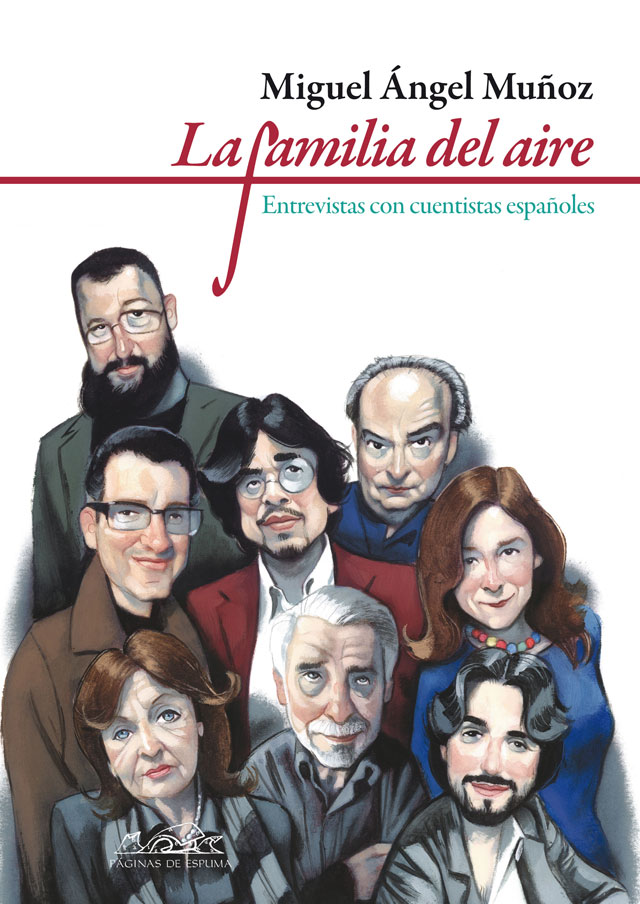
From bottom left clock wise: Cristina Fernandez Cubas, Miguel Ángel Muñoz, Hipolito G. Navarro, Fernando Iwasaki, Enrique Vila-Matas, Mercedes Abad, Andrés Neuman, José María Merino
La familia del aire: Entrevistas con cuentistas españoles (The Family of the Air: Interviews with Spanish Short Story Writers)
Miguel Ángel Muñoz
Páginas de Espuma, 2011, 474 pg.
The Spanish short story writer Miguel Ángel Muñoz’s La familia del aire: Entravistas con cuentistas españoles (The Family of the Air: Interviews with Spanish Short Story Writers) is an invaluable guide to the modern Spanish short story, and one of the best books I’ve read on the art of writing. Muñoz is an excellent and dedicated interviewer whose questions show a deep and thoughtful reading of each interviewee’s body of work. He sees interviews as not just another genre, but as an art unto itself and as he mentions in his introduction, he keeps collections of interviews in binders. He believes that letting an author talk about his or her work helps expand it, place it in a deeper context, rather than only letting the work speak for it self. It is this deep devotion to short stories and his ability to draw from the 37 included authors what makes short stories so compelling makes the book a must read for anyone interested in the short story. It is all the more impressive since all the interviews were conducted over a series of 3 or so years and published on his blog, El sindrome Chejov. In one of those great acts of personal fascination lived publicly, in 2006 Muñoz began to interview Spanish short story authors. What started quietly without any grand ambitions, morphed over the intervening years into one of the primary sources about authors working with the short story. Muñoz notes he was a little surprised by the willingness the authors agreed to interviews, but his dedication and preparation, which at the minimum includes reading each interviewee’s oeuvre, makes him a trustworthy interviewer, one that most writers would love to have. Muñoz also brings an sense of excitement to the short story. When reading his interviews (or his blog posts) it is easy to catch that same excitement—I should know, since every time I read one, I want to go out and read the author’s stories. The book is truly a one of a kind success that I wish existed for English language authors.
The only draw back of the book for my English language readers is that very few of these authors are available in English (certainly not the author’s fault). I have tried to remedy that with my recent article about unpublished Spanish Short story writers at the Quarterly Conversation. And when an author has been translated into English it is usually a novel. The most recognizable name in the book is probably Enrique Vila-Matas. Andrés Neuman, the last interview of the book and one of the better ones, also just had a novel come out in English (read my review here). That said, one of the most fascinating things about the book for an English speaker is to see what authors have influenced these authors. Given that English language authors may not be exposed to as many translations as they are in Europe, it might come as a surprise that two of the most common names that came up were Raymond Carver and John Cheever. Over and over in the list of influences these two always showed up. Some authors have turned to the English speaking authors as a refuge from the Spanish language traditions, but even when they cite Spanish language authors those two show up. I’m not so sure that would be the case for the reverse. Other English language authors mentioned were Poe, Anderson, Fitzgerald, Hemingway, Mansfield, Lorrie More and Alice Munro.
Spanish language influences tended to come mostly from Latin America. Cortazar was the most sited, the Onetti and Borges, and with a little less frequency Rulfo. There was a sense of disinterest in Spanish short authors from the middle of the century. The only two that were commonly cited were Juan Eduardo Zúñiga and Medardo Fraile. I think this is a function of one generation turning against another, something Andrés Neuman noted, saying that Spanish authors should take more pride in their own tradition with mid century authors like Ana Maria Matute. Only one author, Fancisco Afilado, though, really did not like the Latin Americans, especially Cortazar who he said led too may young writers to play games with their stories. Again, as a contrast to the American scene that notion of play is often lacking and too many write in the realistic vain. Afilado, naturally, is the author who loved the American realists the most, and is a perfect example of those who believe that noir is the best writing because it is the most real. I can’t say I agree with that, but it was refreshing and annoying at the same time to find one author in these interviews who has that opinion.
There were relatively few references to authors outside of the English and Spanish traditions. There were, of course, the trinity, Chekhov, Maupassant, and Kafka, but relatively few references to authors from any other languages (except perhaps Catalan). Only once did I see a reference to Thomas Bernard, for example. But given who rich both of these traditions are, there is quite a bit to mine in terms of influence.
With the exception of a few novelists, all the interviewees are dedicated to the art of the short story. As such, every interview has a question about the disrespect given to short stories in Spain. There were several theories all of which probably have some validity. My favorite was Carlos Castán’s theory that all the Christmas stories that come out ever year and which written by famous authors, turn readers away from the short story, because the stories are written by people who are not short story writers. I think the lack of critics who specialize in the short story, especially those at newspapers, is probably a better theory. The short story has the perception that it is just what you do between novels. Another mentioned that the public likes to engross themselves in a big story and don’t like the stopping and restarting that a collection of short stories entails. That may be the prescient commentary: it is one I sometimes feel when I am reading collections of short stories, especially ones larger than 200 pages.
Of course, things always look better across the water, and there were multiple references to the tradition of the short story in the US. However, I often feel that what they are looking at is a tradition that is from 30 years ago, if not father back. While major publishers do bring out collections of short stories, they are still a small fraction of published fiction. And while there are small magazines and journals like Tin House, the short story also lacks for prestige. Perhaps things are better here, but it certainly is not a paradise.
Ultimately, the book with its ample indexes, appendices of authors cited in the interviews, and a list of each author’s published works, short story or otherwise, is one of the best references to the short story I can think of. And as one might expect my list of authors that I’m interested in reading has grown. These are just a few that you may see on these pages some day: Mercedes Abad, José María Merino, Medardo Fraile, Juan Eduardo Zúñiga, Iban Zaldua, Ángel Olgoso, among others. That, I think, is the highest praise for La familia del aire: Entravistas con cuentistas españoles.
While I thought Bonsai was well written and showed some inventiveness, I thought it was a little juvenile at times. Still I was curious how such a literary novel would be turned into a movie, especially all the references to writing and reading. I’ve long since gotten over the truism that the book and the movie are never the same. What interests me is what decisions they have made. As far as the literary content goes, they handled it quite nicely. The running joke about the main character writing a novel that he is really supposed to be transcribing is in some ways a little more interesting because it is subtle. Where as the narrator has to explain it in the novel, the film just shows it. It is one of those advantages that film can occasionally have. The real plus of the film, though, was it did not seem as juvenile as the book. The change in narrative perspective is most likely what created that feeling. The film it self is serious, the incidents are comic, whereas the narration of the novel is light and jokey. One is certainly not better than the other; they are their own things. The novel is certainly more revolutionary; the film is fairly straight forward. As literary movies go, though, it is one of the better ones. The film makers didn’t try to create a metaphor for the creation of writing, something that is usually tedious. Rather writing is just something one does and reading is something one enjoys. Moreover, they were able to use the same jokes from the book to show the two lovers injecting literature into their lives and constructing literary significances to even the smallest things. That sense of the primacy of literature in the book is stronger because in the movie the characters, almost comically, are often going to puny parties at the college that makes all their pretensions seem funny. So although Bonsai the movie is not Bonsai the book, as adaptations go, it is one of the better ones.
El Pais has an excerpt of a novel he was working on when he passed away. It is called Federico en su balcón and you can read an excerpt of it at El Pais. Given his last works, I’m not sure really how thrilling it will be, but you can be the judge.
Sesenta y seis. Esos son los años que estuvo atrapado Carlos Fuentes por la verdadera pasión de la literatura. Sesenta y seis años que hay entre el descubrimiento que hizo de El conde de Montecristo, a la edad de 17 años, y la escritura de sus dos últimos libros: Personas y Federico en su balcón que dejó a los 83 años, antes de morir el 15 de mayo. El primero son unas memorias sobre los personajes que conoció y el segundo una novela en la que salda cuentas con Nietzsche.
No es solo el legado póstumo de uno de los escritores e intelectuales más relevantes del mundo hispanohablante del último medio siglo. “El significado de Federico en su balcón”, explica Pilar Reyes, editora de Alfaguara que publicará la novela a finales de año, “es que Fuentes nunca pensó que fuera el último. Pero ahora cobra una gran dimensión simbólica. Resume dos aspectos: el Fuentes ciudadano y el literario e intelectual. Es una reflexión sobre el poder y la decisión moral en las pequeñas cosas de la vida. Una especie de combate entre lo público o el poder que incide en la vida de todos y las decisiones pequeñas y privados”.
Carlos Fuentes was one of the first writers who I can really remember inspiring my interest in writing. I was not a reader of literature before I got to college. I read history, but fiction wasn’t something I thought much about. It took sometime for literature to interest me. The first author I can remember was James Baldwin, but after I ran across Juan Rulfo and Carlos Fuentes I saw the real possibilities of great writing. I had been taking one of those classes that only The Evergreen State College could create: one whole quarter (16 credits) dedicated to Mexican literature, history, and culture. It was a truly immersive experience and we read two works of Fuentes: The Death of Artemo Cruz and The Old Gringo. One was a masterpiece and the other one of his many less than stellar efforts. We all knew The Old Gringo was week, but when you have an Artemo Cruz it doesn’t really matter. It was Fuentes at his best: expansive, using history as his tablet, and letting his structural inventions wow young writers to be. After going over his works in class and out, I had to find other books, reading Where the Air is Clear, Aura, Burnt Water, and the Good Conscience shortly after. I particularly identified with the Good Conscience, a coming of age story that was set in Guanajuato, a city I had visited once. Thinking about it now it’s funny that I would find the book so compelling, but he was able to capture something. Later, when I finally made it to Mexico city several I spent a day or two with my head raised, looking for the mansard roofs he had mentioned over and over in Where the Air is Clear, as if finding a sloping roof would explain something about Mexico. It was unnecessary; Fuentes had already constructed a Mexico for me, one that I described in my piece, Just a Handshake is Enough.
A few years later I lost some of my fascination with his fiction. Perhaps it was the unevenness of his later works. They never seemed to have the exciting sense of a man forging a vision of a country. Instead they showed a man whose fiction seemed to be self absorbed. Even then, however, his literary criticism, his ability to talk about writing and writers was always interesting. His book La geografía de la novela was the first book I ever read in Spanish and was an exciting not because it delved into theory, but because he could make writing and the whole process of literature sound important and vital. For Fuentes, literature was more than games for grad students and that sense of passion you read in any article or heard in any interview was kept him interesting even after his later fiction lost some of its weight. Hearing of his passing was a shocker because just the other day I was reading an article in El Pais about his adventures in Buenos Aires for the book fair. He always seemed to be connected to the literary world and could talk about the newer generations and the same time as Cervantes, and, again, it made reading and writing exciting. In an age of e-books, hand wringing about the future of books, and enfeebled academia, despite Fuente’s flaws he made writing and love of literature seem one of the most important endeavors one could undertake.
RIP/DEP
There are plenty of articles and tributes in Spanish that you might want to read.
Era autor de más de 20 novelas y contaba con el Premio Cervantes (1987) y el Príncipe de Asturias (1994). Escribió obras como ‘La región más transparente’ o ‘La muerte de Artemio Cruz’. El velatorio será privado en su casa. A las 13.00 (hora de México) sus restos llegarán al Palacio de Bellas Artes
El corazón de los caballos (The Heart of the Horses)
Miguel Ángel Muñoz
Alcalá, 2009, 145 pg
El corazón de los caballos is the Spanish short story writer Miguel Ángel Muñoz’s first novel. A refreshingly short novel, it is a continuation of a story that first appeared in his collection Quédate donde estás (Stay Where You Are), called El reino químico and which was my favorite of the collection when I reviewed it a year or two ago. As in the short story, the novel opens with unspoken tension between the narrator’s father and grandfather. It is a tension that has populates the world of the grandson, Victor, who doesn’t understand why his father does not like his grandfather. It is a relation that in the novel is distant and still remains unexplained, but it sets the tone of the novel. What seemed like the eccentric behaviors of a loving grandfather in the El reino químico, are actually the foundations of Victor’s problems.
Victor’s life hasn’t quite worked out as he wanted. He was a promising mathematics student but when he fails to get a scholarship after years of graduate study, he loses his patience and attacks the professor. He loses everything and on his journey to his final court date he goes to a Pyrenean town with his boyfriend Andrés, who is going to receive a literary award. It is a journey that begins to trigger a series of memories that he has if not suppressed, avoided. The first is of Eva, his former student, an anorexic and troubled girl who intrigued him. It isn’t so much as sexual, although there is some sort of tension, but one of shock, fear, confusion or even disappointment. When he does discover that she binges at night he is angry and like the mystery of his father and grandfather, she disappears and he hears nothing of her again. The second, darker memory is of a drug addict who likes to climb from balcony to balcony. Scared, a knife in his trembling hand, he watches as the man loses his balance on his porch and falls to his death without doing anything. He’s accused of pushing him, but he’s released because the man was a druggie known for that dangerous game.
With those incidents in the background, Victor and Andrés enter the Pyrenees. The awards ceremony is really just a chance for the town to feel important, but they meet two people of interest: the previous winner, Ines, a mysterious woman who has not let her photo appear on the cover of her books since her first book; and an old man and his granddaughter. Each has a story that Andrés, a man who lives to gather stories and rewrite them as he sees fit, as if he is reconstructing the reality of those he has stolen from. And it is a form of theft, because he is unrepentant in his using of other people’s lives. The old man talks about a Portuguese man he met during the Spanish Civil War and who had been wrongly accused by the old man’s comrades of being a traitor. The story captivates both Andrés and Victor, and the old man promises they can see a photo of him the next day. From then on Victor’s life begins to get worse and over the next few hours he descends into darkness and violence as Andrés dumps him, and Victor begins a search for the photo the old man promised. Ultimately, ending in a desperate moment of hate.
What makes the novel interesting is the interplay between the stories that the characters tell, and the way Andrés uses them to recreate Victor’s existence. A week man, Victor is at the mercy of Andrés ability to rewrite his own story, and when that story has ceased to be interesting, he leaves him; thus, rewriting his life again. It is that interweaving of Andrés power to draw a story from a character that creates Victor’s experience. It is as if, Andrés were actually the author of the book. It is a nice play on the journey narrative, and takes the reader deeper into the layers of story than just the Heart of Darkness references (in Spanish it is translated as El corazon de las tinieblas). Muñoz is an author who is very interested in the interplay of story, reality, and how they construct each other and that playfulness is what makes him an interesting story teller and El corazón de los caballos a book worth reading.
Traveler of the Century
Andrés Neuman
Farrar, Straus and Giroux, 2012, 564 pg
El viajero del siglo
Andrés Neuman
Alfaguara, 2009, 531 pg
Andrés Neuman’s Traveler of the Century (El viajero del siglo) is a broad novel of ideas that takes place in post a Napoleonic Europe that at first seems distant, but as he makes quite clear the same debates and the same arguments are still with us. It is an impressive bit of scholarship, bringing to life the philosophical arguments that have receded into the past. At the same time, Neuman also constructs a narrative that is equally interesting, giving the book a narrative impulse that is a good counterpoint to discussions about Schiller, Goethe and other 19th century German thinkers.
The novel follows Hans a world traveler who stops at the town of Wandernburg on the border of Saxony and Prussia. He intends to stay only a few days and move on, but he meets an organ grinder in the town square and they begin a friendship. The organ grinder is a kind of sage with whom he respects for his detached way of looking at the world, which lets him obverse the town, but stay distant from its intrigues. He also has seems to know that Hans should stay in the town and suggests after they first meet that he should stay an extra week. In that week, Hans who still plans to leave as he does every town he visits, meets the Gottlieb family and is taken with the daughter, Sophie. Once he has meet the family, striking up a friendship with the father and latter managing to get himself invited to the salon that Sophie hosts, he becomes, at least for a time, a resident of the town.
During the salon Hans, Sophie, an older professor named Mietter, a Spanish expat Alvaro, and several towns people discuss everything from the European union under Napoleon, the value of religion, which forms of government are best, and the merits of classicism versus romanticism. While everyone chimes in, Hans as the worldly traveler brings the new liberal and romantic ideals to the group and often spars with Mietter who represents a conservative, Catholic, and classical view. The two are usually at odds and although Alvaro with his anti-clericalism can shock the group, Hans is the true rebel of the group expressing ideas that propose to overthrow the established order and many times are illegal in Saxony.
It is during these salons that the book returns over an over to the idea of identity. What is it that makes Europe, Europe? It seems to be odd to discussing these ideas again, and occasionally during the salons I found myself thinking, yes, I already know this, why do I need to read this way. Yet these arguments are still going on and taking a gaze at Europe it is obvious that these arguments only seem settled because they are old. For example, at one point Alvaro notes it is better have less religious freedom because it leads to greater belief, unlike Spain which has such high disbelief thanks to the church. That friction still exists in Spain and has been an issue for a over a century. In other parts of the book, he looks at the desire for every ethnic group to have its own country, a topic that is still hotly debated in several countries. It is in these discussions that the book is more than just a rereading of German romantic thought, but rediscovery of the same problems that they tried to address and which have yet to be settled. While the novel was written between 2003 and 2008, the questions have taken on even more weight in light of the financial crisis that has exposed even more points of contention between the countries of Europe. (Alvaro’s funny take of the genius of Goya who knew to change the heads of the figures in the painting Allegory of the City of Madrid with the each change in politics, is particularly funny and telling.)
The narrative begins to move ahead at a quick pace when Hans and Sophie begin a passionate love affair. At first it is stolen glances and furtive meetings on country excursions, but soon the begin to meet in his rooms under the pretext of translating poems for publication. Between making love and delving into the subtlest meanings of words, they spend hours together in a world of romance and translation, as if each were part of the other. Neuman spends a fair amount of time talking about translation and his interest in the subject is quite deep. And within the greater theme of the book that Hans as a traveler is a translator of different places and ideas, it ties together all these discussions about politics with the simple need to be heard: without translation, in its specific sense of language, or the broader sense of different ideas into new forms that can be understood by new people, people stagnate. Of course, it is also a literary argument and Neuman shows great care in describing the process of translation, especially the argument between fidelity to the language versus fidelity to the meaning. As Sophie says, “Translation and manipulation are two different things wouldn’t you say?”
Eventually, Hans is found out to be the revolutionary he is–as men and women with new ideas are always called. As a result the love affair ends and Hans knowing that there is nothing left for him, has to leave town, finally, a year latter. At first the ending may see a little abrupt because Hans leaves town and nothing has really changed, except that Sophie is no longer engaged. But that is it. Yet that is really the perfect way for a traveler to come and go, both in the narrative and metaphorical sense. Hans is not meant to stay long, because like ideas, he must continue on, encountering new problems, new challenges to meet. Ultimately, it doesn’t matter where Hans is, because he has exposed Sophie to something that will continue to grow and help question what identity really is. And in that exploration Neuman has created a work that is both prescient and needed.
A Note on the Translation
I read the first two thirds in Spanish. I had bought the book back in 2010 and had not gotten around to reading it until now. I switched to the English translation when the publisher sent it to me, mostly likely at the behest of Andrés (but who ever sent it, thanks). Although it was a little strange to hear the characters all of a sudden in English instead of Spanish when I made the switch, I thought the translation was quite effective. It was a very good representation of the original Spanish and eminently readable.
El Pais has an interview with Alejandro Zambra on the publishing of his book of criticism, No leer, in Spain. What is interesting about the article, especially in context of some recent articles questioning the structure of the publishing industry in the Spanish speaking world, is that he says he read most of his books in photocopied editions because they were too expensive otherwise. And due to all this, he is looking forward to the e-book which will reduce the cost of the book (although, there is a cost to entry in that you have to have a reader, but I suppose he takes that for granted).
“Muchas grandes obras que fueron importantes para mí las leí en fotocopia. Los libros en Chile son objetos de lujo, carísimos. Parecen diseñados como para que la gente no lea. Las fotocopias me recuerdan los tiempos que uno le pasaba sus poemas a la amiga que estabas conociendo y hacías como un libro, o cuando un amigo fotocopiaba Guerra y paz, de 30 en 30 páginas. Por eso me interesan los e-books. Si finalmente puedes pagar mucho menos por un libro, ¿por qué no? El libro es solo un producto, lo importante es el texto. Y a la vez soy hiperfetichista de los libros. Me interesan todos los formatos. También me gustan mucho los audiobooks, porque creo que un buen texto debiera uno poder escucharlo en voz alta. La prosa tiene que tener ritmo. Y ese ritmo tiene que sorprenderte, provocar efectos específicos. No hay que olvidar que así era la literatura. La costumbre de leer en silencio es relativamente nueva. En las ventas del Quijote se lee una novela para que varios la escuchen”.
Five Dials has an Essay from Javier Marías (pdf) of The Leopard from Giuseppe Tomasi di Lampedusa.
There is no such thing as the indispensable book or author, and the world would be exactly the same if Kafka, Proust, Faulkner, Mann, Nabokov and Borges had never existed. It might not be quite the same if none of them had existed, but the non-existence of just one of them would certainly not have affected the whole. That is why it is so tempting – an easy temptation if you like – to think that the representative twentieth-century novel must be the one that very nearly didn’t exist, the one that nobody would have missed (Kafka, after all, did not leave just the one work, and as soon as it was known that there were others, as well as Metamorphosis, any reader was then at liberty to desire or even yearn to read them), the one novel that, in its day, was seen by many almost as an excrescence or an intrusion, as antiquated and completely out of step with the predominant ‘trends’, both in its country of origin, Italy, and in the rest of the world. A superfluous work, anachronistic, one that neither ‘added to’ nor ‘moved things on’, as if the history of literature were something that progressed and was, in that respect, akin to science, whose discoveries are left behind or eliminated as they are overtaken or revealed to be incomplete, inadequate or inexact…
The May issue of Words Without Borders is out now, featuring writing from the Indian Ocean. It also has a story fro perennial favorite, Etgar Keret.
This month we spotlight writing from the islands of Mauritius, Reunion, Madagascar, and Mayotte. Francophone writing in the region dates back to the eighteenth century; the coexistence of French with the area’s other languages (Creole, Malagasy, Arabic, and Hindi), and its relationship to French colonialism, inflect writers’ thematic, stylistic, and syntactic choices. See how J. William Cally, Ananda Devi, Nassuf Djailani, Michel Ducasse, Boris Gamaleya, Alain Gordon-Gentil, Carpanin Marimoutou and Françoise Vergès, Esther Nirina, Barlen Pyamootoo, Jean-Luc Raharimanana, and Umar Timol imaginatively engage with this complex heritage. And guest editor Francoise Lionnet provides an illuminating introduction. Elsewhere, Mauritian writer Nathacha Appanah joins Etgar Keret and Wojciech Jagielski in writing from cities not their own. And we deliver the third installment of Sakumi Tamaya’s “The Hole in the Garden.”
The ever excellent blog El sindrome Chejov recently polled a series of Spanish language short story authors about what they thought were the best collections of short stories to be published over the last five years. It is a broad ranging list that includes authors English speakers would probably be familiar with, such as Alice Munro and Lydia Davis. Of interest to me were the books originally written in Spanish (I’m already sufficiently familiar with the English speakers). Some of these I’ve heard of and in a few cases I’ve even read some of the books. I certainly agree with some of the choices and am looking forward to finding some new authors.
The three most cited authors were Juan Eduardo Zúñiga, Alice Munro and Ángel Olgoso. However, I saw many references to Javier Sáez de Ibarra, Andres Neuman’s Hacerse el muerto (read my review), and Smanta Schweblin’s Pajaros en la boca, a book that I am looking forward to reading soon. Miguel Ángel Muñoz’s list is of particular interest especially since he has read 250 collections over the last 5 years. I also thought Miguel Ángel Zapata’s was interesting because it listed the writers and their approaches which gives you a little context. Lest the embarrassment of riches make you think things are all rosy over there, Muñoz does end his survey with a complaint that could be easily leveled here in the states:
Buenos libros y buena labor editorial. Mejora sensible en la atención de los medios. …Y pocos lectores. En un país con desesperantes bajos índices de lectura -disfrazados por la atención mayoritaria a unos pocos libros populares- pero con una media de cuatro horas diarias ante la televisión, el cuento, que requiere de un predisposición particular y una educación del gusto para disfrutar de sus resortes narrativos, tan distintos a los de la novela, no puede salir bien parado. Aun así, sigo pensando que el cuento posee un poder que nuestro sistema educativo no ha sabido aprovechar. Aún. Confío en centenares de profesores de bachillerato que van descubriendo, y difundiendo, las posibilidades que el relato corto ofrece para introducir a los alumnos en el placer de la literatura y, todavía más, en el mejor conocimiento y explicación de materias distintas de las estrictamente literarias. Historia o Filosofía, para empezar (¿se sigue estudiando eso en Bachillerato?).
En la última década, el cuento español abandona las trincheras incómodas del gueto y comienza el lento acomodo en las mesas de novedades y en las reseñas de los diarios nacionales. Eso es un hecho; lento y a gotas, pero un hecho: llueve. Ya se ha apuntado muchas veces antes la labor encomiable y de zapa de editoriales especializadas en el género como Menoscuarto, Páginas de Espuma, Salto de Página, Tropo, Traspiés o Cuadernos del Vigía. Pero cabe anotar igualmente la proliferación de espacios en la blogosfera que promueven la expansión de los géneros breves y su rápida recepción por un público silente aunque masivo tras la pantalla del ordenador. En cuanto a las direcciones que asume el cuento actual, es precisamente la heterogeneidad de propuestas la clave para entender su auge: el terror contemporáneo entreverado de cierto apego a la sobriedad realista del cuento norteamericano en la obra de Jon Bilbao, la relectura del fantástico desde posiciones especulativas o metafísicas (en tres maestros del género en su estado más puro: Ángel Olgoso, Juan Jacinto Muñoz Rengel, Manuel Moyano), la experimentación formal en la renovación que parte del fantástico hacia territorios que lindan con lo telúrico (la portentosa cuentística de lo inaudito plausible que desarrolla David Roas), la orfebrería impresionista de altísimo octanaje literario (Óscar Esquivias, Jesús Ortega), lo cotidiano transfigurado (Miguel Ángel Muñoz, Andrés Neuman y Ernesto Calabuig, que hacen virtuosismo genuino de la lectura entre líneas y la fuerza emocional de las historias), el lirismo surreal (Juan Carlos Márquez en su estupendo “Llenad la tierra”, todo un despliegue talentoso de recursos y técnica)… Si a ello sumamos el trabajo de fondo de maestros contemporáneos que siguen trabajando el género aportando periódicamente nuevas obras de impronta clásica y generosos ejercicios de estilo (Merino, Calcedo, Aramburu, Díez, Aparicio, Fernández Cubas, Peri Rossi…), da la sensación de políptico generacional completo, de relevo asegurado y estupenda salud del género, como certifica el análisis que hizo del cuento en 2011 el artículo del crítico Ricardo Senabre para el último número del “El Cultural” el año pasado. Otra cosa, por supuesto, es la flexibilidad de mercado, distribuidores y librerías en el sostenimiento de títulos suficientes de un género que siempre supone un quebradero de cabeza para las editoriales que funcionan con la calculadora y la cuenta de resultados ante la mesa. Mientras siga chispeando…”
If you are interested in the short story, these 7 posts are worth skimming through.
El Pais had an article recently about La Feria del LIbro de Buenos Aires and a group of Latin American authors who gave their thoughts on where the power base of Spanish publishing is. Historically it has gone back and forth. While Spain was under Franco Latin America was the publishing center. When Spain became a democracy and Latin America had its own problems the center of publishing moved to Spain. Now the question is, is it about to change? Many of the authors consulted hoped it would, pointing out it is silly that to get books published they have to go to Spain, and that if they only publish in their home country their book probably won’t leave their home country. Ebooks, of course, were touted as one of the solutions but it is uncertain if that is going to be as liberating as might be hoped for. Given that Spain refused to put in a large presence in the book fair do to a squabble with Argentina, things are certain to change.
Vale, no hay un nuevo Gabriel García Márquez en Latinoamérica. Ni “rayuelas”, ni “conversaciones en la catedral”. No hay millones de personas en el mundo esperando a que salga el último libro de la porteña Claudia Piñeiro, o de su compatriota Marcelo Cohen, premio de la Crítica en Argentina por su novela Balada. La gente no abarrota las salas donde habla la mexicana Guadalupe Nettel, ni se detiene el tráfico cuando cruza un semáforo con su mochila al hombro el chileno Alejandro Zambra o el colombiano Tomás González. Y sin embargo, a todos ellos les va bien dentro y, a veces, fuera de sus países. La Feria del Libro de Buenos Aires también goza de excelente salud: desde el 19 de abril y hasta el 7 de mayo se espera la asistencia de 1.250.000 personas que pagarán el equivalente a 4,5 euros por entrar en un recinto casi tan grande como cinco campos de fútbol lleno de libros. Los cinco novelistas se dieron cita el viernes en la Feria para hablar ante una audiencia de unas 200 personas no sobre sus propios libros, sino de sus experiencias como lectores. Muy pronto surgió la cuestión de España: ¿Por qué se depende tanto de las editoriales españolas para encontrar a los buenos autores de Latinoamérica? ¿Por qué siguen llegando los libros de otros idiomas traducidos al español de España?
José Ovejero has won the 40th Anagrama Prize for the Essay. It is a work about cruelty in art, such as the work of Cormak McCarthy or Onetti.You can read the full post at El Pais.
Si bien Ovejero (Madrid, 1958) aborda ese aspecto en ámbitos como el cine y el teatro (como la obra de Peter Handke Insultos al público), es el peso de esa crueldad en la literatura donde disecciona con mayor profundidad. Para ello, escoge siete novelas que serían a su entender paradigmáticas de esa crueldad necesaria, como son El astillero (Juan carlos Onetti), Meridiano de sangre (Cormac McCarthy), Auto de fe (Elías Canetti), Historia del ojo (Georges Bataille), Tiempo de silencio (Luis Martín Santos) y dos obras de la Nobel Elfriede Jelinek: Deseo y La pianista.
¿Dónde está la crueldad de estas obras? “Son diferentes; está la de la sexualidad oscura de Bataille a la del relato sangriento de McCarthy, de esas horas de hombres de frontera que dan una nueva mirada sobre la historia de EEUU; o la crueldad más psicológica de Onetti y que demuestra que la literatura cruel no tiene por qué ser sangrienta sino que puede despojarnos de la fe y esperanza que nos hemos construido para creernos felices; Onetti desengaña al lector y lo confronta, como Jelinek desguaza la sociedad austríaca y sus mentiras”.
Ivan Thays has a recent article in El Pais about the forgotten writers of the Boom, especially the women. I have mentioned many times before in the pages of this blog about the seeming paucity of women in the best of lists and various literary pantheons that exist. Here Thays contemplates some reasons why the names of the Boom are all men, especially a certain four: Garcia Marquez, Fuentes, Vargas Llosa, and Cortazar. As he mentions the times and the authors were at least somewhat sexist, but it was also the image of the male writer as self assure, committed and hegemonic writer that gave little room for women writers. While that image is probably true, recent lists by Spanish speaking critics have shown that there is still a long way to go before that phenomenon has abated. (for more see the Letras Libres failure).
Esta semana en el FB de Andrea Jeftanovic, estupenda escritora chilena, se discutió el tema. Ella, además del nombre de Clarice Lispector, soltó el de la mexicana Elena Garro como otra olvidada del Boom. Sostuvo además que “siempre hay redes de poder en la legitimación y visibilidad” cuando se elabora un canon. Y por supuesto, el Boom es un canon absolutamente masculino por más que sus autores (pienso en las colaboraciones de Julio Cortázar con Carol Dunlop o en la admiración que siente Vargas Llosa por Nélida Piñón, a quien le dedicó La guerra del fin del mundo) no desprecien necesariamente a las escritoras. Más que el machismo de los autores, la ausencia de mujeres en el Boom es producto de la ideología de esos años en los que la escritura femenina ocupaba en América Latina un lugar marginal y opacado por una imagen del escritor masculino, comprometido, seguro de sí mismo, hegemónico. Cuando veo la serie Mad Men identifico a Don Draper con la imagen del escritor latinoamericano del Boom, exitoso, convincente, trajeado y encorbatado, fumando o bebiendo whisky, hablando de negocios, de arte o de política, mientras a su alrededor orbitan mujeres vulnerables.
El Boom fue un fenómeno comercial y un hito histórico instalado en su tiempo. Pero ajeno a este, la literatura latinoamericana permanece en movimiento y en discusión constante. Una prueba innegable de ello es la importancia que ha adquirido un autor que logró ingresar al Boom, aunque nunca fue muy bien considerado por sus pares, como Manuel Puig, quien en las últimas décadas se ha convertido en el principal referente de la literatura latinoamericana. El brillo de algunos nombre y libros concretos del Boom, en cambio, ha ido desluciéndose con el paso de los años. Todo puede ser replanteado a través de nuevas lecturas y, en especial, siguiendo el rastro que los escritores dejan en la obra de los autores posteriores. Por ello, Clarice Lispector (como quizá algún día Elena Garro) ocupa hoy un lugar excepcional en la literatura latinoamericana, más allá del detalle anecdótico de si perteneció o no al Boom.
The Argentina Independent has a list of five new Argentine novels that have come out in English recently. I have heard of two of the authors, Sergio Chejfec and César Aira and I am currently reading Andrés Neuman’s Viajero del siglo (Traveler of the Century). Hopefully, Ill finish it soon. It is enjoyable if a little long. A Full review will be forth coming. I trust the list will get peek your interests. (via)
Friends of Mine by Ángela Pradelli
For loyal readers of this series, Ángela Pradelli needs no introduction. An excerpt from her novel ‘Amigas Mías’, translated expertly by Andrea G. Labinger, helped us launch as our first installment a year ago. Now, after much anticipation, the full-length novel from which that excerpt was taken will be released in English from the Latin American Literary Review Press. Called ‘Friends of Mine’, and also translated by Labinger, the novel tells the story of a group of women living in the Buenos Aires province, who meet once a year on 30th December to eat dinner, celebrate the New Year, and reflect on the strange, difficult and wonderful passage of time. Structured in short, lucid fragments, the novel reads like a coming-of-age tale for a group of friends, a neighborhood, and an era of life in middle-class Argentina that has as much resonance today (and outside of Spanish) as it did when it was first published in 2002 and was awarded the Premio Emecé. Re-read our interview with Pradelli for more context, or peruse the sample we published last year. Then head over to the LALRP website to buy a copy for all your friends — after all, that’s what the novel is about.
The Islands by Carlos Gamerro
When we spoke to Carlos Gamerro last year, two of his acclaimed novels were in the process of being translated into English, both by his friend Ian Barnett (who also translated ‘The Peronist Princess’ by Marcelo Pitrola). Last year, the first of those books, ‘An Open Secret’ (Pushkin Press), was released to a critical consensus: The Economist — a publication not known for effluvient rhetoric — declared that Gamerro’s novel had “the makings of a classic,” and the Independent called it “haunting and disturbing.” This isn’t news to us; we’ve been enjoying Gamerro’s brand of darkly comic prose since we published his story ‘Bad Burgers’ in August. Now English-reading fans of his fiction will have another reason to cheer: this May, And Other Stories, a new British publishing concern, will release a translation of Gamerro’s first novel, ‘The Islands’. Like the spiralling narrator of ‘Bad Burgers,’ the protagonist of ‘The Islands’ chases his own trauma down a rabbit hole when he discovers that, despite the passage of ten years, the Falklands/Malvinas War is still raging — a reality he’s not quite ready to confront. Written with Gamerro’s trademark muscularity, we’re certain this new addition to the English-language cannon will only swell his growing fanbase. Head over to the And Other Stories site to pre-order a copy.
 Max Aub.





 By The Firelight