José Manuel Caballero Bonald Winsthe Cervantes Prize

José Manuel Caballero Bonald has one the Cervantes Prize. He is a poet, novelist, memoirist, and historian of flamenco. I think he is most well know for his poetry, which has its roots in realism but plays with that.

El Pais has a brief description of his most important works.

A note form El Pais on the announcement and a few other links.

Watch a video of him talking about contemporary poetry.

Running an All Short Story Press in Spain: an Interview with Juan Casamayor at Revista Ñ

Revista Ñ has a good interview with Juan Casamayor, the editor of Páginas de Espuma an all short story press in Spain. I think it is is a great press and I’m still amazed it exists (and Menos Cuarto for the mater). I don’t know of any all short story presses in English. Please let me know if there are any. He is a dedicated fan of the short story even when publishers don’t support them enough and makes the market week. He does have a point, that if more publishers published short stories there would be a better market for all short stories. (via Moleskine)

-Se suele decir que el cuento no se vende, que no es negocio, que la gente busca novelas. ¿Cuánto hay de mito y de verdad en esta afirmación? 
-Cuando empezamos, se nos dijo y repitió que “el cuento no vende, el cuento no vende”. Trece años después, casi 250 títulos después, contestamos con ironía que “vivimos del cuento”. La existencia de una editorial como la nuestra demuestra que era posible levantar una editorial independiente cuya línea de ficción sólo incluye cuento. Que el cuento vende menos que la novela, por supuesto. No obstante, la decisión y la voluntad de comercializar el cuento en el mercado por parte de los editores ha sido mínima o nula. El cuento como trampolín, como descanso de novelista, como cláusula de contrato. Sinceramente, creo que esto está cambiando, aunque sea despacio. Nosotros hemos logrado diseñar un catálogo que se comunica entre sí, con autores, cuya obra posee gran número de lectores, y otros que están definiendo su público. La experiencia, por lo tanto, no puede ser más positiva. No puedo dejar de decir que nuestra labor con el cuento es la que ha dado a nuestra editorial su viabilidad y su visibilidad.

-Pero, ¿por qué cree que el cuento, específicamente, es menos buscado por los lectores?
-¿Le puedo dar la vuelta a esa pregunta? ¿Por qué el cuento específicamente es menos ofrecido por los editores? Esa sin duda es una de las causas, si no la más sobresaliente. No veo ninguna razón literaria para justificar por qué el lector se decide por uno u otro género. El mecanismo editorial está orientado por sus políticas hacia la novela y esto crea en el público lector una reacción de consumo y gusto. Las editoriales apuestan su comercialización, su distribución, su promoción a la novela y esto ha dejado, engañosamente, en otro plano al cuento. Porque el cuento vende. Ahí están todos esos grandes long sellers, ahí están algunas sorpresas editoriales, o, por qué no, un proyecto como Páginas de Espuma, que casi es testimonio de la existencia de un lector que va aumentando.

Andrés Neuman Meets His Readers: Virtual Interview at El Pais

The virtual interviews that El Pais runs where the public can ask questions of an author can be hit and miss. Andrés Neuman on the occasion his newest book participated in one. There are some good questions, especially his take on overlooked or up and coming authors.

Buenas, Andrés. Ya que se cumple medio siglo del fenómeno, ¿qué autor del ‘boom’ está -o pretende estar- más presente en tu obra? Muchas gracias.

De los autores más consabidos de ese período, siempre he sentido predilección por Onetti. Por otra parte, los ataques a Cortázar o García Márquez me parecen esnobs y me molestan. El Boom, como todas las grandes explosiones, dejó una nube de polvo que nos impide ver más a lo lejos. Pero detrás, ahí, de pie, enteros, caminan también Puig, Di Benedetto, Garro, Lispector, Ocampo, Arreola.

Qué escritores españoles actuales nos recomendaría?

De mi generación, admiro por ejemplo a narradores como Elvira Navarro, Isaac Rosa, Andrés Barba o Mercedes Cebrián. Entre los poetas, me parecen excelentes (y precoces) Elena Medel, Juan Andrés García Román, Juan Antonio Bernier o Berta García Faet.

Felicitaciones y una pregunta: qué autores jovenes argentinos poco conocidos podría recomendar. Gracias.

Luis, ahí va el banquete: Hernán Ronsino, Samantha Schweblin, Oliverio Coelho, Fernanda García Lao o Pedro Mairal entre los narradores. Natalia Litvinova, Laura Wittner o Fabián Casas entre los poetas. Hay muchos más.

¿Hasta qué punto favorece la precocidad en el mercado a la labor literaria? En todos los libros que he leído de usted inciden en lo mismo, en el talento aunado a la juventud. Pero da la sensación de que esa forma de encasillar es un arma de doble filo, y da la sensación de que es necesario que usted rompa el mercado, o los cimientos de la literatura, o ambas cosas, para que le quiten de ese carro de las promesas y le otorguen el valor que su obra ya merece. ¿Cuánto pesan las etiquetas?

Estoy de acuerdo. Desde mi primer libro, tuve la certeza de que la juventud era un fetiche público de corto alcance: lo que (supuestamente) te beneficiaba al principio, te descartaría enseguida para que la maquinaria de las novedades siguiese funcionando. Existe el prejuicio de que lo joven vende, etcétera. Pero eso es una fantasía publiciataria: si pensamos por ejemplo en la situación del mercado laboral, vemos que los jóvenes son un sector particularmente desfavorecido. Por lo demás, jamás se me ocurriría empezar definiendo a un autor por su edad. La edad es una anécdota biológica. Algunos escritores dan lo mejor de sí en la madurez (no sé: Borges, Saramago), y a otros el tiempo los destruye (pienso en Capote). Además, ay, ahora tengo canas en la barba. Y esas canas me gustan: también prometen algo.

Javier Cercas: On His Novel and the Nationalism of Spanish Language Fiction

Revista Ñ has an interview with Javier Cercas about his new novel Las leyes de la frontera, which returns to his themes of how a history is constructed. But as a provocateur he also notes that the literature of the Spanish world is isolated between countries. Readers in one country don’t read works from another and vica versa. But he lays his heaviest criticism on Spain, noting that partly for historical reasons and partly for a kind of navel gazing and narcissism of the newly rich. (via Moleskine)

–¿Por qué casi siempre los escritores españoles están aislados de sus pares latinoamericanos?

–Mi impresión es que ése es un tema general de la literatura en español: hay una atomización. Es decir, los escritores y los lectores argentinos leen poca literatura española; los españoles, poca literatura argentina y los mexicanos, poca peruana; por ejemplo. Hay una especie de impermeabilización, hay muy pocos escritores que traspasan esas fronteras, que no son fronteras. Es un drama. Por otra parte, la literatura española es menos cosmopolita que muchas literaturas latinoamericanas. La literatura española, con excepciones, se ha encerrado, primero por causas históricas, pero también por una especie de ombliguismo, narcisismo estúpido y también por esta cosa que hemos tenido de nuevos ricos los últimos 30 años. El nacionalismo es la peste, pero en literatura es el horror. Pertenecemos a una tradición muy amplia, aunque nuestra tradición literaria sea muy inferior a las grandes tradiciones –la del inglés, el francés, el alemán– ahora es más potente quizás que muchas, hay que beneficiarse de eso.

You can also see an interview with him at Canal-L

[vimeo http://player.vimeo.com/video/52044276%5D

Excerpt of The Miracle Cures of Dr. Aira at Bomb

This came out a little while, but I can’t let it go by unnoticed. Bomb has an the first chapter of The Miracle Cures of Dr. Aira

One day at dawn, Dr. Aira found himself walking down a treelined street in a Buenos Aires neighborhood. He suffered from a type of somnambulism, and it wasn’t all that unusual for him to wake up on unknown streets, which he actually knew quite well because all of them were the same. His life was that of a half-distracted, half-attentive walker (half absent, half present) who by means of such alternations created his own continuity, that is to say, his style, or in other words and to close the circle, his life; and so it would be until his life reached its end—when he died. As he was approaching fifty, that endpoint, coming sooner or later, could occur at any moment.

(via  Scott)

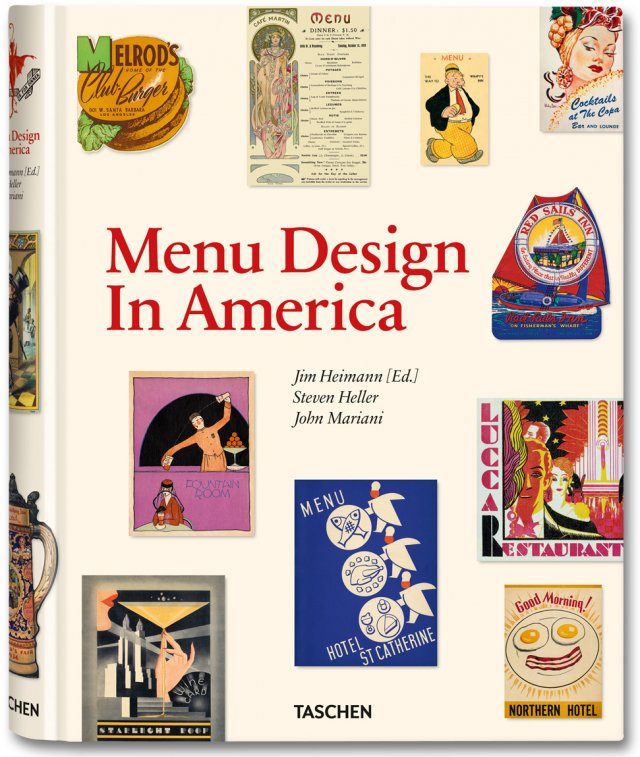
Menu Design in America, 1850–1985 – A Review

Menu Design in America, 1850–1985
Taschen, 9.8 x 12.5 in., 392

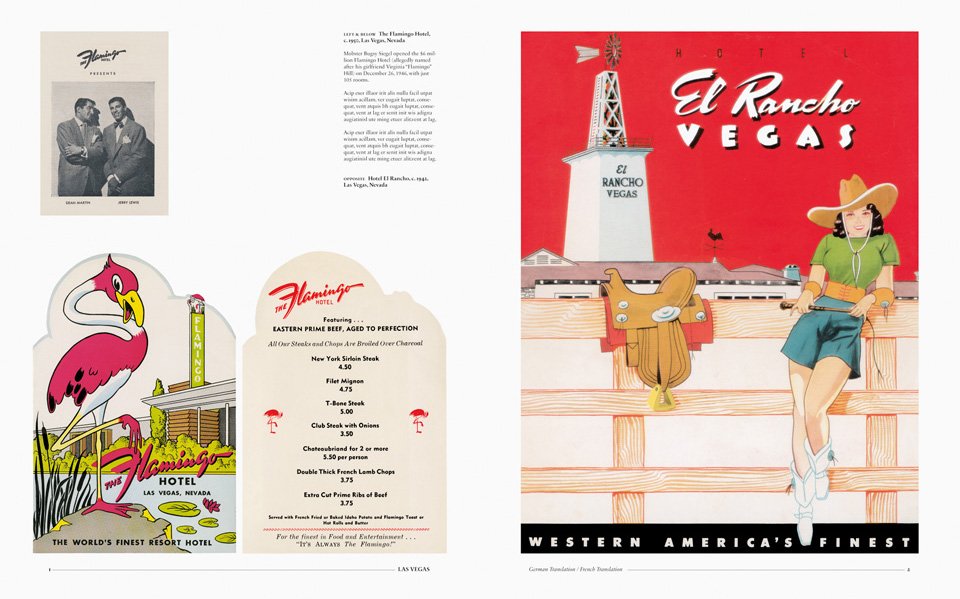
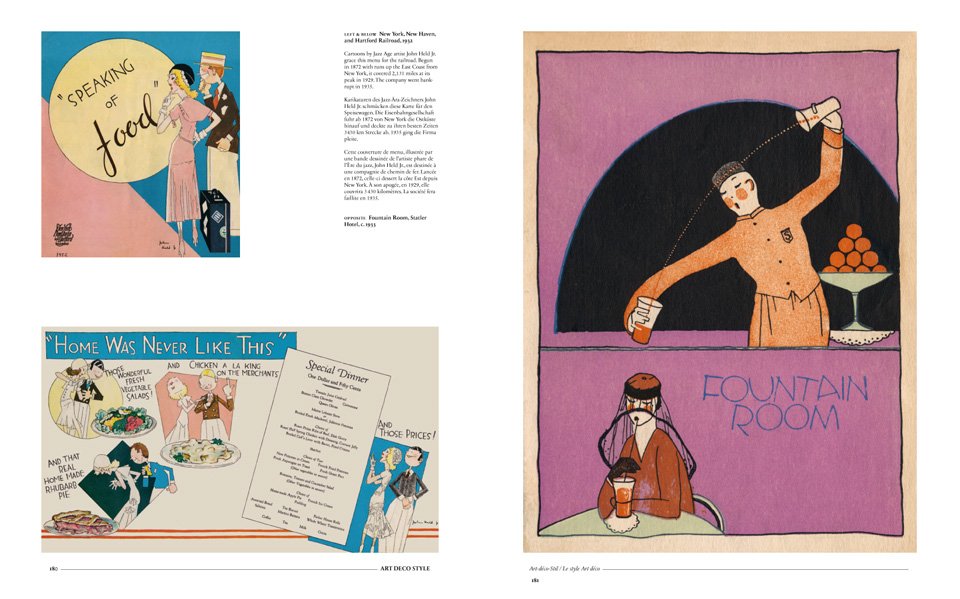
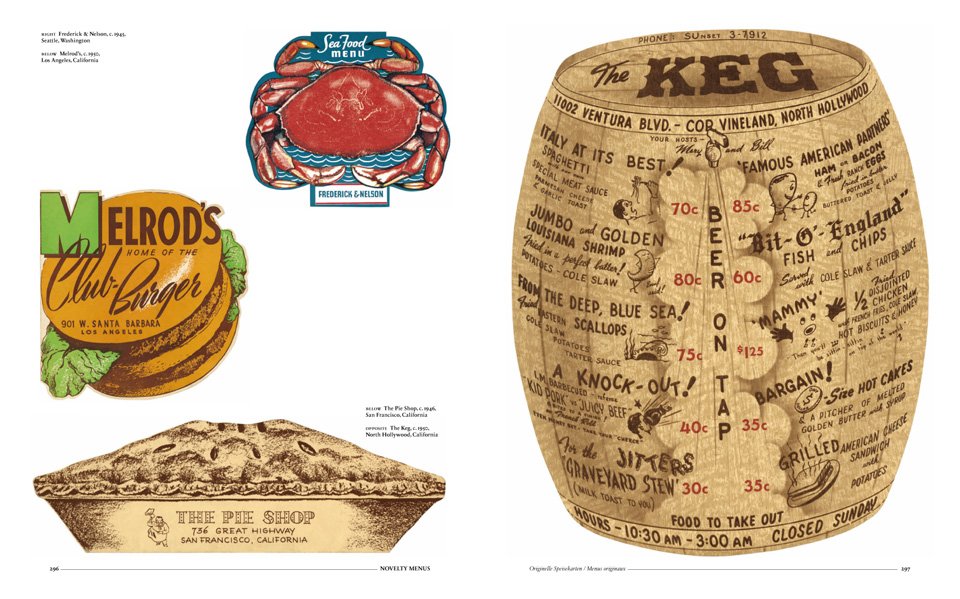
Taschen’s Menu Design in America is a fascinating collection of 130 years worth of American menus from restaurants and private parties. While the book is marketed more as an art and design book(Taschen’s primary focus), it’s also a great look at how American’s have eaten in public. The earliest menus are utilitarian and surprisingly large, offering often ten types of hot meat and as many cold meats, along with a little seafood, a couple vegetables  usually of the potato variety, and some deserts. By modern standards its both a surprising number of options with meat and a very limited vegetable offering. Moreover, meats were presented on menus in the manner they were cooked, rather than the preparation of the dish. Boiled as well as roasted beef seems to be on many of the early menus at the same time. As restaurants became more common and served a broader range of clientele, the number of offerings tended to slim down, although not always, especially in restaurants serving a thousand clients at a time (it is hard to imagine such a place today since that style of eating has gone out of style). However, the food stays essentially in the meat and potatoes form for quite some time, with the occasional addition of canned tomatoes, and corn. One tradition that would be interesting to see come back is how desert is handled up through the 20’s. Usually there were two categories: pastry which is what we commonly call desert now, and desert which was an assortment of fruits and nuts.

As you can see from these images, the art work reflects each era quite readily, often in its sexist and occasionally in its racist incarnations. Reading the menus form Chinese, Mexican and other ethnic restaurants will show just how much American dinning has changed as much of what is on those menus is no longer served any more. While all eras represented have an occasional use of whimsy, it is’t until the menus from less upscale restaurants of the 30’s and especially the post war period begin to appear that the humor and gimmickiness that has been associated with American eating of the second half of the 20th century appear. The earlier menus are much more refined, aimed at a wealthier group who excepted a refined experience, even if the food doesn’t seem it now. Where as restaurant eating became a much more common thing, the mid century exuberance for all things commercially inviting shows up in most of the menus. It makes for an intriguing contrast between the aspirations of both refined and common place of diners, and naturally with an American beset with foodies and celebrity chefs. It is a contrast that makes the foodie revolution just that more impressive.

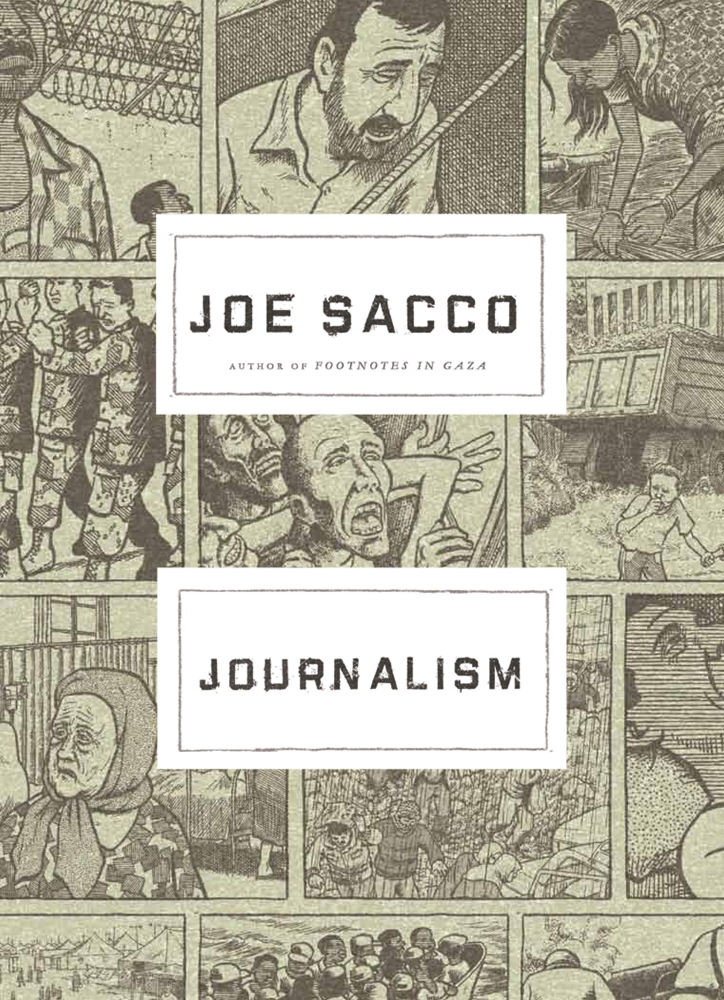
Journalism by Joe Sacco – A Review

Journalism
Joe Sacco
Metropolitan Books 2012, pg 192

Joe Sacco’s work has long been a fascination of mine. The comics medium has a lot of potential, but even the most serious work is unable to distance itself enough from its roots in either style or in content. Sacco’s work, on the other hand, opens up different directions for comics, not so much in style as he is still in a realist vein, but in subject. It is the content that shapes the power of his style rather than the reverse (here I’m thinking of a Charles Burns whose style is amazing, but the story isn’t as much). In his journalist works published to date (I’m not going to count Notes of a Defeatist which is very alt-comic) he has focused on telling long stories that dig into an issue, telling as best he can, different sides of the issue. Even works like the Fixer seem to come out of his larger work on Bosnia, Safe Area Grozny.  Journalism, on the other hand, is a collection of pieces written for various publications over the last decade or so, ranging from embedding with the Army in Iraq to a long report on migrants in Crete to an investigation on the lives of Dalits in India.  The publications range from Time magazine, which includes some of his only colored work, to a French magazine devoted to comic journalism. The wide ranging publication history leads to less consistent work, as Sacco points out in several of the introductions that follow each story. Still there are some gems in the collection, especially his report from Crete, India, Chechnya, and the story of embedding in Iraq. The first three are also the longest pieces in the book and, therefore, offer the fullest look at a particular subject, akin to a full length magazine feature. It is in the longer stories his trade mark style of interviews presented as a mix of close ups, dramatized scenes as the interviewee narrates the story, and Sacco as character asking the questions, although in these pieces he doesn’t seem to characterize himself so comically. Some of the stories seem old news, but they are still powerful. In the Chechnya story there is a hopelessness both with the situation of the refugees and the aid agencies that just cannot cope with. The story of the Dalits of India is as equally hopeless and one can not help but wonder if there is ever a way to lift the Dalits out of poverty. While the previous two stories seem the farthest away, the refuges from Crete (he is originally from Crete) offers a story that should both be familiar to Americans and Europeans, detailing the problems with unwanted migrants. Crete has received numerous migrants from Africa who want to go on to Europe. It is a small country that has been unavailable to adequately cope with them. Unsurprisingly, there are problems and nativist groups who want to chase them out. Sacco gives a well rounded treatment of the story and both the “what right do you have to come here” and the “what right do you have to keep me out” view points are given in depth treatment, which is all one can ask of a journalist.

The question after reading the journalistic pieces is does comics journalism work? Or more to the point can it be taken seriously? I think they definitely work, although not in the sense of a daily newspaper. What he is writing is long form journalism, which is what he is best at. (There is one opinion piece from the NY Times and it isn’t that great, which he admits). Writing takes time and drawing the detailed kind of narrative he does even longer. His body of work, as this book attests, shows a solid journalist whose commitment to a story is strong. Still, I can’t see his work in major media (whatever of that there is left) yet. Not for his faults, but because, as I have long thought, few authors have managed to blend narrative demands with artistic in a way that doesn’t leave the reader wondering if the art work was really necessary or a better writer should have been added to the project. Sacco avoids both problems. It is too bad the only comics journalism magazine that I know of is in French.

You can read  his story about the war crimes tribunal which appeared in Details (which caused no end of problems for him when interviewing the subjects)at the publisher’s site.

 

Milestones of Latin american Literature Before the Boom

El Pais has an interesting list of the important works of the 20th century from Latin America, before the boom. Like any list it is flawed but is an interesting starting point and a nice way to see that there was literature before the Boom.

1918 Los heraldos negros. César Vallejo

Cuentos de la selva. Horacio Quiroga

1920 El hombre muerto. Horacio Quiroga

1922. Trilce. César Vallejo

1924. La vorágine. José Eustasio Rivera

Veinte poemas de amor y una canción desesperada. Pablo Neruda

1926. Don Segundo sombra. Ricardo Güiraldes

El juguete rabioso. Roberto Arlt

Cuentos para una inglesa desesperada. Eduardo Mallea

God and Science: Return of the Ti-Girls by Jaime Hernandez – A Review

God and Science: Return of the Ti-Girls
Jaime Hernandez
Fantagraphic Books

I’ve never liked superhero comic books much. Even before I was a teenager I found them a little boring. Really, what happens in a superhero comic book? The hero spends his time moaning about their powers, or at least wondering if they’ll be strong enough to defeat the villain. The hero and villain run around chasing each other for the 30 pages or so, often the hero faces a set back, but then they overcome. While character development is a fine thing, comic books often suffer from the repeated analysis of their own heroic virtues. Yes, the very early comics were all plot, but at some time that switched and it was just tedious talking without even the littles bit of story telling. It’s harsh, and there are certainly quality examples of the superhero, such as the oft noted Watchmen. I’d rather read a Tin-Tin any day.

I mention all that because I finally read one of the Hernandez brother’s books. They have a great reputation among those who like graphic novels and it has long been over due for me to read one of their books. I know they write non superhero things, but I happened to pick up a superhero story. It has redeeming elements that take it beyond a superhero story. In the world of the Ti-Girls, only women are superheros and they have been fighting the good fight for many years. So many that the Ti-Girls are in retirement and are forced to come out of retirement when the most powerful woman in the universe goes into shock after loosing her baby and becomes a danger to Earth. While he has some nice touches playing with the stock elements of superheros the book, again, comes down to that same flaw. The heroes run around beating on each other. One side seems to get the upper hand, then the other, and in between they discus their powers and those of the mourning woman, and add in a little plot. Except for Hernandez’s reinvention of how superpowers are handed out, there isn’t too much difference between this and a Marvel or a DC comic. And I get it. Super powers are difficult to use, but it doesn’t mean that they have to be the center of every story. Super powers as a metaphor for identity  has been done, especially if you are writing for adults, which Hernandez  certainly is with his illusions to other superheros. The graphic novel has removed the constraints on comics, it is too bad that homages have to fall into the same traps.

The Children of the Boom Generation Talk About What it Means to Them

El Pais had a couple articles this week on the Boom. The most interesting were the brief quotes from younger writers reflecting on what the Boom has meant to them, good or bad. I like to see a few criticisms of the terms and celebrations of certain elements. (emphasis mine)

Damián Tabarovsky (Argentina, 1967)

El boom retoma la ilusión de que el escritor latinoamericano tiene que tener algo de for export, de very typical (Bolaño es el último avatar del boom) con algunas gotitas de denuncia social y pasteurización de tradiciones locales. A la vez, introduce la novedad de que para ser escritor, o aún peor, hombre de letras, hace falta tener a una Carmen Balcells, o alguien como Carmen Balcells, o a muchos como Carmen Balcells; expresa el momento en que Barcelona comenzó a volverse sede del poder económico editorial en castellano; informa sobre la necesidad del mercadeo de izquierda como paradigma de la figura mediática del escritor latinoamericano (García Marketing, como lo llamaba Fogwill). Lamentablemente no aprendí demasiado de esas cosas. O por la negativa, tal vez sí, mucho. Algo más: hace poco releí Pedro Páramo y Tratados en La Habana, casi antagónicos y ambos notables.

Yuri Herrera (México, 1970)

Quizá lo primero es lo que los mismos escritores del boom aprendieron de los modernistas: que la voluntad de estilo define la mirada sobre la realidad y la fuerza de su narrativa. Que la del boom, entre otras cosas, adolece de ser una lista compuesta casi exclusivamente por hombres. Que un fenómeno mercadotécnico a veces solo es eso, y a veces se aprovecha de algo evidente, como que la mejor literatura en lengua española ya se estaba escribiendo en el continente americano. Que un buen escritor no necesariamente es una autoridad moral: algunos de los que escribieron las mejores novelas del siglo XX también plagiaron el trabajo de otros, sostuvieron amistades con dictadores, justificaron invasiones injustificables y subordinaron sus opiniones políticas a las necesidades de sus patrocinadores. Que una buena novela sobrevive a las mezquindades de sus autores e inclusive a su propio éxito.

Andrés Neuman (Argentina, 1977)

Ninguna etiqueta explica la realidad, pero algunas la mutilan hasta volverla incomprensible. De eso que llamamos boom aprendí el abismo entre los rótulos y las obras. ¿Qué tiene que ver Lezama con Onetti? ¿Por qué García Márquez (1927) y Vargas Llosa (1936) sí, mientras Puig (1932) no? ¿Hasta cuándo maestros como Di Benedetto o Ribeyro seguirán fuera de la foto? ¿Por qué no figuran poetas, habiéndolos brillantes? ¿No resulta sospechoso que ni siquiera Elena Garro, Silvina Ocampo o Clarice Lispector aparezcan en tan viriles listas? De eso que llamamos boom admiro la ambición estética de sus autores, que me hace pensar en la infinitud de la escritura; y recelo de sus mesianismos políticos, que me hacen pensar en la patología del liderazgo. Entre tanta generalización, dos décadas de textos extraordinarios. Tan grandes que merecen ser leídos como por primera vez, desordenando los manuales.

Antonio Muñoz Molina has an interesting memory of meeting Onetti, a writer who is not usually listed in the boom.

And on the publication of Luis Harss’ collection of interviews,  Los nuestros, with Boom era writers, there is a lengthy profile and excerpt.

All the Boom one needs for the week.