Página 12 has an interview with uan Casamayor Editor of Páginas de Espuma, one of my favorite publishers right there with Open Letter. They specialize in short stories and have published some great works by some of the best in short stories (see my reviews of Navarro and Neuman). The interview talks about the press, its history, and the craziness of the publishing industry, which functions in Spain much like it does in the US.
–Un latiguillo frecuente, dicho por muchos editores, es que los libros de cuentos no venden. ¿Qué diría para desmontar este “mito” o prejuicio?
–El primer hecho incontestable es que trece años después una editorial que empezó partiendo de una pareja que decide buscar un hueco muy especializado ya no es una editorial pequeña por facturación. Páginas de Espuma está facturando en torno a los 800 y 900 mil euros; es una facturación fuerte. Las cifras son públicas. Los libros de cuentos se venden. Otra cosa es que se quiera vender cuentos. Si partes de la filosofía que el libro de cuentos es un descanso de novelista o una cláusula de un contrato, el posicionamiento ya no comercial sino editorial es endeble para vender el libro. Yo hago giras en España por catorce ciudades con un libro de cuentos. Además tenemos un premio de 50.000 euros al mejor libro de cuentos que compite con cualquier premio de novela. Claro que para esto me busqué a alguien que tuviera la plata para poder financiarlo. Ribera del Duero está muy contenta con este premio porque ha posicionado su marca de origen de un vino en un mundo cultural que les ha interesado mucho. No tengo otra vía de ingresos. Aunque mis padres son médicos, soy un poco espartano. Y si bien me dieron un poquito de dinero para arrancar con la editorial, vivo exclusivamente de lo que dan los libros. Algo tiene que vender el cuento para mantener Páginas de Espuma, ¿no?
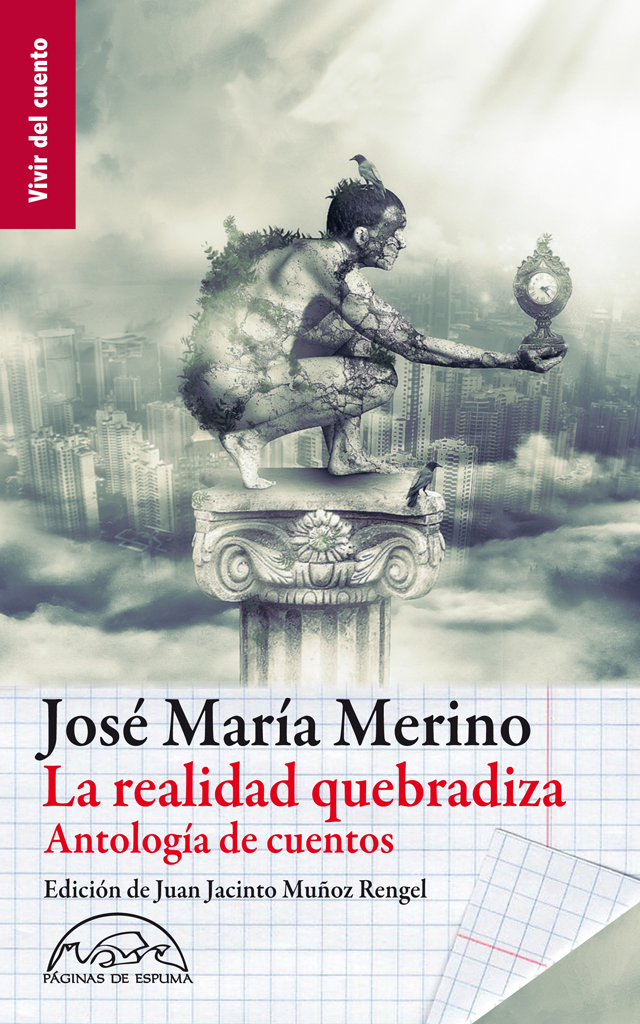
El Pais among other newspapers have some interesting interviews with José María Merino on the occasion of the publication of an anthology of his writing by Páginas de Espuma. He is a short story writer I’ve been looking forward to reading soon. Last year his book El libro de las horas contadas was given high praise and end up on some best of the year lists. The interview from El Pais is interesting. It was especially gratifying to hear a short story writer say there are only so many short stories one can read in a sitting, something for all the short stories I read, I find to be true.
-¿Y que hay de los microrrelatos?
-Hay gente que los desdeña, pero es como si un pintor desdeñase el soporte de óleo o el soporte de madera. En ellos puede haber cosas estupendas o cosas deleznables, exactamente igual que en la novela. Para mí, como escritor, lo que aporta es que puedes decir cosas que no podrías decir de otra manera.
-¿Son estos capaces de satisfacer el hambre literaria?
-Sería absurdo comparar un minicuento con Ana Karénina, pero son sabores que pueden resultar más intensos, pueden dar un matiz diferente. El problema es que no puedes leer demasiados minicuentos seguidos, porque te empachan. Pero pueden despertar ideas interesantes y divertirte mucho.
You can read the introduction of the anthology here. It will give a good sense of his work. And if you are looking for a few more interviews the publisher has a few links here, here, here.
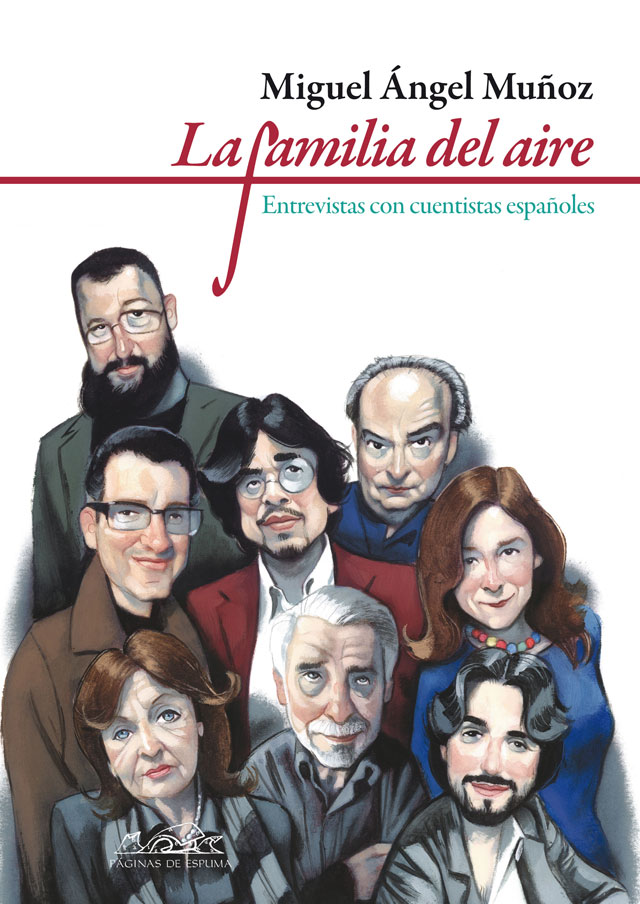
From bottom left clock wise: Cristina Fernandez Cubas, Miguel Ángel Muñoz, Hipolito G. Navarro, Fernando Iwasaki, Enrique Vila-Matas, Mercedes Abad, Andrés Neuman, José María Merino
La familia del aire: Entrevistas con cuentistas españoles (The Family of the Air: Interviews with Spanish Short Story Writers)
Miguel Ángel Muñoz
Páginas de Espuma, 2011, 474 pg.
The Spanish short story writer Miguel Ángel Muñoz’s La familia del aire: Entravistas con cuentistas españoles (The Family of the Air: Interviews with Spanish Short Story Writers) is an invaluable guide to the modern Spanish short story, and one of the best books I’ve read on the art of writing. Muñoz is an excellent and dedicated interviewer whose questions show a deep and thoughtful reading of each interviewee’s body of work. He sees interviews as not just another genre, but as an art unto itself and as he mentions in his introduction, he keeps collections of interviews in binders. He believes that letting an author talk about his or her work helps expand it, place it in a deeper context, rather than only letting the work speak for it self. It is this deep devotion to short stories and his ability to draw from the 37 included authors what makes short stories so compelling makes the book a must read for anyone interested in the short story. It is all the more impressive since all the interviews were conducted over a series of 3 or so years and published on his blog, El sindrome Chejov. In one of those great acts of personal fascination lived publicly, in 2006 Muñoz began to interview Spanish short story authors. What started quietly without any grand ambitions, morphed over the intervening years into one of the primary sources about authors working with the short story. Muñoz notes he was a little surprised by the willingness the authors agreed to interviews, but his dedication and preparation, which at the minimum includes reading each interviewee’s oeuvre, makes him a trustworthy interviewer, one that most writers would love to have. Muñoz also brings an sense of excitement to the short story. When reading his interviews (or his blog posts) it is easy to catch that same excitement—I should know, since every time I read one, I want to go out and read the author’s stories. The book is truly a one of a kind success that I wish existed for English language authors.
The only draw back of the book for my English language readers is that very few of these authors are available in English (certainly not the author’s fault). I have tried to remedy that with my recent article about unpublished Spanish Short story writers at the Quarterly Conversation. And when an author has been translated into English it is usually a novel. The most recognizable name in the book is probably Enrique Vila-Matas. Andrés Neuman, the last interview of the book and one of the better ones, also just had a novel come out in English (read my review here). That said, one of the most fascinating things about the book for an English speaker is to see what authors have influenced these authors. Given that English language authors may not be exposed to as many translations as they are in Europe, it might come as a surprise that two of the most common names that came up were Raymond Carver and John Cheever. Over and over in the list of influences these two always showed up. Some authors have turned to the English speaking authors as a refuge from the Spanish language traditions, but even when they cite Spanish language authors those two show up. I’m not so sure that would be the case for the reverse. Other English language authors mentioned were Poe, Anderson, Fitzgerald, Hemingway, Mansfield, Lorrie More and Alice Munro.
Spanish language influences tended to come mostly from Latin America. Cortazar was the most sited, the Onetti and Borges, and with a little less frequency Rulfo. There was a sense of disinterest in Spanish short authors from the middle of the century. The only two that were commonly cited were Juan Eduardo Zúñiga and Medardo Fraile. I think this is a function of one generation turning against another, something Andrés Neuman noted, saying that Spanish authors should take more pride in their own tradition with mid century authors like Ana Maria Matute. Only one author, Fancisco Afilado, though, really did not like the Latin Americans, especially Cortazar who he said led too may young writers to play games with their stories. Again, as a contrast to the American scene that notion of play is often lacking and too many write in the realistic vain. Afilado, naturally, is the author who loved the American realists the most, and is a perfect example of those who believe that noir is the best writing because it is the most real. I can’t say I agree with that, but it was refreshing and annoying at the same time to find one author in these interviews who has that opinion.
There were relatively few references to authors outside of the English and Spanish traditions. There were, of course, the trinity, Chekhov, Maupassant, and Kafka, but relatively few references to authors from any other languages (except perhaps Catalan). Only once did I see a reference to Thomas Bernard, for example. But given who rich both of these traditions are, there is quite a bit to mine in terms of influence.
With the exception of a few novelists, all the interviewees are dedicated to the art of the short story. As such, every interview has a question about the disrespect given to short stories in Spain. There were several theories all of which probably have some validity. My favorite was Carlos Castán’s theory that all the Christmas stories that come out ever year and which written by famous authors, turn readers away from the short story, because the stories are written by people who are not short story writers. I think the lack of critics who specialize in the short story, especially those at newspapers, is probably a better theory. The short story has the perception that it is just what you do between novels. Another mentioned that the public likes to engross themselves in a big story and don’t like the stopping and restarting that a collection of short stories entails. That may be the prescient commentary: it is one I sometimes feel when I am reading collections of short stories, especially ones larger than 200 pages.
Of course, things always look better across the water, and there were multiple references to the tradition of the short story in the US. However, I often feel that what they are looking at is a tradition that is from 30 years ago, if not father back. While major publishers do bring out collections of short stories, they are still a small fraction of published fiction. And while there are small magazines and journals like Tin House, the short story also lacks for prestige. Perhaps things are better here, but it certainly is not a paradise.
Ultimately, the book with its ample indexes, appendices of authors cited in the interviews, and a list of each author’s published works, short story or otherwise, is one of the best references to the short story I can think of. And as one might expect my list of authors that I’m interested in reading has grown. These are just a few that you may see on these pages some day: Mercedes Abad, José María Merino, Medardo Fraile, Juan Eduardo Zúñiga, Iban Zaldua, Ángel Olgoso, among others. That, I think, is the highest praise for La familia del aire: Entravistas con cuentistas españoles.
The Peruvian author Fernando Iwasaki has release a new book of short stories which collects his early works in one volume. The stories were written between 1987 and 1993 and published in two volumes. The ever interesting Paginas de Espuma has just reissued them. An excerpt from the publisher is available here. The story, in many ways, shows themes that he has mined since, especially in España, a parte de mi estés premios. It is about a Peruvian of Japanese descent who is given a Samurai sword that belonged to his grandfather, the last of the great Samurais. He uses the fabulistic and pop cultural images of Japan to tell an emigrant’s story. For what I’ve read of Iwasaki, he tends towards the comical and plays with perceptions in his writing, avoiding the more realistic, something that can be refreshing.
You can also listen to an interview with him on El ojo critico and read about his method of writing short stories. He generally writes thematic collections, but the ones in these volumes are more disparate. (Via Moleskine Literario)
El escritor Fernando Iwasaki saca a la luz sus primeros relatos en el libro Papel carbón, en el que incluye los volumenes Tres noches de corbata y A Troya, Elena, en los que se incluyen los cuentos que el autor escribió entre 1987 y 1993. Este libro responde a “una época en la que acumulaba los cuentos que escribía y después decidia si tenía el número suficiente para reunirlos en un volumen”, ha explicado este lunes, en declaraciones a Europa Press.
Por tanto, a diferencia de lo que hace ahora, no tenía un “plan” establecido. “Era un método un tanto maternal: estaba de siete cuentos e iba a tener un libro”, indica. Según explica el autor, se trata de relatos que escribió entre los 22 y 32 años. “A esa edad no te ha pasado nada especialmente importante, las cosas relevantes ocurren en la adolescencia y después de los 40”, subraya.
The Spanish author Eugenia Rico has published a new book of short stories from Páginas de Espuma called El fin de la raza blanca (The End of the White Race). Not having read the whole book, the title is a little off putting for how loaded a term it can be. You can read an excerpt here. I wasn’t too impressed, but you can also read an English translation of part of one of her novels here. There are also some links to videos, etc.
She has one of the more interesting book trailers I’ve ever seen, one that doesn’t try to use a text genre in a visual genre.
Hacerse el muerto
Andrés Neuman
Páginas de Espuma, 2011, pg 138
Andrés Neuman, one of the 20 selected by Granta last year, is one of the best of the group of the writers and Hacerse el muerto (Playing Dead) a collection of 30 stories is ample proof of that. Although little of his work has been translated into English yet, two of the stories from this collection are in the Granta volume with slightly different titles: Madre atras (Mother Behind) and El infierno del Sor Juna (Sor Juna’s Hell). What makes his short stories so good is devotion to the short story form as a means to explore different narrative ideas. He has no one style of writing the stories and some range from the heart felt descriptions of the loss of his mother to the fabulistic Sor Juna’s Hell to meta fiction that is consumed with the role of story. It should not be surprising that he has such interest as he has already published 3 other books of short stories and has edited one collection of Short Stories from Spain. That devotion even extends to the inclusion of 20 aphorisms on the art of writing short stories, of which many are koan-like and offer not only a guide to the writer, but a guide to Neuman’s art.
Hacerse el muerto is structured around the theme of death in all its forms, whether real or not, and is broken into six five story sections are thematically and stylistically linked. It is an approach that allows him to experiment with many different forms and modes of story telling. The book opens with El fusilado (The Firing Squad) a story of a man who is kneeling before a firing squad. Neuman describes the fear and terror in linguistic terms, taking apart the logic behind the words. But in that final moment when the order to fire is to be given, the true nature of the firing squad is given: it is a joke. The firing squad marches off laughing, calling him faggot. He is alive, but he is also dead, all his energy spent waiting in fear, he can do nothing more than lay in the mud like a dead man. In Un suicida resueño (A Reverberating Suicide) the narrator explains how he tries to kill himself but every time he tries to pull the trigger he breaks out laughing and is forced to drop the gun. The best he can do is wait and see if that laughter will go away, a sub conscious laughter that makes fun of the narrator’s seriousness and gives him something to live for, even if its to try again.
The above stories are well written and have great turns, but the stories that make up Una silla para alguien (A Seat for Someone) and the story Estar descalzo (To Be Shoeless) are the most arresting. All of them focus on the loss of a parent, mother in the former, father in the latter. He captures a sense of loss that is tied to the absences objects remind us of. In Estar descalzo the narrator is given his father’s shoes in the hospital and it is his relationship to the shoes that is the means for overcoming loss. Or in Madre atras (Mother Behind) he gives a sponge bath to her back and uses the sponge to write what he has wanted to write since they had entered the hospital. Each of stories (often you might call them prose poems) are a meditation of loss that are subtle and not interested in the immediate feelings of grief, but a reflection years later of what it meant. Perhaps the best example is the very short Ambigüedad de las paradojas (The Ambiguity of the Paradoxes), which captures not only how beauty and loss go together, but how Neuman approaches those ideas, always leaving the story open.
Enterramos a mi madre un sábado al mediodía. Hacía un sol espléndido.
We buried my mother one Saturday at mid day. There was a splended sun.
Neuman also likes to experiment. In the section titled, Breve alegato contra el naturalismo (A Brief Argument Against Naturalism) he constructs five meta stories that either are interested in how one writes, or tries to break out of the naturalistic tendency in fiction. The most successful example is Policial cubista (Cubist Police Officer) which describes a murder scene in terms of a cubist. If you use Nude Descending a Staircase as an example the story makes perfect sense. In each case, it isn’t just one image, but multiple images as if you were seeing several photos at once. So in Neuman’s story you see the body, but you also see the person fleeing the scene. In a compact 200 words or so, he describes the arc of the encounter that led to the murder. It is a clever story that is as economical as a story could be and a great reuse of cubism.
Reading the stories of Andrés Neuman it is obvious that he is a great story teller, especially of the micro-relato (less than 1500 words). His stories are notable for their economy and the way he can pull the surprising conclusions together at the very last minute in ways that are both satisfying and leave the world of the story open, leaving one wanting to return to what passed by so quickly. That is the mark of a good writer.
To finish I’ll leave you with a couple of my favorite quotes from his ideas about writing short stories. These are not rules, as he points out, but ideas that are still evolving.
Mucho más urgente que noquear a lector es despertarlo.
It is much more important to wake the reader up than knock them out.
El cuento no tiene esencia, apenas constumbres.
A story does not have an inherent nature, it scarcely has customs.
Páginas de Espuma, the short story only press in Spain, has published a book of interviews with Spanish short story writers, La familia del aire. These interviews are all available on the blog of Miguel Ángel Muñoz, El Sindrome Chejov. I have read many of them and if your are interested in the New Spanish short story they are a great collection and insight into the short story writers in Spain today.
Concer Al Autor has nearly a hundred short videos of Spanish authors talking about their books. Some of it is a little short and of course about their most recent book, but interesting nonetheless. The Paginas de Espuma subsite is filled with authors I am much more familiar with including Javier Saéz de Ibarra y Andres Neuman. http://www.conoceralautor.com/paginasdeespuma/
The ever excellent Páginas de Espuma has release Pequeñas resistencias 5, its latest collection of short stories by authors under 50. The collection contains works by 40 authors most of whom focus on the short story. Andres Neuman, who is the editor and one of the Granta under 40, noted in interview on Ojo Critico that the book is focused on the stories. Many times collections like this come out and it is focused on getting well know authors, who write short stories but are mainly novelists. His goal is to find the specialists.
At 500 pages I’m sure it has some interesting work. A description from El Pais:
El cuento ha ganado espacio entre editores y lectores a base de argumentos ingeniosos y calidad narrativa. Un buen ejemplo: la historia de un desdichado que se dedica a responder los spam para aliviar los agujeros dejados por una soledad mal llevada. Este y otro puñado de relatos, firmados por 40 escritores nacidos después de 1961, se incluyen en Pequeñas Resistencias 5, Antología del nuevo cuento español, presentada ayer bajo la mirada escrutadora de una veintena de autores en el salón Borges de la Casa de América de Madrid.
Los escritores de esta edición, entre los que se encuentran Mercedes Cebrián, Elvira Navarro, Espido Freire, Berta Marsé o Ricardo Menéndez Salmón, no pertenecen a una misma generación ni tampoco pueden ser encasillados dentro de una corriente estética. Se trata, simplemente, de autores de distintas edades que han publicado al menos un libro de cuentos desde 2001.
El encargado de la presente edición fue el argentino Andrés Neuman, quien explicó que la selección se ha basado en la diversidad estética y en las propuestas de calidad. “En esta sociedad de la hiperabundancia”, dijo, “un libro de estas características sirve para ofrecer una síntesis al lector”.
Estados Unidos y América Latina tienen una tradición cuentística más arraigada que la de España. Páginas de Espuma asumió hace diez años el desafío de llenar esa “fisura de manera casi quirúrgica”. Para “celebrar” esos diez años dedicados a “vivir del cuento”, también se editó un libro con retratos del argentino Daniel Mordzinski -o “fotinski” como le llamó Andrés Neuman-.
El primer tomo de Pequeñas resistencias salió en 2002, dedicado al nuevo cuento español. El segundo reunió textos de autores centroamericanos; un tercero se dedicó a la nueva literatura suramericana, y el cuarto recopiló textos de Norteamérica, México y el Caribe. “Es una herramienta muy útil porque sirve para entender por qué caminos va el cuento en nuestro idioma y por dónde puede ir en el futuro. Como brújula funciona muy bien; es una antología que corrobora el buen momento que vive el cuento en español”, indicó el escritor Eloy Tizón, prologuista del tomo, que cuenta con 505 páginas.
Juan Casamayor, director de la editorial, y condecorado de manera simbólica con un pin de Edgar Allan Poe, repasó las andaduras del sello editorial desde febrero de 2000, cuando apareció en las librerías el primer título, Escritos de Buñuel. A juzgar por el interés creciente de los lectores, ha quedado claro que los libros de cuentos ya no suelen ir a parar a la basura.
I had the luck to have a couple of days to do some book shopping in Barcelona and came back with 7 books. It was hard to limit myself because I recognized so many authors that I’d seen on El Publico Lee. And when I found the display of books from Paginas de Espuma on my last day I was tempted to buy a couple more books. In the end I settled on the following, a mix of Latin American, Spanish, African and Lebanese books. I normally don’t buy books translated into Sanish but Zeina Abrached’s books are unavailable in English so I could justify it.
Felix J Palma -El menor espectaculo del mundo
Miguel Angel Munoz – Quedate donde estas
Zeina Abrached – El juego de las golondrinas
Zeina Abrached – Me acuerdo Beruit
Daniel Sada – Ese modo que colma
Horacio Castellanos Moya – Con la congoja de la pasada tormenta
Hernan River Letelier – El arte de la resurrecction
For the Adolfo Bioy Casares completists Spain’s Páginas de Espuma is publishing a book of photos and a diary he kept during a 1960 trip to Brazil. I don’t know what the photos are like, but you can read the publisher’s press release.
La mirada de un viajero, Adolfo Bioy Casares en Brasil El 6 de septiembre se realizará su lanzamiento mundial y se inagurará en Madrid una exposición que recoge las fotografías del libro
Madrid.- El próximo 6 de septiembre se realizará el lanzamiento mundial del libro Unos días en el Brasil (Diario de viaje), del escritor argentino Adolfo Bioy Casares, y con posfacio del editor y traductor Michel Lafon. El libro será publicado simultáneamente desde Argentina y España por las editoriales La Compañía y Páginas de Espuma, que suman de este modo un título más a su labor en común. Fruto de esta colaboración, en septiembre títulos como Lady Susan, de Jane Austen, o Nabokov y su Lolita, de Nina Berberova estarán disponibles en las libreráis españolas, mientras en las argentinas lo estarán El último minuto, de Andrés Neuman o Tres por cinco, de Luisa Valenzuela.
Las páginas prácticamente inéditas de Unos días en el Brasil (Diario de viaje) recogen el diario de un viaje en 1960, motivado por la invitación que Bioy Casares recibe de la organización del congreso del PEN Club en Brasil. Unos días en el Brasil recorre aquellos días de 1960 que Bioy estuvo entre las ciudades de Río de Janeiro, São Paulo y una incipiente Brasilia, de la que se celebra su 50º Aniversario como capital de Brasil. Testimonio de uno de los autores claves de la literatura en castellano del siglo XX, este diario se completa con una serie de fotos inéditas de este viaje. Coincidiendo con el lanzamiento, se celebrará una exposición titulada Basilia 1960. Fotografías inéditas de Adolfo Bioy Casares en la Galería Guayasamín de Casa de América en Madrid del lunes 6 de septiembre al domingo 19. La construcción de la ciudad comenzó en 1956, siendo Ludo Costa el principal urbanista y Oscar Niemeyer el principal arquitecto. En 1960, se convirtió oficialmente en la capital de Brasil. Junto con Putrajaya (la capital administrativa de Malasia) y Naypydaw (la nueva capital de Birmania) es una de las ciudades capitales de más reciente construcción en el mundo. El 8 de septiembre a las 20 horas será la presentación del libro en Casa de América. El acto contará con la presencia de Eduardo Berti, Juan Casamayor y muy especialmente del editor, traductor y ensayista francés Michel Lafon, que esos días concederá entrevistas. Según palabras recogidas en su posfacio, el diario tiene un cometido íntimo y personal del autor “para seguir transformando cualquier día de su vida en un viaje y una aventura, cualquier lugar del mundo en una isla encantada, donde todo se vuelve posible, e incluso deseable”. Lafon mantiene que Bioy ” no sabe por qué aceptó la invitación, no tiene nada que decirles a los otros invitados, rechaza las amistades obligadas y los ejercicios impuestos, odia la retórica vacía, no quiere hablar en público”. Aun así, Lafon acaba preguntándose: “Viajar para escribir, escribir para olvidarse de que uno está viajando, y para recordarlo después. ¿Y si Bioy fuera el mayor diarista del continente?”.
For your end of summer reading pleasure: short stories from Andres Neuman, Fernando Iwasaki, Hipólito Navarro, Clara Obligado, and Patricia Esteban Erlés. These are all in Spanish and unfortunately I doubt Google translate will help. All of these links are via the publisher Paginas de Espuma.
El Pais has a story about the dynamism in the Spanish short story of the last 30 years and naturally it is brief. It mentions some of the authors, blogs and presses I have mentioned in these pages over the last few months. I don’t have time to translate anything from it, but you can always use Google translate or read my thoughts on Hipólito Navarro or Fernando Iwasaki.
Para Valls, su nueva antología certifica un hecho insólito hasta ahora: “La continuidad desde los años setenta de un género que en el panorama español ha sido guadianesco”. Ello pese a la calidad de figuras como Ignacio Aldecoa, Juan Eduardo Zúñiga o Medardo Fraile. Para Eloy Tizón, por su parte, la gran muestra de la vitalidad del género es, en lo literario, el hecho de que estos dos últimos sigan activos a la vez que los 35 nuevos autores antologados por Valls: de Carlos Castán, de 47 años, a Matías Candeira, de 26, pasando por Hipólito G. Navarro, Pilar Adón, Ricardo Menéndez Salmón o Elvira Navarro.
“Están a la altura de los autores latinoamericanos de cuentos de su generación. Eso es algo que podemos decir pocas veces”, afirma Fernando Valls de unos autores cuya “melodía de época”, dentro de una gran variedad de temas, sería su pertenencia a “la tradición del realismo” y una “asimilación no mimética de las vanguardias”. Más que boom del cuento, apunta Casamayor, lo que hay es “un crecimiento sostenido”. Un crecimiento al que han contribuido tanto las ediciones de cuentos completos de grandes clásicos por parte de Alfaguara, Lumen, Anagrama o Alba como los minilibros con uno o dos textos lanzados por Alfabia, Gadir o Alpha Decay.
Recently I read two books from the publisher Páginas de Espuma, a Spanish press devoted to the art of the short story. Both España, a parte de mi estos premios (Fernandow Iwasaki), and El pez volador (Hipólito G. Navarro) are very good and are part of the resurgence of the Spahish short story. Páginas de Espuma has published many of the writers that are part of the resurgence and fills an important role in celebrating an art that is often held in less esteem than the novel. But the catalog doesn’t stop at modern Spanish writers, but includes thematic collections and republications of older writers. Recently they published an edition of Poe’s stories with an introduction for each story written by a different author. With El pez volador they have introduced a new series, Vivir del Cuento (Living with stories) that I hope they continue with. The books is divided into three parts: a long overview of the work of the author; a representative sample of the author’s stories; a long interview with the author. It is a great way to get an introduction to an author’s work, especially if you are not familiar with his or her milieu. Hopefully, next time I get to Spain I can pick up a few more books of theirs.
 Página 12 has an interview with uan Casamayor Editor of Páginas de Espuma, one of my favorite publishers right there with Open Letter. They specialize in short stories and have published some great works by some of the best in short stories (see my reviews of Navarro and Neuman). The interview talks about the press, its history, and the craziness of the publishing industry, which functions in Spain much like it does in the US.






 By The Firelight