Catastrophe 1914: Europe Goes To War
Max Hastings
Knopf 2013, pg 628
Max Hastings’ history of 1914 is a magnificent account of the events leading up to World War I and the first months there after. Catastrophe is the appropriate title for the book, because in every stage of the outbreak of war the participants made so many horrendously bad decisions. It is too easy to say war is always a waste, disaster or insert your description, without understanding the full disaster that one the size of World War I was. A hundred years on there are many ideas held, if held at all, about the war that obscure the reality of what went on. Hastings is not a revisionist but he is interested in looking at the first year of the war with freshness. Of course, when discussing the start of the war the eternal question must be answered: who was responsible for the start. While Hastings suggests all sides had some blame given the alliances system. However, he squarely believes that Germany was the chief culprit in letting the war get going. Austria was a greedy bully living in its splendid imperial decay and had no business trying to control the Balkans, but Germany with the blank check given to Austria if it were to suffer a Russian attack is really the central player. He also criticizes Russia for its rush to war. Ultimately, though he points out that it may have been hard to avoid the conflict given that many of the countries involved were looking to start a war. The Austrians had an outsized view of their power and thought they could easily take on Russia. Germany was paranoid that they would soon be strangled by the growing economic power of Russia and with the growing size of the Russian rail roads they soon would be unable to fight a two front war. Hastings is also dismissive of the idea that the any one country could have avoided the war or negotiated their way out of it. The Central Powers were too tied to a militaristic stance and underestimated the ability of other countries to defend themselves. Moreover, the German plan required a quick advance into France to knock them out of the war in what is commonly referred to as the Schlieffen plan, before the Russians could mobilize. Moreover, once the armies were mobilized they were difficult to stop. On the Entie side, fast mobilization, too, was required to prevent surprise. In other words, all sides were on hair triggers and once committed, felt their was no way to stop otherwise their battle plans, ones the various armies had worked on for years, would fail. The British experience is a little different since they were not in the immediate path of invasion, but Hastings argues that Great Brittan could not let Germany become the sole power in Europe because their position would become tenuous, and given that Germany was committed to attacking their was nothing they could do. For Britain it is an ironic outcome because they believed Austria had good standing and were the victims, not the Serbs.
Hastings devotes 3/4 of the book to the actual war. Given that we are only talking about a six month period, Hastings is quite detailed in his analysis of the war. As any one who reads about the war will now, much of the combat in WWI was a disaster of old strategies and new technologies. In the opening moments of the war that was never more apparent. Amongst the great jubilation of each nation, most assuming this would be a quick war over by Christmas, millions of men were led to the front with ideas and tactics out of the 19th century. The most egregious, perhaps were the French and their red pants, but all countries went to war unaware of how destructive the new armaments had become. Yet despite technological advances in armaments, those of transportation had not matched pace and the German plan which required quick movement would ultimately fail because once the armies reached the end of their rail networks, they were on foot and at a disadvantage to the defending French who could make use of their rail lines. For Hastings, and many others, it was this single fact that made it impossible for the Germans to succeed. Not that they didn’t come close, and Hastings is critical of all the generals. Joffre’s, and France’s, commitment to attack was bad and the battle of the Frontiers, the plan to take back Alsac Lorianine, a disaster that if Joffre had not succeed in transferring armies to the west in September, he would have gone down as one of the worst generals of the war. The British were poorly led and though useful, were not particularly important. The last point is contrary to may histories and popular lore in England that says they were critical to the defense. Ultimately, what Hastings is at pains to point out is that the first months of the war were the most deadly of the war. Massive armies, often with ill trained reservists and new recruits, were launched at each other without an understanding of what the new weapons would do. The staggering loses are hard to imagine. For the British the greatest single day loss of life was in 1914, not during the Somme. Hastings defends the generals to some degree, noting that their callousness in the face of such losses is part of the role of the commander. However, there catastrophe that was the opening months was still inexcusable.
His coverage of the eastern front is as equally detailed. Though the war would always be decided on the western front, the disaster that happened on the east was just as large. The Austrian army collapsed almost completely and was no match for either the Russians or the Serbians. And if the war in the west was brutal, especially with bad training and horrendous care for the wounded and civilian populations, the east was even worse. The wounded often had little care and many of the deaths were due to wounds. The east was more savage in another way: the Austrian atrocities. They had a policy of preemptive and demonstrative executions to keep the local population under control.
Ultimately, for Hastings the Entie powers had no choice to fight the war and what they represented was a better outcome of the war. He particularly points out the German behavior in occupied zones. While no where near that of World War II it was still known for arbitrary and brutal punishment for any opposition to their rule. He notes this was partly in response to what happened in the Franco Prussian war when franco-saboteurs harassed the Germans. But in no way does it excuse the atrocities they committed. He also notes that due to the sensitization of the atrocities in propaganda it has been easy to dismiss them and say both sides were equally to blame and a victory either way would have been the same. I think most English speaking readers will agree. Catastrophe is an excellent history and one that is best at describing the pointless brutality of the opening battles.

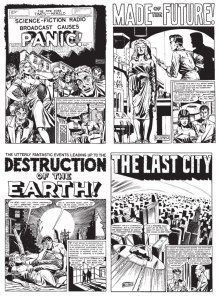 Time travel offers many opportunities for paradox and these stories are no exception. Made of the Future! is the best, and perhaps worst, of these. In the story a man stumbles on to a tour of New York given for people from the future. He sneaks along with them and in the future finds a place that makes instant wives. He brings here back to 1950 and enters bliss. But then she goes out for a walk and never returns and he realizes she must have ended up on the tour and never returned. Despite the leap in logic to her eventual fate, it has some nice touches, especially the notion what comes easily disappears easily. I called it perhaps the worst story because the sexual politics of the story are rather strange. The idea that you can just buy the perfect woman in the future is not a healthy prospect and once again turns women into commodities.
 Just in time for the 100th anniversary of World War I is Goddamn This War! by Tardi with chronology by Jean-Pierre Verney (translated by Helge Dascher). The book is a brief history of World War I that eschews plot or characterization and instead dwells on the massive incompetence and horrid logic of the war, using mounting barbarities as an indictment of the war. The book seems as if it is narrated by a soldier and in a way it is: the voice of the nameless, a kind of chorus, recounting pointless act after another. Told in little short vignettes that relate everyday life of the war, Tardi shows the pointless of it all. From relating the death of a man while doing his business to showing the graphic moment results of a shell landing in a trench to showing a snow covered field with blood leaking through. No moment of the grotesque escapes his vituperation and sarcasm. If you’re squeamish this is not a book for you; however, there is more here than just war porn. Tardi is reasonably effective in showing the low points of the war (mostly that’s what they were). The basic chronology and graphic depiction of it will give anyone reading this an excellent insight into the war. He does narrate the major events, such as when Italy enters the war or the Battle of Verdun is taking place, what interests him, though, is not the movement of troops or the political implications, but how little it matters. In addition to Tardi’s narrative there is a fine chronology of the war written by Jean-Pierre Verney. Like Tardi’s work it show’s just how badly run the war was and how unprepared the French and British were. The chronology and Tardi’s work make this anything but a typical work of military history. It seems more like the work of the German anarchist Ernst Friedrich’s Krieg dem Kriege (War against War!), published in 1924 and filled with images what really happens in war, the maiming, deaths, etc. It is in this focus on what happened, what the aftermath was like for those with facial wounds, what little support the disabled were given, that his book takes on its real power: the reminder that war is more than just movement of little ticks on a map.
 By The Firelight