The High Window by Raymond Chandler – A Review

The High Window
Raymond Chandler
Library of America, 1995

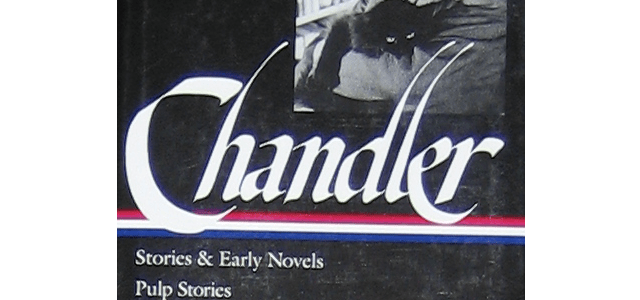
Chandler’s The High Window is shorter and less robust than his other novels, but it is one of the few that I have not seen in a movie version (one exists from 1944 but it isn’t considered a particularly good film). In theory that should make for a better reading experience. It has the usual collection of reprobates and self destructive lowlifes. Still, it feels a bit sanitized, as if the real dark side of LA had been overlooked. Sure there are the murders and the mysterious young woman who is kept as a virtual slave in the house of his Marlowe’s client, but there isn’t any tension to them. They just happen 1,2,3 and each time Marlowe goes back to his client, a port drinking shut-in, only to have her refuse to answer his questions. After all that back and forth, Marlowe explains what happened. It is not a particularly interesting way of doing things. Any work of mystery that has to have a lengthy explanation at the end of it to explain what happened is usually a failure. Chandler usually managed to avoid those failures. On the plus side, his depiction of the drunks on Bunker Hill has his typically dark clarity, as do all his depictions of alcoholics. And the young private eye that follows him around only to get killed is funny, if nothing else. As a work of Chandler, though, The High Window is a disappointment. In part because his client, stays in the shadows, both figuratively and literally and does not animate the novel the way Farewell, My Lovely or The Big Sleep. Without that interaction in the plot, something is missing. The High Window is, at best, an intermezzo between his better works, and one any person new to Chandler should not read first.

Natasha Wimmer Interview about Bolaño at Conversational Reading

Conversational Reading has an interview with Natasha Wimmer about Roberto Bolaño’s latest book to be published in English, The Third Reich. It s a good interview, especially the parts about approaching a Bolaño novel.

SE: It’s interesting that you read the novel’s lack of a strong climax as a positive thing, since I’ve seen a number of reviewers ding The Third Reich for not having that one culminating scene of horror that many of Bolaño’s other novels accustom you to expect. (For my own part, I liked the anti-climax, regarding it more as a failure of Udo’s transformation than of Bolaño’s imagination.) To tie this in to your reading of the book as a farce, do you think there’s a certain perception out there of what Bolaño represents and that a book like Third Reich will be judged in terms of what’s accepted “Bolaño” instead of simply on its own terms?NW: Yes, I do think that there is a certain expectation of what a Bolaño novel will be, and I worried from the beginning that critics wouldn’t appreciate The Third Reich. Mostly I thought they would have problems with it on a sentence level, because Bolaño’s prose is thinner and more transparent than usual, with fewer of the oblique-lyrical moments that so dominate a novel like By Night in Chile, for example. My sense of the book, though, is that it’s one giant oblique-lyrical moment, and that the pacing is what gives it its stylistic edge and distinctiveness. It’s a book that leaves you feeling off-balance without realizing quite why, because the effect develops so gradually. I like your interpretation of the anti-climax as a reflection of the failure of Udo’s transformation, although I do think that he’s changed—diminished, or somehow shrunken—by his loss of faith in gaming, absurd or creepy as that faith was.

Farewell, My Lovely by Raymond Chandler – A Review

Farewell My Lovely
Raymond Chandler
Library of America, 1995

The problem with Chandler is that every time I read him I hear voices: Humphrey Bogart, Dick Powell, Robert Montgomery and even Gerald Mohr (thankfully, not Elliot Gould). Because I’ve listened to dozens of Richard Diamond radio shows Dick Powell is the foremost of the voices, but they’re all there and as I read the novel itself seems strange, foreign, as if it were the fake and all the films and radio versions were the real thing. That cultural ever-presence distracts one from the source and obfuscates through layers of sanitizing changes the real Chandler and his clear observations. As I read him, scraping away layers of Hollywood, I’m always surprised at the society Chandler describes: its as petty and real as the one I know. There is no tabu that he is unwilling to acknowledge and it is that willingness to show every nasty detail that makes returning to his books so rewarding.

When thinking about Chandler, if you can separate yourself from the film and radio versions, the way he constructs the narrative voice is refreshingly clean, edited down to an almost editorially free mode of observation. That the observations are commentaries in of themselves goes without saying, but he always remains professionally detached. Perhaps not to the level of a Johnny Dollar, but its there. Of course, that detachment is suspect with women characters. Still even his romantic interests have the sense of the reportage about them. This might not seem so important, but when compared to his contemporaries, even some non crime writing, the clarity of his work, uncluttered by repeating the obvious via internal monologues.  While I hate the “show don’t tell” prescription to writers, Chandler is one writer who knew how to follow it and it makes his work still stand.

Farewell, My Lovely opens with a clear eyed description of the changing racial make up of LA. Marlowe goes to a bar in central LA that had changed from white to black clientele. Like most things in these Chandler novels, Marlowe is in the area on a case and sees a tough enter the bar and decides to follow him in. It’s there that Chandler sketches the racial tensions of the changing city as the tough, Moose Malloy, cannot understand how the bar could change. That aggravation, first shown verbally through racial slurs, is ultimately expressed in a violence that leads to murder. When Marlowe is interviewed by the police, Chandler again shows the complete indifference of white society to the minorities. The cop in charge wants some glory from the case, but knows he’ll get nothing from it because no one cares. In those opening pages he sets up a great critique of LA, dark as it can be, and Marlowe is restrained in using racist language (he sticks with the then common negro).

Where his work breaks down, is the silly Indian character who seems like some stereotype right out of the movies. At one point in the book he is captured by a crime boss. One of his henchmen is an Indian who has a sideline as an Indian in western movies. Problem is, he talks as if he were on the plains of the old west circa 1880. Perhaps it was supposed to be a joke, but the only thing it is silly. Where he captured the corruption and racial tensions of LA in the bar scene, here he just imports mid century stereotypes for a little buffoonery that is not funny at all.

Still, it is the I don’t give a damn about you attitude that permeates the characters that makes the book so fresh. Nor is is a cartoonish look. Here I’m specifically thinking of the drunk woman he visits repeatedly. This isn’t a Hollywood drunk of so many noir films that has some semblance of control, but a total wastrel whose only goal in life is the next bottle. The busybody across the street from the woman is interesting, too, a nice depiction of the non criminal, but still having the Chandler eye for details.

Plenty of people have commented on the logic of his plots so I won’t bother here, and really I don’t care. They are good enough for me. It is the world he creates that interests me. But one thing that will strike anyone is that Marlowe is lucky and that several moments of the book hinge on fortunate accidents, especially when he is in a dark canyon and hit over the head and a young woman comes to his rescue. And the chances he takes, such as sneaking on to the gambling ship anchored off Bay City to confront the a crime boss. Occasionally, it is a little too much and were it not for the writing, perhaps it would be. (I can’t help but imagine Marlowe years latter suffering dementia for all the certain concussions he’s received.) Yet despite all that Farewell, My Lovely is an excellent piece of noir that rises above so much of the pulp material of the era (I’ve been reading some of it and have been quite disappointed. Just compare the first paragraph of Chandler’s Red Wind to anything else and you’ll see what I mean). One I could easily read again and hopefully, finally, get those voices out of my head.
When Borges Lost the Premio Nacional Because of Politics

The Nobel wasn’t the only prize Borges lost because of politics. He also lost the Premio Nacional in 1941, the year of El jardín de senderos que se bifurcan. Revista Ñ has an article about the ins and outs of his loss. Mostly, though Borges was ahead of his time.

La pérdida del premio acaso no fuera tan inesperada. En la bibliográfica que publicó en Sur en mayo de 1942, apenas antes de que se conociera el dictamen del jurado, Bioy Casares fue clarividente y se adelantó a los reparos que el libro recibiría: “Estos ejercicios de Borges producirán tal vez algún comentador que los califique de juegos. ¿Querrá expresar que son difíciles, que están escritos con premeditación y habilidad, que en ellos se trata con pudor los efectos sintácticos y los sentimientos humanos, que no apelan a la retórica de matar niños, denunciada por Ruskin, o de matar perros, practicada por Steinbeck?”. Captando el clima de época, Bioy conjetura que “tal vez algún turista, o algún distraído aborigmpensa nacional, a una obra exótica y de decadencia (…) juzgamos que hizo bien.”

Best Book of 2011 from Elvira Navarro, Carlos Yushimito, Ana María Shua and other Spanish Language Authors

Canal-l has put together a blog that lists the favorite books of 2011 by various Spanish Language authors such as Elvira Navarro, Carlos Yushimito, Ana María Shua. It is an interesting list and I have even read one book, Alberto Fuget’s Missing. Una investigación which I thought was a great book and one of my favorites of the year. Another I have been reading for a while, The Complete Short Stories of Lydia Davis. As with all the lists from outside of the US it is always fascinating to see how many books from outside the Spanish speaking world they choose.

Libro de mal amor by Fernando Iwasaki – Reviewed at La Jornada

La Jornada has a review of the Mexican republication of the Libro de mal amor by Fernando Iwasaki. The book was originally published in Spain, where Iwasaki lives, in 2001. Iwasaki can be quite funny and I have read one of his more recent books, España, aparte de mi, estes premios. This book sounds funny and interesting.

Fernando Iwasaki (Lima, 1961) es un autor que no goza de la fama que merece. Tal vez porque siempre ha escrito lo que le ha venido en gana sin afán de satisfacer a los lectores. Él mismo nos dice que “no cree en la escritura como texto de representación, sino como texto de presentación”.

[…]

Primero: cada una de las diez veces Fernando se enamoró de la mujer más bella del mundo. ¿Hay forma de que no sea así? Enamoradizo a más no poder, el personaje y narrador siempre supo entregarse por completo. Para ello requería ser seducido por una mujer que valiera la pena. Cada una de ellas lo valía por completo. ¿Se puede amar de otra forma? Parece ser que no.

[…]

La lista continúa. Pero la suma de las virtudes de este libro sólo sirve para evidenciar algo: reírse de uno mismo sirve para hacer literatura, para desmitificar el amor y para, en una de ésas, lograr presentarlo como sólo las palabras lo pueden hacer.

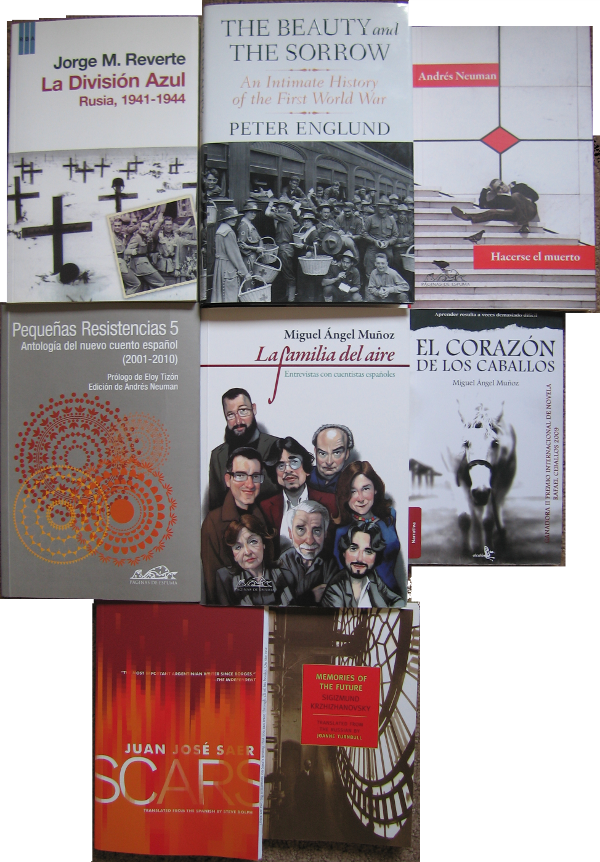
Recent Acquisitions – More Spanish Short Stories and a Little History for Good Measure

Christmas always means books to me and this year, between what I bought myself and a few gifts, my to read stack grew nicely. I continue with my reading, or should I say study, of the Spanish short story. And since I like history but don’t read it enough I picked up a few interesting titles. I can’t wait to read start reading them.

I forgot one:

Literary Resolutions 2012

For the last few years running I’ve been making a few small literary resolutions. This years are much like last years, read things I already own and get some fiction published. Simple right? Well if I look back on how well I did from last year, the first item wasn’t too bad. The main problem with the first is I keep adding to the items that I own, but that just shows my enthusiasm (my next post will be evidence of that phenomenon). The second, though, did not happen at all. I wrote, but sending things to publish is such a bore and eats time I could be writing or reading or doing something much more interesting. I guess that is just the way it is.

Last year I believe I said I wanted to read more in Spanish. I think I fulfilled that requirement. And for the year that comes I don’t think I’ll have a problem with that since quite a bit of what I bought this year was in Spanish, so if I’m reading what I own, in theory, I’ll be reading in Spanish.

Any one else have literary resolutions?