My Review of Fear: A Novel of World War I by Gabriel Chevallier Is Up

My review of Fear: A Novel of World War I by Gabriel Chevallier is up at Three Percent.

One hundred years have passed since the start of World War I and it is difficult to believe that there are still novels, considered classics in their own countries, that have never been published in English. Perhaps it was the overwhelming number of novels in English in the years following the war that prevented their appearance. Just looking at the list of American authors, a country whose contribution was quite short, Wharton, Cather, Cummings, Faulkner, Dos Passos, and of course Hemingway with A Farewell to Arms, makes it obvious that it was a subject that once had to be written about. Still, that doesn’t explain why perhaps the most famous WWI novel is from Germany, Erich Maria Remarque’s All Quiet on the Western Front. Maybe it was that a second even more devastating war eclipsed the first one, and pushed it into the background. It is a shame, because as Paul Fussell noted, World War I was a literary war and Gabriel Chevallier’s Fear: A Novel of World War I, ably translated by Malcolm Imrie, is a long overdue addition to that literature in English.

Gabriel Chevallier (1895-1969) was called up at the beginning of the war, wounded, and after convalescing returned to the front for the remainder of the war. Fear follows a similar trajectory: call up, wounding and hospitalization, and a return to the front. It follows a typical pattern of novels written by veterans and even echoes that of Remarque. The power that comes in front line narratives is not in the intricacies of plot, but in how they can evoke the experience of war. Chevallier is successful in his descriptions of the front lines, the constant shelling, the gruesome description of the dead, and one will come away with a sense of the terror and fear men faced. At times there is a monotony in this and it seems as if all there is to the book is moving from shell hole to shell hole. Yet it is that repetition without seeming purpose, a drama played out on an isolated stage where little context exists and the characters just survive one shelling after another, that is the real story.

Andrés Neuman on Julio Cortázar

Andrés Neuman published an excellent article on Julio Cortázar in El Pais this week, one that is worth reading and shows his breath as a writer.

Los cuentos fantásticos de Cortázar han sido aislados en un canon restrictivo que tiende a traicionar la genuina variedad de su poética. Las piezas perfectas (uno de los epítetos más recurrentes en su prosa) al estilo de Continuidad de los parques, escritas durante los años cincuenta y sesenta, han eclipsado una extraordinaria periferia que, contradiciendo la opinión oficial, incluye su obra tardía. Pese a los sobreexplotados artefactos de inversión como Axolotl, muchos de sus cuentos memorables (La autopista del sur, Casa tomada) no condescienden al malabarismo estructural, ni concluyen en sorpresa. En otras palabras, la mayoría de los cuentos de Cortázar operan al margen de la simplificadora ecuación con que suele identificarse su narrativa breve, persiguiendo más bien lo que él alguna vez denominó “mecánicas no investigables”.

Un ejemplo de esas afueras es Queremos tanto a Glenda, del libro homónimo, legible como parábola de la reescritura, pero también de la censura autoritaria; se trata de un excelente cuento político, descargado de lastres panfletarios. Y sobre todo Diario para un cuento, del postrero Deshoras. En este texto final y sin embargo fundacional, Cortázar declara su intención de escribir “todo lo que no es de veras el cuento”, los alrededores de lo narrable: el contorno de un género. Quizá por eso repita la frase “no tiene nada que ver”, a modo de mantra digresivo. Para éxtasis del hermeneuta universitario, en este cuento se cita y traduce, acaso por primera vez en una obra de ficción latinoamericana, un fragmento de Derrida.

Dead Stars by Álvaro Bisama – A Review

Dead Stars
Álvaro Bisama
Megan McDowell, trans

Álvaro Bisama’s Dead Stars is a fascinating take on a troubled woman’s failing attempt to survive political violence in Chile. The novel follows Javiera a woman who was beaten and raped by the Chilean secret police during the Pinochet era. She was a committed communist and lost everything, almost dying at the hands of the police as many of her contemporaries did. She is a troubled woman who returns to college, engaging in political activities and taking up with a student years younger than her. It is a rocky relationship and the fights and arguments are legendary among their friends. As the novel progresses it is a relationship that can never turn out well. Why she continues with her brutish lover is hard to understand but she gives up everything for him, even her relationship with the party, sliding farther and farther into obscurity until she only resurfaces in the newspaper with the police.

This is where the narration actually starts. A couple whose tension bubbles throughout the narration as yet another disappointed backdrop, is sitting in a restaurant and stumble on the article in the paper. The article not only shows a tension between the couple, but starts a narrative that is elusive, confrontational, and creates a dialog between what is remember able and what the narrators want to remember.

She said: You’re going to have to listen to me, you owe it to me; we’re going to spend the whole morning on this shit.

It starts just like that: with an image. The two of them sitting together. In the first row. By chance. I stayed in the back. It was the first day of classes. I didn’t talk to anyone. They talked to each other. Maybe that’s what defined everything. The first minute of the years to come, the laws o attraction that would embrace them, the solitude of the rooms they would inhabit and the desert they would flee to, the volume of gray sea’s murmur, like a dream of silence.

Already, Bisama starts to construct the narrative in a series of confrontations and memories. The two narrators are already negotiating what they are willing to construct as they listen to each other and remember what they can.

Their relationship to Javiera is one not one only of friendship, but of animus. She is the older survivor of the dictatorship and the female narrator felt smaller for it: “The past was a liturgy that excluded us from its miracle […] Because we had no share in the tragedy, and we had no right to ask for anything.” The statement puts a line between the veterans of the repression and those too young and now have different expectations, and throughout the novel one has the impression that a form of survivor guilt is at work in Javiera. The narrator doesn’t understand it in those terms but she does understand that the children of the 80’s are not the same politically engaged revolutionaries of the 60s and 70s.

Memory and the reason when remember keeps returning as a theme as the story evolves and the narrator’s try to make sense of what they are saying and why. The female narrator notes

But that’s how I feel now. Poisoned by other people’s stories, by other people’s lives. When I think about those two, that’s how I feel: I feel like the witness to something that no one cares about. That’s why I haven’t stopped talking, that’s why I’m not going to stop talking, she said.

Then the primary narrator chimes in

I didn’t tell her that I did know parts of that story, I didn’t tell her I’d seen Javiera and Donoso in some photos when I went through her old albums trying to get a look at her face back before we’d bet. It was another life. I wasn’t there. But I couldn’t tell her anything, ask her anything. It wasn’t my place.

Each narrator attempts to construct something. She who knew Javiera does it because she has no choice, as if she is obligated. Yet it is an obligation stemming not a deep bond something akin to guilt. And if one is poisoned by another’s stories why repeat them? Why not forget them? He for his part has attempted to construct something that is unconstructable: a image of Javiera that is his and is accurate. He knows it is hers to do.

As the story continues Bisama keeps returning to the question of why the story has to be told, if these two are really not that interesting. Can anything come from this act? It certainly will not bring the two narrators closer. And she only grows more doubtful as time goes on:

Her: Aside from many other things, the past is that: a photo taken in a hotel we wish was our home–false photographs, proof of the life we never had.

Later she rephrases it:

The past is always a newspaper page left behind on the ground, she said.

In each case there little to be gained from remembering the past. These kind of sentiments reflect something generational in the narrators. An escape perhaps from activist era of Javiera and the disillusionment with her behavior. The narrator during college retreats into punk, into rebellion that is not as political and what there is to remember just doesn’t mater.

Bisam’s continual reworking of the narrative purpose makes Dead Stars more than its basic plot suggests. It creates a narrative the questions if it she be told, and yet when read says, yes, it should. Javiera’s life is tragic, all the more so because no one knows what to do with it. She survived the police, but did not become a hero for it and lost herself and her history in the process.


Verdun: The Longest Battle of the Great War by Paul Jankowski – A Review

9780199316892_450Verdun: The Longest Battle of the Great War
Paul Jankowski
2014, pg 336

The more I read military history the more I’m convinced that most books divide into two types: the narrative of action; and the analysis of events. The former reads like a novel, full of action and sweeps the reader along—an exciting read, the stuff of adventure. The latter eschews narrative and picks apart elements of a battle or war, often returning over and again to a moment to look at it from a different angle. The former is easy to read, the latter feels more honest to scholarship asking questions that narrative sweep can obscure. Paul Jankowski’s Verdun: The Longest Battle of the Great War definitely falls into the latter camp and for that is an excellent account of the events and participants that made Verdun a byword for futility and waste.

Jankowski begins with an investigation of motives for the attack. In particular, he shows the Erich von Falkenhayn’s goal to bleed France white was really something he came up with after the war to justify his attack and his persistence. Jankowski notes that it is hard to know for sure these details because the German archives were destroyed in World War II, and both the French and German official histories have elements of propaganda in them. Given that Falkenhayn was not truthful, what were his reasons for continuing with the attack? And for that mater what were those of the French to hold on to a system of forts they had decided were useless and had virtually abandoned? In each case it seems as if there was a momentum that made it impossible to withdraw. The Germans couldn’t withdraw after committing so much, the French couldn’t afford to loose any more land. For the French, Verdun, as the battle dragged on, became a point of pride and instead of withdrawing to safer and more strategic zone they chose to fight.

Jankowski the battle itself was not as legend has led us to believe. The initial losses of the forts was as much luck on the German side as disinterest on the French side. But once lost they became focal points of the battle. The French were not prepared to fight the battle either. They were short of guns, especially heavy ones, but they did advantages when it came to supplying the troops. He spends considerable time looking at what made the troops continue to fight. On the French side it is a critical question because the next year the French army would see mutinies. He points out, though, that the commitment to the battle was stronger than later events would have us believe. It was when the futility of the battles of 1917 became apparent, the men lost their will to fight. His analysis is a complex picture of competing motives and pressures that kept the men at the front.

Ultimately, the brilliance of Jankowski’s book comes from the way he shows there are no easy answers to why the battle lasted so long, why the men fought it, and how the two sides were able to maintain the intensity. I think anyone reading this will come away from it with the impression that what kept it all going so long was simple momentum. And though it did help sap the French of their will to fight, the post war analysis and legends only served to obscure what really was happening and what the participants thought. Jankowski has added new light to those times.

Europe in Sepia by Dubravka Ugresic – A Review

Europe_in_Sepia_largeEurope in Sepia
Dubravka Ugresic
David Williams, Trans.
Open Letter, 2014, pg 230

I like the ideas suggested by the title Europe in Sepia, a place that is living on its past and uncertain where it is going. Is it a museum piece or something living, dynamic. And I like the idea of Dubravka Ugresic: a writer who has the insights and bravery to see the problems. As in her previous book Karaoke Culture this is true to a certain extent. Ugresic when confronting the realities of Croatia, her home country, is clear, concise and full of ire at the Croatian nationalism that looks back at mythic times of national purity as a way forward. Her experience as a writer who dares to question the exclusionary policies that come with national pride and to long for not a return, but a reckoning with the peaceful Yugoslav era. How could the Croats and the Serbs share a language and then suddenly not? These questions have led to death threats and she now lives in Amsterdam in exile. These are powerful questions because the flip side to preserving traditions and language, especially in small countries, is exclusion and extreme cases repression of out groups. In Ugresic’s telling, those who do not write about or celebrate the Croatian state are enemies of the Croatian people, even if those heroes were part of the fascist and murderous Ustaše.

When she steps away from Croatia and the Balkans, though, her precision weakens and in some cases she is just so ill informed her arguments are embarrassing. The fundamental problem is in her style. Most of her essays interweave her personal experiences to draw out a larger point. However, her personal experiences are those of an international literati (and as she would insist, one with little influence). She is not an investigator, a journalist, a scholar, or someone who spends time studding a subject. The effect is of one who misses so many opportunities do delve deeper into what is going on, to ask deeper questions, the questions that when you read her takes on Balkans you know she is capable. At her worst we have this

They’re hawkers of cheap souvenirs, angel figurines everywhere, the Slovaks stealing them from the Poles, the Czechs from the Slovaks. Croats sell gingerbread hearts and bags of lavender. Few display and imagination-imagination doesn’t sell. They wan UNESCO to protect their non-material resources; the Croats have already hocked off kulen and sparnik. Yes, they live off souvenirs, like European Indians in a European reservation. Honey cookies, gingerbread, a bit of folklore, embroidery and lacework, olive oil from handpicked olives, traditional local recipes. At the markets in Vienna these Indians (Serbs? Gypsies? Macedonians?) sell fake Roman coins and fibulas. Their squaws—women with bleached hair and faces roasted like Chinese smoked duck (sun beds are sill in fashion)—are ragpickers, traders in “original fakes,” clothing, caps, ans scarves. Everyone sells his or her bric-a-brac. Yes, the future is definitely elsewhere. In the time of communism watches sped ahead, now they go backwards.

On first read it has a certain coherence. But when you start looking at it, it is such as mishmash of ideas that it is irritating. First is the use of the word squaw. I’m not sure if this is the translator at work, but the word is considered offensive. But let’s put that aside because there is a bigger issue here: context. Comparing the American Indians to the groups in Europe with such different histories is lazy writing at best. Instead of asking interesting questions about identity and language and what it takes to maintain these and other elements of culture especially given the different power relationships over time (i.e., subjugation of Native Americans vs. European nationalism), she goes for facile comparisons. And the conclusion of the quote is indicative of her position, too. Given the disaster that the past is she wants to jettison everything about the past. That’ll never happen, and more to the point, there are things from the past worth saving. And I don’t think the slavish devotion to the future is necessarily a remedy either. There are so many potential ideas to work out in this brief quote, yet she just throws them around half developed and that is the greatest problem with her writing, the stutter stop flow of ideas as she comes across something else she doesn’t like. I would have stopped reading her some time ago if I wasn’t always hoping that once, just once, she’d bring it all together.

I have similar complaints with the rest of the book. The notable exception is at the end when she writes about women and writing. She is much more concise here and her arguments are much more narrow in focus and, thus, hold together better. What Is An Author Made of? is the best piece in the collection and one that I would put as a must read, without qualifications. It is so good, I wished it was at the beginning of the book because I almost stopped reading and would have been sorely disappointed had I missed it. Granted, it may only appeal to people interested in literary theory, but it is accessible and compelling. Her core argument is all the theories about the death of the author come at the expense of women and that it is easy for men to play these games with authorship because they have the power and luxury to play them. Moreover, these games tend to silence, or at best sideline, women writers because it diminishes the importance of the author, the voice of a woman who has her own unique things to say, and replaces it with a universalizing kind of literature. She is especially unhappy with the literary establishment that is still too male.

I’ll try her next book, if there is one, but I’m always going to be doubtful. Her essays, with some rare exceptions, just never quite deliver what they promise. That is too bad because she has some great insights.

Thirteen Crime Stories from Latin America – A Review

Thirteen Crime Stories from Latin America
McSweeney’s No. 46
McSweeney’s 2014, pg 270

Maybe I just don’t like crime fiction? I don’t read much of it. Perhaps reading this collection was a mistake for someone like myself? But I’ve read enough fiction with criminality and violence that I can only conclude something else was at work. As much as I tried to like the stories within and find something redeeming, if not in substance at least in style, I failed. I read one story after another and it turns out most of them are not that good. Lazy is a better adjective. I get the feeling that some of these stories are written by writers who don’t read much crime fiction either. Santiago Roncacliolo’s story is a case in point. It was essentially a police officer’s disposition of a crime, told in a linear fashion with little in the way of interesting touches. The subject, too, was just as uninteresting, a murder of a singer over drugs. There is, of course, potential in the subject but other than pointing out the drugs are a problem, the story is flat. Fine. Roncacliolo’s stories aren’t my favorite anyway. I think the best story of his I’ve read was in the the Future is not Ours collection. The next story by the Argentine Mariana Enriquez gave me a glimmer of hope. The narrator of the story is a woman who lives in a run down part of Buenos Aries. She’s a middle class woman, a little naive, who lives in the neighborhood because of the great old art deco mansions. On the street she encounters a dirty street child, the son of a crack addict who lives somewhere near by. She befriends the boy and he seeks her help when the mother disappears. The mother doesn’t want anything to do with the woman and jealously guards her son. Unlike many of these stories, the story resolves back into mystery when the addict disappears and the narrator is fairly certain, but not 100 percent sure, she has seen the little boy’s corpse by the side of  road. Enriquez’s story presents a couple elements missing from most of the stories: narrative mystery (as opposed to a mystery story), subtlety with her characters, and a resolution that is open ended. It is one of the few stories that doesn’t attempt wrap up a crime in easy terms. Another story of note was from Alejandro Zambra. It has his usual narrative adventurousness and is both a story and the story of a story. What makes the story suffer is the graphic sex with a child. As a subject, child abuse is fine, but there was something off putting about the way he wrote it, as if he enjoyed writing it too much. It is a touchy subject where art and crime meet and in the case I think he went too far. Speaking of graphic sex, several of the writers have something for transvestite prostitutes. Fine, but also a cliche. And why do they have to end up dismembered ? At least Enriquez gave her transvestite her own voice. The only other story of interest was Rodrigo Ray Rosa’s account of a drug clinic buried in the Guatemalan jungle. It was interesting, had an air of mystery to it and until the ending was well written. Unfortunately, it had one of the sloppiest endings that was just tacked on to finish it off. Finally, one last complaint: where are the women authors? There was only one Enriquez. A 1:13 ratio is bad. There have to be a few more women who want to write crime fiction. It certainly would have given a little more variation. So, no, I did not like much about this collection. One of the more disappointing things I’ve read for sometime.


Asymptote Journal’s Latin American Issue Out Now

Asymptote Journal has put together a special feature on Latin American fiction for their July issue. Amongst this rich issue are some stand out Latin American writers. See the full contents here.

Our special feature on Latin American fiction continues this theme of rebellion, with warm tributes to Gabriel García Márquez (by his Portuguese translator), Julio Cortázar (by the great Chejfec), and Osvaldo Lamborghini (by Aira, translated by recent English PEN Award winner and Asymptote contributing editor Adrian West) appearing alongside authors translated into English for the very first time: Julián Herbert (Mexico) and Nona Fernández (Chile). Poetry opens with Waly Salomão, a jet-lagged poet from Syria and Brazil, and closes with Raúl Zurita, the Chilean poet and performance artist who wrote some of the largest poems ever using bulldozers and skywriting planes.

Beyond our striking cover, emblazoned with a polar bear and a map leaping off an iceberg, the juxtaposition of man versus animal extends into Fiction (where Zsófia Bán channels the USSR’s first dog in space and Faruk Šehić‘s terrestrial astronaut learns to read fish), Nonfiction (where Uyghur writer Patigul mimics a monkey), and even to our largest-ever Criticism section (where Guadalupe Nettel translates “animal traits to human behavior”). Throughout, guest artist Robert Zhao Renhui‘s mysterious photography highlights man’s fragile position vis-à-vis the natural world, complementing an exciting lineup that includes César Aira, Sergio Chejfec, Amit Chaudhuri, Daniel Hahn, Mary Jo Bang & Yuki Tanaka, ‘Misty poet’ Wang Xiaoni, Mui Poopoksakul‘s survey of Thai fiction, and a review of Qiu Miaojin‘s Last Words from Montmartre alongside an excerpt from a now-uncensored feminist classic from 1954, Thérèse and Isabelle, Violette Leduc‘s scandalous account of convent-girl passion (a treat if you’ve just caught Martin Provost’s “Violette” at the cinema).

The Short Story “The Final Days of Daniel Knopoff” by Pablo Besarón up at Contemporary Argentine Writers

The blog Contemporary Argentine Writers has a new short story up: “The Final Days of Daniel Knopoff” by Pablo Besarón. There is also a short bio and an interview with him in Spanish.

The morning of Thursday, February 7, 2007, was a typical summer morning. With suffocating heat settling in for the rest of the day, it was inadvisable to walk or take the subway.

Daniel backed out of the garage on his way to temple. The last week in Buenos Aires; on Sunday, he would take Katia and their three children to Mendoza. A stream with a magnificent canyon in the background, a good way to relax for two weeks after a year-long stretch of demanding work.


July Words Without Borders on Migrant Labor out now

While the World Cup still rages, Words Without Borders July issue is on Migrant Labor.

This month we present writing about migrant labor. Through official channels or underground networks, fleeing poverty or chasing dreams, the characters here leave their homelands in search of work and new lives, finding nothing is quite as they expected. Bulgarian journalist Martin Karbovski harvests cucumbers and comedy. Christos Ikonomou’s sorrowful Greeks watch their world slip away. Journalist Wang Bang interviews Chinese prostitutes in a shadowy London, and Russian graphic artist Victoria Lomasko documents modern slavery in Moscow. Taleb Alrefai learns the hidden cost of a work permit. In Paris, Wilfried N’Sondé takes the temperature of a simmering banlieue. Vladimir Vertlib sees Russia recreated in Brighton Beach. Saud Alsanousi, the winner of the 2013 International Prize for Arabic Fiction, portrays a mixed-blood Kuwaiti victimized by that country’s harsh immigration policies, while Bangladesh’s Shahaduz Zaman’s visa applicant endures medical tests and examines his own emotions. Mely Kiyak observes Turkish immigrants in Germany, and Juan Carlos Mestre mourns a worker who never returned. Elsewhere, Musharraf Ali Farooqi introduces and translates a group of Sindhi folk tales.

Catastrophe 1914: Europe Goes To War by Max Hastings

Catastrophe 1914: Europe Goes To War
Max Hastings
Knopf 2013, pg 628

Max Hastings’ history of 1914 is a magnificent account of the events leading up to World War I and the first months there after. Catastrophe is the appropriate title for the book, because in every stage of the outbreak of war the participants made so many horrendously bad decisions. It is too easy to say war is always a waste, disaster or insert your description, without understanding the full disaster that one the size of World War I was. A hundred years on there are many ideas held, if held at all, about the war that obscure the reality of what went on. Hastings is not a revisionist but he is interested in looking at the first year of the war with freshness. Of course, when discussing the start of the war the eternal question must be answered: who was responsible for the start. While Hastings suggests all sides had some blame given the alliances system. However, he squarely believes that Germany was the chief culprit in letting the war get going. Austria was a greedy bully living in its splendid imperial decay and had no business trying to control the Balkans, but Germany with the blank check given to Austria if it were to suffer a Russian attack is really the central player. He also criticizes Russia for its rush to war. Ultimately, though he points out that it may have been hard to avoid the conflict given that many of the countries involved were looking to start a war. The Austrians had an outsized view of their power and thought they could easily take on Russia. Germany was paranoid that they would soon be strangled by the growing economic power of Russia and with the growing size of the Russian rail roads they soon would be unable to fight a two front war. Hastings is also dismissive of the idea that the any one country could have avoided the war or negotiated their way out of it. The Central Powers were too tied to a militaristic stance and underestimated the ability of other countries to defend themselves. Moreover, the German plan required a quick advance into France to knock them out of the war in what is commonly referred to as the Schlieffen plan, before the Russians could mobilize. Moreover, once the armies were mobilized they were difficult to stop. On the Entie side, fast mobilization, too, was required to prevent surprise. In other words, all sides were on hair triggers and once committed, felt their was no way to stop otherwise their battle plans, ones the various armies had worked on for years, would fail. The British experience is a little different since they were not in the immediate path of invasion, but Hastings argues that Great Brittan could not let Germany become the sole power in Europe because their position would become tenuous, and given that Germany was committed to attacking their was nothing they could do. For Britain it is an ironic outcome because they believed Austria had good standing and were the victims, not the Serbs.

Hastings devotes 3/4 of the book to the actual war. Given that we are only talking about a six month period, Hastings is quite detailed in his analysis of the war. As any one who reads about the war will now, much of the combat in WWI was a disaster of old strategies and new technologies. In the opening moments of the war that was never more apparent. Amongst the great jubilation of each nation, most assuming this would be a quick war over by Christmas, millions of men were led to the front with ideas and tactics out of the 19th century. The most egregious, perhaps were the French and their red pants, but all countries went to war unaware of how destructive the new armaments had become. Yet despite technological advances in armaments, those of transportation had not matched pace and the German plan which required quick movement would ultimately fail because once the armies reached the end of their rail networks, they were on foot and at a disadvantage to the defending French who could make use of their rail lines. For Hastings, and many others, it was this single fact that made it impossible for the Germans to succeed. Not that they didn’t come close, and Hastings is critical of all the generals. Joffre’s, and France’s, commitment to attack was bad and the battle of the Frontiers, the plan to take back Alsac Lorianine, a disaster that if Joffre had not succeed in transferring armies to the west in September, he would have gone down as one of the worst generals of the war. The British were poorly led and though useful, were not particularly important. The last point is contrary to may histories and popular lore in England that says they were critical to the defense. Ultimately, what Hastings is at pains to point out is that the first months of the war were the most deadly of the war. Massive armies, often with ill trained reservists and new recruits, were launched at each other without an understanding of what the new weapons would do. The staggering loses are hard to imagine. For the British the greatest single day loss of life was in 1914, not during the Somme. Hastings defends the generals to some degree, noting that their callousness in the face of such losses is part of the role of the commander. However, there catastrophe that was the opening months was still inexcusable.

His coverage of the eastern front is as equally detailed. Though the war would always be decided on the western front, the disaster that happened on the east was just as large. The Austrian army collapsed almost completely and was no match for either the Russians or the Serbians. And if the war in the west was brutal, especially with bad training and horrendous care for the wounded and civilian populations, the east was even worse. The wounded often had little care and many of the deaths were due to wounds. The east was more savage in another way: the Austrian atrocities. They had a policy of preemptive and demonstrative executions to keep the local population under control.

Ultimately, for Hastings the Entie powers had no choice to fight the war and what they represented was a better outcome of the war. He particularly points out the German behavior in occupied zones. While no where near that of World War II it was still known for arbitrary and brutal punishment for any opposition to their rule. He notes this was partly in response to what happened in the Franco Prussian war when franco-saboteurs harassed the Germans. But in no way does it excuse the atrocities they committed. He also notes that due to the sensitization of the atrocities in propaganda it has been easy to dismiss them and say both sides were equally to blame and a victory either way would have been the same. I think most English speaking readers will agree. Catastrophe is an excellent history and one that is best at describing the pointless brutality of the opening battles.


Ana María Matute Has Died

The Spanish author, recipient of the Cervantes prize in 2010, has died. She was known for novels and short stories and was one of the representative writers of the mid century Spain. I’ve always enjoyed her work, even if she was lumped in with the social realists that are much out of favor these days. Hers were some of the first stories I read when I was mastering Spanish and making it a literary language. My favorite story of hers is from Las Historias de las Artimillas. I forget the name, but in the story a beggar forces a woman to house him by threatening to tell her husband that he has a great secret. When she finally has it with him and kicks him out he says, ok, but ask yourself what your husband is hiding if he also let me stay. A brilliant ending.

The Washington Post had a obit in English. Spanish ones below.

Ms. Matute’s novels spanning the 1940s to the 1960s depicted the devastation of rural, war-torn Spain from a child’s perspective.

Ms. Matute and other writers scarred by the 1936-1939 war — Juan Goytisolo, Ignacio Aldecoa, Carmen Martin Gaite and Carmen Laforet — were dubbed the generation of the frightened children.

“You know how horrible it is to be 11, and go from being a little middle-class girl . . . to finding yourself in a world divided, even brothers were divided. . . . Going through a war with atrocities, discovering the ugliest things in life,” she said.


From El Pais:

“Su papel fue relevante en la posguerra desde el punto de vista sociológico, por su condición de mujer que jugó un papel importante al abrirse paso en un mundo machista, y literario al reflejar la realidad a través de líneas duras y poéticas con dosis de ironía”, asegura Emili Rosales, editor de Destino.

La tercera mujer que ganó el Cervantes fue capaz como pocas, como pocos, de imbricar en su escritura las indispensables dosis de realismo con un irrenunciable hálito de lirismo. Matute llevó a las librerías novelas de la dimensión de Los Abel (1948), Pequeño teatro (1954, premio Planeta), El río (1973), Olvidado Rey Gudú (1996) y Paraíso inhabitado, su última novela. Con Primera memoria había ganado en 1959 el prestigioso Premio Nadal.

Marcada especialmente por los recuerdos de las bombas de la Guerra Civil, episodio que reflejó siempre desde la mirada infantil porque quizá nunca tuvo otra, sus problemas matrimoniales (se casó en 1952 con el escritor Eugenio de Goicoechea) marcaron tanto su vida como su obra literaria. En este segundo aspecto, la trayectoria fulgurante de una de las mejores voces de las letras españolas de postguerra, que ya llevaba consigo el bagaje del Premio Café Gijón por Fiesta al noroeste (1952), galardón al que siguieron los Premios Nacional de Literatura Miguel de Cervantes y de la Crítica por Los hijos muertos en 1959 (el mismo año en que consiguió el Nadal por Primera memoria, se frenó. No poder ver a su hijo sólo los sábados y no obtener su custodia hasta que Juan Pablo no alcanzó los 10 años después, lo marcó todo, en especial un proceso de divorcio, algo inaudito en la machista y retrógrada España de los 60. El resultado fue que tomó la decisión de irse a EEUU como lectora. Ello explica que en la Universidad de Boston esté hoy buena parte de su legado literario.

My Review of Mr. Gwyn by Alessandro Baricco is up at Three Percent

My review of Alessandro Baricco’s Mr. Gwyn by is up at Three Percent.

Alessandro Baricco’s Mr. Gwyn is a set of two loosely interlinked novellas that play with narrative and the construction of character. Ably translated by Ann Goldstein, Mr. Gwyn plays some subtle metafictional games as Baricco delves into what it means not just to write, but to create representations of ourselves. Is narrative a story, or a portrait, or both? It is a question Baricco delightfully plays with, with intriguing results that can be quite sensual.

In the title novella, a writer, Jasper Gwyn, after publishing only three novels publicly announces in the Guardian that he is never going to write another book. The reason? It “no longer suited him.” His publisher and friend try to no avail to have him change his mind. Gwyn is unwilling to go back on what he’s said and refuses to write another book. However, he is restless after his decision and feels the pull of writing. His solution is to become a copyist, a man who makes portraits. Gwyn determines he needs 30 days of observing his subject for four hours every day in the nude. His first subject is his publisher’s assistant, an overweight woman who is somewhat self-conscious. It is an encounter that starts awkwardly as each learns what it means to be the observer and the observed. Slowly, the assistant finds the experience liberating and at times erotic as she lies there with her body exposed to Gwyn, often ignoring him.

A Few Links to Some Spanish Lit in English

The amazingly productive Stu at Winston’s Dad put together a list of lists Spanish language books, translated in English. See more here

El Mundo the best 25 books from Spanish 1989 (thanks Arcadia books for link their Blind sunflowers is on the List ,plus two books by Juan Marse that Maclehose is publishing soon .

Conversational reads has another list of 20 great books from Spanish .

Scauffi has a longer list here in Spanish a lot of Marquez on this one

The telegraph has ten best Latin american novel here ,Not all Spanish but mostly

A Short Story from Daniel Sueiro (Mi Asiento en el Tranvia )

A short story from Daniel Sueiro, Mi Asiento en el Tranvia, which the critic Fernando Valls recommends (high praise for me). Read it all here

Los días son más largos ahora, cerca ya el verano, y el viaje de vuelta lo hago aún con sol, sean las siete o las ocho de la tarde.

No hay cosa que me guste más en el mundo que estos viajes en el tranvía, con el sol. Hasta voy al trabajo con ganas, y me olvido del cansancio cuando vuelvo. Es lo que pasa cuando hay un aliciente en la vida.

Sentado en tu asiento, sin hacer caso de nada, con la frente pegada al cristal y el sol que te calienta, así vas, mirando las casas y las aceras, los árboles, las glorietas, todo lo que pasa en la calle, las puertas de los bares, los coches, las disputas, la gente; todo eso moviéndose o quieto, todo al sol, mientras tú pasas de viaje y disfrutas tu bonita horita de tranvía todos los días.

New Book of Literary Essays from José María Merino: Ficción perpetua

The Spanish writer and critic, member of the Real Academa, José María Merino has a new collection of literary essays out. I’ve liked his approach to writing, typically what I find in introductions to collections of short stories. You can read a description of the book here.

Ficción perpetua se divide en dos partes. La primera se abre con el trabajo titulado “Diez jornadas en la isla”, donde su autor nos ofrece una selección de libros que salvaría en un naufragio, para continuar con meditaciones sobre el cuento, centrándose especialmente en la tradición oral -a veces despreciada de manera injusta y torpe, como bien subraya-, la lectura, los libros de caballerías y El Quijote, la literatura fantástica y de ciencia-ficción o el mestizaje literario.

En la segunda parte, aborda la exploración de varios escritores y obras, como Chéjov, Maupassant, Álvaro Cunqueiro, Enrique Jardiel Poncela, el Unamuno cuentista -una de las facetas menos estudiadas del autor de Niebla-, Dickens y su David Copperfield, o el Manuscrito encontrado en Zaragoza, de Jan Potocki, entre otros, terminando con el ensayo “Bibliofobia”, en el que trata de las muchas amenazas que se ciernen sobre el libro, muchas veces desgraciadamente materializadas en la destrucción o la censura en diferentes épocas y circunstancias.


Child of Tomorrow by Al Feldstein – A Review

Child of Tomorrow
Al Feldstein
Fantagraphic Books, 2013

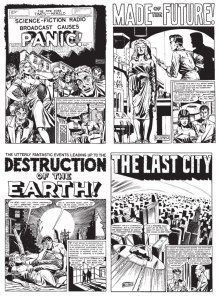
5b0cbb4257f556c8f92efbd70096b60eChild of Tomorrow is a collection of Al Feldstein’s science fiction work for EC comic’s Weird Science. All of the stories were published between May 1950 and July 1952 and present a fascinating view of an America terrified by the the atomic age. While the stories are science fiction with their requisite optimism, there is always an unease working through these stories, as if the technological future is not going to turn out so well, something more than evident when talking about atomic weapons. A prime example of this fear is the story called “The Utterly Fantastic Events Leading up to the Destruction of the Earth!”, where the creation and testing of the hydrogen bomb ends up pushing the earth out of orbit and into the sun, destroying, naturally, all of man kind. And in typical Twilight Zone style the twist is that the narrator is an alien on some planet warning his students of human folly. Many of the stories for a lack of a better word are silly and the story telling hangs on some twist at the end that makes you realize that the story is about you. It was a rather popular technique showing up in the Twilight Zone and X Minus One a radio science fiction show from the same era, as well as in comics. However, when taken as a whole body of work, the stories have a weight that makes them a fascinating insight into an anxious era, much like the sci-fi movies of the time.

Despite the formulaic nature of many of the stories, there are some clever ones that show wit and self depreciation that suggests the authors didn’t take themselves too seriously. My favorite of the bunch was “The Unbelievable Events Leading up to the Cosmic Ray Bomb Explosion” wherein the writers of Weird Science magazine create a story based on minimal science that ends in the destruction of Washington. There are even scenes of the men laughing at the outlandishness of their command of the science. A nice touch showing had serious they take things. When the issue is published, though, foreign agents get a hold of the magazine and build the bomb described in the story and destroy Washington. The story was clever, loping back on itself in a kind of meta manner, never taking itself seriously and yet giving the writers an outsized impression of their own importance.

chitom-catprevTime travel offers many opportunities for paradox and these stories are no exception. Made of the Future! is the best, and perhaps worst, of these. In the story a man stumbles on to a tour of New York given for people from the future. He sneaks along with them and in the future finds a place that makes instant wives. He brings here back to 1950 and enters bliss. But then she goes out for a walk and never returns and he realizes she must have ended up on the tour and never returned. Despite the leap in logic to her eventual fate, it has some nice touches, especially the notion what comes easily disappears easily. I called it perhaps the worst story because the sexual politics of the story are rather strange. The idea that you can just buy the perfect woman in the future is not a healthy prospect and once again turns women into commodities.

In a similar vein, Space-Warp! has a time travel paradox that has a bizarre romantic conclusion. A space explorer leaves his wife, friends and earth and goes far into space. On returning he finds that everyone has aged and he has lost everyone, even his wife. Or so it seems, then he sees her and calls her name. But it isn’t her, it is her daughter with his best friend. No big deal, the explorer is happy with that and marries her. You might think something interesting might occur here with the emotional consequences of such an occurrence, but no. These are, after all, stories for juveniles.

Despite the short comings of the stories, they are an interesting look into a kind of science fiction that to modern eyes seems quaint and anything but technologically advanced. They are a fascinating curiosity of a lost time and Fantagraphics has done a great job reissuing these.

An Analysis of Juan Eduardo Zúñiga at Turia

The Spanish literary magazine Turia has an excellent overview and analysis of the work of Juan Eduardo Zúñiga, in particular his trilogy of the Spanish Civil War, by Fernado Valls, a literary critic whose work I like. It is a long article and worth the read. Zúñiga is the author of Largo novembre de Madrid and two other collections of short stories about the Spanish Civil War. His work is impressive. Words Without Borders published one of his stories not too long ago.

1980 puede ser la fecha clave como punto de partida para hacer un balance del conjunto de la producción literaria de Juan Eduardo Zúñiga, pues entonces es cuando gracias a los buenos oficios del editor y traductor José Ramón Monreal, se publica en la editorial Bruguera Largo noviembre de Madrid, recopilación de cuentos que le proporciona un reconocimiento inmediato y un prestigio literario discreto, pero de calidad, que no ha parado de crecer hasta el presente. Sin embargo, hubo una etapa anterior que arranca en 1945, fecha en la que apareció su primer ensayo: La historia de Bulgaria. Un año antes, junto a Teodoro Neicov, tradujo la novela del escritor búlgaro Iordan Iokov, El segador (Epesa, 1944). Su interés por la cultura, por la literatura eslava, se mantendrá vivo a lo largo de toda su existencia.  Y en ese mismo año de 1945 reseña elogiosamente Nada, de Carmen Laforet ([1]).

Como traductor, Zúñiga se ha ocupado de la obra de diversos autores de los antiguos países del Este, y de escritores portugueses, entre los que destacan Urbano Tavares Rodrigues (Realismo, arte de vanguardia y nueva cultura, Ciencia Nueva, 1967) o Mario Dionisio (Introducción a la pintura, Alianza, 1972). Gracias a esta labor obtuvo en 1987 el Premio Nacional de Traducción por su versión de las obras de Antero de Quental, Poesías y prosas selectas (Alfaguara, 1986), realizada en colaboración con José Antonio Llardent, aunque nuestro autor solo se ocupó de la obra en prosa ([2]).

Bestiario by Javier Tomeo – A Review

Bestiario
(from Cuentos Completos)
Javier Tomeo
Páginas de Espuma, 2012

Javier Tomeo was a Spanish writer who wrote hundreds of micro fictions along with novels and plays. His sort works are unique, especially those of the Bestiario, for their parable-like nature that mixes Aesop with modern science. First published in 2000, Bestiario presents the reader with a series of parables narrated by the titular insect, beetles, worms, and ants being the most common. Each insect narrates who it is in scientific terms, describing what it looks like, what it does. These are quite self aware insects who’ve had some time to look in the mirror and admire their appearance. His stories are not just an exploration of insectoid science, though. At their core they are an anthropomorphic exploration of the complexities, particularly the paradoxes, of living. Even in the midst of the detailed anatomy written by a man no doubt fascinated by science there is a human element. Or perhaps it is better to say that there is a little insect in all of us. In the habits and customs he describes you can see yourself reflected. The reflection is a melancholy one. Even the greatest of braggarts, the scorpion, is full of melancholy, of times lost, realities that have turned on him. Despite their repetition (the critic Fernando Valls suggested reading all of Cuentos Completos in one go is a little too much of the same), it is the little failures and disappointments, the cosmic joke that imbues such little creatures with lofty dreams, that make the stories a delight to read. They are not all brilliant but a good half caught me with their tone and insight and are great addition to the art of the micro story.

As I mentioned, his stories have a melancholia and insight that builds one up, only to find futility. For the powerful, Tomeo is the hardest as in the scorpion where an ancient symbol knows he can never regain what he has lost. He lives amongst the ruins of the past—his memory—aware that to live there does little for him, and yet it is what makes him. It is an economic style of writing that when Tomeo is at his best it sings.

El Escorpión/The Scorpion

Soy la expresión de las oscuras fuerzas telúricas, relacionadas con las tinieblas y las viejas piedras. Los hombres me temen. En otros tiempos fui protector de la diadema real y di forma a uno de los más antiguos jeroglíficos. Evocar ahora me pasada grandeza, sin embargo, no me sirve de consuelo, porque vivir de recuerdos es como vivir entre muertos.

I am the expression of obscure earthly forces related to shadows and worn stones. Men fear me. In other times I was the protector of the royal crown and gave form to one of the oldest ancient hieroglyphics. Remembering my great past now, though, doesn’t help console me because to live on memories is like living with the dead.

The story La Mantis Religiosa (The Praying Mantis) is typical of many of the stories, presenting a dialogue between the insect and an unknown interlocutor. The end of the story is also typical of many of his stories, turning what is an insectoid behavior into the unspoken attributes of human kind. This story in particular is particularly biting in its cometary, showing the way in which we praise the peace in religion but value the brutal.

La Mantis Religiosa/The Praying Mantis

—Voy a contarte algo de lo que te sentirás orgullosa —le digo a la mantis religiosa—. ¿Sabes tú, amiga mia, que los romanos colocaban junto a los ídolos de sus dioses la imagen tallada en bronce de una de tus antepasadas? ¿Sabes que, por esos mundos de Dios, quedan todavía campesinos que, al encontraros en el bosque, os preguntan cuál es el mejor camino a seguir?

—No me sorprende lo que cuentas —responde—. Nuestro aspecto es como para impresiona a cualquiera: ojos tranquilos e inocentes y las patas anteriores en actitude de súplica. Piensan que somos unos insectos piadosos y nos admiran por eso.

—Te equivocas —replico—. Te equivocas, porque lo que más admiran de vosotras no es ese aire de beatas, sino vuestro canibalismo sin remordimientos.

“I’m going to tell you something that will make you proud,” I said to the praying mantis. Do you know, my friend, that the Romans placed next to the idols of their gods bronze engravings of your forefathers? Do you know that, in this world of God, there are still peasants who, upon finding one of you in the forest, ask them which is the better road to follow?

“What you’re saying doesn’t surprise me,” he responded. “Our features impress everyone: tranquil and innocent eyes, and front legs in a praying position. They think that we are pious insects and they admire us for that.”

“You’re mistaken,” I replied. “You are mistaken because what they admire most is not that blessed air, but your guilt-free cannibalism.

At their best his stories have a power surprise and delight with dark insights. They have a hermetic  conciseness that belies a hidden world just beyond the surface. Using insects is apt metaphor for finding what is buried just beyond comprehension.


Goddamn This War! by Tardi and Jean-Pierre Verney – A review

Goddamn This War!
Tardi and Jean-Pierre Verney
Helge Dascher, trans
Fantagraphis Books, 2013

e4a0b604e5e23a2777988cfd2b4a1efcJust in time for the 100th anniversary of World War I is Goddamn This War! by Tardi with chronology by Jean-Pierre Verney (translated by Helge Dascher). The book is a brief history of World War I that eschews plot or characterization and instead dwells on the massive incompetence and horrid logic of the war, using mounting barbarities as an indictment of the war. The book seems as if it is narrated by a soldier and in a way it is: the voice of the nameless, a kind of chorus, recounting pointless act after another. Told in little short vignettes that relate everyday life of the war, Tardi shows the pointless of it all. From relating the death of a man while doing his business to showing the graphic moment results of a shell landing in a trench to showing a snow covered field with blood leaking through. No moment of the grotesque escapes his vituperation and sarcasm. If you’re squeamish this is not a book for you; however, there is more here than just war porn. Tardi is reasonably effective in showing the low points of the war (mostly that’s what they were). The basic chronology and graphic depiction of it will give anyone reading this an excellent insight into the war. He does narrate the major events, such as when Italy enters the war or the Battle of Verdun is taking place, what interests him, though, is not the movement of troops or the political implications, but how little it matters. In addition to Tardi’s narrative there is a fine chronology of the war written by Jean-Pierre Verney. Like Tardi’s work it show’s just how badly run the war was and how unprepared the French and British were. The chronology and Tardi’s work make this anything but a typical work of military history. It seems more like the work of the German anarchist Ernst Friedrich’s Krieg dem Kriege (War against War!), published in 1924 and filled with images what really happens in war, the maiming, deaths, etc. It is in this focus on what happened, what the aftermath was like for those with facial wounds, what little support the disabled were given, that his book takes on its real power: the reminder that war is more than just movement of little ticks on a map.

Andrés Neuman’s Newest Book: Barbarismos

This came out a few weeks ago, but I’ve been a little busy lately.

Andrés Neuman has a new book out in Spain called, Barbarismos (Barbarisms). It is a collection of humorous definitions of common words. Kind of reminds me of Bierce’s Devil’s Dictionary. You can read about it, get and excerpt, and see a video all at Paginas de Espuma, the publisher.

Here are a few samples (with my translation)

bandera. Trapo de bajo coste y alto precio.

flag. Rag of low price and high cost.

búsqueda. Hallazgo casual de otra cosa.

search. Casual discovery of something else.

cuentista. Mentiroso que busca la verdad un poco más lejos.

storyteller. Liar that searches for the truth a little bit father away.

democracia. Ruina griega. || 2. ~ parlamentaria: oxímoron.

democracy. Greek ruin || Member of parliament: oxymoron

escritura. Autobiografía colectiva.

writing. Collective autobiography.