Javier Marías – I don’t play tricks that’s why I write in first person

Javier Marías was at the Hay festival and was interviewed by Juan Gabriel Vásquez. El Pais offers a summation of their conversation. The most interesting thing out of the article is his statement, “I don’t play tricks, that’s why I write in first person.” Interesting statement, but first person is a trick too. Since I haven’t read any of his works, I guess I can’t say how that strategy works in practice.

Las difusas, cambiantes, dubitativas, etéreas y ondulantes voces de la narrativa de Marías tienen un componente líquido y obsesivo. Tanto, que Constanza es un nombre que, de haber nacido mujer, le habría hecho justicia. Por la perseverancia, por el empecinamiento, por esa tendencia al aislamiento consagrado a la literatura tan marcado en él. Valga un ejemplo técnico. “No hago trampas. Por eso escribo en primera persona. [Emphasis mine] Es una decisión que tomé hace tiempo, en 1986, con El hombre sentimental y desde entonces no he dejado de buscar maneras de sortear las dificultades que me supone”, aseguró.

Lejos queda hoy del solvente y académico Marías el chaval de 19 años que escribió Los dominios del lobo. Ahora, con 60, algunos le siguen llamando el “joven Marías”. Y lejos está él de renegar de aquella primera novela. “Es mi obra más divertida”. Una reivindicación de la imaginación y el territorio del escritor frente, dice él, “al daño que nos hizo el realismo social”. Desde entonces hasta ahora han pasado 40 años y un recorrido de éxito constante, la búsqueda de un estilo basado en la indagación interior, la verdad íntima, la especulación como manera de conocer la verdad que le ha llevado a la conclusión de que la novela es un arte de reconocimiento: “Lo mismo que otros géneros lo pueden ser de conocimiento, la novela lo es de reconocimiento. Y digo esto en cuanto a que nos permite saber cosas que sabíamos, pero no teníamos idea de ellas hasta que no las leemos en una novela”. Una gran verdad que le ha llevado a afirmar también, como recordaba Vásquez, “que el ser humano necesita conocer lo posible además de lo cierto y lo que pudo ser, además de lo que fue”.

Translation Round Up: Tips for Translators, How Google Translate Works

Arabic Literature (in English) has been running a series of interviews with translators about what one should and shouldn’t do. The translators translate from more than just Arabic, but also Spanish, and poetry. It is a great feature. I found the one for about Spanish translations fascinating, in part because one of the translators has already translated works by María Shua who I just discovered the other day. Read the full interview here.

from Lisa Carter

1. Love the work

You are about to spend an inordinate amount of time with any literary translation, so make sure you love it. You can love the text itself, the style, the author, the opportunity the project presents, the editor, the publisher, any number of things. Just remember that initial attraction to the work as the weeks and months pass, when the challenge becomes daunting, when you doubt yourself or your ability. Remember to love the work.


from Andrea G. Labinger

5. For Spanish translators or others whose source language has many regional variations: Find good regional dictionaries, including lexicons of slang. In my arsenal, for example, are: El diccionario etimológico del lunfardo (Argentine slang) by Oscar Conde, Francisco J. Santamaría’s Diccionario de mejicanismos [sic] and a number of country-specific online dictionaries.

You can find a few more articles here about poetry , picture books, and Arabic translations.


David Bellos had an interesting article in the Independent about how Google Translate works: it use translations made by people. As someone who once seriously considered studding computational linguistics, it is both fascinating and disappointing. In some ways the machine can’t really do it. And that’s especially obvious when it tries to translate the indirect object pronoun of the romance languages. (via Scott)

The corpus it can scan includes all the paper put out since 1957 by the EU in two dozen languages, everything the UN and its agencies have ever done in writing in six official languages, and huge amounts of other material, from the records of international tribunals to company reports and all the articles and books in bilingual form that have been put up on the web by individuals, libraries, booksellers, authors and academic departments.

[…]

A good number of English-language detective novels, for example, have probably been translated into both Icelandic and Farsi. They thus provide ample material for finding matches between sentences in the two foreign languages; whereas Persian classics translated into Icelandic are surely far fewer, even including those works that have themselves made the journey by way of a pivot such as French or German. This means that John Grisham makes a bigger contribution to the quality of GT’s Icelandic-Farsi translation device than Rumi or Halldór Laxness ever will. And the real wizardry of Harry Potter may well lie in his hidden power to support translation from Hebrew into Chinese. GT-generated translations themselves go up on the web and become part of the corpus that GT scans, producing a feedback loop that reinforces the probability that the original GT translation was acceptable. But it also feeds on human translators, since it always asks users to suggest a better translation than the one it provides – a loop pulling in the opposite direction, towards greater refinement. It’s an extraordinarily clever device. I’ve used it myself to check I had understood a Swedish sentence more or less correctly, for example, and it is used automatically as a webpage translator whenever you use a search engine.

Short Story from Hipólito G. Navarro at La nave de los locos

The fine literary blog La nave de los locos has an unpublished short story from Hipólito G. Navarro a writer whose work I like. Although, I wouldn’t call this a story so much as a meditation or a reflection. That is often the case with very short stories. They aren’t so much a story with some action then a resolution, but a reflection what might have happened.

The first paragraph:

BALANCE

A un tigre, así sea albino, nunca le da por contar sus rayas. Tener algunas de más o de menos sobre la piel es asunto que le trae bastante al fresco….

25 Latin American Authors You’ve Never Heard of But May Some Day

El Pais pointed me to the La Feria del Libro de Guadalajara (México) which is presenting 25 Latin American authors who are not well known out side their country but have great potential. Looking over the list, I can see that I don’t recognize any of them. You can read their bio’s and a piece of their work at the fair’s site.

The authors are (via El Pais)

Juan Álvarez (Colombia, 1978), Luis Alberto Bravo (Ecuador, 1979), Andrés Burgos (Colombia, 1973), Fabián Casas (Argentina, 1965), Miguel Antonio Chávez (Ecuador, 1979), Carlos Cortés (Costa Rica, 1962), Francisco Díaz Klaassen (Chile, 1984), Jacinta Excudos (El Salvador, 1961), Nona Fernández (Chile, 1971), Fernanda García Lao (Argentina, 1966), Ulises Juárez Polanco (Nicaragua, 1984), Roberto Martínez Bachrich (Venezuela, 1977), Emiliano Monge (México, 1978), Javier Mosquera (Guatemala, 1961), Diego Muñoz Valenzuela (Colombia, 1956), Enrique Planas (Perú, 1970), María Eugenia Ramos (Honduras, 1959), Luis Miguel Rivas (Colombia, 1969), Giovanna Rivero (Bolivia, 1972), Hernán Ronsino (Argentina, 1976), Pablo Soler Frost (México, 1965), Daniela Tarazona (México, 1975), Dani Umpli (Uruguay, 1974), Eduardo Varas (Ecuadro, 1979) y Carlos Oriel Wynter Melo (Panamá, 1971).

Any one heard of them?

Less Well Known Spanish Authors Who Should Be Well Known – Acording to El Pais

El Pais ran an article on authors who should be more well known in Spain. In some ways it is a bit of a your not telling me anything surprising: some authors are more famous than others. However, the list of authors is interesting. I haven’t read any of these, although I know a few of the names, such as Tusquets (she is related to the publishing house), Chribes, Giralt Torrente, and of course Barba. They make quite a bit of Javier Cercas, noting that perhaps his pre Soldiers of Salamis works was better, i.e. the work before he was famous. It isn’t a claim I can refute, but it is one I’ve heard before. Any how, there is a nice list of authors and works at the end.

The other interesting fact is only 58% of Spaniards read once a week. Considering read could mean anything, that is low.

Hoy es el amanecer de un mundo dual, impreso y electrónico, donde sólo el 58% de los españoles dice leer al menos una vez a la semana. Donde la resonancia de los escritores tiene varias vías cuyas repercusiones entran dentro de un “enigma sociológico”, según J. Ernesto Ayala-Dip, crítico literario de Babelia. “Hasta Soldados de Salamina, Javier Cercas era un autor de minorías, con novelas y cuentos publicados. ¿Era mejor el Cercas exitoso que el Cercas minoritario? No me atrevería a afirmarlo, incluso creo que una novela como La velocidad de la luz es superior a Soldados de Salamina, pero el éxito no se repitió. Así que me parece que lo más sensato es seguir escribiendo al irrenunciable dictado de un proyecto narrativo y dejar que la suerte juegue su papel. Así lo siguen haciendo autores tan minoritarios como dueños de una sólida poética: Javier Tomeo, Juan Eduardo Zúñiga, Luciano G. Egido, Ramiro Pinilla, Menchu Gutiérrez, Justo Navarro, J. A. González Sainz, Julián Ríos, Gonzalo Hidalgo Bayal, Irene Gracia, Vicente Molina Foix, José Carlos Llop y Esther Tusquets. Así como su relevo en Juan Francisco Ferré, Javier Saiz de Ibarra, Marta Sanz, Manuel Vilas, Andrés Barba o José Ovejero”.

Lecturas (Readings)

Jaume Cabré, Yo confieso (Destino). Francisco Ferrer Lerín, Familias como la mía (Tusquets). Gonzalo Hidalgo Bayal, Conversaciones (Tusquets). Justo Navarro, El espía (Anagrama). Irene Gracia, El beso del ángel (Siruela). Menchu Gutiérrez, El faro por dentro y La niebla (Siruela). Ramiro Pinilla, Cuentos (Tusquets). Andrés Trapiello, Apenas sensitivo (Pre-Textos). Esther Tusquets, Pequeños delitos abominables (Ediciones B). Juan Eduardo Zúñiga, Brillan monedas oxidadas (Galaxia Gutenberg). Andrés Barba, Muerte de un caballo (Pre-Textos) y Agosto, octubre (Anagrama). Nuria Barrios, El alfabeto de los pájaros (Seix Barral). Joaquín Berges, Vive como puedas (Tusquets). Marcos Giralt Torrente, El final del amor (Páginas de Espuma) y Tiempo de vida (Anagrama). Luis Magrinyà, Cuentos de los 90 (Caballo de Troya) y Habitación doble (Anagrama). Antonio Orejudo, Un momento de descanso (Tusquets). Javier Pérez Andújar, Todo lo que se llevó el diablo (Tusquets). Isaac Rosa, La mano invisible (Seix Barral). Marta Sanz, Black, black, black (Anagrama). Francesc Serés, Cuentos rusos (Mondadori).

Tin House 49 – Cesar Aira Interview and Excerpt, Ben Okri, Kelly Link, and Oliver Broudy – A Review

Tin House issue 49, The Ecstatic, arrived last week and in a fit of diligent reading I finished it off in a week’s time, I’m rather pleased with this. Anyway, the issue, as always, had some high points and some forgettable pieces. What I was most exited with was Scott Eposito’s interview with Cesar Aira which was quite good (unfortunately it is not available on-line). Scott is a good reader and had some great questions to for Aira. Most interesting is his way of working which is a revisionless writing that only continues until he is uninterested or his idea is exhausted. (He does spend a day or so per page, so it isn’t exactly revisionless writing). The review and the excerpt did make me want to read his work. The excerpt which will be out in 2012 was interesting, more than most excerpts, is about a Panamanian government official who writes a master piece by accident. It has potential and I am interested in knowing where he is going with it. The only thing that annoyed me was that tedious statement that says the only way you can enjoy something is in the original language. Not true and rather limiting. I wish writers would stop with this kind of nonsense. There are limits, but there is no other way for most of us to read the world.

The interview with Ben Okri was interesting, if a little too much about NY. It is on-line but you’ll have to a little diffing to find it. The short story from Kelly Link called the Summer People was very good. A mix of the fantastic and the surreal about a young woman who is the care taker for the mysterious inhabitants of an old house. They are never seen, but communicate telepathically giving her their wishes. Anytime she does something they reward her with fantastically create objects, often wind up toys of undescrible complexity. But they are a strange people who though never seen are described in terms of queens and workers, as if they were a form of bee. Link was able to build a fascinating and complex world that has no explanation and though cannot exist, seems like it just could. My only criticism is it was filled with southernisms and while I’m not against them it seems as if they were more stereotypical than real. I haven’t been to the south in years, so I don’t know if they are real, but they felt a little forced.

Finally, Oliver Broudy’s non-fiction piece about a kung fu master who is running a school to train the next masters of white crane style was great. As someone who grew up on kung fu, to read about a man who has gathered a handful of students in a ten year course of study, living a monkish lifestyle of training and asceticism was fascinating. He told the story, in part, from the perspective of a poor young American who seemed the most unlikely to finish the training. The conflict between the easy American life, even in a run down part of Pennsylvania that has no future, and the hard work of kung fu is an almost insurmountable tension. In many ways, it is evocative of problems facing the nation.


Ana María Shua – Interview Video in English, Short Stories, and Other Things

Now that I’ve read a little of Ana María Shua’s newest book, I can say I liked some of it. Some of the circus stories were OK, others such as Evolución del Circo were quite interesting. The blog La nave de los locos has a couple more excerpts of her work.

The Spanish culture program also had an interview with her: El ojo crítico – Ana María Shua y su circo de relatos breves – 09/09/11 . It was a good interview and they go over why she wrote a circle of stories about circuses.

Finally, Revista de Letras has this video from Shua explaining her early life, especially the dictatorship in Argentina. It is in Spanish with English subtitles.

Guadalajara by Quim Monzo – A Review


Guadalajara
Quim Monzo
Open Letter, 2011, 125pg

Quim Monzo is a joker. A literary one, but a joker all the same. In Gasoline, his last work to make it into English, that humor was sour and lacked direction (see my review). Consequently, I had some trepidation that Guadalajara would succumb to the meandering obsessions that were neither fun nor interesting. Fortunately, Guadalajara is immanently readable and the stories show that his reputation as an inventive short story writer is well deserved. His stories all have an undercurrent of humor often coming from the retelling of well known stories. It is in subverting of the heroic or even just the humanistic that Monzo makes his black commentaries on human behavior, usually to great effect. But Guadalajara also reveals a writer interested in extending and playing with the stories that are literary common places, and in doing so constructing his own enigmas and dilemmas; counter enigmas that stand on their own but enrich the familiar.

In Outside the Gates of Troy he creates an alternate story of the Trojan Horse where Ulysses and his men wait day after day for the Trojans to drag the wooden horse into the walls. But the Trojans are to smart or suspicious and the men slowly die, alone, weak, unable to leave the horse. Ulysses holds on to the futility and can only cover his ears to avoid the groans of his men. Instead of heroism, we have the desperate futility of hanging on to a plan that will not work. Bravery sounded good, but Ulysses is left with nothing and so has to hope for something that will never come. Plugging his ears doesn’t save the men like it would in the Odyssey, it is a disappointment.

In a similar line, Gregor flips Kafka’s Metamorphosis and writes it from the prospective of a cockroach who becomes a man. The process of becoming a man is a discovery: the new sensations, the new physical attributes, the freedom to roam among the humans. But it is a heartless self discovery as he becomes a true human and purposely squashes his family under foot, because to be human is to be amongst one’s own kind, but to also destroy the foreign. For Monzo, Gregor could do little but squash his family, because that is the nature of transformations, you become something else, you are not both.

You see that thought, too, in Family Life, which describes a family where young boys when they come of age, have part of their finger cut off. Some boys go willing into the ritual because that is what one is expected to do, a few are resistant, but they internalize the cutting and in future generations expect others to have their fingers cut. Eventually, though, one boy refuses because he wants to be a musician and the family lets him escape the punishment. But that act of kindness also destroys the tradition and without tradition the family slowly grows apart. Given the power of tradition to hold groups together, the question here is which was worse? Or does that even matter since this is just what happens? With Monzo you have the sense that it is a once a problem, but inevitable. Although, like some of the stories in Merce Rodereda, tradition is too often evoked to excuse the powerful.

Monzo also likes to lean to the surreal. In Centripetal Force he describes an apartment building whose residents cannot leave by themselves. If someone comes to visit, they can leave with them, but if they try the same feat latter they find themselves in an endless loop. It is a contagious feature of the building and when “the man” (he often does not name his characters) is rescued by firefighters, the firefighters become trapped within the building. Its a comic and surreal story, but that Centripetal Force is all pervasive and the man who can’t leave his apartment, is really just an extreme compression of most people’s lives: the daily return to home, that centripetal force everyone has.

He also likes to play with the way people interpret events through the media. In  The Lives of the Prophet and During the War he builds realities based on the rote generics that fill the media during war or great calamity. During the War Monzo narrates the start of a war, but what war is it really? The descriptions that describe the war are almost a template of how wars should be reported. During the War has the strange honor of being devoid of description, or actual specific content, such as place, but feels as if the war is real because it is a narrative seen so many times. His writing style underscores that nicely since Monzo is a spare writer and the bland description of the war starting makes it even more darkly funny.

Despite its short length, Guadalajara is filled with stories like these that are funny, dark, and enigmatic. They also feel fresh, a reinvestigation of the short story that sometimes feels rote and repetitive. He is well deserving of his reputation of one of Spain’s best short story writers.

Amazon Moves into Spain And A Conversation of the State of eBooks in Spain

TechFlash reports that Amazon has opened an online presence in Spain with and fitting Spain’s multi-language society, Spaniards can buy books in Spanish, Catalan, Galician and Basque. Books are not discounted (it is illegal), but DVDs, software and appliances are. No Kindle yet, though.

And from you can watch (I would recommend just listening to it) the 30 minute conversation. It is interesting especially since Javier Celaya the Spanish expert suggests the Kindle won’t be as big a player. It will be more the tablets. There are some sad statistics about home many people read books in Spain: 50% say no, and another large portion buy 3 to 4 a year.

Los Tigres Albinos (The Albino Tigrers) By Hipolito G Navarro – A Brief Review

Los Tigres Albinos (2001) is the second of the three books of short stories collected in Los Últimos Percances and is further evidence shown in El AburrimientoLester (1996), the first book of the collection, of Navarro’s masterful command of the short story medium. His stories are always inventive, seeking to stretch the short story form. I’m not sure if I could pick a favorite out of the collection, since there are so many interesting stories. He can be quite funny too and many of his stories turn on the humors desperation of solitary characters. I don’t want to say too much more since I’m writing a review article for a different site, but it is a shame he’s not available in English.

Patricio Pron Interview on Canal-L – Spanish Only

Canal-l recently interviewed Patricio Pron. It is one of their drier interviews but, interesting to some degree.

New Short Story Collections from Juan Carlos Márquez, Óscar Esquivias, Daniel Gascón Reviewed in El Pais

El Pais has a review of some new short story collections which sound interesting. I have read a story by Juan Carlos Márquez, which is mentioned in the article and it is funny and well written (I have a link in this post to the story). The Daniel Garzónsounds interesting as he writes about 30 somethings who are college educated with jobs that are precarious or outside their field of study, an all too common problem in Spain and other countries.

Narrativa. Al reseñar Pequeñas resistencias, 5 (Antología del nuevo cuento español, 2001-2010), uno de los nombres que destaqué fue el de Juan Carlos Márquez (Bilbao, 1967), por su habilidad para conjugar microscopia cotidiana y surrealidad, valiéndose de un lenguaje tan incisivo y preciso como brillante en el empleo de imágenes reveladoras. Este rasgo esencial (verdadero nudo gordiano de su narrativa), “cierto desplazamiento de qué hacia el yo”, como lo denomina el autor, sustenta prácticamente todos los relatos del último libro de Juan Carlos Márquez, Llenad la tierra, que trata de lo que sucede a partir del día en que un padre aparece en el umbral de casa “con el corazón en un puño”, de la (espeluznante) vida de un hombre solitario que vive cerca de los contenedores de un hospital cuyos restos y desechos lo alimentan, del odio histórico que revierte sobre el guardameta de la selección alemana de fútbol, de los delirios de un padre ante los hipotéticos peligros que amenazan a su hijo, de un viejo mercenario que mata para sobrevivir y cuenta cómo actúa “llegado el momento”, o de los subterfugios de vida que ocultan las barras de los bares. En otros relatos, breves y a modo de sketches o escenas dialogadas, la presencia de lo absurdo en una situación anodina opera como revulsivo (hilarante): la anciana madre que recita a Neruda, la pareja ante la tarta de aniversario, el imposible “orden integral” en la cola de un supermercado o la “mecánica popular”: espléndido ejercicio mezcla de equívocos, nonsense e ignorancia.

New Lucía Puenzo Novel Reviewed in el Pais Shortest Review Ever

El Pais has a review, or perhaps a description is a better word for it, of Lucía Puenzo’s latest book. You can see the complete review below. What perhaps the most interesting is the statement that it is her 4th book but the first to be published in Spain, which only goes further illustrate the phenomena in Spanish language publishing where authors don’t make it out of their home country.

Narrativa. “El que pierde tumba al rey”, le dice Razzani, un exitoso empresario, a su hijo de 11 años. Es el último partido de ajedrez entre ambos y el primero que el niño puede llegar a ganar. Prófugo de la justicia y de otros poderes menos conspicuos, Razzani está llegando al final de la imposible carrera por mantener el control de sus múltiples negocios tras perder lo más apreciado en ese mundo: el anonimato. Sin embargo, el protagonista de La furia de la langosta, cuarta novela de la escritora argentina Lucía Puenzo (1976) y primera publicada en España, no es Razzani sino su hijo, Tino, un niño que madura a golpes cuando otros le revelan a él -y a todos- la vida secreta de su padre. “A Tino se le cruza por la cabeza una idea insoportable: que todas las acusaciones contra Razzani son ciertas (y otra aún peor: que aunque todo sea cierto, no dejará de quererlo)”. Más de algo excesivo hay en esa familia donde los abogados, los guardaespaldas y las criadas son tan parte de ella como los hermanos de Tino y su madre, una familia que prolifera casi tanto como las propiedades que Razzani acumula en la vasta geografía de su país. Aunque el retrato de la corrupción en la sociedad argentina es acerado e inmisericorde, el corazón de la novela está en otra parte, está en ese niño que crece y aprende de la manera más dura a leer el mundo desde la pérdida de la inocencia.

72 Migrantes Artists and Writers Remember the Murdered 72 – Includes Work from Volpi and Poniatowska

72 Migrantes is a site dedicated to the memory of the 72 immigrants murdered in the desert in northern Mexico. Each of the 72 are remembered by a photographer and writer.The photos can be disturbing, but show the realities of the dangerous journey not only crossing the American border, but moving through Mexico from Central America. I’m not familiar with all the writers, but both Jorge Volpi and Elena Poniatowska have contributed pieces. Poniatowska has long been a journalist and advocate against violence. It is a very interesting site. The only thing is the way you find a particular writer’s work is by cycling through the all the stories. A little annoying.

From the piece by Poniatowska

Quién sabe cuanto faltará pero otros han cruzado a Estados Unidos y han encontrado trabajo y hasta mandan traer a su familia. No soy el único en atravesar, soy el 57 de 72, pero no caminamos juntos los 72, llamaríamos demasiado la atención. Caminamos a buen paso, cada quién con su pensamiento, caminamos de sol a sol, caminamos sin detenernos casi, otros lo han hecho. Seguro, ya pasó lo más duro. Tamaulipas suena a flor, a tulipán, a buena sombra. A pesar de los huizaches se puede caminar, claro que cuesta trabajo llegar pero se llega. A los demás no los conozco y se me hace más fácil platicar con las mujeres, sobre todo en la noche, cuando andamos con un pocillito caliente en la mano e intercambiamos unas cuantas palabras. No muchas, las indispensables. Son como catorce las mujeres pero apenas si levantan los ojos. Guardan todas sus fuerzas para el camino. Son anónimas. Toda la vida, conviene ser anónimo. Mejor no tener nombre, allá me lo voy a hacer, allá lejos de El Salvador y Honduras, lejos de Ecuador y de Brasil, lejos de la favela y la inundación, de las aguas negras y del techo caído, lejos de la intemperie y las armas de fuego, los rifles, las carabinas, los cartuchos y los cargadores, lejos de la policía y de los cárteles. […]

From the piece by Volpi

soy nadie mi nombre es nadie mi nombre no yace sepultado junto a mi cuerpo mi única pertenencia lo única único que tenía robado arrancado por la fuerza vuelto jirones como mi piel como mis vísceras sepultado aquí en este lugar que tampoco tiene nombre o no lo tiene para mí o nunca lo tuvo llegar aquí desde tan lejos a este lugar sin nombre para terminar sin nombre sepultado en esta tierra idéntica a toda la tierra a la tierra que dejé atrás a la tierra que perseguía a la tierra prometida caminar en mi vida sólo supe caminar nunca hice otra cosa andar desde niño con las botijas de agua al cuello andar con los adobes con los terneros con los pollos caminar por el lodo hacia el riachuelo caminar del riachuelo hacia la casa caminar cuatro kilómetros a la escuela caminar cuatro kilómetros de la escuela a la casa caminar las jornadas a la milpa caminar la milpa de arriba abajo con las semillas en la mano sobre la tierra sin agua esa tierra tan parecida a esta tierra sin nombre donde me hallo sepultado a esta tierra donde me fue arrancado el nombre como quien arranca una muela caminar siempre supe caminar nadie camina como yo caminar de la niñez a la juventud de la juventud a la madurez con eso basta caminar bajo la sequía y la tormenta[…]

Michael Hart Founder of Project Gutenberg – RIP

Michael Hart the founder of Project Gutenberg has died. He in many ways is the enventor of the e-book, which for good or bad, has become a definining media of our time. But his interest was in giving free access to e-books and Project Gutenberg is pretty cool, if a bit uneven. I’ve read a few books via  Project Gutenberg, most recently a book on Posters from World War I. It is one of those noble, ideas that seemed to come from the early days of computing. If you’ve never been to Project Gutenberg you should check it out.

From Geekwire

Tacoma native and electronic book pioneer Michael S. Hart has died at the age of 64. Before Kindle, Nook or iPad entered the lexicon, Hart was tinkering with electronic books.

In 1971 at the University of Illinois at Urbana-Champaign, Hart created Project Gutenberg with the goal of making electronic copies of books available to the public. It became his life’s work.

After starting with the Declaration of Independence, Hart spent spent the bulk of his career working on ways to make electronic versions of books accessible to people. Today, there are more than 36,000 free eBooks available through Project Gutenberg, allowing customers titles to the PC, Kindle, Android or iOS devices.

New Words Without Borders – From the Spainish Works from Slavko Zupcic, Guadalupe Nettel, Eduardo Halfon

Words Without Borders released its September 2011 edition which includes three short stories from Spanish Language writers and a review of Sergio Chejfec’s newest book, among other things. I wasn’t familiar with any of the writers included in this edition. Slavko Zupcic is from Venezuela and wrote what I thought was the strongest story of the bunch about a man who steals books only to have the author die a day latter. The Mexican author Guadalupe Nettel’s story was OK, about the breakup of a relationship via gardening. It had its moments until he decided he was a cactus, which should have been funny but became tedious. I skimmed Eduardo Halfon’s story before giving up quickly. I don’t like stories about writers and writer’s conferences. Maybe I should have given it more time, but I have no patience for that.

New Quarterly Conversation Issue 25 Featuring Translation of Juan Francisco Ferré

A new Quarterly Conversation  is out and this one features a translation from Providence (2009). I don’t know the author, and honestly the description makes doubt I’ll like it (to much sci-fi), but it is worth a look. Also of noteis a translation of Belgian Fabulist Yves Wellens, a defense of reading Antonio Lobo Antunes, reviews of The Seamstress and the Wind by César Aira, From the Observatory by Julio Cortázar amongst many others.
From the introduction:

Providence (2009) is Juan Francisco Ferré’s most ambitious novel, his longest and more complex fictional work to date. Written during one of his stays at Brown University, Providence, as much as Ferré’s previous books, is a deeply erotic, abrasively satirical, gargantuan fiction dealing with both contemporary American culture and Spanish literary tradition. But rather than focusing on cultural differences, Ferré investigates the common literary roots of the new global culture, producing a true “transatlantic” fiction—in some sense. Providence could be considered as much a Spanish novel about America as an American novel written in Spanish.

Providence is a haunting glimpse into a labyrinth of imaginary spaces assembled together by, among many other things, the spell of H.P. Lovecraft, the remembrance of Alain Resnais homonymous film, a personal interpretation of Spielberg’s Jaws, and the sexual drive and misguided efforts of the Spanish independent filmmaker Álex Franco. After being lured by a mysterious female producer, Franco travels to Rhode Island with the purpose of writing a script about “Providence.” However, like in a wicked Cronenberg-inspired bio-game, “Providence” starts mutating to become something quite different from what he expected. Forced to confront a new set of otherworldly relationships he can no longer dismiss, Álex will find himself trapped in a surreal multiverse of fictional/mythical “Providences” made up by Lovecraftian secret societies evolving from steampunk into cyberpunk; from The Age of Mechanical Reproduction to the Age of Digital Simulation. The adventures of Álex Franco constitute a metaphor of the ongoing transition from reproduction technologies that render external sophisticated representations (Pro videns) to embodied simulation technologies “happening” through our flesh (Providenz).

Sergio Ramírez Wins the José Donoso Prinze

Nicaraguan writer (and ex-vice president) Sergio Ramírez won the José Donoso Prinze, reports El Pais.

El escritor nicaragüense Sergio Ramírez ha ganado el Premio de Letras José Donoso, establecido para reconocer el trabajo, originalidad y calidad en la trayectoria literaria de un autor iberoamericano. El galardón fue instituido el año 2001 por la Universidad de Talca (Chile) en memoria del destacado escritor José Donoso, vinculado por sus raíces familiares y culturales a la Región del Maule. Esta institución ha dado a conocer el fallo mediante su perfil en la red social de Internet, Twitter.

He has an interesting life story for a writer. I have no idea what his writing is like. Has any one read him?

New Directions Publishing Evelio Rosero, Good Offices – Novel Excerpt Link

New Directions is publishing the Colombian writer  Evelio Rosero’s novel Good Offices. Honestly, I don’t know much about him, or the book, but with a 13 page excerpt you can at least get a basic idea of what the book is about. Read the excerpt here.

From New Directions write up:

Tancredo, a young hunchback, observes and participates in the rites at the Catholic church where he lives under the care of Father Almida. Also in residence are the sexton Celeste Machado, his goddaughter Sabina Cruz, and three widows known collectively as the Lilias, who do the cooking and cleaning and provide charity meals for the local poor and needy. One Thursday, Father Almida and the sexton must rush off to meet the parish’s principal benefactor, Don Justiniano. It will be the first time in forty years Father Almida has not said mass. Eventually they find a replacement: Father Matamoros, a drunkard with a beautiful voice whose sung mass is spellbinding to all. The Lilias prepare a sumptuous meal for Father Matamoros, who persuades them to drink with him. Over the course of the long night the women and Tancredo lose their inhibitions and confess their sins and stories to this strange priest, and in the process reveal lives crippled by hypocrisy.

Recent Additions to the Pile

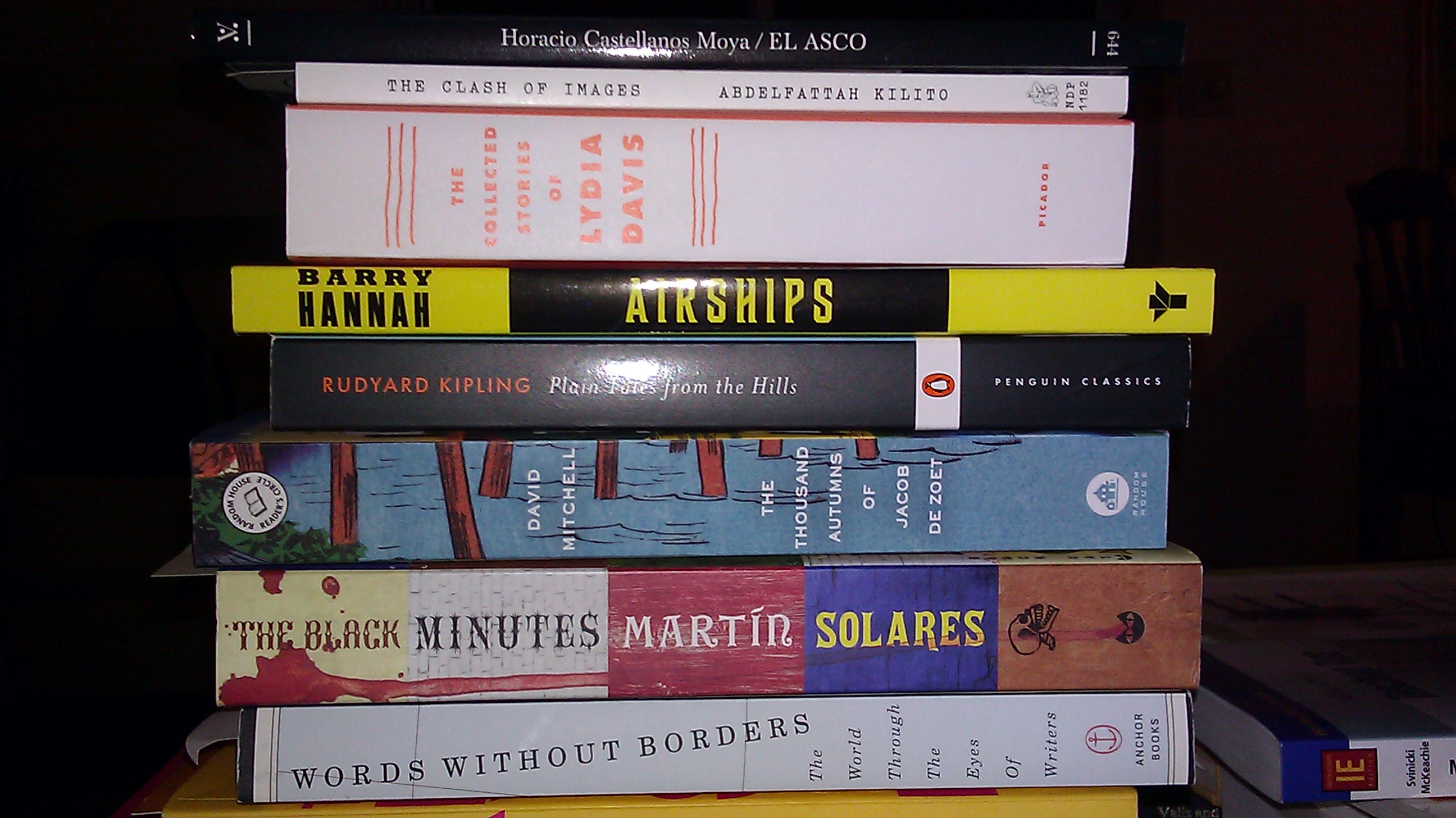
This summer it has been a little bit busy here around the fire light, for varying reasons. But never fear I have been stocking up for when the nights are longer, taking advantage of a trip through Portland tip buy a few books at Powells, a sale at my local indie Elliot Bay Book Co, and my first Associate Reward from Amazon. Below you can see the fruits of my labors.