Stories from Mexico City Youths in La Jornada

La Jornada has a selection of short stories form Mexico City youths in the juvenile justice system. It is an interesting collection and one is an eye to writers who one would probably never come across.Out of 360 stories submitted, they published around 10. This is from the first

Todo esto empezó el 28 de septiembre de 1992, en una familia pequeña, integrada por papá, mamá, tres varones y una niña, la más pequeña de la familia.

El piloto de esta familia era Mario, el papá. Él era el que decía la última palabra, pero no antes de consultar a mamá e hijos.

Todo marchaba muy bien. Claro, siempre había problemas, pero nada que no resolvieran papá o mamá.

Un día viernes por la noche como a eso de las 9:45. Mario llegó del trabajo muy agotado, apenas podía mantenerse de pie, se tiró al sillón como desmayado. Claudia, la mamá de la familia pensó: pobre de mi querido esposo, está muy cansado; Claudia le quitó los zapatos y los acomodó abajo en un rincón de su cama de Mario y Claudia.

Claudia agarró el último billete que les quedaba, que era uno de doscientos, se queda pensativa y dice en voz alta, ¡aunque se enoje Mario y me moje, tengo que ir a la panadería de Macario!

La familia del aire: Entrevistas con cuentistas españoles (The Family of the Air: Interviews with Spanish Short Story Writers) by Miguel Ángel Muñoz – A review

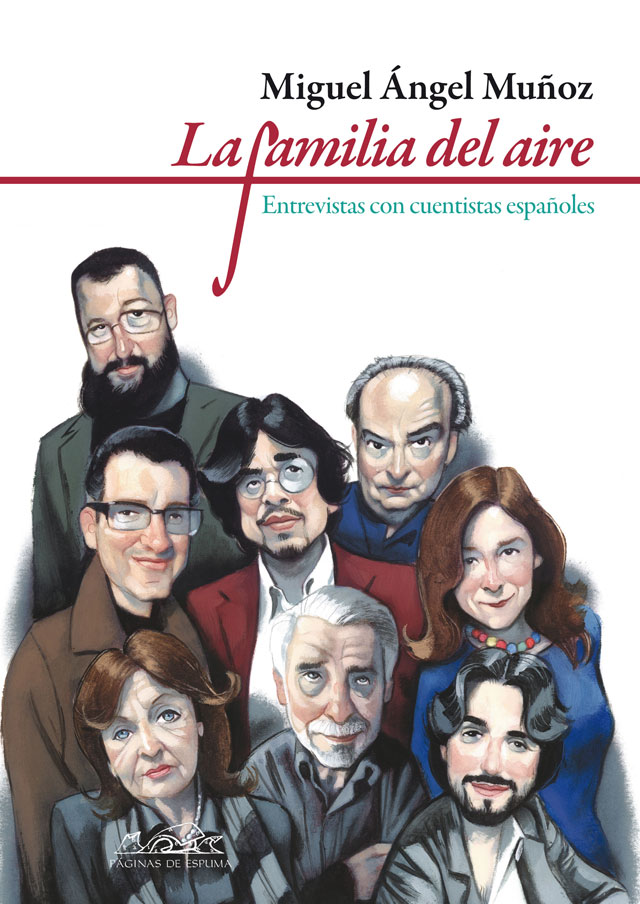
From bottom left clock wise: Cristina Fernandez Cubas, Miguel Ángel Muñoz, Hipolito G. Navarro, Fernando Iwasaki, Enrique Vila-Matas, Mercedes Abad, Andrés Neuman, José María Merino

La familia del aire: Entrevistas con cuentistas españoles (The Family of the Air: Interviews with Spanish Short Story Writers)
Miguel Ángel Muñoz
Páginas de Espuma, 2011, 474 pg.

The Spanish short story writer Miguel Ángel Muñoz’s La familia del aire: Entravistas con cuentistas españoles (The Family of the Air: Interviews with Spanish Short Story Writers) is an invaluable guide to the modern Spanish short story, and one of the best books I’ve read on the art of writing. Muñoz is an excellent and dedicated interviewer whose questions show a deep and thoughtful reading of each interviewee’s body of work. He sees interviews as not just another genre, but as an art unto itself and as he mentions in his introduction, he keeps collections of interviews in binders. He believes that letting an author talk about his or her work helps expand it, place it in a deeper context, rather than only letting the work speak for it self. It is this deep devotion to short stories and his ability to draw from the 37 included authors what makes short stories so compelling makes the book a must read for anyone interested in the short story. It is all the more impressive since all the interviews were conducted over a series of  3 or so years and published on his blog, El sindrome Chejov. In one of those great acts of personal fascination lived publicly, in 2006 Muñoz began to interview Spanish short story authors. What started quietly without any grand ambitions, morphed over the intervening years into one of the primary sources about authors working with the short story. Muñoz notes he was a little surprised by the willingness the authors agreed to interviews, but his dedication and preparation, which at the minimum includes reading each interviewee’s oeuvre, makes him a trustworthy interviewer, one that most writers would love to have. Muñoz also brings an sense of excitement to the short story. When reading his interviews (or his blog posts) it is easy to catch that same excitement—I should know, since every time I read one, I want to go out and read the author’s stories. The book is truly a one of a kind success that I wish existed for English language authors.

The only draw back of the book for my English language readers is that very few of these authors are available in English (certainly not the author’s fault). I have tried to remedy that with my recent article about unpublished Spanish Short story writers at the Quarterly Conversation. And when an author has been translated into English it is usually a novel. The most recognizable name in the book is probably Enrique Vila-Matas. Andrés Neuman, the last interview of the book and one of the better ones, also just had a novel come out in English (read my review here). That said, one of the most fascinating things about the book for an English speaker is to see what authors have influenced these authors. Given that English language authors may not be exposed to as many translations as they are in Europe, it might come as a surprise that two of the most common names that came up were Raymond Carver and John Cheever. Over and over in the list of influences these two always showed up. Some authors have turned to the English speaking authors as a refuge from the Spanish language traditions, but even when they cite Spanish language authors those two show up. I’m not so sure that would be the case for the reverse. Other English language authors mentioned were Poe, Anderson, Fitzgerald, Hemingway, Mansfield, Lorrie More and Alice Munro.

Spanish language influences tended to come mostly from Latin America. Cortazar was the most sited, the Onetti and Borges, and with a little less frequency Rulfo. There was a sense of disinterest in Spanish short authors from the middle of the century. The only two that were commonly cited were Juan Eduardo Zúñiga and Medardo Fraile. I think this is a function of one generation turning against another, something Andrés Neuman noted, saying that Spanish authors should take more pride in their own tradition with mid century authors like Ana Maria Matute. Only one author, Fancisco Afilado, though, really did not like the Latin Americans, especially Cortazar who he said led too may young writers to play games with their stories. Again, as a contrast to the American scene that notion of play is often lacking and too many write in the realistic vain. Afilado, naturally, is the author who loved the American realists the most, and is a perfect example of those who believe that noir is the best writing because it is the most real. I can’t say I agree with that, but it was refreshing and annoying at the same time to find one author in these interviews who has that opinion.

There were relatively few references to authors outside of the English and Spanish traditions. There were, of course, the trinity, Chekhov, Maupassant, and Kafka, but relatively few references to authors from any other languages (except perhaps Catalan). Only once did I see a reference to Thomas Bernard, for example. But given who rich both of these traditions are, there is quite a bit to mine in terms of influence.

With the exception of a few novelists, all the interviewees are dedicated to the art of the short story. As such, every interview has a question about the disrespect given to short stories in Spain. There were several theories all of which probably have some validity. My favorite was Carlos Castán’s theory that all the Christmas stories that come out ever year and which written by famous authors, turn readers away from the short story, because the stories are written by people who are not short story writers. I think the lack of critics who specialize in the short story, especially those at newspapers, is probably a better theory. The short story has the perception that it is just what you do between novels. Another mentioned that the public likes to engross themselves in a big story and don’t like the stopping and restarting that a collection of short stories entails. That may be the prescient commentary: it is one I sometimes feel when I am reading collections of short stories, especially ones larger than 200 pages.

Of course, things always look better across the water, and there were multiple references to the tradition of the short story in the US. However, I often feel that what they are looking at is a tradition that is from 30 years ago, if not father back. While major publishers do bring out collections of short stories, they are still a small fraction of published fiction. And while there are small magazines and journals like Tin House, the short story also lacks for prestige. Perhaps things are better here, but it certainly is not a paradise.

Ultimately, the book with its ample indexes, appendices of authors cited in the interviews, and a list of each author’s published works, short story or otherwise, is one of the best references to the short story I can think of. And as one might expect my list of authors that I’m interested in reading has grown. These are just a few that you may see on these pages some day: Mercedes Abad, José María Merino, Medardo Fraile, Juan Eduardo Zúñiga, Iban Zaldua, Ángel Olgoso, among others. That, I think, is the highest praise for La familia del aire: Entravistas con cuentistas españoles.

Note: For those interested you can read my reviews of Miguel Ángel Muñoz short story collection Quedate donde estas and his novel El corázon de los caballos.

El corazón de los caballos (The Heart of the Horses) by Miguel Ángel Muñoz – A Review

El corazón de los caballos (The Heart of the Horses)
Miguel Ángel Muñoz
Alcalá, 2009, 145 pg

El corazón de los caballos is the Spanish short story writer Miguel Ángel Muñoz’s first novel. A refreshingly short novel, it is a continuation of a story that first appeared in his collection Quédate donde estás (Stay Where You Are), called El reino químico and which was my favorite of the collection when I reviewed it a year or two ago. As in the short story, the novel opens with unspoken tension between  the narrator’s father and grandfather. It is a tension that has populates the world of the grandson, Victor, who doesn’t understand why his father does not like his grandfather. It is a relation that in the novel is distant and still remains unexplained, but it sets the tone of the novel. What seemed like the eccentric behaviors of a loving grandfather in the El reino químico, are actually the foundations of Victor’s problems.

Victor’s life hasn’t quite worked out as he wanted. He was a promising mathematics student but when he fails to get a scholarship after years of graduate study, he loses his patience and attacks the professor. He loses everything and on his journey to his final court date he goes to a Pyrenean town with his boyfriend Andrés, who is going to receive a literary award. It is a journey that begins to trigger a series of memories that he has if not suppressed, avoided. The first is of Eva, his former student, an anorexic and troubled girl who intrigued him. It isn’t so much as sexual, although there is some sort of tension, but one of shock, fear, confusion or even disappointment. When he does discover that she binges at night he is angry and like the mystery of his father and grandfather, she disappears and he hears nothing of her again. The second, darker memory is of a drug addict who likes to climb from balcony to balcony. Scared, a knife in his trembling hand, he watches as the man loses his balance on his porch and falls to his death without doing anything. He’s accused of pushing him, but he’s released because the man was a druggie known for that dangerous game.

With those incidents in the background, Victor and Andrés enter the Pyrenees. The awards ceremony is really just a chance for the town to feel important, but they meet two people of interest: the previous winner, Ines, a mysterious woman who has not let her photo appear on the cover of her books since her first book; and an old man and his granddaughter.  Each has a story that Andrés, a man who lives to gather stories and rewrite them as he sees fit, as if he is reconstructing the reality of those he has stolen from. And it is a form of theft, because he is unrepentant in his using of other people’s lives. The old man talks about a Portuguese man he met during the Spanish Civil War and who had been wrongly accused by the old man’s comrades of being a traitor. The story captivates both Andrés and Victor, and the old man promises they can see a photo of him the next day. From then on Victor’s life begins to get worse and over the next few hours he descends into darkness and violence as Andrés  dumps him, and Victor begins a search for the photo the old man promised. Ultimately, ending in a desperate moment of hate.

What makes the novel interesting is the interplay between the stories that the characters tell, and the way Andrés uses them to recreate Victor’s existence. A week man, Victor is at the mercy of Andrés ability to rewrite his own story, and when that story has ceased to be interesting, he leaves him; thus, rewriting his life again. It is that interweaving of Andrés power to draw a story from a character that creates Victor’s experience. It is as if, Andrés were actually the author of the book. It is a nice play on the journey narrative, and takes the reader deeper into the layers of story than just the Heart of Darkness references (in Spanish it is translated as El corazon de las tinieblas).  Muñoz is an author who is very interested in the interplay of story, reality, and how they construct each other and that playfulness is what makes him an interesting story teller and El corazón de los caballos a book worth reading.

You can read the first chapter here (pdf).

Essay from Javier Marías (in English) at Five Dials

Five Dials has an Essay from Javier Marías (pdf) of The Leopard from Giuseppe Tomasi di Lampedusa.

There is no such thing as the indispensable book or author, and the world would be exactly the same if Kafka, Proust, Faulkner, Mann, Nabokov and Borges had never existed. It might not be quite the same if none of them had existed, but the non-existence of just one of them would certainly not have affected the whole. That is why it is so tempting – an easy temptation if you like – to think that the representative twentieth-century novel must be the one that very nearly didn’t exist, the one that nobody would have missed (Kafka, after all, did not leave just the one work, and as soon as it was known that there were others, as well as Metamorphosis, any reader was then at liberty to desire or even yearn to read them), the one novel that, in its day, was seen by many almost as an excrescence or an intrusion, as antiquated and completely out of step with the predominant ‘trends’, both in its country of origin, Italy, and in the rest of the world. A superfluous work, anachronistic, one that neither ‘added to’ nor ‘moved things on’, as if the history of literature were something that progressed and was, in that respect, akin to science, whose discoveries are left behind or eliminated as they are overtaken or revealed to be incomplete, inadequate or inexact…

New Words Without Borders: Writing from the Indian Ocean – Plus Etgar Keret

The May issue of Words Without Borders is out now, featuring writing from the Indian Ocean. It also has a story fro perennial favorite, Etgar Keret.

This month we spotlight writing from the islands of Mauritius, Reunion, Madagascar, and Mayotte.  Francophone writing in the region dates back to the eighteenth century; the coexistence of French with the area’s other languages (Creole, Malagasy, Arabic, and Hindi), and its relationship to French colonialism, inflect writers’ thematic, stylistic, and syntactic choices.  See how J. William Cally, Ananda Devi, Nassuf Djailani, Michel Ducasse, Boris Gamaleya, Alain Gordon-Gentil, Carpanin Marimoutou and Françoise Vergès, Esther Nirina, Barlen Pyamootoo, Jean-Luc Raharimanana, and Umar Timol imaginatively engage with this complex heritage. And guest editor Francoise Lionnet provides an illuminating introduction. Elsewhere, Mauritian writer Nathacha Appanah joins Etgar Keret and Wojciech Jagielski in writing from cities not their own. And we deliver the third installment of Sakumi Tamaya’s “The Hole in the Garden.”
By Françoise Lionnet
Francophone writing in the Mascarene region dates back to the eighteenth century. more>>>

Ludwig and I Kill Hitler for No Particular Reason

By Etgar Keret       
Translated from Hebrew by Miriam Shlesinger
“Adolf, it’s you, I didn’t recognize you at first without the ridiculous mustache.” more>>>

The Best Short Story Collections in Spanish Over the Last 5 Years

The ever excellent blog El sindrome Chejov recently polled a series of Spanish language short story authors about what they thought were the best collections of short stories to be published over the last five years. It is a broad ranging list that includes authors English speakers would probably be familiar with, such as Alice Munro and Lydia Davis. Of interest to me were the books originally written in Spanish (I’m already sufficiently familiar with the English speakers). Some of these I’ve heard of and in a few cases I’ve even read some of the books. I certainly agree with some of the choices and am looking forward to finding some new authors.

The three most cited authors were Juan Eduardo Zúñiga, Alice Munro and Ángel Olgoso. However, I saw many references to Javier Sáez de Ibarra, Andres Neuman’s Hacerse el muerto (read my review), and Smanta Schweblin’s Pajaros en la boca, a book that I am looking forward to reading soon. Miguel Ángel Muñoz’s list is of particular interest especially since he has read 250 collections over the last 5 years. I also thought Miguel Ángel Zapata’s was interesting because it listed the writers and their approaches which gives you a little context. Lest the embarrassment of riches make you think things are all rosy over there, Muñoz does end his survey with a complaint that could be easily leveled here in the states:

Buenos libros y buena labor editorial. Mejora sensible en la atención de los medios. …Y pocos lectores. En un país con desesperantes bajos índices de lectura -disfrazados por la atención mayoritaria a unos pocos libros populares- pero con una media de cuatro horas diarias ante la televisión, el cuento, que requiere de un predisposición particular y una educación del gusto para disfrutar de sus resortes narrativos, tan distintos a los de la novela, no puede salir bien parado. Aun así, sigo pensando que el cuento posee un poder que nuestro sistema educativo no ha sabido aprovechar. Aún. Confío en centenares de profesores de bachillerato que van descubriendo, y difundiendo, las posibilidades que el relato corto ofrece para introducir a los alumnos en el placer de la literatura y, todavía más, en el mejor conocimiento y explicación de materias distintas de las estrictamente literarias. Historia o Filosofía, para empezar (¿se sigue estudiando eso en Bachillerato?).

From Zapata’s comment:

En la última década, el cuento español abandona las trincheras incómodas del gueto y comienza el lento acomodo en las mesas de novedades y en las reseñas de los diarios nacionales. Eso es un hecho; lento y a gotas, pero un hecho: llueve. Ya se ha apuntado muchas veces antes la labor encomiable y de zapa de editoriales especializadas en el género como Menoscuarto, Páginas de Espuma, Salto de Página, Tropo, Traspiés o Cuadernos del Vigía. Pero cabe anotar igualmente la proliferación de espacios en la blogosfera que promueven la expansión de los géneros breves y su rápida recepción por un público silente aunque masivo tras la pantalla del ordenador. En cuanto a las direcciones que asume el cuento actual, es precisamente la heterogeneidad de propuestas la clave para entender su auge: el terror contemporáneo entreverado de cierto apego a la sobriedad realista del cuento norteamericano en la obra de Jon Bilbao, la relectura del fantástico desde posiciones especulativas o metafísicas (en tres maestros del género en su estado más puro: Ángel Olgoso, Juan Jacinto Muñoz Rengel, Manuel Moyano), la experimentación formal en la renovación que parte del fantástico hacia territorios que lindan con lo telúrico (la portentosa cuentística de lo inaudito plausible que desarrolla David Roas), la orfebrería impresionista de altísimo octanaje literario (Óscar Esquivias, Jesús Ortega), lo cotidiano transfigurado (Miguel Ángel Muñoz, Andrés Neuman y Ernesto Calabuig, que hacen virtuosismo genuino de la lectura entre líneas y la fuerza emocional de las historias), el lirismo surreal (Juan Carlos Márquez en su estupendo “Llenad la tierra”, todo un despliegue talentoso de recursos y técnica)… Si a ello sumamos el trabajo de fondo de maestros contemporáneos que siguen trabajando el género aportando periódicamente nuevas obras de impronta clásica y generosos ejercicios de estilo (Merino, Calcedo, Aramburu, Díez, Aparicio, Fernández Cubas, Peri Rossi…), da la sensación de políptico generacional completo, de relevo asegurado y estupenda salud del género, como certifica el análisis que hizo del cuento en 2011 el artículo del crítico Ricardo Senabre para el último número del “El Cultural” el año pasado. Otra cosa, por supuesto, es la flexibilidad de mercado, distribuidores y librerías en el sostenimiento de títulos suficientes de un género que siempre supone un quebradero de cabeza para las editoriales que funcionan con la calculadora y la cuenta de resultados ante la mesa. Mientras siga chispeando…”

If you are interested in the short story, these 7 posts are worth skimming through.

  1. First
  2. Second
  3. Third
  4. Fourth
  5. Fifth
  6. Sixth
  7. Seventh

Fernando Iwasaki’s Newest Collection of Short Stories – Papel Carbón – With Excerpt

The Peruvian author Fernando Iwasaki has release a new book of short stories which collects his early works in one volume. The stories were written between 1987 and 1993 and published in two volumes. The ever interesting Paginas de Espuma has just reissued them. An excerpt from the publisher is available here. The story, in many ways, shows themes that he has mined since, especially in España, a parte de mi estés premios. It is about a Peruvian of Japanese descent who is given a Samurai sword that belonged to his grandfather, the last of the great Samurais. He uses the fabulistic and pop cultural images  of Japan to tell an emigrant’s story. For what I’ve read of Iwasaki, he tends towards the comical and plays with perceptions in his writing, avoiding the more realistic, something that can be refreshing.

You can also listen to an interview with him on El ojo critico and read about his method of writing short stories. He generally writes thematic collections, but the ones in these volumes are more disparate. (Via Moleskine Literario)

El escritor Fernando Iwasaki saca a la luz sus primeros relatos en el libro Papel carbón, en el que incluye los volumenes Tres noches de corbata y A Troya, Elena, en los que se incluyen los cuentos que el autor escribió entre 1987 y 1993. Este libro responde a “una época en la que acumulaba los cuentos que escribía y después decidia si tenía el número suficiente para reunirlos en un volumen”, ha explicado este lunes, en declaraciones a Europa Press.

Por tanto, a diferencia de lo que hace ahora, no tenía un “plan” establecido. “Era un método un tanto maternal: estaba de siete cuentos e iba a tener un libro”, indica. Según explica el autor, se trata de relatos que escribió entre los 22 y 32 años. “A esa edad no te ha pasado nada especialmente importante, las cosas relevantes ocurren en la adolescencia y después de los 40”, subraya.

Etgar Keret Short Story Like Bats at Asymptote Journal

Asymptote Journal has a short story from Etgar Keret. I’m not sure what collection it is from, certainly not the newest one, Suddenly, a Knock on the Door, or any of the others as I recall. You can read some of his other stories here.

Sometimes I think about him, and then I miss him terribly. Especially at night. I can’t fall asleep. I’m too hot in the summer and cold in the winter. It’s never exactly right. Some animals don’t sleep either. They go out to hunt at night, but at night I don’t even get out of bed to pee. At night, I don’t even get up to go to the refrigerator. I once told him I was afraid of roaches. After that, the whole summer, every time we had sex, he’d hoist me on his back and take me to the shower or the bathroom like a taxi. I’d wrap my arms around his back and go wherever I wanted. Mom says that’s why he left me.

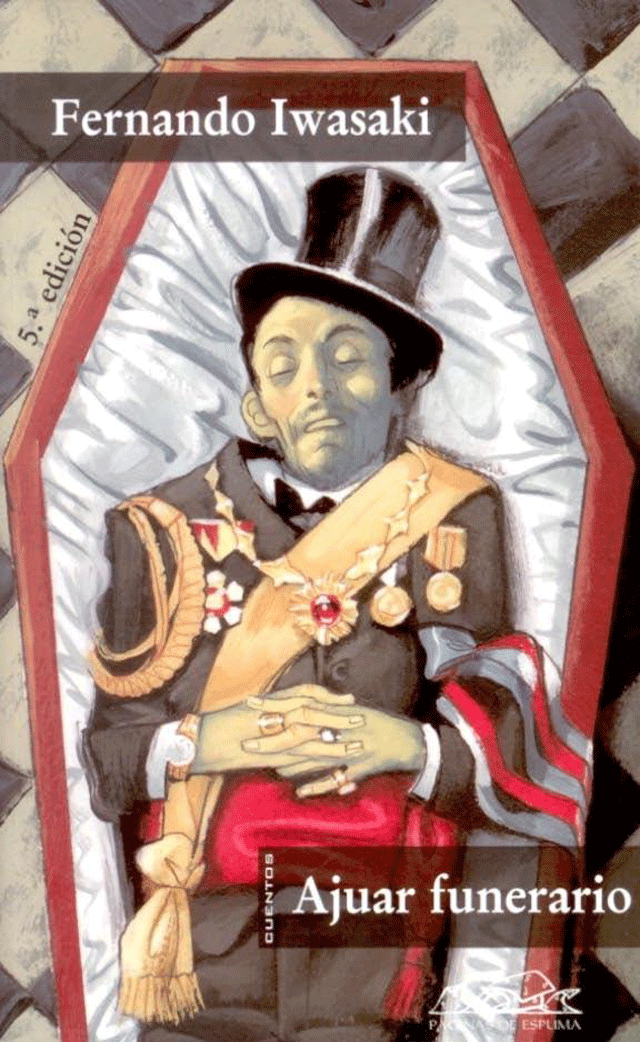
Fernando Iwasaki’s Ajuar funerario (Funeral Dress) Profiled in El Pais

El Pais has a profile of Fernando Iwasaki’s Ajuar funerario, a collection of short stories that has sold the relatively phenomenal 60,000 copies over multiple printings. The stories are in the horror genre, but with Iwasaki there is always humor, and so I doubt the stories are particularly gruesome. If his España, a parte de mi estes premios is any indication the book aught to be rather funny.

Ahí va un ejercicio para los lectores. Imaginen a un escritor latinoamericano, peruano de nacimiento, japonés de origen, sevillano de facto (casado desde hace veinticinco años con una sevillana), director de una fundación de arte flamenco, que escribe un libro de microrrelatos de terror con retrogusto de humor y que se vende como churros en las dos orillas de Atlántico. Es Fernando Iwasaki y su Ajuar Funerario, de la editorial Páginas de espuma, un longseller que lleva más de 60.000 ejemplares vendidos desde 2004 sin perder el ritmo, y acaba de lanzar su séptima edición. ¿El secreto del éxito de sus microrrelatos? Contienen historias… de miedo.

“Empecé con este género de minificción hace años, cuando me encargaron lecturas y conferencias para la universidad. Verdaderamente me sentía incapaz de leer textos míos de ocho o diez páginas, el público no merecía que le aburriese, así que decidí escribir estas pequeñas historias. Pero para que sean microrrelatos tiene que haber historia, y si no lo hay entonces podrá ser un poema en prosa, una anécdota, un aforismo estirado como un chicle… Pero no un microrrelato”. Iwasaki afirma que vivimos en un mundo invadido de ficción aunque no nos demos cuenta. “Ficción son los currículum vitae, son las esquelas de los periódicos, son los anuncios por palabras… Esa persona que publica: ‘Licenciado, 42 años, culto, encantador, desearía conocer señorita…’ ¡Eso es ficción!, ¿Cómo es posible que nadie haya llegado a esa situación de abandono a los 42 con todas esas cualidades?” Bromea el escritor.

Eugenia Rico – New Collection of Stroies plus excerpts in English

The Spanish author Eugenia Rico has published a new book of short stories from Páginas de Espuma called El fin de la raza blanca (The End of the White Race). Not having read the whole book, the title is a little off putting for how loaded a term it can be. You can read an excerpt here. I wasn’t too impressed, but you can also read an English translation of part of one of her novels here. There are also some links to videos, etc.

She has one of the more interesting book trailers I’ve ever seen, one that doesn’t try to use a text genre in a visual genre.

A brief interview about here book is also here.

My Article on Four UnTranslated Short Stories Is Up at the Quarterly Conversation

My article about four untranslated Spanish short story writers is now up at the Quarterly Conversation. It turned out really well and is a much longer form article than I normally write coming in at a little over 3K words. While I think the stories mentioned in the article are great I had to leave out so many different ones that it seems at times I haven’t written that much. Writing about short stories is always hard because you end up with some many different ones and you have to try come up with some sort of thematic element to link them together. This was esspecially the case with these four, but I think I was able to do it.

Collections of short stories are generally considered difficult to market, and thus they’re often looked down upon by editors who acquire new works of literature in the United States. This fact is no less true when it comes to editors who acquire works of foreign literature translated into English, an already notably under-represented group. To make matters worse, what stories that do get translated are often lumped into anthologies of what you might call stories from over there, which obscure the full range of an author’s talent beneath the idea that one story is a representative sample.

This is all very important in the case of Spanish literature, which in recent decades has seen a rebirth of the possibilities of the short story. For authors of what’s called the New Spanish Short Story, this tendency has hidden a great burst of creativity that began in the early 1980s and flowered during the 1990s and 2000s (the few stories that have been translated have been relegated to obscure editions unavailable in the United States). From the stories of the fantastic by Cristina Fernádez Cubas to the structural inventions of Hipólito G. Navarro and the surrealism of Ángel Zapata, Spanish short story writers have created an exciting and diverse body of work marked by its openness and dedication to pushing the boundaries of the form.

I  have also commented on other stories from Navarro and Cubas. The rest of the Quarterly Conversation looks very good, too, and definately worth reading. They have a nicely timed overview of the works of Mercè Rodoreda. (You my reviews of Death in Spring and her short stories)

Etgar Keret Story at Guernica

Guernica has a good short story from Etgar Keret. It has fun with the idea of the writer and is one of his stories that touches more directly on the troubles. The story is from his forthcoming book to be published in April, I believe.

“Tell me a story,” the bearded man sitting on my living-room sofa commands. The situation, I must admit, is anything but pleasant. I’m someone who writes stories, not someone who tells them. And even that isn’t something I do on demand. The last time anyone asked me to tell him a story, it was my son. That was a year ago. I told him something about a fairy and a ferret—I don’t even remember what exactly—and within two minutes he was fast asleep. But here the situation is fundamentally different. Because my son doesn’t have a beard, or a pistol. Because my son asked for the story nicely, and this man is simply trying to rob me of it.

Cuentos para el andén #3 Out Now

Cuentos para el andén #3 is out now. I didn’t find it as interesting as the first two. The stories in the second one were quite good. At least with this issue there is a short story form Max Aub, an author who I have read only in novel form. I can’t say I was knocked out by his story, but it was worth reading nonetheless.

¿POR qué me juzgan? ¿Con qué derecho? Todos ustedes son funcionarios, luego elévenme un monumento; y que acabe mi vida con la gloria que merezco.

Jueces son, luego funcionarios, dependientes de superiores; el ministro en el altar mayor, el subsecretario a la derecha y el oficial mayor a la izquierda. No juego con las palabras. Jamás jugué. Si lo hice, no me acuerdo. Lo maté por viejo. No él, yo.

Tin House #50 – A Review

I finally finished the ever interesting Tin House this week. As usual, there were some excellent pieces and some that, while not bad, weren’t as interesting. The big piece in the issue was an excerpt form Michel Houellebecq’s newest book, The Map and the Territory. I’ve only read Platform and found parts of it interesting, this piece, as is the case with most novel excerpts, did little to interest me, or better said, I would like to read his book in spite of what I read here. On the other hand, Maggie Shipstead’s You Have A Friend in 10A mines in some way similar territory as Houellebecq, but makes it a little more interesting. Essentially, it is the story of a Katie Holmes like actress who is trying to survive the escape from a Scientology-like group. It is a dark picture of control, a story one knows or thinks one knows after passing the magazines at the checkout counter so many times. She had several rhetorical touches that made the story interesting and lifted it above the cringe worth stories of drugs and depravity that can come from this subject. Eric Puchner’s Little Monsters was a nice change of pace, telling a science fiction story of a race of young people who are manufactured and who kill any older adults who were created through sexual intercourse. It isn’t exactly a new idea, I know there is a Star Trek story along those lines, but he brought an impressionistic sensibility to what could have been cold science fiction. And as the two young characters learn to take care of a dying adult, the transformation doesn’t bring about a revolution but does cast the brutality of their lives into a new light. The best story of the fictions, though was Quintan Ana Wikswo’s The Little Kretshmar, a story about a couple learning to deal with their disabled son. What set the story apart is Wikswo strips the story down, removing all temporal and physical baggage so that it is just the actions or results of actions that exist.:

For now, the rings dangle on short strings around their necks. When they lean over the little Kretschmar, the rings swing and dangle. But the little Kretschmar cannot see them, nor can he grab at them. The rings swing in peace as the little Kretschmar rolls to the left, and then to the right.

It is all a reminder of the sauna, of Saturday, of sex and disgust and shame. He will no longer look at her rich, high breasts. She turns away when he unbuttons.

And they avert their eyes from the little Kretschmar when he cries, and tuck the rings inside their shirts.

The accumulation of the little pieces, almost devoid of emotion are more arresting, and do not weigh the story down with the extraneous details about time of day or the color of the sun.

The best piece of non fiction in the issue was Sonia Faleiro’s piece Leela, The Mumbai Bar Dancer. The opening is an excellent example of stretching the essay form. Faleiro starts off in what is third person but is really a playful first person between her and Leela, a kind of dance that Leela plays out with all her clients. It gives a great sense of Leela because it characterizes her, lets her act and speak on her own (even though this is just an illusion), instead of a description of her. She manages to capture more than just the working conditions, but a sense of Leela.

Short Story by Etgar Keret at Tin House

Tin House has a short story form Etgar Keret.

Every night, after she had finally left him, he’d fall asleep in a different spot: on the sofa, in an armchair in the living room, on the mat on the balcony like some homeless bum. Every morning, he made a point of going out for breakfast. Even prisoners get a daily walk in the yard, don’t they? At the café they always gave him a table set for two, and sat him across from an empty chair. Always. Even when the waiter specifically asked him whether he was alone. Other people would be sitting there in twos or threes, laughing or tasting each other’s food, or fighting over the bill, while Avichai sat by himself eating his Healthy Start—orange juice, muesli with honey, decaf double espresso with warm low-fat milk on the side. Of course it would have been nicer if someone had sat down across from him and laughed with him, if there had been someone to argue with over the bill and he’d have to struggle, to hand the money to the waitress saying, “Don’t take it from him! Mickey, stop. Just stop! This one’s on me.” But he didn’t really have anyone to do that with, and breakfast alone was ten times better than staying home.

‘Three Messages’: Mexican stories of the fantastic – Reviewed in the Seattle Times

The Seattle Times has a a review of a new collection of Mexican short stories. I’m not sure I would seek it out or not since it sounds like genres I don’t read much, but since so little in the way of short stories makes it into English, it might be worth reading. I found the references to magical realism annoying. On the other hand that most of the stories have been written in the last 10 years is exciting. Too many anthologies seem to be the greatest hits of the greatest writers and don’t have anything new to say.

This anthology contains 34 stories; all but one of them were originally published after 2000, and most in the past two years. All were written by Mexican-born authors. All are short, and some are extremely short, lasting no more than three or four pages. They range in tone from delirious to grim, and exhibit various attitudes toward the marvelous intrusions into the mundane which they recount: embarrassed and regretful, slyly ambiguous, reluctantly accepting, prosaic. They occupy the memory stubbornly, insisting on their own eccentric logics, powered by the writers’ dark or shining visions, steered via authorial voices that can be disarmingly direct, cuttingly ornate, or deceptively quiet.

Xingu and Other Stories by Edith Wharton – A Review

Xingu and Other Stories
Edith Wharton
Charles Scribner’s Sons, October 1916, 436 pg

Xingu and Other Stories is an uneven collection of stories from a writer in the midst of her most fertile work. The good stories show similar concerns of her more famous novels such as the house of Mirth. When she is examining the lives of couples or more commonly the lives of women she is a powerful writer that doesn’t write polemics, but creates heroines that self aware and willing to try to size what should be theirs. They may not get it, but they’ll try. Interspersed among those stories, though, are less than convincing ghost stories, atrocity stories from World War I, and tales of revenge. Nevertheless, Xingu has some gems in it.

The eponymous story Xingu  is a funny send up of conformity and phony intellectualism. A group of women get together regularly and invite a writer to talk to the group about their book. The writers quickly bore of the  morally bland middle class women and their pedantic questions. Nor are the women are capable of  having their own opinions about the works. They all seek a kind of respectable consensus on what each book means and it makes for a conservative and unimaginative group. One day when they are trying to entertain a pompous writer one of the members mentions begins to talk about a place called Xingu. Everyone at the lunch fakes knowledge of Xingu, but none of them have heard of it. As the story builds, they begin to get more and more extravagant in their claims. Finally, the woman who first mentions Xingu , turns the table on them all and tells them what Xingu means, deflating the pedantic women of the group. It is a funny story although the punch line is a little long. Wharton can occasionally draw a story out a little too far.

Autres Temps… is classic Wharton with its subtle and nuanced look at women in society. In the story, a woman returns to New York after her divorce, a scandalous idea in during the late 1800’s, forced her to flee to Europe and a new life. She returns because her daughter has just divorced, too, and is going to remarry and she wants to be there to help her, because she remembers what a disaster it was for her. When she arrives, though, her daughter reminds her everything is alright. No one seems upset, even the women of her generation, the women she was friends with at one time. She begins to think that her exile is over, but slowly her daughter begins to suggest, perhaps she is too tired to come to dinner with everyone. Maybe she should stay in her rooms. It is a brilliant moment, both in the coldness of her daughter who should have been grateful for her help, and the identification of that all too common trait where mores change for the young, but those of the older generation still remember the past sins. It doesn’t so much as mater what she did, just that she did something at some point and should return to her exile.

The Long Run is perhaps the most cutting of all the stories and reminiscent of The House of Mirth. It it, a single man and a married woman are friends and lovers. They have been friends for years and the desire between them is strong. One night she comes to him and says she can be his. She is ready to give everything up for him and will run away that very evening. Although he says he wants it and would love to leave the factory he owns and write again with as his muse, he won’t do it. He says it wouldn’t be good for her. He is not the free thinker he is, but now the respectable factory owner more concerned about what people will think about him. Yet he is aware of his situation:

…she had married that pompous stick Phillip Trant because she needed a home, and perhaps also because she wanted a little luxury. Queer how we sneer at women for wanting the thing that gives them half their attraction!

But she is too independent for this and refuses his half measures that are more interested in respectability than love. She also sees that the winner if they do things his way is him. She won’t have any power. She wisely says no in the best line of the book:

…one way of finding out whether a risk is worth taking is not to take it, and then to see what one becomes in the long run, and draw one’s inferences.

The novella The Bunner Sisters is a strange tale about drug addiction, or as the drug addict is called in the book, drug fiends. The drug in question is opium and though Wharton never shows anyone taking it, it is the axis of the story. Even in the opening pages of the book there is a sense of danger and squalor populated by drunks and it sets the tone for the book. Describing the neighboorhood the Bunner Sisters live in she says,

These three house fairly exemplified the general character of the street, which, as it stretched eastward, rapidly fell from shabbiness to squalor, with an increasing frequency of projecting sign-boards, and of swinging doors that softly shot or opened at the touch of red-nosed men and pale little girls with broken jugs.

In other words, saloons, the so called scourge of preprohibition America. The story is about two lonely sisters who have a small millinery shop. They live a solitary life until one buys the other a clock for her birthday. The man they bought it from has a little shop and both women hold out hopes of marring him, but it is the younger sister finally marries him. Unfortunately, he is an opium addict and the older sister worries constantly about what happened to her sister who went to St. Louis wither her husband. Finally, the sister returns and tells a tale of addiction, poverty, violence, that finally ends in a still born baby and death by tuberculosis. It is a frightful tale of what can happen when you have no one and you are dependent on a man. The younger sister renounces her freedom in the little shop, although it isn’t much freedom, and chooses unwisely. It is a story that is only one step away from Dickens. It is hard to say, though without knowing more about drug usage in her works and in general (I do know in her novel Custom or the Country there is an overdose), whether this falls under prescient or after school special. That said, it is in the general tenor of the social realist problem novel. At the same time, it is well drawn picture of the two spinsters, ones you can imagine she probably met at one time or anther. And Wharton does capture the loneliness well.

As for the rest of the stories, we have Coming Home which is purported to be a story from American ambulance drivers in France during World War I. It is a story of a Frenchwoman who is caught behind enemy lines. She has no other option than put up with the Germans, letting them stay in her house, eat her food, and though it is not said, rape her. When the French take the town back her brother learns the truth and when finding the German officer who raped her he murders him, leaving as if he had been mortally wounded. It isn’t a bad story as they go, but it fits right in there with German atrocity stories and is as much propaganda as anything else. Wharton was quite committed to the war and had already written Fighting France and had helped set up hospitals, and would later write the novel, A Son at the Front. It was also the only story written for the collection and shows a hurried rush to write something relevant.

The rest of the stories are so-so. One is a ghost story with a tiresome ending that has little suspense and another is a mysterious murder that really isn’t that mysterious.

Xingu has some great Wharton and it has some less than stellar work, but the good ones are excellent. Now if only publishers would pay $2000 for stories like these as they did in her time.

Open Letter Books Spring Summer Catalog Featuring Short Stories from Latin America, and Sergio Chejfec, Kristín Ómarsdóttir, Benjamin Stein

Open Letter has released its Spring Summer 2012 Catalog and there are some interesting books in it. But most exciting of them all are works from young Latin American writers. The only one I have read a fair amount of is Samanta Schweblin, who I like quite a bit. You can read the whole catalog here (pdf).

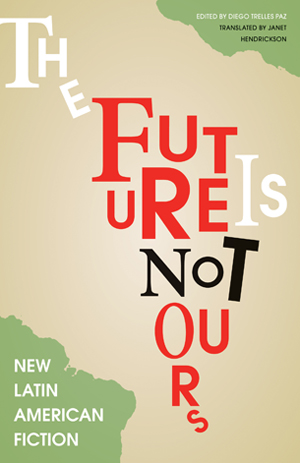
The Future Is Not Ours: New Latin American Fiction brings together twenty-three Latin American writers who were born between 1970 and 1980. The anthology offers an exciting overview of contemporarySpanish-language literature and introduces a generationof writers who came of age in the time of military dictatorships, witnessed the fall of theBerlin Wall, the end of the Cold War, the birth of the Internet, the murders of Ciudad Juárez,Mexico, and the September 11th attacks in New York City.The anthology features: Oliverio Coelho, Federico Falco, and Samanta Schweblin (Argentina);Giovanna Rivero (Bolivia); Santiago Nazarian (Brazil); Juan Gabriel Vásquez and AntonioUngar (Colombia); Ena Lucía Portela (Cuba); Lina Meruane, Andrea Jeftanovic, and AlejandroZambra (Chile); Ronald Flores (Guatemala); Tryno Maldonado and Antonio Ortuño (México);María del Carmen Pérez Cuadra (Nicaragua); Carlos Wynter Melo (Panama); Daniel Alarcónand Santiago Roncagliolo (Peru); Yolanda Arroyo Pizarro (Puerto Rico); Ariadna Vásquez (DominicanRepublic); Ignacio Alcuri and Inés Bortagaray (Uruguay); and Slavko Zupcic (Venezuela).

New Cuentos para el andén Featuring Stories from Luis Mateo Díez, Jesús Ortega and Matías Candeira

A new issue of Cuentos para el andén is out, featuring stories from three authors I have never heard about: Luis Mateo Díez, Jesús Ortega and Matías Candeira. The last issue was enjoyable and I liked the idea of supporting short stories with a free quick read magazine.