Melenio has a letter from Carlos Fuentes only surviving child describing her anguish at her relationship with her father. It is a sad letter (he wasn’t the best father as people who are very busy tend not to be) but one that is interesting when thinking about a writer who was such a personality. (via )
¿Habrás sabido alguna vez cuánto te quise y cuánto te extrañé siempre? Hace muchos años iniciaste una nueva vida con una nueva familia y por alguna razón, decidiste tratar de borrar de tu historia a mi mamá y a mí. Algo imposible porque existimos, porque tuvimos un pasado, porque compartimos momentos reales y porque sé que, a pesar de tu aparente rechazo al cariño y al calor humano, alguna vez me quisiste y me cuidaste. Ahora que leo las cartas que le escribiste a mi mamá durante los quince años que estuvieron juntos, lo compruebo. Siempre había un dibujito para mí, o palabras tiernas o de preocupación. Yo sé que jamás logré ser la hija que hubieras soñado, pero lo intenté. No. No soy ni alta ni guapa ni sofisticada ni delgada ni culta ni interesada en la política, pero hice mi mejor esfuerzo estudiando y trabajando, siempre tratando de que me abrieras un lugarcito en tu vida. Nunca lo logré.
Juan Gabriel Vásquez has a solid review of Traveller of the Century by Andrés Neuman in the Guardian. If you haven’t read about the book, perhaps this is the review to interest you in reading it. (You can always read my review here.)
Traveller of the Century doesn’t merely respect the reader’s intelligence: it sets out to worship it. An unusual talent is required to pull this off, and Neuman has it. Perhaps the awareness of dealing with an imaginary place has made him watch his world all the more closely, and with language so vivid and new you will find yourself reading as if you were rereading: for the pleasure of detail, imagery and style (all magnificently rendered by translators Nick Caistor and Lorenza García, who had a daunting task before them). Neuman, born in Argentina but raised in Andalusia, is a poet and aphorist as well as a fiction writer, and his virtuosity in the short distances does wonderful things to the long novel: the attention he pays to one of his main characters is the same he pays to the sound of an adjective while describing the wind, or a dog’s ears, or light.
The Guardian has a great podcast this week on Latin American novels and poetry. Mostly the podcast is concerned with describing Latin American writers since the boom (partly prompted by the passing of Carlos Fuentes). They make the case, one that is relatively true, that Latin American writers are not interested in trying to describe their countries or define what it is to be Latin American, as was common in the Boom. They have different interests, often times more literary or experimental. Also included at the link is a list of suggested reading. Definitely, worth checking out.
This came out a couple months ago, but I haven’t kept track of anything lately. It is a really nice and long overview of the writer, heavy on the biographical. Worth a read. (via Scott)
Whether or not César Aira is Argentina’s greatest living writer, he’s certainly its most slippery. His novels, which number more than sixty, are famous for their brevity—few are longer than a hundred pages—and for their bizarre, unpredictable plots. In How I Became a Nun (2005) an innocent family outing climaxes with murder. The weapon? A vat of cyanide-laced strawberry ice cream. In The Literary Conference (2006) an attempt to clone the Mexican writer Carlos Fuentes causes giant blue silkworms to attack a Venezuelan city, and in Aira’s latest book to appear in English, Varamo (2002), two spinsters get caught smuggling black-market golf clubs.
Aira loves to keep readers guessing—he once said that he deliberately writes the opposite of whatever fans praise—and several of his novels are actually works of probing psychological realism. But for all the variety of his novels’ plots, what has remained consistent during the thirty-odd years he has been writing is his taste for blending genres. Social realism and haunted-house tale mix with architectural theory in Ghosts (1990). Biography, pioneer tale and biogeography melt together in An Episode in the Life of a Landscape Painter (2000). The B-movie plot of The Literary Conference is peppered with asides on myth and translation.
Tim Parks has a fascinating article in the New York Review of Books about how in some countries in Europe the translation into a foreign language in Europe has is completing with the English originals. He posits that in countries where English is commonly spoken as a second language, that readers are more interested in reading books from English writers, and given a choice between a translation from English and the original they will pick the original. This has lead to the phenomenon where English language authors are considered the best writers. Instead of broadening access to writers, it has had the effect of limiting narrowing access. I don’t think this phenomenon is as pronounced in Spain, but I do marvel at how many English speaking authors make it in to Spanish. On reading through a book of interview I was also amazed that outside of some classic short story authors, most of the influences were Spanish or English language authors only. Fascinating stuff. (Via)
When I asked people to list titles they had recently read, they seemed surprised themselves how prevalently English and American, rather than simply foreign, these novels were. A linguist from Amsterdam University, for example, went away and jotted down the names of all the novelists on his shelves: fifty-eight Anglophone authors (many were Booker and Pulitzer winners), nineteen from eight other countries and twenty Dutch. Until he wrote down this list, he remarked, he had not been aware how far his reading was driven by publicity and availability. Indeed, no one spoke of any method behind his or her choice of novels (as opposed to non-fiction, where people declared very specific and usually local interests).
“I read foreign novels because they’re better,” was a remark I began to expect (surprisingly, a senior member of the Dutch Fund for Literature also said this to me). I asked readers if that could really be the case; why would foreign books be “better” across the board, in what way? As the responses mounted up, a pattern emerged: these people had learned excellent English and with it an interest in Anglo-Saxon culture in their school years. They had come to use their novel-reading (but not other kinds of reading) to reinforce this alternative identity, a sort of parallel or second life that complemented the Dutch reality they lived in and afforded them a certain self esteem as initiates in a wider world.
Apart from the immediate repercussions on the book market, where there is now fierce competition between English and Dutch editions of English language novels, the phenomenon suggests a few things about reading and the modern psyche. There appears to be a tension, or perhaps necessary balance, between evasion and realism in fiction, between a desire to read seriously about real things—to feel I am not wasting my time, but engaging intelligently with the world—and simultaneously a desire to escape the confines of one’s immediate community, move into the territory of the imagination, and perhaps fantasize about far away places.
Guernica has an unpublished interview with Carlos Fuentes from 2006 that is worth reading (you can also listen to it if you scroll to the bottom of the page). It covers politics more than literature, although there is a lengthy section on his admiration for Juan Marse. Fuentes was always a fairly astute political commentator and he has some interesting things to say about immigration and democracy.
Guernica: Do you consider yourself a writer in exile?
Carlos Fuentes: I have never considered myself a writer in exile because I grew up outside of my own country, because my father was a diplomat. Therefore, I grew up in Brazil, Chile, Argentina, the United States, I studied in Switzerland—so I’ve always had perspective on my country—I am thankful for that.
Our greatest novelist ever, Juan Rulfo, the author of Pedro Páramo, never left Jalisco and the states of Mexico where he sold tires and drove around and heard stories—he is the great example of a writer very much bred, rooted in the country, that transforms all he has heard into great art. My position was very different because I had a perspective on Mexico since I was a child. I was a boy of ten when President Cárdenas expropriated the oil holdings of foreign companies, and there was a wave of anti-Mexicanism in the United States. There were big headlines, “Mexican Communists Steal Our Oil,”—then I lost friends at school (I was in grade school), I was looked upon with suspicion. And I was the son of a diplomat; when I heard the news from Mexico I sided with Mexican causes. I grew up in a kind of exile until I was fifteen years old, always outside of Mexico, but always very conscious that I was a Mexican. Yet that gave me a different consciousness of being Mexican from someone who had never left Mexico—so, it worked both ways.
For a moment there I could have become Argentinean or Chilean—I was very bound to my friends, my schools in Santiago and Buenos Aires, but no—no, Mexico has won me over, and do you know why? Because Mexico always was and always will be a mystery for me, a big question mark. What is this country all about? How can I understand it? You know, when García Márquez doesn’t understand the baroque political situation in Mexico, he goes to the National Museum of Anthropology, and stands before the Coatlicue the Mother Goddess of the Aztecs, the gigantic sculpture of block, of serpents, headless, tremendous, of a goddess saying, “I am a goddess not a person—don’t try to find personality in me. I am not Venus—I am Coatlicue, the goddess of serpents.” And when he has stood five minutes in front of Coatlicue, he says, “Now I understand Mexico,” and leaves.
It’s a very complex, mysterious country. I will never understand it fully, and that’s why I write so much about it, in order to try to understand it.
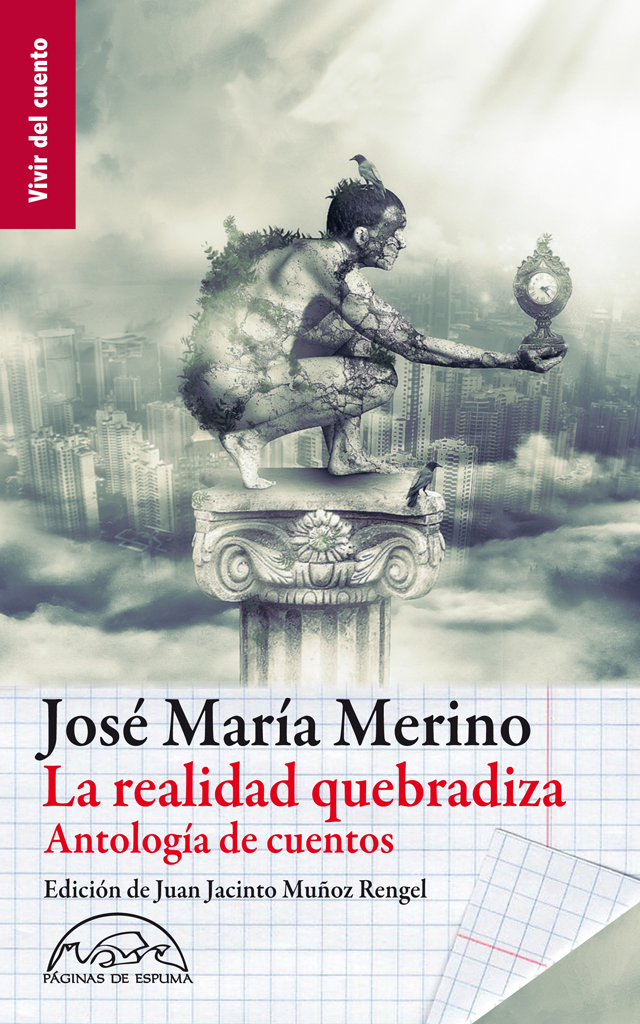
El Pais among other newspapers have some interesting interviews with José María Merino on the occasion of the publication of an anthology of his writing by Páginas de Espuma. He is a short story writer I’ve been looking forward to reading soon. Last year his book El libro de las horas contadas was given high praise and end up on some best of the year lists. The interview from El Pais is interesting. It was especially gratifying to hear a short story writer say there are only so many short stories one can read in a sitting, something for all the short stories I read, I find to be true.
-¿Y que hay de los microrrelatos?
-Hay gente que los desdeña, pero es como si un pintor desdeñase el soporte de óleo o el soporte de madera. En ellos puede haber cosas estupendas o cosas deleznables, exactamente igual que en la novela. Para mí, como escritor, lo que aporta es que puedes decir cosas que no podrías decir de otra manera.
-¿Son estos capaces de satisfacer el hambre literaria?
-Sería absurdo comparar un minicuento con Ana Karénina, pero son sabores que pueden resultar más intensos, pueden dar un matiz diferente. El problema es que no puedes leer demasiados minicuentos seguidos, porque te empachan. Pero pueden despertar ideas interesantes y divertirte mucho.
You can read the introduction of the anthology here. It will give a good sense of his work. And if you are looking for a few more interviews the publisher has a few links here, here, here.
The latest issue of the Quarterly Conversation came out recently. As usual it has some great material in it, including a review of Daniel Sada’s Casi Nunca which was published a couple of months ago. It is a good review in terms of thinking about Sada’s language and grounding him in Mexican letters. It isn’t so good in giving you a sense of what the book is about. That’s ok I guess. You can’t have every thing. The book has been on my shelf for years. I’m going to get around to read it one of these days.
Douglas Glover believes that there is a major failure in literary culture, and his new volume of essays, Attack of the Copula Spiders, attempts to re-teach the skills of reading and writing. Attack of the Copula Spiders, however, definitely is not an exercise in remedial education. Glover is a literary technocrat with a cranky, professorial temperament. He studies the percentages of load-bearing words within sentences and paragraphs, offering dictums in terms that would be familiar to central bankers. But are his remedies right for our literary problems?
A highly educated man proposes that the government create a publicly funded system of healthcare. His opponents question the scientific basis of his ideas while clinging to religion. Some wonder where the money will come from; others worry about who will decide who receives care. As ordinary citizens see more and more of their friends and family fall victim to a corrupt system, they unite in a protest that is intended to be non-violent but turns bloody when challenged by government militia. But, rather than the people’s triumph, the seizure of power only marks the moment when hypocrisy, under the banner of “compromise,” becomes pervasive. That’s what happens in Machado de Assis’ 1882 novella The Alienist , the opening chapters of which are excerpted in this issue of The Quarterly Conversation. The Alienist takes place not in the United States of 2012 but in the Brazilian colonial outpost of Itaguaí, sometime around the year 1800.
You know, the problem is that anything that’s the least bit serious gets bad PR. Kafka got bad PR, and so does the Bible. The Old Testament is a pretty hard text to read; anyone who finds my writing difficult must have trouble with the Bible, too. Our consumer culture aims at putting your mind to sleep, and you’re not even aware of it. It costs a lot of money to keep this singular procedure going, and there’s an insane global operation in place for that very purpose.
The chronicles of Itaguaí tell that long ago there lived in town a certain Doctor Simeon Blunderbuss, a man of noble birth and the greatest doctor in Brazil, Portugal, and both Old and New Spains. He had studied at Coimbra and at Padua before returning to Brazil at the age of thirty-four. The King could not manage to convince him to stay on in Coimbra as regent of the university, nor in Lisbon directing royal affairs.
I thought it strange the baby not crying. I wanted to get up and check that it was all right, but I was worried I’d hurt myself, plus I was in a bit of a daze—it was as though my eyelids weighed more than usual. I asked myself: what dreams would I have had while I was under? I couldn’t remember a thing. Strange, because I always dream, and I always remember my dreams. I’d had a recurring nightmare over the previous nine months, over and over: in agony, I’d be giving birth to a baby that made a sound like a cat.
It’s Ibn Fadlan’s account of his remarkable journey that takes up the larger part of Paul Lunde and Caroline Stone’s newly translated anthology Ibn Fadlan and the Land of Darkness: Arab Travellers in the Far North. In 922 Ibn Fadlan set off from Baghdad as the envoy of caliph Muqtadir, bound for the upper Volga River and the Turkic-speaking court of Almish ibn Yiltawar at Bulghar. His mission was simple: to instruct the newly converted Almish and his people in the Islamic faith, to oversee the building of a congregational mosque, and to assist in the construction of a defensive fortress. Because of their richness, Ibn Fadlan’s detailed observations retain an authentic power to shock. He maintains a coolly dispassionate sense of importance and breadth, documenting a dizzying range of anthropological gems, from Turkish marriage customs to hospitality, from hygiene and the Ghuzz taboo on washing to horse sacrifices.
The Future is Not Ours: New Latin American Fiction
Diego Trelles Paz, ed
Open Letter, 2012, 254 pg
I won’t say too much about the book since I will be reviewing it for the Quarterly Conversation. It was a good book. As with any collection of short stories there were a few stories that didn’t interest me much, but the over all quality was good. Reading stories that come from outside the American tradition is always nice because I don’t have to be bothered with the craft of the story, since the authors tend to have different interests in writing. I did find the introduction slightly annoying, mostly because it promised something that the stories did not deliver: reactions to the recent past. The editor notes how important that the connections to the history of dictatorships, etc is in their work, but that is rarely mentioned in the stories. It is the fault of the introduction not the writers, for advancing that idea. Also his effort to locate the book in the context of a new Latin American writing that has gone past the Boom and the McOndo of Alberto Fuguet, doesn’t quite work. Many of these stories have a Fuguet quality and don’t seem so distant from the his McOndo style.
All of these are quibbles, since the stories, on the whole, are good. I will leave it at that until the review comes out.
El Pais had an interesting article about the Spanish authors who went into exile and the works that reflect that exile. I’ve read a little of Aub (my review was luke-warm), but none of the works here are familiar to me. I think a couple sound interesting. You can read some excerpts here.
Max Aub, La gallina ciega. Diario español
Max Aub.
max Aub publicó en vida dos fragmentos ampliados de sus diarios: Enero en Cuba recogió su estancia insular en 1968 y La gallina ciega, su regreso a España en 1969. En su inicio, puso una execración de Franco; en su final, una zumbona carta al ministro solicitando su beneplácito para publicarlo. Y en medio, afirma: “No intenté ser imparcial”, porque “no soy juez, sino parte”. Le fastidió casi todo… Que las coquinas de 1969 no supieran como las de 1936, que España se hubiera convertido en el lugar de veraneo internacional y, sobre todo, que nadie se acordara de lo sucedido entre 1936 y 1939, ni de la vida cultural republicana, ni de quienes se fueron al exilio. Asistir a una comida con Luis Buñuel y Dámaso Alonso, o al reencuentro con el fascista Santa Marina son experiencias inolvidables, contadas en esta prosa conceptuosa y restallante. (Joaquín Mortiz. México, 1971).
Cuntos para el andén, the free magazine of short stories from Spain is out with its newest edition. It includes a couple of pieces of short fiction from Juan Jacinto Muñoz Rengel. I’ve been interested in reading something of his ever since I read La familia del aire a few weeks ago. He uses the fantastic in his writing. Also there is one from Francisco Umbral who I don’t know, but have heard his name a few times.
The June 2012 Words Without Borders is out now. The theme this month is Queer. As usual there is an interesting selection as well as a review of Andrés Neuman’s Traveler of the Century which I also reviewed.
La furia de las pestes
Samanta Schweblin
Fondo Editorial Casa de las Americas, 2008, 111 pg
For readers of Spanish language literature in translation Samanta Schweblin’s name is slowly getting a little more notice. She has appeared in Words Without Borders, the Granta 22 best Young Writers in Spanish, and will appear in the forth coming The Future is Not Ours from Open Letter. However, with such spotty coverage it is hard to get a good sense of this writer’s work, a writer who has earned the respect of many of contemporary Spanish Language short story writers.It is a shame because her reputation as a short story writer to watch is deserved.
La furia de las pestes is Schweblin’s second book and won the Casa del las Americas short story prize in 2008. A couple of the stories have been translated into English: Conservas, which appeared in Words Without Borders (where I first encountered her work), and En la estepa, which is in The Future is Not Ours. Both of these stories are marked by the fantastic and show her at her best. Conservas is the story of a woman who reverses her pregnancy over the course of months, slowly shrinking it down until there is nothing left of it. Ultimately, it is a bitter sweet moment when she realizes that what she wanted so badly is perhaps not quite for the best. It nicely turns what easily could have turned into a didactic story on women’s rights, and gets at a more emotionally wrenching truth that there is no answer to such dilemmas. En la estepa (On the Stepe) is a fantastic story, yet one where the fantastic is only alluded to and like here best work, plays on customs most people would know, but are just a little strange and call into question those very customs. Throughout the story the characters keep mentioning some sort of creature that all want and that the lucky ones have found on the stepe. The first time I read it I thought it was just a story about a beast (and uninteresting at that), but when you look at the language everything the characters says are the words one uses when expecting a child. Used in a different context they sound abusive, selfish and it makes one question exactly what one is talking about when talking about children.
Those stories are available in English. But what about the rest of the stories? One thing that is obvious is that she is not tied to the fantastic. In two stories Papa Noel duerme en casa (Santa Claus Slept at My House) and Mi hermano Walter (My Brother Walter), she uses depression as a form of the fantastical. In each the characters loose contact with an accessible reality and their actions, naturally, seem strange. Interspersed with in stories of the fantastic, it underscores the strange nature of depression. The depression is not treated lightly and Papa Noel duereme en casa has a troubling vision of a marriage coming to an end and narrated by a young girl. Or in a story called Cosas que se tiran (The Things That Are Thrown), where a the narrator’s partner throws all their possessions into the shower before leaving, there is just a glimpse of something dying (the story is only 2 pages long). It forms a recurring theme of loss that leaves a dull ache for the unobtainable and at the same time a mater of fact sense of attachment to those losses, as if the narrators are so accustomed to them there is nothing one can do. That sense is most evident in El hombre sirena (The Merman), about a woman who meets a merman who is sitting on a dock. He offers her something different, but she doesn’t take him up on it. Or at least that is the suggestion, because she drives away with her brother to the waiting doctor. Is this another depressed person? She is obliviously anxious when she gets in the car to drive away. And like so many of her stories, the narrator says, perhaps tomorrow there will be another one waiting for me. The unspoken future is mostly likely not too much better.
The title story is a nice nod to Juan Rulfo about a man who goes to a forgotten village and tries to get the people to say something. It is one of those lost villages out of The Burning Plain (El llano en llamas) where everyone stays in their stone homes when a stranger comes to town. The twist her is when he tries get the people to talk and offers them something he thinks will help, it only reminds them of what they don’t have.
Finally,Cabezas contra el asfalto (Heads Against the Asphalt) is dark story about art. It opens with the shocking lines
Si golpeás much la cabeza de alguien contra al asfalto–aunque sea para hacerlo entrar en razón–, es probable que termines lastimándolo.
If you hit someone’s head a bunch of times against the asphalt–even though you are doing it for their own good–you’ll probably end up hurting it.
From there it follows a narrator who from time to time gets angry and beats people’s heads against the asphalt. As a child it gave him power because bullies would leave him alone. At other times it terrified people. However, he is able to channel the anger into painting. He becomes famous painting pictures of heads beat against the asphalt. His paintings sell for millions of dollars. All that matters is the frame of reference and beating someone’s head against the asphalt is perfectly acceptable. The narrator is completely detached from what is acceptable and it throws into relief which beatings are acceptable and which are not. The story ends with the ultimate taboo, but as far as the narrator is concerned it was just another beating. It didn’t matter who the person was, he just made him angry and he had to beat him. Unfortunately, for him reality is not self constructed.
Samanta Schweblin’s stories can be deceptively simple, but when she is at her best the stories open up new realities from ones that surround us every day. He ability to turn the language of child rearing into something dark, or reimagine a fairytale like the Little Mermaid as a series of indecisive acts, make one of the more interesting writers coming from Latin America.
La Jornada has a selection of short stories form Mexico City youths in the juvenile justice system. It is an interesting collection and one is an eye to writers who one would probably never come across.Out of 360 stories submitted, they published around 10. This is from the first
Todo esto empezó el 28 de septiembre de 1992, en una familia pequeña, integrada por papá, mamá, tres varones y una niña, la más pequeña de la familia.
El piloto de esta familia era Mario, el papá. Él era el que decía la última palabra, pero no antes de consultar a mamá e hijos.
Todo marchaba muy bien. Claro, siempre había problemas, pero nada que no resolvieran papá o mamá.
Un día viernes por la noche como a eso de las 9:45. Mario llegó del trabajo muy agotado, apenas podía mantenerse de pie, se tiró al sillón como desmayado. Claudia, la mamá de la familia pensó: pobre de mi querido esposo, está muy cansado; Claudia le quitó los zapatos y los acomodó abajo en un rincón de su cama de Mario y Claudia.
Claudia agarró el último billete que les quedaba, que era uno de doscientos, se queda pensativa y dice en voz alta, ¡aunque se enoje Mario y me moje, tengo que ir a la panadería de Macario!
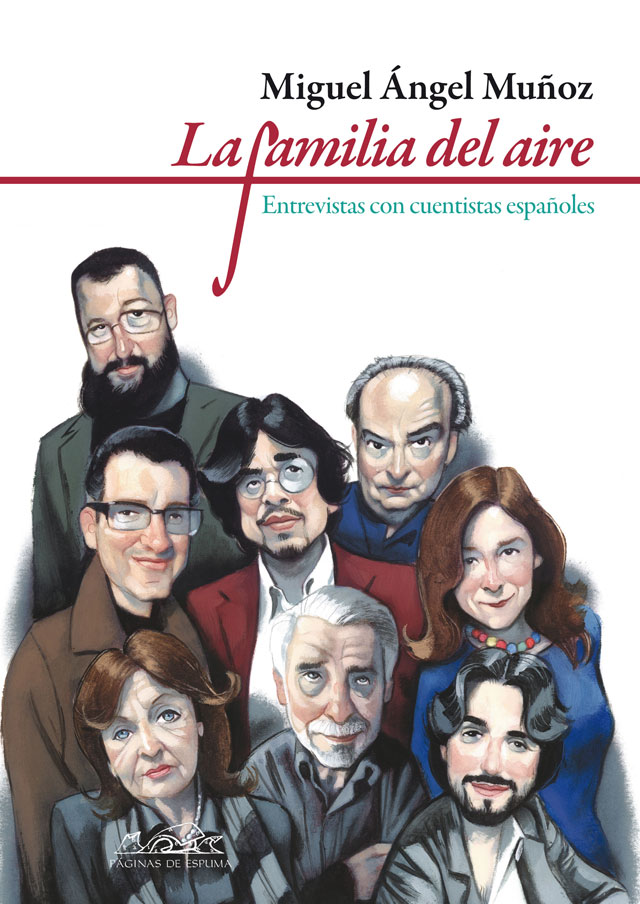
From bottom left clock wise: Cristina Fernandez Cubas, Miguel Ángel Muñoz, Hipolito G. Navarro, Fernando Iwasaki, Enrique Vila-Matas, Mercedes Abad, Andrés Neuman, José María Merino
La familia del aire: Entrevistas con cuentistas españoles (The Family of the Air: Interviews with Spanish Short Story Writers)
Miguel Ángel Muñoz
Páginas de Espuma, 2011, 474 pg.
The Spanish short story writer Miguel Ángel Muñoz’s La familia del aire: Entravistas con cuentistas españoles (The Family of the Air: Interviews with Spanish Short Story Writers) is an invaluable guide to the modern Spanish short story, and one of the best books I’ve read on the art of writing. Muñoz is an excellent and dedicated interviewer whose questions show a deep and thoughtful reading of each interviewee’s body of work. He sees interviews as not just another genre, but as an art unto itself and as he mentions in his introduction, he keeps collections of interviews in binders. He believes that letting an author talk about his or her work helps expand it, place it in a deeper context, rather than only letting the work speak for it self. It is this deep devotion to short stories and his ability to draw from the 37 included authors what makes short stories so compelling makes the book a must read for anyone interested in the short story. It is all the more impressive since all the interviews were conducted over a series of 3 or so years and published on his blog, El sindrome Chejov. In one of those great acts of personal fascination lived publicly, in 2006 Muñoz began to interview Spanish short story authors. What started quietly without any grand ambitions, morphed over the intervening years into one of the primary sources about authors working with the short story. Muñoz notes he was a little surprised by the willingness the authors agreed to interviews, but his dedication and preparation, which at the minimum includes reading each interviewee’s oeuvre, makes him a trustworthy interviewer, one that most writers would love to have. Muñoz also brings an sense of excitement to the short story. When reading his interviews (or his blog posts) it is easy to catch that same excitement—I should know, since every time I read one, I want to go out and read the author’s stories. The book is truly a one of a kind success that I wish existed for English language authors.
The only draw back of the book for my English language readers is that very few of these authors are available in English (certainly not the author’s fault). I have tried to remedy that with my recent article about unpublished Spanish Short story writers at the Quarterly Conversation. And when an author has been translated into English it is usually a novel. The most recognizable name in the book is probably Enrique Vila-Matas. Andrés Neuman, the last interview of the book and one of the better ones, also just had a novel come out in English (read my review here). That said, one of the most fascinating things about the book for an English speaker is to see what authors have influenced these authors. Given that English language authors may not be exposed to as many translations as they are in Europe, it might come as a surprise that two of the most common names that came up were Raymond Carver and John Cheever. Over and over in the list of influences these two always showed up. Some authors have turned to the English speaking authors as a refuge from the Spanish language traditions, but even when they cite Spanish language authors those two show up. I’m not so sure that would be the case for the reverse. Other English language authors mentioned were Poe, Anderson, Fitzgerald, Hemingway, Mansfield, Lorrie More and Alice Munro.
Spanish language influences tended to come mostly from Latin America. Cortazar was the most sited, the Onetti and Borges, and with a little less frequency Rulfo. There was a sense of disinterest in Spanish short authors from the middle of the century. The only two that were commonly cited were Juan Eduardo Zúñiga and Medardo Fraile. I think this is a function of one generation turning against another, something Andrés Neuman noted, saying that Spanish authors should take more pride in their own tradition with mid century authors like Ana Maria Matute. Only one author, Fancisco Afilado, though, really did not like the Latin Americans, especially Cortazar who he said led too may young writers to play games with their stories. Again, as a contrast to the American scene that notion of play is often lacking and too many write in the realistic vain. Afilado, naturally, is the author who loved the American realists the most, and is a perfect example of those who believe that noir is the best writing because it is the most real. I can’t say I agree with that, but it was refreshing and annoying at the same time to find one author in these interviews who has that opinion.
There were relatively few references to authors outside of the English and Spanish traditions. There were, of course, the trinity, Chekhov, Maupassant, and Kafka, but relatively few references to authors from any other languages (except perhaps Catalan). Only once did I see a reference to Thomas Bernard, for example. But given who rich both of these traditions are, there is quite a bit to mine in terms of influence.
With the exception of a few novelists, all the interviewees are dedicated to the art of the short story. As such, every interview has a question about the disrespect given to short stories in Spain. There were several theories all of which probably have some validity. My favorite was Carlos Castán’s theory that all the Christmas stories that come out ever year and which written by famous authors, turn readers away from the short story, because the stories are written by people who are not short story writers. I think the lack of critics who specialize in the short story, especially those at newspapers, is probably a better theory. The short story has the perception that it is just what you do between novels. Another mentioned that the public likes to engross themselves in a big story and don’t like the stopping and restarting that a collection of short stories entails. That may be the prescient commentary: it is one I sometimes feel when I am reading collections of short stories, especially ones larger than 200 pages.
Of course, things always look better across the water, and there were multiple references to the tradition of the short story in the US. However, I often feel that what they are looking at is a tradition that is from 30 years ago, if not father back. While major publishers do bring out collections of short stories, they are still a small fraction of published fiction. And while there are small magazines and journals like Tin House, the short story also lacks for prestige. Perhaps things are better here, but it certainly is not a paradise.
Ultimately, the book with its ample indexes, appendices of authors cited in the interviews, and a list of each author’s published works, short story or otherwise, is one of the best references to the short story I can think of. And as one might expect my list of authors that I’m interested in reading has grown. These are just a few that you may see on these pages some day: Mercedes Abad, José María Merino, Medardo Fraile, Juan Eduardo Zúñiga, Iban Zaldua, Ángel Olgoso, among others. That, I think, is the highest praise for La familia del aire: Entravistas con cuentistas españoles.
While I thought Bonsai was well written and showed some inventiveness, I thought it was a little juvenile at times. Still I was curious how such a literary novel would be turned into a movie, especially all the references to writing and reading. I’ve long since gotten over the truism that the book and the movie are never the same. What interests me is what decisions they have made. As far as the literary content goes, they handled it quite nicely. The running joke about the main character writing a novel that he is really supposed to be transcribing is in some ways a little more interesting because it is subtle. Where as the narrator has to explain it in the novel, the film just shows it. It is one of those advantages that film can occasionally have. The real plus of the film, though, was it did not seem as juvenile as the book. The change in narrative perspective is most likely what created that feeling. The film it self is serious, the incidents are comic, whereas the narration of the novel is light and jokey. One is certainly not better than the other; they are their own things. The novel is certainly more revolutionary; the film is fairly straight forward. As literary movies go, though, it is one of the better ones. The film makers didn’t try to create a metaphor for the creation of writing, something that is usually tedious. Rather writing is just something one does and reading is something one enjoys. Moreover, they were able to use the same jokes from the book to show the two lovers injecting literature into their lives and constructing literary significances to even the smallest things. That sense of the primacy of literature in the book is stronger because in the movie the characters, almost comically, are often going to puny parties at the college that makes all their pretensions seem funny. So although Bonsai the movie is not Bonsai the book, as adaptations go, it is one of the better ones.
El Pais has an excerpt of a novel he was working on when he passed away. It is called Federico en su balcón and you can read an excerpt of it at El Pais. Given his last works, I’m not sure really how thrilling it will be, but you can be the judge.
Sesenta y seis. Esos son los años que estuvo atrapado Carlos Fuentes por la verdadera pasión de la literatura. Sesenta y seis años que hay entre el descubrimiento que hizo de El conde de Montecristo, a la edad de 17 años, y la escritura de sus dos últimos libros: Personas y Federico en su balcón que dejó a los 83 años, antes de morir el 15 de mayo. El primero son unas memorias sobre los personajes que conoció y el segundo una novela en la que salda cuentas con Nietzsche.
No es solo el legado póstumo de uno de los escritores e intelectuales más relevantes del mundo hispanohablante del último medio siglo. “El significado de Federico en su balcón”, explica Pilar Reyes, editora de Alfaguara que publicará la novela a finales de año, “es que Fuentes nunca pensó que fuera el último. Pero ahora cobra una gran dimensión simbólica. Resume dos aspectos: el Fuentes ciudadano y el literario e intelectual. Es una reflexión sobre el poder y la decisión moral en las pequeñas cosas de la vida. Una especie de combate entre lo público o el poder que incide en la vida de todos y las decisiones pequeñas y privados”.
Carlos Fuentes was one of the first writers who I can really remember inspiring my interest in writing. I was not a reader of literature before I got to college. I read history, but fiction wasn’t something I thought much about. It took sometime for literature to interest me. The first author I can remember was James Baldwin, but after I ran across Juan Rulfo and Carlos Fuentes I saw the real possibilities of great writing. I had been taking one of those classes that only The Evergreen State College could create: one whole quarter (16 credits) dedicated to Mexican literature, history, and culture. It was a truly immersive experience and we read two works of Fuentes: The Death of Artemo Cruz and The Old Gringo. One was a masterpiece and the other one of his many less than stellar efforts. We all knew The Old Gringo was week, but when you have an Artemo Cruz it doesn’t really matter. It was Fuentes at his best: expansive, using history as his tablet, and letting his structural inventions wow young writers to be. After going over his works in class and out, I had to find other books, reading Where the Air is Clear, Aura, Burnt Water, and the Good Conscience shortly after. I particularly identified with the Good Conscience, a coming of age story that was set in Guanajuato, a city I had visited once. Thinking about it now it’s funny that I would find the book so compelling, but he was able to capture something. Later, when I finally made it to Mexico city several I spent a day or two with my head raised, looking for the mansard roofs he had mentioned over and over in Where the Air is Clear, as if finding a sloping roof would explain something about Mexico. It was unnecessary; Fuentes had already constructed a Mexico for me, one that I described in my piece, Just a Handshake is Enough.
A few years later I lost some of my fascination with his fiction. Perhaps it was the unevenness of his later works. They never seemed to have the exciting sense of a man forging a vision of a country. Instead they showed a man whose fiction seemed to be self absorbed. Even then, however, his literary criticism, his ability to talk about writing and writers was always interesting. His book La geografía de la novela was the first book I ever read in Spanish and was an exciting not because it delved into theory, but because he could make writing and the whole process of literature sound important and vital. For Fuentes, literature was more than games for grad students and that sense of passion you read in any article or heard in any interview was kept him interesting even after his later fiction lost some of its weight. Hearing of his passing was a shocker because just the other day I was reading an article in El Pais about his adventures in Buenos Aires for the book fair. He always seemed to be connected to the literary world and could talk about the newer generations and the same time as Cervantes, and, again, it made reading and writing exciting. In an age of e-books, hand wringing about the future of books, and enfeebled academia, despite Fuente’s flaws he made writing and love of literature seem one of the most important endeavors one could undertake.
RIP/DEP
There are plenty of articles and tributes in Spanish that you might want to read.
Era autor de más de 20 novelas y contaba con el Premio Cervantes (1987) y el Príncipe de Asturias (1994). Escribió obras como ‘La región más transparente’ o ‘La muerte de Artemio Cruz’. El velatorio será privado en su casa. A las 13.00 (hora de México) sus restos llegarán al Palacio de Bellas Artes
El corazón de los caballos (The Heart of the Horses)
Miguel Ángel Muñoz
Alcalá, 2009, 145 pg
El corazón de los caballos is the Spanish short story writer Miguel Ángel Muñoz’s first novel. A refreshingly short novel, it is a continuation of a story that first appeared in his collection Quédate donde estás (Stay Where You Are), called El reino químico and which was my favorite of the collection when I reviewed it a year or two ago. As in the short story, the novel opens with unspoken tension between the narrator’s father and grandfather. It is a tension that has populates the world of the grandson, Victor, who doesn’t understand why his father does not like his grandfather. It is a relation that in the novel is distant and still remains unexplained, but it sets the tone of the novel. What seemed like the eccentric behaviors of a loving grandfather in the El reino químico, are actually the foundations of Victor’s problems.
Victor’s life hasn’t quite worked out as he wanted. He was a promising mathematics student but when he fails to get a scholarship after years of graduate study, he loses his patience and attacks the professor. He loses everything and on his journey to his final court date he goes to a Pyrenean town with his boyfriend Andrés, who is going to receive a literary award. It is a journey that begins to trigger a series of memories that he has if not suppressed, avoided. The first is of Eva, his former student, an anorexic and troubled girl who intrigued him. It isn’t so much as sexual, although there is some sort of tension, but one of shock, fear, confusion or even disappointment. When he does discover that she binges at night he is angry and like the mystery of his father and grandfather, she disappears and he hears nothing of her again. The second, darker memory is of a drug addict who likes to climb from balcony to balcony. Scared, a knife in his trembling hand, he watches as the man loses his balance on his porch and falls to his death without doing anything. He’s accused of pushing him, but he’s released because the man was a druggie known for that dangerous game.
With those incidents in the background, Victor and Andrés enter the Pyrenees. The awards ceremony is really just a chance for the town to feel important, but they meet two people of interest: the previous winner, Ines, a mysterious woman who has not let her photo appear on the cover of her books since her first book; and an old man and his granddaughter. Each has a story that Andrés, a man who lives to gather stories and rewrite them as he sees fit, as if he is reconstructing the reality of those he has stolen from. And it is a form of theft, because he is unrepentant in his using of other people’s lives. The old man talks about a Portuguese man he met during the Spanish Civil War and who had been wrongly accused by the old man’s comrades of being a traitor. The story captivates both Andrés and Victor, and the old man promises they can see a photo of him the next day. From then on Victor’s life begins to get worse and over the next few hours he descends into darkness and violence as Andrés dumps him, and Victor begins a search for the photo the old man promised. Ultimately, ending in a desperate moment of hate.
What makes the novel interesting is the interplay between the stories that the characters tell, and the way Andrés uses them to recreate Victor’s existence. A week man, Victor is at the mercy of Andrés ability to rewrite his own story, and when that story has ceased to be interesting, he leaves him; thus, rewriting his life again. It is that interweaving of Andrés power to draw a story from a character that creates Victor’s experience. It is as if, Andrés were actually the author of the book. It is a nice play on the journey narrative, and takes the reader deeper into the layers of story than just the Heart of Darkness references (in Spanish it is translated as El corazon de las tinieblas). Muñoz is an author who is very interested in the interplay of story, reality, and how they construct each other and that playfulness is what makes him an interesting story teller and El corazón de los caballos a book worth reading.
Traveler of the Century
Andrés Neuman
Farrar, Straus and Giroux, 2012, 564 pg
El viajero del siglo
Andrés Neuman
Alfaguara, 2009, 531 pg
Andrés Neuman’s Traveler of the Century (El viajero del siglo) is a broad novel of ideas that takes place in post a Napoleonic Europe that at first seems distant, but as he makes quite clear the same debates and the same arguments are still with us. It is an impressive bit of scholarship, bringing to life the philosophical arguments that have receded into the past. At the same time, Neuman also constructs a narrative that is equally interesting, giving the book a narrative impulse that is a good counterpoint to discussions about Schiller, Goethe and other 19th century German thinkers.
The novel follows Hans a world traveler who stops at the town of Wandernburg on the border of Saxony and Prussia. He intends to stay only a few days and move on, but he meets an organ grinder in the town square and they begin a friendship. The organ grinder is a kind of sage with whom he respects for his detached way of looking at the world, which lets him obverse the town, but stay distant from its intrigues. He also has seems to know that Hans should stay in the town and suggests after they first meet that he should stay an extra week. In that week, Hans who still plans to leave as he does every town he visits, meets the Gottlieb family and is taken with the daughter, Sophie. Once he has meet the family, striking up a friendship with the father and latter managing to get himself invited to the salon that Sophie hosts, he becomes, at least for a time, a resident of the town.
During the salon Hans, Sophie, an older professor named Mietter, a Spanish expat Alvaro, and several towns people discuss everything from the European union under Napoleon, the value of religion, which forms of government are best, and the merits of classicism versus romanticism. While everyone chimes in, Hans as the worldly traveler brings the new liberal and romantic ideals to the group and often spars with Mietter who represents a conservative, Catholic, and classical view. The two are usually at odds and although Alvaro with his anti-clericalism can shock the group, Hans is the true rebel of the group expressing ideas that propose to overthrow the established order and many times are illegal in Saxony.
It is during these salons that the book returns over an over to the idea of identity. What is it that makes Europe, Europe? It seems to be odd to discussing these ideas again, and occasionally during the salons I found myself thinking, yes, I already know this, why do I need to read this way. Yet these arguments are still going on and taking a gaze at Europe it is obvious that these arguments only seem settled because they are old. For example, at one point Alvaro notes it is better have less religious freedom because it leads to greater belief, unlike Spain which has such high disbelief thanks to the church. That friction still exists in Spain and has been an issue for a over a century. In other parts of the book, he looks at the desire for every ethnic group to have its own country, a topic that is still hotly debated in several countries. It is in these discussions that the book is more than just a rereading of German romantic thought, but rediscovery of the same problems that they tried to address and which have yet to be settled. While the novel was written between 2003 and 2008, the questions have taken on even more weight in light of the financial crisis that has exposed even more points of contention between the countries of Europe. (Alvaro’s funny take of the genius of Goya who knew to change the heads of the figures in the painting Allegory of the City of Madrid with the each change in politics, is particularly funny and telling.)
The narrative begins to move ahead at a quick pace when Hans and Sophie begin a passionate love affair. At first it is stolen glances and furtive meetings on country excursions, but soon the begin to meet in his rooms under the pretext of translating poems for publication. Between making love and delving into the subtlest meanings of words, they spend hours together in a world of romance and translation, as if each were part of the other. Neuman spends a fair amount of time talking about translation and his interest in the subject is quite deep. And within the greater theme of the book that Hans as a traveler is a translator of different places and ideas, it ties together all these discussions about politics with the simple need to be heard: without translation, in its specific sense of language, or the broader sense of different ideas into new forms that can be understood by new people, people stagnate. Of course, it is also a literary argument and Neuman shows great care in describing the process of translation, especially the argument between fidelity to the language versus fidelity to the meaning. As Sophie says, “Translation and manipulation are two different things wouldn’t you say?”
Eventually, Hans is found out to be the revolutionary he is–as men and women with new ideas are always called. As a result the love affair ends and Hans knowing that there is nothing left for him, has to leave town, finally, a year latter. At first the ending may see a little abrupt because Hans leaves town and nothing has really changed, except that Sophie is no longer engaged. But that is it. Yet that is really the perfect way for a traveler to come and go, both in the narrative and metaphorical sense. Hans is not meant to stay long, because like ideas, he must continue on, encountering new problems, new challenges to meet. Ultimately, it doesn’t matter where Hans is, because he has exposed Sophie to something that will continue to grow and help question what identity really is. And in that exploration Neuman has created a work that is both prescient and needed.
A Note on the Translation
I read the first two thirds in Spanish. I had bought the book back in 2010 and had not gotten around to reading it until now. I switched to the English translation when the publisher sent it to me, mostly likely at the behest of Andrés (but who ever sent it, thanks). Although it was a little strange to hear the characters all of a sudden in English instead of Spanish when I made the switch, I thought the translation was quite effective. It was a very good representation of the original Spanish and eminently readable.


 Max Aub.





 By The Firelight