Defense Against the Picky Grammarian: The Lexicographers Dilemma – A Review

The Lexicographer’s Dilemma
Jack Lynch
Bloomsbury, 336 pg

Finally, a book that takes English as it is, not something that has to be fixed, scolded and, if you are a self important (i.e., deluded) grammarian, made fun of. That I ended the last sentence with a preposition shouldn’t really matter, it is the natural way of speaking, yet over the the last 400 years when grammarians began to fear English was on its last legs, English has been burdened with all kinds of strange rules that don’t reflect how the language is spoken now or in the past. Take the rule against splitting and infinitive. Early English grammarians brought this rule from Latin where it is impossible to split an infinitive. Since Latin was a “perfect language” English should follow its rules. It doesn’t matter that the English infinitive is made of two words and it makes perfect sense to split it: to go boldly, or to boldly go, depending on your taste. The split infinitive rule is just one of the many oddities that prescriptive grammarians have seized on and which Jack Lynch in his enlightening book, shows have no basis in usage, modern or historical. Yet what is it that makes some people so certain that English is about degrade into some bastard language and only grammarians such as the late William Safire or Lynne Truss can save us from such a fate? Lynch doesn’t have an answer (although he suggests they tend to be conservatives) but he makes the case for a middle ground between the prescriptive grammarians who get upset with slight mispronunciations of a word and the descriptive grammarians who say, if it works it is valid. Noting that Ovid said that language is what the people speak, Lynch shows that English has gone through many changes over the years and unlike other European languages, has not had a central body to codify the changes. The lack of a central body has often left prescriptive grammarians fearful that English was about to decay. Often decay meant change, sometimes coming with social change as different classes advanced into more affluent circles, but often it just meant the natural evolution of language. Who decides what is good and what is bad is often left to the self appointed who pick arbitrary rules or frames of reference on which to base good grammar. Whether it is the language of Shakespeare which has many inconsistencies, the rules of Latin (both grammar and spelling) , or the custom of one’s class, the rules that have come down to us are a mix of the arbitrary and urban legend. While he points out there needs to be rules, especially  in written communication, they should not be dogma and should change over time, as they inevitably do. Moreover, he makes the case, disappointing as it maybe to bad spellers the world over, that English spelling as weird as it is, shouldn’t be radically reformed, if for no other reason that it will keep older works of English more readable years down the line. While changing English spelling may not be needed, it was gratifying to learn that many spellings are completely arbitrary and inconsistent, and that early dictionary makers would often change a word’s spelling so that it would conform to Latin or French, but not change words with similar roots. ( All of which has lead to the least interesting of endeavors: the spelling bee). Occasionally, the details of the book become a little too much, but it is fascinating to see how the idea of correctness has evolved, and worth the read.

The Death of Fiction? Or Just a Change in the Landscape

Ted Genoways’ Mother Jones article on the death of fiction isn’t particularly new in its publication (from January), nor its subject manner, but it is does have some valid points and is worth looking at. Yet before I mention the good points, let me get to the tired element: too many schools graduate too many writers, be they poets or prose writers. I think this is true (it happens in other fields, so it can certainly happen in creative writing) and after a certain level of schooling I’m not sure how you can be taught to write fiction. While one of the problems he identifies is an over supply of writers who have turned inward, writing things that only other writers want to read (poetry gets this criticism all the time), he doesn’t ask if there are other reasons. What happened to the readers? Did they all turn into James Paterson swilling boobs or do they have other issues or has other media pulled them away? In many ways Genoways is making the B R Myers argument about not reaching out to readers with readable and interesting fiction.  I’m sympathetic to the criticism. There are certainly modern books I can’t stand, such as White Noise, yet I love Thomas Bernhard who is much father from White Noise in accessibility. What ever you interests, saying there is an over abundance of creative writing programs which has led to an insular, dull, and engaged literary culture is not enough. At least Genoways is savvy enough to know that it is up to the writer to get out there and connect. I wonder, though, if the last 50 years was more of an aberration and writers will be returning to working in fields that have nothing to do with literature just to make a living, like Stevens or Kafka or any number of writers before general interest magazines and latter the university made it possible to live on writing fiction. I don’t want to see it, and hopefully an iTunes model might work and save the us from the Death of Fiction.

Little wonder then that the last decade has seen ever-dwindling commercial venues for literary writers. Just 17 years ago, you could find fiction in the pages of national magazines like The Atlantic, Elle, Esquire, Glamour, Good Housekeeping, GQ, McCall’s, Mother Jones, Ms., Playboy, Redbook, and Seventeen, and in city magazines and Sunday editions like the Boston Globe Magazine, Chicago, and the Voice Literary Supplement. Not one of these venues (those that still exist) still publishes fiction on a regular basis. Oh, sure, The Atlantic still has an annual fiction issue (sold on newsstands but not sent to subscribers), and Esquire runs fiction online if it’s less than 4,000 words. But only Harper’s and The New Yorker have remained committed to the short story.

One would think that the rapid eviction of literature from the pages of commercial magazines would have come as a tremendous boon to lit mags, especially at the schools that have become safe harbors for (and de facto patrons of) writers whose works don’t sell enough to generate an income. You would expect that the loyal readers of established writers would have provided a boost in circulation to these little magazines and that universities would have seen themselves in a new light—not just promoting the enjoyment of literature but promulgating a new era of socially conscious writing in the postcommercial age. But the less commercially viable fiction became, the less it seemed to concern itself with its audience, which in turn made it less commercial, until, like a dying star, it seems on the verge of implosion. Indeed, most American writers seem to have forgotten how to write about big issues—as if giving two shits about the world has gotten crushed under the boot sole of postmodernism.

In the midst of a war on two fronts, there has been hardly a ripple in American fiction. With the exception of a few execrable screeds—like Nicholson Baker’s Checkpoint (which revealed just how completely postmodernism has painted itself into a corner)—novelists and story writers alike have largely ignored the wars. Even our poets, the supposed deliverers of “news that stays news,” have been comparatively mum; Brian Turner is the only major poet to yet emerge from Iraq. In this vacuum, nonfiction has experienced a renaissance, and the publishing industry—already geared toward marketing tell-all memoirs and sweeping histories—has seized upon the eyewitness remembrances of combatants and the epic military accounts of journalists. That, combined with the blockbuster mentality of book publishing in the age of corporate conglomeration (to the point of nearly exterminating the midlist), has conspired to squash the market for new fiction.

Ana Maria Matute, Amin Maalouf and Nicanor Parra Finalists for the Principe de Asturias

The Spanish author Ana Maria Matute, the Lebanese Amin Maalouf, and the Chilean Nicanor Parra are the finalists for the Principe de Asturias prize, which will be awarded on Wednesday. El Pais has a run down on the authors. It is interesting that a Lebanese author is listed amongst an otherwise Spanish language prize. As a fan of Matute I would like to see her win.

Where Have the Latin American Novelists and the Dictators Gone?

Ilan Stavans has an article in the Chronicle Review looking at the demise of Latin American novelists who were politically engaged. I think the article provides a good overview of the boom authors, but I think it is a little weak when describing younger authors. Certainly there are authors who haven’t been politically engaged like Llosa or Fuentes, but not all of them. It also depends what engagement means. Is it writing about a dictatorship, or has it shifted to the narco novel? Perhaps when Volpi goes expands from Mexico, he is actually making a new engagement with the new realities that leave a country like Mexico at the mercy of other forces, too. I wonder what he would think of Jorge Volpi’s three examples of political writers: Edmundo Paz Soldan, Ivan Thays, or Santiago Rocagliolo? Ultimately, what he didn’t mention was perhaps the novel of the cauldio is just tired. There are so many of them that they may have worn themselves out.

Is it that they don’t usually torture and kill adversaries? That their regimes aren’t controlled by vengeful police forces? That they have been democratically (more or less) elected? Perhaps. But in important ways, they are caudillos. They rewrite constitutions to perpetuate themselves as supreme leaders. They embrace a populist oratory that condemns materialism and ridicules individuality (thereby fostering an environment where freedom is often a casualty). They promote an anti-imperialist (often synonymous with anti-American) message that brooks no disagreement. Their rhetoric embraces the downtrodden but creates fear among all who disagree with them.

To answer why writers have not taken on the left-wing strongmen, it is important to remember that the Latin American intelligentsia in the 20th century, particularly from the 1930s through the 70s, habitually embraced communism. To be a novelist was tantamount to being anti-establishment. As opposed to writers in North America, you didn’t need to be a bohemian to be considered serious. You needed to believe that power corrupts, and that excess power corrupts excessively. And you needed to see Latin America as the victim of colonialism and capitalism.

The road to the region’s redemption lay in rejecting foreign ideologies—except those of communism. Communism was viewed as representative of collective goodness, a utopianism that would magically retrieve what was best in the pre-Columbian past, as if the indigenous population before the arrival of the Europeans had always lived in harmony. Communism became a vindication of the Indian past.

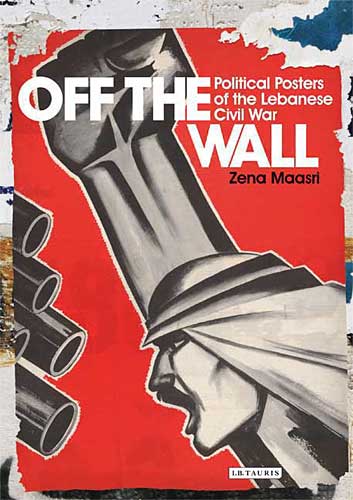
Off the Wall – Political Posters of the Lebanese Civil War – A Review

Off the Wall: Political Posters of the Lebanese Civil War
Zeina Maasri
I. B. Tauris, 168 pg

Every war has its own aesthetic. As bad as it sounds to equate art and style which often had a connotation of beauty and goodness to war, the need to solidify group membership, demonize the other, and provide a vision of the future with its implicit sense of triumph, lend themselves to symbolic interpretation through art. The poster in the modern industrial world is a cheep, quick and disposable medium that has been one of the most common ways to mix art and war. Even if a faction could not afford radio or TV, the poster was available, and that ease of production has left many enduring images that shape the impressions of a war. For Americans, the Uncle Sam I Want You Poster from World War I or Rosie the Riveter from World War II, are as important to the iconography of those wars as a trench scene or raising the flag on Iwo Jima.

It is with these ideas in mind that Zeina Maasri approaches the 150 posters that make up the richly printed collection from the Lebanese Civil War. Maasari finds in the posters reflections of an aesthetic and a politics that were unique to Lebanon. While she notes that the posters may seem at first similar to the propaganda posters of the wars of the 20th century whose goals were to inspire and demonize, the posters in Lebanon, due to the sectional nature of the conflict, were more focused on establishing control and marking territory. Since the lines between combatants were not always marked out clearly, the posters became a means of showing areas of control and describing who was in power. At the same time, the posters performed their traditional role of forging group cohesion. Moreover, Maasari points out that politics in Lebanon for at least the last half of the 20th century was marked by factional dynasties that provided leadership for each group, and whose leaders passed leadership from father to son; thus, the posters often served the dual role of emphasizing the role of the leader as the head of the faction and reminding the view of the faction’s strength. Finally, religion is an important element in many of the posters, especially as the Shiites moved away from the traditionally left leaning parties to the religious.

From these elements which Maasri outlines in a series of insightful chapters that mix the history with posters, the reader can understand not only what the posters mean but their context. Providing context is not a simple task when describing the Lebanese Civil war. The shifting allegiances, numerous parties, and different leaders make it difficult to follow the evolution of the war and the posters. However, Maasri provides a brief introduction to each faction (although she might have noted their general tendencies, such as left, right), a chronology of the war, and an in depth discussion of the posters. Her discussion is broken up into four themes, leadership, commemoration, martyrdom, and belonging, each of which is given its Lebanese context. The chapter on leadership is probably the most helpful, since it is difficult to know who all the iconic leaders are. It also helps to understand how the parties were led by dynasties. The chapter on martyrdom probably is of most interest outside of the civil war. While Maasri sticks only to the war, the concept of martyrdom is comes up in the news, and her explanation of how the various parties developed the posters from almost simple funeral announcements for soldiers killed in battle to symbolic representations of the dead, complete with drawings of the act.

Most of the posters are available on-line at the American University of Beirut, but unless you can read Arabic or the occasional French, it will be hard to understand what is going on in the posters. If you are even a bit interested in the subject the book is worth a read. The only draw back of this otherwise well written book is the first chapter which is an example of everything that is wrong with modern academic writing. I read it, but it was painful and, worse, not really needed. Maasri’s analysis of the posters explains her thesis quite well and is much more palatable. You would do well to read the the chapters after the theory section and pay special attention to her detailed analysis of most of the posters. You will come away with a detailed understanding of the symbols of the factions in the civil war, so of which, like those of Hezbollah, still are effective.

Martín Solares’ Mexican Noir Novel Reviewed at NY Times

Martín Solares novel The Black Minutes was reviewed by the NY Times. It is a positive review and for a crime novel it sounds a little atypical. Perhaps one of the reasons it was translated was it has a sense of the urgent with characters involved in the drug trade and corruption, something that is plaguing Mexico. While I don’t read much crime fiction, done right it can transcend the genre and become a report on its times. Considering Jorge Volpi’s call for a more committed literature, perhaps this novel is a good example in the Mexican context.

The best detective novels are those that go beyond the limitations of genre and a specific story to limn the broader society in which they take place. Mr. Solares does that in a profound but entertaining fashion here, revealing the surprising subterranean linkages that give politicians, the police, labor unions, drug cartels, the Roman Catholic Church, business interests and sectors of the press an interest in covering up the truth of the two cases.

To that end he makes especially effective and clever use of the separate time frames, one of whose purposes is to show how chronic, endemic corruption erodes the desire and ability of the individual to do the right thing, or even to act at all. Current-day Paracuán’s duplicitous police chief, Joaquín Taboada, is thus shown as a young, somewhat bumbling officer in the 1970s with the hilarious nickname El Travolta. There is also Fritz Tschanz, an immigrant Jesuit priest who knows so much and has heard so many sordid confessions over the years that his world-weariness has paralyzed him.

Over all it sounds good, but I’m not sure what ethnic types he is talking about:

But Mr. Solares is a graceful, even poetic, writer, especially in his hard-boiled dialogue and his descriptions of the wildly varied landscapes and ethnic types of northern Mexico. Though the world of “The Black Minutes” is one to inspire fear and revulsion, Mr. Solares’s descriptions of it are oddly beautiful and fascinating in the same way that overturning a rock and observing the maggots beneath can be a perversely edifying spectacle.

The Most Important Spanish Authors as Critic José María Pozuelo Yvancos Sees It

ABC has an interview with Spanish critic José María Pozuelo Yvancos and an excerpt of his new book on the 100 most important writers in Spain today (link to book review in Spanish). I am familiar with many of them, even though I haven’t had a chance to read many of them. Some are obvious, such as Javier Marias and Enrique Vila-Matas. I’m in the midst of reading Cristina Fernandez Cubas work and I can’t say if she is one of the best in Europe, but she is a great writer and deserves to be know outside of Spain.  I ran this through Google Translate (I don’t have time to translate it) and fixed a few obvious problems although many more remain, but at least you’ll get a sense of them.

  • Armas Marcelo: “The reader sees at once that their literature is written in fury and win, who cares.”
  • Fernando Aramburu: “I appreciate it especially that a work of serious tone and follow other with mocking irony.”
  • Juan Pedro Aparicio, “His stories hide behind wit molla.
  • J. M. Caballero Bonald: “It is one of the few writers have total, so good storyteller as a poet.”
  • Casavella Francisco: “A case of genius cut short by a young death.”
  • Rafael Chirbes: “His novels will help us to trace the memory of the Transition.”
  • Luis Mateo Díez: “One who has conquered territories narrator’s own imagination and memory.”
  • Cristina Fernández Cubas, “In the first row of European short story writers.”
  • Juan Goytisolo: “A commitment-minded narrator essayist.
  • Luis Goytisolo: “It’s nice to see how being a senior makes in experimentation and search for many young people.”
  • Raul Guerra Garrido: “His novels are used to open our eyes on the situation of the Basque Country.”
  • Eduardo Lago: “Few can draw better connection of Spanish and American traditions.”
  • Luis Landeros’: The real disciple of Cervantes in themes and tone. “
  • Manuel Longares: “Example of stylistic requirement that the novel should not forget.”
  • José Carlos Llop: “His stories married life and fiction so intelligently.”
  • Javier Marias: “A great writer who created his own style by combining reflective and narrative voices.”
  • Jose Maria Merino: “To say that he is master of the story should not conceal their excellent novels.”
  • Antonio Muñoz Molina: “The mind is a large area of memory: the best has won.”
  • Ramiro Pinilla: ‘No person may have the same form that has been the formation of Basque History of the twentieth century. “
  • Alvaro Pombo: “He has the rare privilege of looking out the soul of his characters and showing the readers who are like them.”
  • Soledad Puértolas: “Their literature has the merit of linking personal and collective memories.”
  • Valenti Puig: “Reading it one thinks of Chesterton, the smart way to be English from Catalonia.”
  • Juan Pedro Quiñonero “His memoir shows the formation of a vocation as a reader as I have known few.”
  • Clara Sanchez: “He has the rare virtue of that side show their troubling everyday.”
  • Antonio Soler: “Literature made in forging a requirement.”
  • Enrique Vila-Matas: “Few like him can say creators of a unique style, original in the representation of a self.”

Can Crime Fiction Be Funny?

Colin Bateman at the Guardian UK asks whether crime fiction can be funny. While I don’t read much crime fiction, I do find something refreshing in his question in part because the constant repetition of  the serial killer and as he puts it, torture porn, is tiresome tedious and has seeped into so many TV and movies that the serial killer is can seem everywhere. While crime by its definition something bad, serial killers leave little room for individual decisions, and instead presents an implacable evil that is uninteresting, more horror than crime. I still remember a Thanksgiving some years ago when an 19 year-old proudly gave a run down of serial killers he knew of. He seemed proud of them, some how, and I thought what is the point? Are you getting some sort of sexual excitement from this? Perhaps the serial killer just reflects a sense of helplessness before something unknown.

However, as the most successful of all popular fiction genres, crime fiction rapidly descended into formula, with thousands of not very subtle variations of little old ladies investigating cosy murder mysteries or tough talking PI’s with a cool line in sardonic put-downs flooding the market. They not only became cliched, but even worse, the subject of parody from which they have never really recovered. Once Woody Allen sent up Bogie in Play it Again, Sam and Steve Martin weighed in with Dead Men Don’t Wear Plaid, there was really nowhere else to go.

Crime fiction was forced to reinvent itself, almost literally, in a new skin, and in doing so it caused not only a seismic shift in public taste, but also in how it was sold. Thomas Harris’s The Silence of the Lambs and Patricia Cornwell’s Postmortem became super sellers 20 years ago – laughs were out, torture porn was in – and their influence is still apparent in bookshops and supermarkets up and down the country; they and their successors actually form the bedrock of publishing in this country today. Pile ’em high, sell ’em cheap.

Jorge Volpi Interview at El País: History Is Often More Important Than Fiction in a Novel

El País offered readers a chance to submit questions to Jorge Volpi for a form of on-line interview. I took the opportunity to submit a question about Season of Ash which I reviewed for the Quarterly Conversation and found to be more interested in writing history than a novel, sacrificing character development to his thesis. I wanted to know if he thought the history was more important than the fictional elements:

When you write fiction mixed with history, what do you think is more important: the narrative and characters, or the history? I noticed in Season of Ash that at times the narrative served more to explain the history, and the characters became a method for arriving at the history.

My intention is for history and fiction to complement each other, though it is certain that in this novel I wanted the History in capital letters to have an importance as clear as the history of the characters, perhaps this provokes the sensation that the characters serve the grand History.

¿Cuando escribes ficción mezclada con historia, cual piensa es mas importante: la narrativa y los personajes o la historia? Noté en ” No será la tierra” que a veces la narrativa sirve mas para explicar la historia y los personajes se convierten en un método para llegar a la historia.

Mi intención es que historia y ficción se complementen, si bien es cierto que en esta novela quería que la Historia con mayúsculas tuviese una importancia tan clara como las historias de los personajes, acaso eso provoque la sensación de que los personajes ficticios “sirven” a la gran Historia.

It is an honest answer and confirms to his interest in writing politically engaged novels. Many of the other questions in the interview make it obvious that he is a political writer, by which I mean he wants to comment on politics and history and use fiction to explore ways of getting at these ideas. He doesn’t write from to serve a specific political base, such as the PRI or PAN, which would make him a hack. He is certainly not a hack and his commitment to working with politics and history is commendable, but it comes with risks. I think Elias Khoury from Lebanon use politics and history in his works with much better affect. Or Fernando Del Paso’s News from the Empire which has the grand sweep of history that Volpi wanted, is also a good example of how to mix the two.

As he mentioned in his lectures for Open Letter Press, he sees the younger generations as less politically engaged:

How do you see the lack of political literature and authors, lets say, or how they called it during the Boom “committed” on a continent that in the midst everything it is very political in those countries that often only breathe politics?

In effect, if we compare the present Latin American literature with that of the 60s and 70s (and after), we find an absence of political literature. On one hand, the fall of the Berlin wall and the end of the USSR contributed to the disappearance of committed literature. And on the other hand, the gradual democratization of our countries made it so that politics stopped being regular material of those intellectuals and passed to the political scientists and political analysts that are part of the media. In addition, the latest generation are not only apolitical, but very apolitical. However, there continue to be examples of political literature in Latin America, you only have to mention the novel of Edmundo Paz Soldan, Ivan Thays, or Santiago Rocagliolo. And, in one sense, the literature about the violence that fills a good part of the region should also be considered political. Even this way, it is certain that writers don’t have a direct interest in contemporary politics, even the most authoritarian and picturesque.

¿Cómo ves la poca presencia de literatura política y autores digamos o como se decia en la epóca del boom “comprometidos” en un continente que en medio de todo es muy político en los países muchas veces tan solo se respira política?

En efecto, si comparamos la literatura latinoamericana actual con la de los sesentas o setentas (e incluso después), nos encontramos con la ausencia de literatura política. Por una parte, la caída del Muro de Berlín y el fin de la URSS contribuyeron a que desapareciera la literatura comprometida. Y, por la otra, la paulatina democratización de nuestros países hizo que la crítica política dejara de ser materia habitual de los intelectuales para pasar a los politólogos y a los analistas políticos de los medios. Además, las últimas generaciones no son sólo apolíticas, sino un tanto antipolíticas. Sin embargo, sigue habiendo ejemplos de literatura política en América Latina, baste mencionar las novelas de Edmundo Paz Soldán, de Iván Thays o de Santiago Roncagliolo. Y, en un sentido, la literatura sobre la violencia que prevalece en buena parte de la región también debe considerarse política. Aun así, es cierto que no parece haber un interés directo por parte de los escritores hacia nuestros políticos actuales, incluso los más autoritarios o pintorescos.

Finally, he talked about his latest novel, a free verse novel that is part fable, part history of the Holocaust. Mixing the Holocaust with non realistic elements could be interesting, or just lend itself to silliness. Hopefully, it isn’t the latter. It is an interesting approach and I would like to look it over someday, if not read it.

What made you write Dark Forest Dark, your latest novel, like a fable?

Dark Forest Dark is meant to reflect on the way everyday people can become an active part of a genocide, with Nazism in the background. However, in this meditation about innocence it seemed to me I could establish a connection between the massacres of Jews in the forests of Poland and the Ukraine, and the forests in the stories of the brothers Grimm, stories that Germans read obligatorily in those years. From this starting point I included many of their stories in the book.

¿Qué te llevó a construir Oscuro bosque oscuro, tu última novela, como una fábula? Gracias por tu literatura.

“Oscuro bosque oscuro” intenta reflexionar sobre la manera en la que la gente común se puede convertir en parte activa de un genocidio, con el nazismo como telón de fondo. Sin embargo, en esta meditación sobre la inocencia me pareció que podía establecerse una conexión entre las masacres de judíos que se producían en los bosques de Polonia y Ucrania, y los bosques de los cuentos de Grimm, que los alemanes leían obligatoriamente en esos años. De allí la inclusión de muchas de sus historias en el libro.

Javier Marias – I Would Like to Be Sherlock Holmes – Spanish Only Video

El País in celebration of the Madrid Book Fair has a video of Javier Marias explaining that if he were to be any character he would like to be Sherlock Holmes. It is a brief interview, but fun for its willingness to pick a character that might not seem the most literary—although, that is not something I would claim as I like the early stories of Doyle. Unfortunately, it is only in Spanish.

Review of Chilean Author Alberto Fuguet’s New Novel

Moleskine Literario has an lengthy and well reasoned review of Alberto Fuguet’s newest book, which is not quite a novel and not quite non-fiction. It is a book based on his own family and his own experience. The narrator, who is also named Alberto Fuguet, is trying to find out more about his uncle, Carlos, who led a Bohemian life in the US during the 60s. Estranged from his father, a man who says

“Stop bothering me,” he said by telephone one night, “cease to exist. You don’t exist for me. You have only brought me problems. We don’t want to see you ever again. I don’t care that you are my son.”

“Deja de molestarnos”, le dijo por teléfono una noche, “deja de existir. No existes para mí. Sólo me has traído problemas. No queremos verte nunca más. No me interesa que seas hijo mío” (25).

While this could become, perhaps, just a tale of family strife, Luis Hernán Castañeda, notes that he uses the search not only to imagine what could have been, but to avoid the malicious that often comes with family investigations.

Missing (an investigation), is, most of all, a touching text: the material is intense, per se, and the treatment of this material does justice to its intensity. Nerveless, it is also a lucid and ambitious textual artifact, in which the gaze of the narrator Fuguet is  sharpened to penetrate the cloudy and confusing and hurtful, with the artistic intention, completely achieved, of returning to the transformed light -perhaps exalted-of a skillful and complex text of elaboration.

“Missing (una investigación)” es, sobre todo, un texto conmovedor: su materia es intensa per se, y el tratamiento de esa materia le hace entera justicia a su intensidad. Sin embargo, también es un artefacto textual lúcido y ambicioso, en el que la mirada del narrador Fuguet se afila para penetrar en lo turbio y lo confuso y lo hiriente, con el propósito artístico plenamente logrado de devolverlo a la luz transformado -quizá enaltecido- en un texto de elaboración diestra y compleja.

What sounds particularly interesting is his use of multiple modes of story telling. If you’ve read Short Cuts you will know that he does like to play with form some what, although this seems like the farthest hes gone.

The formal complexity of the the novel does not respond to a gratuitous pyrotechnic effort but the requirements of dark and tangled material. In the ample formal repertory we find, for example, one whole section dedicated to commenting on the origin of the book that the reader has in his hands, a very short chronicle that appeared in the magazine Etiqueta negra; there is also a section constructed from the Diary of the Psychiatrist, composed of annotations in which Fuguet, transformed into a detective, explains the progress of his investigation; another part of the book gives two interviews conducted by Fuguet with his uncle, en which the uncle expresses himself in the first person, even though it is clear after hearing him that there are enigmatic areas, secret territories that he refuses to reveal. Lastly, the center of the novel, both in terms of expansiveness and importance, emerge in the eighth part, titled The Echoes of his Mind. Carlos Talks [title is in English]. It is about a long narrative and autobiographic poem, one where an imaginary Carlos, fruit of an amalgamation of observation and fantasy, narrates his intire life and seeks to impress a feeling of him for himself and for others.

La complejidad formal de la novela no responde, pues, a un gratuito afán de pirotecnia sino a los requisitos de una materia oscura y enmarañada. En el amplio repertorio formal encontramos, por ejemplo, toda una sección dedicada a comentar el origen del libro que el lector tiene entre manos, una crónica muy breve que apareció publicada en la revista “Etiqueta negra”; existe también una parte construida a partir de un “diario de la pesquisa”, compuesto por anotaciones en las que Fuguet, transformado en detective, va dando cuenta de los progresos de su investigación; otra zona del libro ofrece dos entrevistas realizadas por Fuguet a su tío, en las que éste se expresa en primera persona, aunque queda claro tras escucharlo que hay una zona enigmática, un territorio secreto que se niega a revelarse. Por último el centro de la novela, tanto en términos de extensión como de importancia, eclosiona en la octava parte, titulada “The Echoes of his Mind. Carlos talks”. Se trata de un largo poema narrativo y autobiográfico en el cual un Carlos imaginario, fruto de una amalgama de observación y fantasía, narra su vida entera y procura imprimirle un sentido, para sí mismo y para los otros.

I hope someday it will come out in English, especially since he has had one book published in English already.

Update (6/2/10): I have been informed by @ezrafitz that they are working on a translation right now. No ETA as yet.

Satirizing Modern Spain on the Edge of Crisis: Robert Juan-Cantavella at the Quarterly Conversation

The Quarterly Conversation has a very good article on the young Spanish novelist Robert Juan-Cantavella and his satires of modern Spain on the edge of the current crisis. Whether or not you will ever read him, it is a very good summary of many of the cultural trends that have afflicted Spain in the last few years as the country moves farther from the transition to democracy after the death of Franco. While one article can’t describe a literary scene, he does sound like part of the literary scene where there is quite a bit of playfulness in stories. You can see some of that in my reviews of Fernando Iwasaki and Hipolito Navarro. The segment of from his novel is quite short, but looks like it has promise. Perhaps he’ll be translated or I’ll get a copy in Spanish one of these days.

Ever since the publication in 2001 of Otro, his first novel, Robert Juan-Cantavella has seemed to position his work as a continuation of a certain Spanish literary tradition as much as a cheeky raid on its vaults and a blithe taunt to anyone wishing to hold him accountable for his hijacking of or attacks on sacred cows. In Proust Fiction (2005), a story collection, Juan-Cantavella introduces into several of the pieces a character called Escargot—not really an alter-ego or a pseudonym, probably a heteronym . . .—and we learn that, were it not for him killing them all beforehand, a bunch of giants really would have been waiting for Don Quixote on that fateful day at the windmills. This is no mere comic gesture, not any more than an attempt by a bold young man to pretend that Spanish literature owes him something; it’s also, and more importantly, a way to insist that all creation is also recreation (in more than one sense of the word).

The Shape of EBooks in Spain

Below is a brief outline of the state of the ebook industry in Spain. While it is moving slowly, there have been some big agreements recently that will shape the future of the ebook there. Consumer access to the books, though, remains limited. It will be interesting to see how this works versus the Amazon model, especially now that Apple has entered the game. (The article comes from La Nacion in Argentina and is translated via Google Translate with my corrections).

Is the Spanish publishing industry diving into digital waters? Not really. A few weeks ago in Madrid it announced the upcoming launch of Libranda, a distribution platform for digital books led by Planeta, Santillana and Random House Mondadori. The initiative promises to expand the catalog of electronic books in Spanish: eleven publishers will make their digitized collections available to libraries. For now, however, the reader does not have direct access to the platform. It is not a minor detail: the publishers chose not to neglect the channel now accounts for 90% of its business, and so launched a project that is more a defensive strategy than a full exploitation of the advantages of the digital ecosystem.

While they can not buy and sell ebooks directly through Libranda, readers and authors will benefit of the final price of electronic books which will be 30% lower than the paper copy, and the authors will receive 20% of the selling price , twice as much as they receive a paper copy.

Until the arrival of Libranda, the great platform of electronic books in Spanish was to be TodoEbook, which brings together more than 400 small and medium-sized Spanish publishers, offering 20,000 titles, mostly from collections and nonfiction works whose rights are in the public domain. Now, between the two platforms have 95% of the supply of ebooks in Spanish.

The expanding market for electronic books will result in the growth of eReaders, a scene now dominated by the Kindle, but seriously threatened by Apple’s IPAD. While the latter is more than an e-book reader, a fact revealed when its launch shook the foundations of the emerging ebook industry. According to a recent survey, 60% of Americans heard about the IPAD while only 37% of the Kindle.

On this side of the ocean, Musimundo opened the first shop that sells electronic books in the country. Built on Bibliográfika platform that integrates bookstores and publishers for printing, distribution and marketing of books on demand, now offers an extensive catalog of 20,000 books.

[tweetmeme=http://wp.me/plDex-xz]

Outlook for Publishing Spanish Language Books In English Is Good

Publisher’s Weekly has an interesting summary from the BEA on the outlook for Spanish language publishing in the US and translation from Spanish to English. Of more interest to English speakers is their take on Translation from Spanish to English. They all seem to think the market is growing and acceptance of translated works will be greater. Perhaps translation some day will go from 3% to 4%? I’ll believe it when I see it, but it is good to see that the publishers feel that there is something happening, although publishers have been known to be wrong before.

“Translations from Spanish into English: Overview, potentials and hurdles,” looked at the recent surge of successful translations of Spanish-language books. Esther Allen, translator and director Center of Literary Translation at Columbia University, moderated the panel, and began by saying she has “never felt so excited, so sanguine about the possibilities of bringing work from Spanish into English…both from Latin America and Spain.”

“It’s now ‘groovy’ again to read translations,” said New Directions’ Barbara Epler. “It’s the new generation that doesn’t care about anything,” such as whether it’s a translation or not, she explained. “They’re just really excited about somebody fabulous.” Epler said there’s now a difference in the way Spanish-language literature is being perceived in the U.S., and it’s reflected in the number of translations from Spanish published today. “It’s more than I’ve ever seen.”

Granta en español’s Valerie Miles noted that there is “an awakening of talent” within Spanish-language literature itself. Miles said an upcoming issue of Granta, The Best of Young Spanish-language Novelists, would highlight translations of works by young novelists under 35. Miles later noted it was important to steer clear of “blanket” labels, such as Latin American literature, because such tags don’t allow for the notion that each writer hails from a different culture and tradition.

Jesús Badenes from Editorial Planeta said one way Spanish authors measure their own success now, is by whether or not they’ve been published in the U.S. and, consequently, Spanish editors and agents are putting more of a focus on making that happen. He also noted that the U.S. is now more concerned about “world matters,” and thus open to reading—and publishing—more works in translation.

Julio Cortazar Letters During Hopscotch Period To Be Published in Spain

El Pais notes that the letters of Julio Cortazar written while he was writing Hopscotch will be published in July in Spain. The letters were found amongst a collection of unpublished works last year. In addition to the letters of Cortazar, the letters of his friend and corespondent Eduardo Jonquières will be included, giving a detailed account of this time of his writing career. The almost weekly letters given an excellent insight into the writer as he worked on most important work, and, I’m sure, will be an important book for Cortazar fans.

These letters are “the almost weekly chronicle of Cortazar’s time in Europe.” In them is “the humor, that blessed prose, that capacity for observation and that culture that defined the best of Cortazar.” He writes to Jonquieres “about his poverty,” but this wasn’t an obsession, nor an interruption in the search for the beauty (music, painting) that he reveled in. Carles Alvarez Garriga says tht Cortazar “the only thing he lacked were the indispensables for living: a table, a seat to read in, and most important, time to stroll through the city, go to museums, listen to music…” And it would always be this way. Bernardez explained to Julio Ortega and the audience while at the Casa de America that Cortazar was solitary and stayed in his home while his wife enjoyed Paris; and even when he went out, on returning Julio would say to him, “tell me just a little bit…”

From the little bits he was making Hopscotch which was born in the the world of silence that now remains in the letters to Jonquieres.

Esas cartas son “la crónica casi semanal de la instalación de Cortázar en Europa”; ahí están “el humor, esa felicidad de la prosa, esa capacidad de observación y esa cultura que define al mejor Cortázar”. Escribe a los Jonquières “sobre su penuria económica”, pero esa no era una obsesión, ni una interrupción de la búsqueda de una belleza (música, pintura) que le emborrachó. Carles Álvarez Garriga dice que a Cortázar “sólo le hacía falta lo imprescindible para vivir: una mesa, una silla donde leer, y sobre todo tiempo para pasear, ir a museos, escuchar música…”. Y así sería siempre. Bernárdez le contó en la Casa de América a Julio Ortega (y al público) que Cortázar era un solitario que se quedaba en casa mientras ella callejeaba por París; e incluso cuando él mismo hacía esas excursiones, al volver Julio le decía: “Contame algunas cositas…”.

De esas “cositas” se fue haciendo Rayuela, que nació en un mundo en silencio del que ahora quedan las cartas a los Jonquières.

Arabic Summer Reading Challenge at Arabic Literature (in English)

Arabic Literature (in English) is having a summer Arabic reading challenge. There are prizes too!

To participate: Simply post at the bottom which ONE of these Arabic books (in translation or not) you will read this summer.* I will select a reading-challenge winner on August 20, 2010** and ship her (or him) a bundle of Arabic fiction new to English in 2010.***

It is a nice list of books and I know several are classics and worth the read. I’ve read these and if you have any doubts, they are all great booksa dn it would be a good addition to any summer reading list.

Season of Migration to the North by Tayib Saleh

Elias Khoury, Yalo

Naguib Mahfouz, Cairo Trilogy

Zayni Barakat,

The Bus Driver Who Wanted to Be God by Etgar Keret – a Review

The Bus Driver Who Wanted to be GodThe Bus Driver Who Wanted To Be God & Other Stories
Etgar Keret
Toby Press, 200 pg

The Israeli author Etgar Keret’s short stories don’t describe reality as much as they render it suspect. They are seldom predictable and at his best he surprises the reader, not with a twist, the cheapest of devices, but a brief digression from the real into a longing whose desires can never quite be fulfilled.  At the same time he never looses sight of modern life with its quotidian fast food shops and dead end jobs, and illustrates it with a spare writing style that is short on introspection but whose reality is unfixed and open to question. The brevity and the unexpected never make his stories seem extreme. Instead, there is a naturalness to the incidents he describes, an almost jaded quality, as if that same tired response to mass produced culture that surrounds everyone, especially his characters, has so removed our ability to really see the extraordinary. It is the tension between the ordinary and the strange that make his stories intriguing and reflect a world that has become trapped in its seemingly orderly word.

The story that best illustrates the longing that never quite comes true is Hole in the Wall. A young guy, Uri, is told if he screams a wish into a hole in a wall where an ATM machine had been the wish would come true. He doesn’t believe it and there is a sense that wishes are pointless. Nevertheless, he wishes that an angel would keep him company. One does show up, but he turns out not to be much of a friend. The angel always disappears when Uri needs him, refuses to show his wings, and never wants to fly, afraid someone will see him. Finally, one day the angel and Uri are on the roof of his apartment and he has the impulse to push the angel of the edge of the building to see if he’ll fly. But he doesn’t and falls to his death. Uri notes, “he wasn’t even an angel, just a liar with wings.” The death of the angel upends not only the definition of an angel, it is the frustration of a cultural longing, and in his description of the angel as a different kind of humanity, he extends the cultural fatigue of loneliness in modern life to that of its salves, religion. Screaming for a wish in a hole where an ATM machine had been creates a sense of desperation where economic conditions have slipped and instead of having access to money, the real power to grant wishes, one has to scream for something that is never going to come. Extending the screams into Jewish tradition he a plays on the Wailing Wall, but instead of finding solace in a place of ancient religion, the modern with its disposable infrastructure is the best one can do. It makes for a desperate moment because Uri is left alone again and his searches have ended in futility, leaving him in the same world where the old cultural longings are just as disappointing as the modern commercial ones, and each as transient as the other.

Following the Hole in the Wall in style and theme is his short novella Kneller’s Happy Campers where he constructs and after life that is neither heaven nor hell, but just the same modern city the deceased used to inhabit. It might seem like a form of hell because all the inhabitants of the place are suicides, but if it is hell, it is only the hell of boredom and repetition that comes with a regular job and the ever present need to entertain oneself after, even if there isn’t much to do except to go to the same bars night after night and hope you’ll find someone to date. His vision of the modern hell that is everyday life is one where one feels dull, perhaps anxiety ridden, but nothing is too extreme and the battle for people is to find a way to navigate that. Unfortunately, for the characters in the the story it has lead to suicide. But suicide is not an escape, but a return to that search and the characters continue it, driving to some unknown destination trying to find what they had lost before they committed suicide. Eventually, they get to a strange place where miracles happen but only if they don’t have any meaning and a man called Kneller runs a camp ground where the Messiah King J is planing to perform a great miracle.  J is part Messiah and cult leader and the people follow him hopping for the next revelation. He lives in a great mansion with a pool, squash court, and a buffet pool side. It appears that hell has now become heaven, but again Keret flips the story and the heaven is not as it seems. As in Hole n the Wall, the longing is left unsatisfied and the mysteries wrapped in religion are never answered, but left as just another thing to buy, to engage with temporally. And Miracles, though existing, are nothing more than entertainments devoid of power.

Yet the longing and sometimes melancholy in the characters should not deter one from finding the humor in Keret’s work. He does not write like some of those Central European authors who are so weighed down by the past that even the happiest of times seems miserable. At their most fundamental the stories are funny and full of surprise. And in a story like Breaking the Bank the humor shifts from the black to sympathetic when a boy undermines his dad’s lesson and is unable to destroy the piggy bank that was supposed to teach him value. Keret keeps his humor at a sympathetic level, never satire, and so the stories, even when they go against the character’s longing, don’t make fun, but laugh at the attempts that failed, that could happen to any one.

Keret also writes stories that don’t have fantastical elements, yet these, too, exhibit anxiety and longing. Although, they are not as surprising, it strips the layers to get at his most fundamental elements of his stories. The Flying Santinis is simple enough: a boy wants to join a circus and with the encouragement of his father (this is still Keret after all) he asks the trapeze artist if he can join. He says sure, as long as you can touch your toes, which the boy tries to do, but manages to herniate his disk. The trapeze artist, overcome by the pain and the eagerness of the boy, tells him in the hospital, you could have bent your knees, I wouldn’t have said anything. It is a moment of tenderness, a realization that even when you try your hardest you may not get quite what you want—its just one of those things. Yet Keret is able to infuse a nostalgic longing in the story that deadness the disaster and turns it, along with the trapeze man’s tears it feels as if he almost made it and that was pretty close. Further reducing the pain, is the distance of the narrator, who reports the story like the boy, yet is an adult at the same time. It blurs the line between memory and the present and as in many of his stories, the narrator may no longer be a child, but those inconsistencies children see in the adult world, become a strange reality that adults are shocked by.

Illustrating this best is Shoes, one of several stories that use children and young people to show the way that Israelis look at issues like the Holocaust and the way the young, without a framework of understanding, can interpret what is around them. Shoes begins on Holocaust Memorial Day when a group of students are taken to the Museum of Volhynia Jewry where the narrator, an young boy who is excited by the honor of going to the museum and not its weighty meaning, listens to a Holocaust survivor tell the students that the Germans are evil and he will never forgive them and they still make their products from the bodies of Jews. It is a horrifying image, but the boys can’t grasp it. For them it is just part of a field trip. They can only discuss whether the man with his now frail body could have really strangled a camp guard. The boys are unable to see him as a younger man who might have done that, although, the reader may also question,too, if a weekend prisoner would really have the strength to strangle. A few weeks latter the boy is given a pair of shoes from Germany and he thinks about what the old man has said and he feels guilty. He imagines they are made from his grandfather who had died in the Holocaust. But then he goes to a soccer game and little by little he forgets. After the game, though, he remembers and for a moment feels bad, but then the shoes feel good and he thinks his grandfather must be pleased, even talking to the shoes as if they could hear. It is a risky moment that works because Keret is able to not make fun of the Holocaust, but suggest the solemn honor paid to it can be confusing and in turn make it lose its meaning. How do children interpret the meaning of it when overlaid is the fun of going to the museum? One has the sense that though the Holocaust is in no way similar to commercial culture, the repetition leads to a fatigue that inures one to its power. It is picks up on the feeling in Keret’s other stories. Yet it isn’t dark story, but one where the boy attempts to make his own meaning and, again, this is what often happens with the characters in his stories. The slight readjustment of reality doesn’t disparage the larger world, but allows the character to find a way of integrating parts of it within himself.

The stories of Etgar Keret are both funny and melancholic, a way of readjusting modern reality and turning its loggings upside down. In doing that Keret doesn’t wallow in despair, but constructs something new, something that lets one find a new way to experience modern commercial culture. The ability to that makes his stories a great pleasure to read and think about.

Final Thoughts on Hugo House Writer’s Conference: Finding Your Readers in the 21st Centruy

The Richard Hugo House’s writers conference was tiring, like most conferences, yet a great conference for the those seeking to understand not only how to get published, a timeless question, but how to use the new tools of media. All of it was quite useful and seeing what you have to do to support a book is rather daunting. There was a talk from one PR agent and the details she went in to on just setting up bookstore readings, something that has only minimal success these days, could be a real time suck. What was interesting, too, was not only to get a chance to talk to other writers, but to talk to writers in genres I don’t even think about, and to be honest, sometimes value disparagingly. It gives you a chance to see where you are, but also what it is that drives other people who are committed to an idea that you would never otherwise think about. On the other hand, I got tired of trying to describe my novel since it is too amorphous at this point.

Being with writers searching for readers and also being a reader/reviewer who’s been watching the publishing world struggle it was fascinating to see how those two worlds try to sink up. The new writers are shocked, the more experienced are navigating it the best they can, and we have publishers like Mathew Stadler trying to be innovative, and still there is panic. Yet on the small press front there is the DIY attitude, which is quite refreshing and gives you hope. The turmoil is just so unsettling and now there is no one way to go, and whatever you do it will take some of your precious writing time.

As a web developer who participates in social media projects, the questions that came up about social media are both eager and uncertain. Many writers have such a long way to go to get a handle on social media. I think many writers have a hard time moving beyond the work. I can sympathize, I don’t want to either, but for better or worse, you have to. I saw the same thing in the technical writing community, where you can find writers with a similar mentality. When that group was hammered by the .com bubble there was a cry for the writer to lift the head from the work and it was hard for many.

I’m certainly glad I went and it was definitely worth sacrificing the prime writing time.

Where’s The Magic, Isabel? Reviewing Allende’s Recent Reviews

I haven’t read an Isabel Allende book in ages, but I noticed she had a new one coming out and as one of the most famous Latin American authors in the States, I thought it would be worthwhile to take a look at the reviews. For old time sakes, at least. What is obvious is that if you live by magical realism, you die by it. Every reviewer I came across was asking for some of the good stuff, that old magic that made House of Spirits famous. It is a little lazy to demand a writer keep writing in the same style. Again books from Latin American authors must fit some sort of mold and here it must be the exotic locals, war and love. At least the Times review mentioned Alejo Carpentier.

I wasn’t much impressed by the reviews. From the NY Times:

The resulting canvas contains no less than the revolutionary history of the world’s first black republic as Allende portrays the island’s various factions: republicans versus monarchists, blacks versus mulattoes, abolitionists versus planters, slaves versus masters. She revels in period detail: ostrich-feathered hats, high-waisted gowns, meals featuring suckling pigs with cherries. Her cast is equally vibrant: a quadroon courtesan and the French officer who marries her; Valmorain’s second wife, a controlling Louisiana Creole; Zarité’s rebel lover, who joins Toussaint L’Ouverture in the hills. But for all its entertaining sweep, the story lacks complex characterization and originality. And its style is traditional. Where, you wonder, are the headless men — or, in ­Allende’s case, headless women? Where is the magical realism?

[…]

Ultimately, however, Allende has traded innovative language and technique for a fundamentally straight­forward historical pageant. There is plenty of melodrama and coincidence in “Island Beneath the Sea,” but not much magic.

The review from the LA Times was a plot summary. At least you will know what happens in the book.

With this admirable novel, Allende cements her reputation as a writer of wide scope and amazing talent. Although very traditional in its unfolding — readers enamored by her use of magical realism will find little in this narrative — this historical novel does what one hopes a book of its ilk will do: transport readers to a new world, open up history and make it come alive, and cause readers to forget time passing in the world the author has so carefully and lovingly built.

Hugo House Writer’s Conference Finding Your Readers in the 21st Centruy Day 2

Today’s session was filled with talk about how the relationship between the author and the publisher and the reader has changed radically. Mathew Stadler opened the day with a talk about changing the role of the publisher, towards a small publishers who refuse to participate in the shell game that is book sales: no more returns. Instead, he looked towards a model where the publisher sells just a copy or two to a book store and the publisher gets paid upfront. He wasn’t sure if he was going to make that work, but it was his hope to try and break the old paradigm. He also quoted Epstine in saying that “a publisher’s job is to supply the necessary readings for democracy.” As such, Stadler looks to the small publisher to remove the hierarchy and control and create a more flexible and democratic publishing. In a more practical vein, he suggested that if you take an advance you should know how that will help your publisher’s plans. Avoid the shell game and, instead, make books for readers. Taking the advance just perpetuates the ambiguities between the wasteful system, and actual valid engagement with readers. While some of Stadler’s ideas are politically motivated his ideas are interesting and do suggest a different business model for the publisher – bookstore relationship, which, ultimately, will affect the writer and reader. Only time will show if Stadler’s experiments will work.

The rest of the sessions I attended were focused on how to do the marketing work yourself even if you have some sort of book contract. It is a real mix of things you have to do, everything from having and online presence (check) to determining who you want to send galleys to, what bookstores to target, and just about everything that a publicist for a publisher would have done. It is a little annoying since you should be writing, although it wasn’t something I didn’t already know.

At one moment when a freelance editor was talking and I misunderstood him when he said you need lots of dialogue in your fiction, I had a moment of complete disappointment. What is the point if you have to fit in a formula. Turns out he was not talking about literary fiction, but, still, it was one of those moments when I don’t like thinking about writing and all the silly conventions and rules people come up with when describing what will sell.

Tomorrow more of the marketing then I can return to what actually matters.