Book tour? Now its DIY

The LA Times has an article about what book tours are like for the authors now that publishers are not backing them. It sounds very do it yourself and rewards those who sacrifice writing time for marketing time.

Book tours used to be about local media. “You would go to these places to get reviews, interviews, TV and radio,” Miller explains, but with print outlets closing down and cutting coverage and new technologies enabling long-distance video interviews, “it is becoming less important to do that kind of tour.”

Bookstores are also becoming harder to find. When its B. Dalton shut down this year, Laredo, Texas, population 200,000-plus, became the largest bookstore-less city in the United States. In January, when “Eat, Pray, Love” author Elizabeth Gilbert came to Los Angeles to sign her new book, “Committed,” she wound up at Costco in Marina del Rey.

As the book tour takes on new shapes, what will it mean for writers — and for readers? Authors like Boyle don’t just read — they perform and stay until they’ve signed every book. They know the value of connection. But how will their lesser-known counterparts connect?

via Book tour? More like a safari – latimes.com.

TechFlash: Amazon targets literary agents, authors in Kindle e-book push

TechFlash notes that Amazon is making an end run around publishers to talk with agents and authors trying to have them sell the electronic rights directly to Amazon. I’m not sure this is such a great idea, especially since it is platform dependent. Publishers perform more than just distribution. We will see how this shakes out.

Is Amazon.com trying to do an end-run around publishers for Kindle book rights? The Bookseller reports the online retail giant has been pursuing U.K. literary agents and authors, urging them to sell electronic book rights directly to Amazon. That follows a report from Crain’s in November that Amazon flew a dozen top New York literary agents to its Seattle headquarters for meetings.

Wordless Books – A Review

Wordless Books: The Original Graphic Novels
David Beronä, Abrams 255 pg.

Wordless Books is a collection of excerpts from graphic novels that were drawn in the first half of the 20th century. Despite the range of styles and themes they all have one thing in common: they do not use dialog or narration to tell a story. Instead, the artists structured their stories as a progression of images, each hinting at the next and forming a narrative thread. It is a difficult task to do and one of the drawback of the book is that Beronä has to explain how the excerpts fit together so that the reader can see how the artists structured the narrative. Nevertheless, Wordless Books contains some fascinating work from the early 20th century.

Since much of the work was produced during the turbulent periods of World War I, the depression and World War II, anti-war and anti-capitalist themes link the artists. For the American artists such as Lynd Ward, fit amongst other socially committed artists like Stienbeck or Odets. Each, though, focuses on the struggles of the individual against larger forces, whether it be state power, especially the army, large corporations, or church.

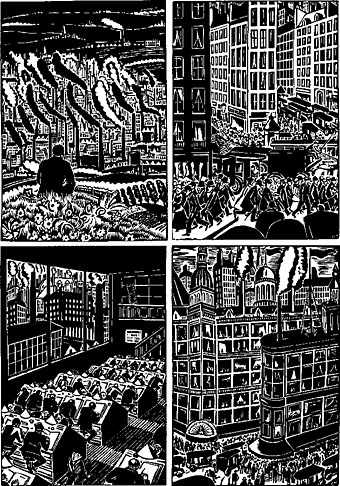
Frans Masereel - The City

Of the artists covered in the book, the most interesting were the Belgian Frans Masereel, the American Lynd Ward, and the Italian-American Giacomo Patri. All three worked with bock printing using wood and black ink. Masereel’s work is blocky and less stylized than the other two and seems to draw more inspiration from late 19th century graphic arts. His saw the modern world as brutal, dark and unforgiving to the less powerful:

Masereel’s depiction of the Western industrial world is so complete that his friend, writer Stefan Zweig, wrote, “Should everything perish, all the books, the photographs and the documents, and we were left only with the woodcuts Masereel has created, through them alone we could reconstruct our contemporary world.”

Lynd Ward - from Song Without Words
Lynd Ward’s work, while following thematically Masreel’s work, is centered in a mix of industrial arts, almost a futurist vision, an American as seen in the likes of Thomas Hart Benton, possibly cinema like Fritz Lang, and one can even see some of the ideas of the Mexican muralist Jose Clemente Orrozco. Using intricately carved wood blocks, he presents an America in the midst of turbulent economic times, filled with strikes, gaunt men in gaunt and defeated men, but also includes in a mid-century ethic that praised the industrial worker energetic, almost neo-Gothic images of men working amongst the dehumanizing machinery. His work is the perfect graphic aesthetic of the era, one that mixes criticism of capitalism with a celebration of industry and the worker who keeps it running.

Giacomo Patri’s work follows in the tradition of Lynd Ward, but begins to add text into scenes so that the reader has more ways of putting the story together. Again his drawings are a mix of the industrial and the energetic, but he focuses more on the individual in everyday life, not abstract beings caught in a modern drama. Moreover, his work is less ornate and leaves the characters as the center piece, not the energy or emotion of Ward.

The drawings in Wordless Books still have a power that resonates, perhaps at times it is a distant power caught in a history now quite distant, but the images of humans against machines is still salient. Perhaps one must substitute Masereel’s  draftsmen in the City for workers in cubical, but it is still the idea, although a contemporary artist might paint it in Starbucks green. While Wordless Books lacks the complete stories these authors tried to tell, it is a great introduction and should make anyone interested want to search for more of these works.

Javier Marias Talks to His Readers About His New Book and Other Things

Javier Marias participated in a chat at El País and in the brief session he answered questions on language, his writing, and literature. There were several questions about his constant pessimism, especially in his weekly article in El País (something I long ago got tired of reading). One in particular wanted to know why he didn’t focus on other countries, but he said he knows Spain best and will stick to that. Continuing in his pessimistic way he made several mentions of the continued “deterioro del español de España” (deteriation of Spanish in Spain). To me it sounded just like a cranky old man when he was on that topic. Language changes and there is not point in complaining about it, but I think that is what he likes most to do.

About his writing he was asked in English language structures have crept into it and he said sometimes he does that to enrich his language, but only when it makes sense. He has begun a new book and the only thing he really knows is that it will be pessimistic, too. He is about half way through, but for the last year he has been on a book tour, something that he has found boring, and is looking to get back to his work.

Finally, he does know how to use a computer, he just doesn’t like to write his books and articles with a computer. And when asked the 3 best novels of the 20th century he said, Lolita by Nabokov, Light in August by Faulkner, and Catcher in the Rye by Salinger.

deterioro del español de España

Samandall – Graphic Novel from Beirut on-line

The blog Arabic Literature (in English) tipped me off to the Beirut based Samandal magazine of “Picture Stories from here and there.” While they don’t require the art to be from Lebanon or in Arabic or French, most of the writers and artists from the first four issues are from that region of the world. You can down load the first four issues of the magazine in pdf format. I looked through some of the issues and there was a wide range of stories and artistic styles that make the magazine a good read. Supposedly you can get issue from Forbidden Planet Comics in NY City, although it is not listed on their website.

Issue 1

Issue 2

Issue 3

Issue 4

New Quarterly Conversation Available

The Quearterly Conversation has just published its 19th edition. A few articles and reviews that look interesting:

From The Girl with the Golden Parasol by Uday Prakash

By Jason Grunebaum

The Girl with the Golden Parasol follows Rahul, a non-Brahmin, who finagles his way as a student into the department of Hindi: one of the most corrupt in the university, and a “den of Brahminism.” He does so after falling utterly for Anjali, a Brahmin girl, who, through simple bad luck, could find a home in no other department. The narrative chronicles exactly how the powers-that-still-be in India have harnessed globalization to further consolidate power over language and culture at the most local of levels. It’s also a love story, and a tale of students protesting the corruption of the Indian university system.


On Jonathan Swift’s Poetry

By Patrick Kurp

In the popular mind Swift remains a one-book author, and even ambitious readers may be unaware he wrote poetry. But scholars have identified roughly 280 poems in English . . .


Per Petterson and The Masculine Question

By Adam Gallari

Petterson, whose work calls to mind the reserved nature of such “masculine” writers as Knut Hamson and Richard Yates, makes a more difficult target than present-day male writers exploring the masculine question through worlds of hyper-violence and hyper-reality. They are the men at the bar talking a good fight, while Petterson is the guy in the corner.

Reviews

Fascism, Art, and Mediocrity: Monsieur Pain by Roberto Bolaño

Review by Stephen Henighan
Precise and dramatic yet suffused with a dreamy suggestiveness, Monsieur Pain is a real discovery and a substantial addition to the growing Bolaño library in English.


Word Games and Surreal Imagery: The System of Vienna By Gert Jonke

Review by Matthew Jakubowski

Jonke’s writing isn’t difficult, though his sentences can stretch on into multi-page masterpieces, and he’s a fan of word games and surreal imagery. But beneath these formal surfaces and experimental style (some have called Jonke a “text composer”), these stories are frequently tender and funny; for all the book’s curiosities and through-the-looking-glass moments, System proves Jonke was that rare thing: a huge, rebellious talent with tremendous heart.


Devotion to the Book: Rex by Jose Manuel Prieto

Review by Geoff Maturen
Rex’s narrative structure—consisting of twelve “commentaries” written some time after the events have occurred, and addressed to J.’s former student Petya—offers an initial clue that it is not a straightforward novel. As becomes evident, J. is not really concerned with relating what has happened. Rather, he seizes upon the events as a series of “teaching moments,” ostensibly to instruct Petya, but, one suspects, really intended as a way for J. to come to terms with the trajectory his life has taken.


Correspondence Theory: The Abyss of Human Illusion by Gilbert Sorrentino

Review by Daniel Green

In his now posthumously released (and presumably final) novel, The Abyss of Human Illusion, Sorrentino again offers a relatively brief work (150 pages) built out of narrative fragments. As Christopher Sorrentino points out in his introductory note, the most obvious features of the novel’s formal structure are its division into fifty numbered sections.


Existential Mysteries: Fugue State by Brain Evenson

Review by Salvatore Ruggiero
Evenson’s story collection has characters who try to dissociate themselves from their beginnings (or who have their beginnings redefined by others), who consciously neglect previous happenings and logical prognostications to believe what they want to believe to make the best of their situation at hand. They look at their past as a constellation, trying to fit the events in order so that it makes the now more palatable. It’s an unrealistic notion, but it’s one that is aptly accentuated by the gothic and grotesque nature of these stories.


A Sensual Anti-Novel: Juan the Landless by Juan Goytisolo

Review by Gregory McCormick

In grappling with Peter Bush’s recent re-translation of Juan Goytisolo’s 1974 novel Juan the Landless, I kept wondering why we read at all. Goytisolo’s book is notoriously challenging: there’s no real punctuation save frequent colons, and the book is full of shifting protagonists and pronouns and constant pressure on the language, as though Goytisolo aims to make the text itself implode. So why do we read, and what can be said about a book seemingly created to subvert the entire act of reading?


Humor in the Face of the Tragical: The Golden Calf by Ilya Ilf and Evgeny Petrov

Review by Karen Vanuska
What if your country was in a midst of a purge of all private wealth, yet all you longed to do was to get your hands on a million rubles and run off to Rio de Janeiro? Well, if you were affable and clever Ostap Bender, the hero of The Golden Calf, you would scheme your way into a fortune.


Reimagining Greek History: The Lost Books of The Odyssey by Zachary Mason

Review by Michael Moreci
When it comes to the elusive concept of authorship, there’s no shortage of reference points. From Harold Bloom’s The Anxiety of Influence to Jonathan Lethem’s “The Ecstasy of Influence,” the definition of authorship is both a polarizing and fascinating topic. In his debut novel The Lost Books of the Odyssey, Zachary Mason takes this debate a step further by conjuring a set of interpretations to a story whose authorship has sparked many academic studies: Homer’s Odyssey.

Interviews

Gert Jonke’s Radical Compassion: The Vincent Kling Interview

Interview by Matthew Jakubowski
I looked up—there was Jonke at the bus stop. And he got on the bus. And I thought, “OK, he’s going to sit next to me.” I know it. And he did. He sat right next to me. And it wasn’t a very crowded bus. And I thought, “OK, you’re never supposed to talk to strangers in Europe—I’m doing it.” So I just said, “You’re Herr Jonke, I believe?” And he said, “Yes, why?” And I said, “Well, I’m writing a scholarly article on you.” He said, “You have to be from Great Britain because nobody from the United States knows who I am.”


The Jason Grunebaum Interview

Interview by Annie Janusch
“No U.S. publishing house has brought out a single living Hindi novelist in translation in more than a generation.” Hindi translator Jason Grunebaum discusses the state of Hindi writing, language, and publishing—and what American readers are missing out on.

On-line Graphic Novel About Iranian Election and Aftermath

The excellent blog Arabic Literature (in English) turned me on to this site. It is a graphic novel about the aftermath of the Iranian election in 2009. Written by a Persian (American) writer, an Arab artist and a Jewish editor it and “Zahra’s Paradise weaves together a composite of real people and events.”  It comes out Mondays, Wednesdays and Fridays in installments of one four to six page panel, which in itself I like. There is something about stories that are published serially that makes the experience of reading them interesting. There are only a few installments, so it is a little difficult to tell how good it is going to be, but a first read it is interesting. I’ll be curious to see how the art evolves, if at all during the run. I imagine it is a difficult task to create the same characters week after week in the same style.

You can start at the beginning here, or go to the most recent episode.

Zahra’s Paradise isn’t just a cemetery where the world comes to an end. It’s also a womb, a garden, where the world is reborn. Sure, Neda is dead, Sohrab is dead, Mohsen is dead, and they’re all buried in Zahra’s Paradise. But just as there is death, so there is life and light bursting out of their shadow. Their virtual reflection, wrapped as fictional characters, allows us to raise our own imaginary army to intervene in history in real time.

Zahra’s Paradise is a wall drawn around the constitution of Iran’s children. Initially, I wanted to avoid grief by taking refuge in farce. The events in Iran, the protests, broke through. Every day, we’d catch glimpses of Iran’s youth (anyone under eighty), their faith, dreams, courage and cool, breaking out through an electronic wall. But their story appeared as fragments scattered across the face of time. Zahra’s Paradise is the garden where we’ve tried to piece together the fragments, and put a name and face to the story. Mehdi.

A Guide to Online Fiction at the Millions

The Millions posts a nice overview of some on-line fiction that David Backer has found. Some of it looks genre shaping, others such as Words Without Borders are more traditional literary reviews. The article is sure to have something for all tastes.

First, look Ben White’s Nanoism. White is a medical school student in Austin who’s developing the quality and presentation of twitter-sized fiction (140 characters or less). This isn’t a new form of fiction: fragments have existed from Gilgamesh to Kafka. But now these small pieces of language have won a currency in our minute-to-minute lives, a chirping and ambient speech. Sites have come about to present these “litwits” (Escarp, Thaumatrope, Outshine, PicFic). The difference with White’s stuff, both his own writing and the writing he publishes, is that in it you can see the litwit taking shape as a valid form, shaped by our technology, for getting at the truth.

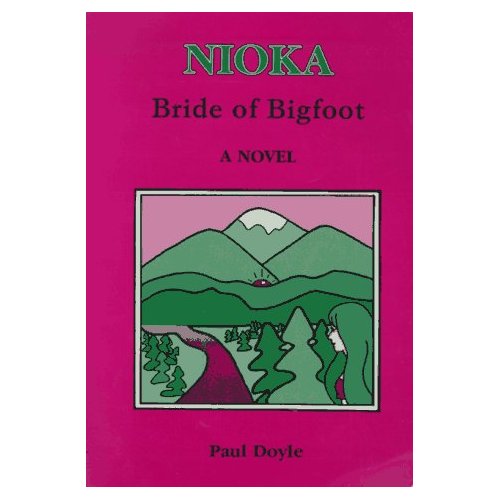
Who I Am Not

This came up recently and so I thought I would let everyone know I am not the author of this work, although I once owned a copy. I have no idea if it is any good because I never got around to reading it.

This isn't my book
This isn't my book

Review at TQC on Borges’ Lectures from the Argentine Master

Daniel Pritchard has written an interesting review at the Quarterly Conversation of Borges’ Lectures from the Argentine Master: Seven Nights. I’d been curious if the book was worth reading. Although it has his similar themes, they sound perceptive and erudite in a way that I find his late fiction isn’t. His latter stories, while continuing with his themes of the other and mirrors, often seem repetitive and don’t have the fictive sparkle of Ficiones, as if he just wanted to write philosophy. By the time 1977 rolls around, I think lectures might have been the best vehicle for him.

The assertion of Jorge Luis Borges’s literary genius is today assumed and completely unremarkable, and since many superior critics have elaborated it, I will refrain from boring you with redundancy. However, it is occasionally overlooked that Borges is also a philosophical genius—philosophical, that is, in that he is completely in love with knowledge, with the pleasure that knowledge for its own sake provides him—and although he is a lover of knowledge, he never declines into reverential pedagogy. Knowledge, to Borges, is not for the knowing, nor for the asserting over and condemnation of others, nor for proving others wrong, but for the pleasure of discovery.

In these lectures, Borges uses his genius to provide that gift of discovery, an experience akin to poetry, “something as evident, as immediate, as indefinable as love, the taste of fruit, of water.” Of the truths themselves, he is always humble. One believes or else one does not; the mind is a malleable thing so that, as he says in the lecture on nightmares, “we may draw two conclusions, at least tonight; later we may change our minds.” And besides, most of what is believed is only an illusion, “our ignorance of the complex machinery of causality.” Like Socrates, Borges is most sure only of the fact that we are mostly ignorant, that there are obscure mechanisms imperceptibly at work in our lives. Whether we decide to call these machinations magic, or God, or fate, each explanation is yet another expression of the consequences of unknown acts.

Javier Marias Interview on Bookworm

Michael Silverblatt interviewed Javier Marias about his trilogy Your Face Tomorrow for his most recent episode of Bookworm. It is an interesting conversation, although one gets the impression that Marías is brushing aside Silverblatt’s often baroque questions. The first part of the interview is here and the second part will be here.

Borges Lost Translations at the Guradian

The Guardian UK (via Words Without Borders) has a short bog post about some translations Borges put together with Norman Thomas di Giovanni of some of his works. It sounds like a true Borges-like project.

Nonetheless, what they produced during this period were not simple translations. Some of their time was given to the collaborative composition of original versions of Borges’s stories in English. Borges’s grandmother was from the Midlands, and he was consequently fluent in English, albeit in a reportedly antiquated turn-of-the-century style. So di Giovanni earned equal writing credit for versions of stories including Tlön, Uqbar, Orbis Tertius, The Library of Babel and The Lottery in Babylon.

48 Year Old Worker Becomes Literary Success in Spain

David Monteagudo, el obrero escritor (the writing worker), has become a literary success in Spain in the last few months. Coming from obscurity to publish the book Fin (End), he has become part triumph of the persistent and a publishing feel good story. The reviews I believe have been good. He has lived a hard life in a box factory but it has given him some humility about the arts. You can read an interview with him here.

Juan Rulfo Reading His Stories Luvina And Tell Them Not to Kill Me

Archivosonoro.org has two recordings of Juan Rulfo reading his two short stories, Luvina and Diles que no me maten (Tell Them Not to Kill Me). The way he reads them really gives a different color to the stories than I originally envisioned. Luvina is my favorite Rulfo story and it is great to hear him read it. The recordings are a little scratchy, but certainly listenable.

Elliott Bay Books Update at the Stranger – To Open on Tax Day

The Stranger has a quick review of the new Elliott Bay Books. They note that it will probably be opening on April 15, 2010. It will not be carrying used books, but I don’t think that was really their thing

Voodoo Histories: The Role of the Conspiracy Theory in Shaping Modern History At Salon

Update: the NY Times has a glowing review of the book from MICHIKO KAKUTANI.

Salon has an interesting interview with British journalist and Times of London columnist David Aaronovitch about his  new book, “Voodoo Histories: The Role of the Conspiracy Theory in Shaping Modern History. As conspiracy theories abound, thanks in part to the power of the Internet, it is good to see a book that addresses the topic and takes apart the theories. Not that the true believers will change their minds.

In recent years, people like the birthers and the 9/11 truthers have gotten a lot of press coverage and pop-cultural play. Are we in a new golden age of conspiracy theories?

I think we live in a more conspiracist period. There’s no question there are more of them, and they’re more global, and they take off more quickly. They’re also more complex and relate to virtual communities rather than real ones. I think it’s because of global interdependence. We live a global period, and there’s a huge temptation among people to believe there is a master plan, because otherwise the suggestion is we’re interdependent and the world is chaotic — and that’s a mindfuck.

There are entire societies where the default position is to believe in conspiracy theories, like in Pakistan or Iran. There are very few people in the Pakistan military, for example, who don’t believe that Bush was behind 9/11. But they’re also probably more easily dispelled, especially in places like the U.S. or Britain. Maybe I’m a false optimist, but I think we have a good skeptics’ movement. My book has done quite well in the U.K. I do think there is some appetite amongst the skeptics that we’ve had enough of this shit and it’s time to fight back.

Literary Life in North Korea at Publishing Perspectives

Publishing Perspectives has an interesting look at literary life in North Korea. While it may not be news, North Korea is not the Soviet Union with its underground of writers hoping to smuggle their work out to the west. North Korea is so controlled that even those risky moments of rebellion don’t exist. And naturally, the works are pure propoganda

B.R. Myers warns that “North Korea is country in which all cultural activity is subjugated to the needs of the Workers Party. Even a simple love story, for example, will carry a propaganda message — a man will fall in love with a woman because she has the right attitude toward working for the state.”

Another typical story might be: A solider is lazy and not sweeping the floor of his tent, so a comrade does it for him. The bad soldier comes in and sees what has been done and bursts into tears and says he’s sorry.

The author of the book The Cleanest Race: How North Koreans See Themselves and Why It Matters by B.R. Myers (Melville House) which is partly reviewed you may know as the author of attacks on modern literature that have appeared in The Atlantic.

Review of New Horacio Castellanos Moya Book at El Pais

El Pais gave a brief review of Horacio Castellanos Moya’s latest book Con la congoja de la pasada tormenta. It is a good review, if brief.

Even though he has not put the stories together with this purpose, the 22 stories in Con la congoja de la pasada tormenta (With the Grief of the Tormented Past), by the Salvadoran writer Horacio Castellanos Moya (Tegucigalpa, 1957), could serve one who does not know the rest of his books as an introduction to characters and themes that people them. Here one meets soldiers and journalists, professors and waiters, photographers and whores, revolutionaries and ex-prisoners, in addition to the endless supporting characters that with a  mere stroke acquire an immediate life (in this Castelanos is Cervantesque). As for the themes, over all of them is one: love, but not hevenly but the other urgent love that is the passion to posses, already seducing, cheating or believing cheated, paying or believing bought. In fact, some stories would fit well in a magazine with naked bodies if it were not for the literary quality, that style of sensual microsurgeon, that is as torrid as the subject mater. Also, because in the stories appear some complicated characters, insecure and anxious men, enfeebled by the testosterone that eroticises one with fantasies about what the rest do in their bed. Likewise alcohol occupies a place of honor – whiskey and beer most of all -, the public places where people drink and the alcoholics in general. And finally, the last of the short list is war, that conditions everything, manipulates and overturns so that the characters walk through the path of exile or brutalization. These three themes, nerveless, treat with unequal fortune and provoke disparate stories, something normal to keep in mind is the stories were written over 20 years. You can recognize two of stories, ‘Variaciones sobre el asesinato de Francisco Olmedo’ and ‘Con la congoja de la pasada tormenta’, that are really short novels. The first relates a trip into the past of a man who looks for the truth about the death of his friend in a gang, or that is what he believes, and fabricates the search with success until it leaves the reader convinced of all his uncertainties. The second uses for its title a quote from Don Quixote when the he found himself at the sale of prostitutes, drinkers and squabbles. Here the narrator is a waiter that becomes involved in a nightmaire at the hands of snobs of all types, and is also about the investigation of a murder. Both stories are near perfect and show that Castellanos dominates that rythm that is not easy to control.

Aunque él no los haya reunido con este propósito, los 22 cuentos de Con la congoja de la pasada tormenta, del escritor salvadoreño Horacio Castellanos Moya (Tegucigalpa, 1957), podrían servir a quien no conociera el resto de su obra literaria como introducción a los personajes y los asuntos que la pueblan. Aquí se encuentran militares y periodistas, profesores y camareros, fotógrafos y putas, revolucionarios y ex reclusos, además de un sinfín de secundarios que con un simple trazo adquieren vida inmediata (en esto Castellanos es cervantino). En cuanto a los asuntos, son sobre todo uno: el amor, pero no el celeste sino ese otro amor urgente que es la pasión por poseer, ya sea seduciendo, engañando o creyendo engañar, pagando o creyendo comprar. De hecho, algunos relatos encajarían bien en una revista con cuerpos desnudos si no fuera porque aquí la calidad literaria, ese estilo de microcirujano sensual, es tan tórrida como el contenido. Y también porque en ellos aparecen algunos personajes complejos, hombres inseguros y ansiosos, enfebrecidos por la testosterona que se erotizan con fantasías sobre lo que hacen los demás en la cama. Asimismo ocupan un lugar de honor el alcohol -sobre todo la cerveza y el whisky-, los lugares públicos en donde se consume y los dipsómanos en general. Y, por fin, el último de la terna es la guerra, que todo lo condiciona, lo manipula y lo trastoca para que los personajes caminen por la senda del exilio o del embrutecimiento. Los tres asuntos, sin embargo, se tratan con fortuna desigual y dan lugar a cuentos dispares, algo normal teniendo en cuenta que se trata de relatos escritos a lo largo de 20 años. Hay que destacar dos de las historias, ‘Variaciones sobre el asesinato de Francisco Olmedo’ y ‘Con la congoja de la pasada tormenta’, que en realidad son novelas cortas. La primera relata el viaje al pasado de un hombre que busca la verdad sobre la muerte de su amigo de pandilla, o eso cree, y que fabula esa búsqueda con éxito hasta dejar al lector convencido de todas sus incertidumbres. La segunda lleva por título una cita tomada del Quijote, cuando el caballero se encuentra en la venta, de nuevo lugar de putas, bebedores y trifulcas. Aquí el narrador es un camarero que se ve involucrado en una pesadilla a manos de señoritos de todos los pelajes, también a propósito de la investigación de una muerte. Ambos relatos rozan la perfección y vienen a demostrar que Castellanos domina ese ritmo nada fácil que exige el medio fondo.

Con la congoja de la pasada tormenta

Horacio Castellanos Moya

Tusquets. Barcelona, 2009

309 páginas. 18 euros

Spanish Authors Video Interviews – Canal-l.com

Moleskin Literario pointed me to this Canal-l which has dozens of interview with Spanish Language authors. There is quite a collection, although the quality suffers a bit. Alone with El Publico Lee from Canal Sur and Pagina 2 from RTVE, one can easily gorge themselves on interviews.

Banipal – New Egyptian Writing (Spring 2006)

I only found out about Banipal a week or two ago and thought of buying a copy, but at 18 pounds for 3 issues (not too bad) and 17 pounds for shipping (ridiculous) forget that. Fortunately, I live near a major university and they have a subscription. I read through issue 25, New Writing from Egypt. First, I was impressed with the quality of the writing. Too often I have read journals that are compendiums of authors and they aren’t particularly interesting. The authors who I found interesting and have books in English were Ahmed Alaidy’s Being Abbas el Abd (American University Cairo, 2006), which not only was an interesting story, but lexicographically interesting; and Hamdy Abowgliel’s Thieves of Retirement (Syracuse University Press, 2006). They bother were in the more seedy and criminal seeming vain but look worth perusing.

In addition to these writers, were several who were more playful in their stories, such as Haytham Al-Wardany’s Pissing on the World which is just about boys pissing on streets and seeing what they can get away with. Also of note was Ibrahim Farghali’s brief story The Monotonous Rhythm of the Years of Drought which describes the humiliation a man feels when he cheats on his fiancé with his old girlfriend. Safaa Ennagar’s Amoeba was about a woman who wears shapely cloths before her marriage, but after must wear baggy ones. One day in a private moment she again finds the freedom to wear the tighter clothes and has a moment of transcendence.

The collection is filled with interesting works, although having looked at a couple other issues, I do know they can be a little poetry heavy which isn’t bad, just something I don’t read much.

To finish I’ll quote Ennagar who comments on the state of Egyptian writing:

Literary production in Egypt today is either a way of releving the poetic situation of the writer or a kind of intellectual luxury that goes beyond reality. It is a literature of the “ghetto” that neither affects, nor is affected by, social and political movements. It is new on the levels of both form and content, but is presented only within the circle of the literati; there is no interest in spreading it outside the small elite. The print-run is limited (usually 1000 copies) as official institutions generally support works that are more traditional and lasting.