Two Lebanese American Novels Reviewed at The New York Review of Books

In Colm Tóibín’s The Anger of Exile at The New York Review of Books he reviews two novels by Lebanese exiles living in the North America. They sound like they have some promise.

About Rabih Alameddine’s book he writes

The Hakawati offers a set of competing narratives, some fabulous, some filled with memory and desire; it allows what we might call geopoetics to flow over geopolitics. By refusing to permit a single perspective or a single story or style to dominate, it offers, almost despite itself, a paradigm of mingling images and rich difference living in a panoramic, harmonic disunity. Alameddine suggests with some subtlety and much exuberance how this tapestry might come to the aid of the very world that the book explores.

About Hag’s novel he writes

In scene after scene our narrator mocks the very idea of the ordered self or the ordered society. He makes racist comments about other immigrants, calling them “welfare dogs” and forcing the reader to side with him or hate him all the more. His deep dislike of a poor émigré Algerian professor is irrational and fierce. He is an affront to all types of decency. The fact that he is writing this in Canada, a country that rightly is proud of its policy on immigration and ethnic diversity, adds a comedy to the book; the sound of the hand that feeds being bitten sharply offers a rhythmic energy to the prose and removes any possibility of easy self-pity from the tone.

Cockroach is all voice, and it depends on the holding and wielding of tone. The problem is that it is also a novel and thus Hage works a number of plotlines through the book, some more convincing than others.

Spanish Author Miguel Delibes Has Died

The Spanish author Miguel Delibes has died at age 89 at his home in Valladolid. El Pais has an obiturary here and commemoration his life here. He had won the Cervantes prize among many others and was considered one of Spains greatest writers of the 20th century. Several of his books have been translated into English.

Javier Marías Conversation at the NY Public Library

Words Without Borders pointed me to a lengthy (90 min) conversation between Javier Marías and Paul Holdengräber at the NY Public Library.

Mexican author Carlos Montemayor has died

I didn’t notice this until today when I saw that La Jornada had put together a special edition in memory of his work. Included in the issue is an interview with Daniel Sada one of his closest friends.

You an read an English language obit here: Mexican author Carlos Montemayor dies at 62 – Yahoo! News.

Book tour? Now its DIY

The LA Times has an article about what book tours are like for the authors now that publishers are not backing them. It sounds very do it yourself and rewards those who sacrifice writing time for marketing time.

Book tours used to be about local media. “You would go to these places to get reviews, interviews, TV and radio,” Miller explains, but with print outlets closing down and cutting coverage and new technologies enabling long-distance video interviews, “it is becoming less important to do that kind of tour.”

Bookstores are also becoming harder to find. When its B. Dalton shut down this year, Laredo, Texas, population 200,000-plus, became the largest bookstore-less city in the United States. In January, when “Eat, Pray, Love” author Elizabeth Gilbert came to Los Angeles to sign her new book, “Committed,” she wound up at Costco in Marina del Rey.

As the book tour takes on new shapes, what will it mean for writers — and for readers? Authors like Boyle don’t just read — they perform and stay until they’ve signed every book. They know the value of connection. But how will their lesser-known counterparts connect?

via Book tour? More like a safari – latimes.com.

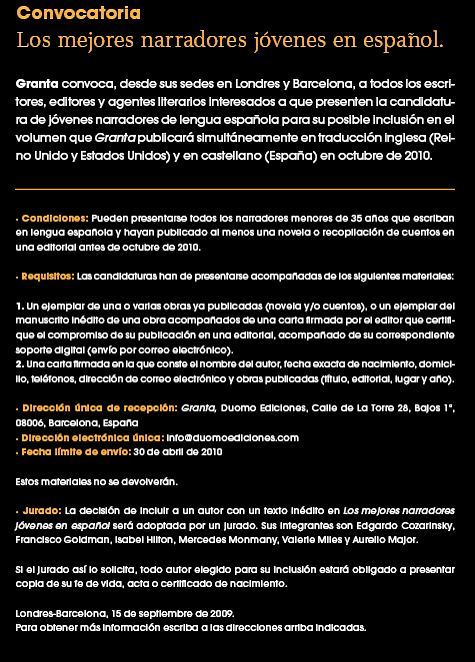
Granta to Publish Best Young Writers in Spanish in October 2010

Moleskine Literario notes that Granta has put a call out for contributions for an issue dedicated to the Best Young Writers in Spanish. It will appear in October 2010, with editions in both Spanish and English.  The complete announcement is below.

Javier Marias Talks to His Readers About His New Book and Other Things

Javier Marias participated in a chat at El País and in the brief session he answered questions on language, his writing, and literature. There were several questions about his constant pessimism, especially in his weekly article in El País (something I long ago got tired of reading). One in particular wanted to know why he didn’t focus on other countries, but he said he knows Spain best and will stick to that. Continuing in his pessimistic way he made several mentions of the continued “deterioro del español de España” (deteriation of Spanish in Spain). To me it sounded just like a cranky old man when he was on that topic. Language changes and there is not point in complaining about it, but I think that is what he likes most to do.

About his writing he was asked in English language structures have crept into it and he said sometimes he does that to enrich his language, but only when it makes sense. He has begun a new book and the only thing he really knows is that it will be pessimistic, too. He is about half way through, but for the last year he has been on a book tour, something that he has found boring, and is looking to get back to his work.

Finally, he does know how to use a computer, he just doesn’t like to write his books and articles with a computer. And when asked the 3 best novels of the 20th century he said, Lolita by Nabokov, Light in August by Faulkner, and Catcher in the Rye by Salinger.

deterioro del español de España

Luis García Montero Reading at the University of Washington

Luis Farcia Montero
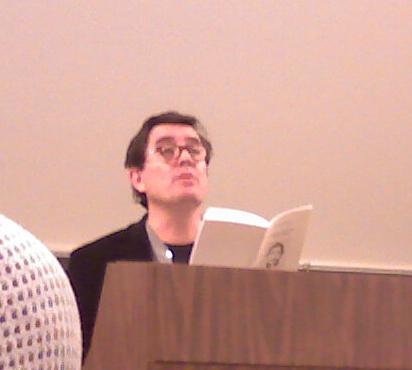
Luis García Montero Reading 3/3/2010

The Spanish poet Luis García Montero read at the University tonight (3/3/2010) to a packed room of students and academics. He read 8 poems from his body of work that the graduate students had translated into English. I’m not that familiar with Spanish poets and so had no idea what to expect, although I had seen his interview on El Público Lee. He is considered one of Spain’s best poets and is considered a realist poet who uses the elements from the everyday to express emotion or the experience of living. The poems that he read were very interesting and would be worth a return to. While he is a realist, the poems did have a good sense of imagery and didn’t slide into that reportage that is so real it describes nothing but itself and seems to afflict many of the American poets I’ve read and seen recently. Before each poem he explained where the ideas came from and they were often from the most basic experiences, but went beyond the moment he explained and captured something about modern living. The one I remember most was his poem to his mother. It was a reflection on the dreams she sacrificed to her family that in the era of Franco were not possible. And although he fought with her as young man who was experiencing the transition to democracy, he now sees her as someone who was so much more.

Read at the Hugo House 3/1/2010

I did a little reading (2 pages to be exact) of a story called Hostages last night at the Hugo House. There was an interesting collection of readers. One woman read a poem that didn’t really seem like a poem, but what was interesting was when she sang parts of it. It was a welcome change from some of the slow talking symbolists. At the opposite spectrum was the Mexican American comedian who gave us 5 minutes of funny stand up. He had great delivery and sure knows how to wait for the laughs. The reading series actually tends to always have a couple of really interesting presenters.

New Words Without Borders – Poetry

A new Words Without Borders featuring international poetry was published today. Featured just in time for the upcoming appearance in Seattle of Luis García Montero is one of his poems.

Spanish Poert Luis García Montero in Seattle 3/3/2010

LA SOLEDAD COMPARTIDA / A SHARED SOLITUDE
Please join us for a bilingual poetry reading with Spanish poet LUIS GARCÍA
MONTERO (Granada, 1958).  Widely considered the most important poet and critic
of his generation, García Montero is a leading proponent of the �Poetry of
Experience,� the dominant trend in Spanish poetry since the 1990s.  He has
received many prestigious awards, including the Adonais Prize and the Loewe
Prize, as well as the National Poetry Prize and the National Critics Award.
Students in Spanish 596 will read their translations of his poetry for this
event.

Wednesday, March 3
7 PM
Smith Hall 205 (UW Campus)
Free and open to the public

Review at TQC on Borges’ Lectures from the Argentine Master

Daniel Pritchard has written an interesting review at the Quarterly Conversation of Borges’ Lectures from the Argentine Master: Seven Nights. I’d been curious if the book was worth reading. Although it has his similar themes, they sound perceptive and erudite in a way that I find his late fiction isn’t. His latter stories, while continuing with his themes of the other and mirrors, often seem repetitive and don’t have the fictive sparkle of Ficiones, as if he just wanted to write philosophy. By the time 1977 rolls around, I think lectures might have been the best vehicle for him.

The assertion of Jorge Luis Borges’s literary genius is today assumed and completely unremarkable, and since many superior critics have elaborated it, I will refrain from boring you with redundancy. However, it is occasionally overlooked that Borges is also a philosophical genius—philosophical, that is, in that he is completely in love with knowledge, with the pleasure that knowledge for its own sake provides him—and although he is a lover of knowledge, he never declines into reverential pedagogy. Knowledge, to Borges, is not for the knowing, nor for the asserting over and condemnation of others, nor for proving others wrong, but for the pleasure of discovery.

In these lectures, Borges uses his genius to provide that gift of discovery, an experience akin to poetry, “something as evident, as immediate, as indefinable as love, the taste of fruit, of water.” Of the truths themselves, he is always humble. One believes or else one does not; the mind is a malleable thing so that, as he says in the lecture on nightmares, “we may draw two conclusions, at least tonight; later we may change our minds.” And besides, most of what is believed is only an illusion, “our ignorance of the complex machinery of causality.” Like Socrates, Borges is most sure only of the fact that we are mostly ignorant, that there are obscure mechanisms imperceptibly at work in our lives. Whether we decide to call these machinations magic, or God, or fate, each explanation is yet another expression of the consequences of unknown acts.

Javier Marias Interview on Bookworm

Michael Silverblatt interviewed Javier Marias about his trilogy Your Face Tomorrow for his most recent episode of Bookworm. It is an interesting conversation, although one gets the impression that Marías is brushing aside Silverblatt’s often baroque questions. The first part of the interview is here and the second part will be here.

Borges Lost Translations at the Guradian

The Guardian UK (via Words Without Borders) has a short bog post about some translations Borges put together with Norman Thomas di Giovanni of some of his works. It sounds like a true Borges-like project.

Nonetheless, what they produced during this period were not simple translations. Some of their time was given to the collaborative composition of original versions of Borges’s stories in English. Borges’s grandmother was from the Midlands, and he was consequently fluent in English, albeit in a reportedly antiquated turn-of-the-century style. So di Giovanni earned equal writing credit for versions of stories including Tlön, Uqbar, Orbis Tertius, The Library of Babel and The Lottery in Babylon.

48 Year Old Worker Becomes Literary Success in Spain

David Monteagudo, el obrero escritor (the writing worker), has become a literary success in Spain in the last few months. Coming from obscurity to publish the book Fin (End), he has become part triumph of the persistent and a publishing feel good story. The reviews I believe have been good. He has lived a hard life in a box factory but it has given him some humility about the arts. You can read an interview with him here.

Juan Rulfo Reading His Stories Luvina And Tell Them Not to Kill Me

Archivosonoro.org has two recordings of Juan Rulfo reading his two short stories, Luvina and Diles que no me maten (Tell Them Not to Kill Me). The way he reads them really gives a different color to the stories than I originally envisioned. Luvina is my favorite Rulfo story and it is great to hear him read it. The recordings are a little scratchy, but certainly listenable.

Richard Hugo House to Host Writers Conference May 21-23

According to the Hugo House’s website they will be hosting a conference focusing on how one finds readers. This is a nice change to see, because while the Hugo House is a good resource (I am a member and read there occasionally) they typically only offer classes and if you are not interested in classes their program isn’t of much use.Looking forward to see if it will be interesting.

On the weekend of May 21-23, Richard Hugo House will be hosting its first writers’ conference. The topic will be: Finding Your Readers in the 21st Century.

Our focus will be on exploring the changing literary landscape and the options available to writers for getting their work out in the world and into the hands of readers. While we will certainly look at traditional publishing models, what we’re really interested in is showcasing new possibilities that writers in our community may not be aware of, from the traditional to the off-the-wall. We’ll look at ways writers can promote themselves and their work directly to their readers, and offer hands on practical workshops on basic tools of the writing business from creating a pre-pub platform to building your own website.

Registration for Finding Your Readers in the 21st Century will open on April 5 for Hugo House members and April 12 for the general public.

Review of New Horacio Castellanos Moya Book at El Pais

El Pais gave a brief review of Horacio Castellanos Moya’s latest book Con la congoja de la pasada tormenta. It is a good review, if brief.

Even though he has not put the stories together with this purpose, the 22 stories in Con la congoja de la pasada tormenta (With the Grief of the Tormented Past), by the Salvadoran writer Horacio Castellanos Moya (Tegucigalpa, 1957), could serve one who does not know the rest of his books as an introduction to characters and themes that people them. Here one meets soldiers and journalists, professors and waiters, photographers and whores, revolutionaries and ex-prisoners, in addition to the endless supporting characters that with a  mere stroke acquire an immediate life (in this Castelanos is Cervantesque). As for the themes, over all of them is one: love, but not hevenly but the other urgent love that is the passion to posses, already seducing, cheating or believing cheated, paying or believing bought. In fact, some stories would fit well in a magazine with naked bodies if it were not for the literary quality, that style of sensual microsurgeon, that is as torrid as the subject mater. Also, because in the stories appear some complicated characters, insecure and anxious men, enfeebled by the testosterone that eroticises one with fantasies about what the rest do in their bed. Likewise alcohol occupies a place of honor – whiskey and beer most of all -, the public places where people drink and the alcoholics in general. And finally, the last of the short list is war, that conditions everything, manipulates and overturns so that the characters walk through the path of exile or brutalization. These three themes, nerveless, treat with unequal fortune and provoke disparate stories, something normal to keep in mind is the stories were written over 20 years. You can recognize two of stories, ‘Variaciones sobre el asesinato de Francisco Olmedo’ and ‘Con la congoja de la pasada tormenta’, that are really short novels. The first relates a trip into the past of a man who looks for the truth about the death of his friend in a gang, or that is what he believes, and fabricates the search with success until it leaves the reader convinced of all his uncertainties. The second uses for its title a quote from Don Quixote when the he found himself at the sale of prostitutes, drinkers and squabbles. Here the narrator is a waiter that becomes involved in a nightmaire at the hands of snobs of all types, and is also about the investigation of a murder. Both stories are near perfect and show that Castellanos dominates that rythm that is not easy to control.

Aunque él no los haya reunido con este propósito, los 22 cuentos de Con la congoja de la pasada tormenta, del escritor salvadoreño Horacio Castellanos Moya (Tegucigalpa, 1957), podrían servir a quien no conociera el resto de su obra literaria como introducción a los personajes y los asuntos que la pueblan. Aquí se encuentran militares y periodistas, profesores y camareros, fotógrafos y putas, revolucionarios y ex reclusos, además de un sinfín de secundarios que con un simple trazo adquieren vida inmediata (en esto Castellanos es cervantino). En cuanto a los asuntos, son sobre todo uno: el amor, pero no el celeste sino ese otro amor urgente que es la pasión por poseer, ya sea seduciendo, engañando o creyendo engañar, pagando o creyendo comprar. De hecho, algunos relatos encajarían bien en una revista con cuerpos desnudos si no fuera porque aquí la calidad literaria, ese estilo de microcirujano sensual, es tan tórrida como el contenido. Y también porque en ellos aparecen algunos personajes complejos, hombres inseguros y ansiosos, enfebrecidos por la testosterona que se erotizan con fantasías sobre lo que hacen los demás en la cama. Asimismo ocupan un lugar de honor el alcohol -sobre todo la cerveza y el whisky-, los lugares públicos en donde se consume y los dipsómanos en general. Y, por fin, el último de la terna es la guerra, que todo lo condiciona, lo manipula y lo trastoca para que los personajes caminen por la senda del exilio o del embrutecimiento. Los tres asuntos, sin embargo, se tratan con fortuna desigual y dan lugar a cuentos dispares, algo normal teniendo en cuenta que se trata de relatos escritos a lo largo de 20 años. Hay que destacar dos de las historias, ‘Variaciones sobre el asesinato de Francisco Olmedo’ y ‘Con la congoja de la pasada tormenta’, que en realidad son novelas cortas. La primera relata el viaje al pasado de un hombre que busca la verdad sobre la muerte de su amigo de pandilla, o eso cree, y que fabula esa búsqueda con éxito hasta dejar al lector convencido de todas sus incertidumbres. La segunda lleva por título una cita tomada del Quijote, cuando el caballero se encuentra en la venta, de nuevo lugar de putas, bebedores y trifulcas. Aquí el narrador es un camarero que se ve involucrado en una pesadilla a manos de señoritos de todos los pelajes, también a propósito de la investigación de una muerte. Ambos relatos rozan la perfección y vienen a demostrar que Castellanos domina ese ritmo nada fácil que exige el medio fondo.

Con la congoja de la pasada tormenta

Horacio Castellanos Moya

Tusquets. Barcelona, 2009

309 páginas. 18 euros

The BBC’s American Archive

Mark Athitakis’ American Fiction Notes points out that the has a series of shows on the BBC with interviews with American authors. The interviews were recorded over a ten year period and all shows are about 30 minutes long. Here are some of the authors featured.

  • Playwright Edward Albee discusses his career.
  • Patricia Cornwell discusses her life and her career as a crime writer.
  • Don DeLillo author of Libra, Underworld and Cosmopolis.
  • E L Doctorow talks about novels including Ragtime and Homer and Langley.
  • Dave Eggers author of A Heartbreaking Work of Staggering Genius talks to Mark Lawson.
  • Ellroy talks about Blood’s A Rover, which completes his Underworld USA Trilogy and why he has to shut himself away to write.
  • John Irving author of A Prayer for Owen Meany and The Cider House Rules.
  • Stephen King discusses writing horror
  • Norman Mailer speaking in the last major broadcast interview of his life.
  • Nobel prize winning author Toni Morrison talking to Mark Lawson at the Cheltenham Literary Festival.
  • Walter Mosley books include a series featuring Private Investigator Easy Rawlins.
  • Joyce Carol Oates author of over 50 novels including Blonde and Black Water.
  • Marilynne Robinson author of novels including Housekeeping and Gilead.
  • Philip Roth speaking as he published his last novel featuring the character Nathan Zuckerman Exit Ghost.
  • John Updike speaking on his 70th birthday.
  • John Updike speaking in his last recorded interview.
  • Gore Vidal discusses writing and politics.
  • Kurt Vonnegut, the author of Slaughterhouse Five, speaking as he publishes a memoir called A Man Without a Country.
  • Playwright August Wilson discusses his attitude to writing.
  • Tom Wolfe explains the ideas behind new journalism.
  • Tom Wolfe discusses new journalism and a novel depiciting sex amongst college kids; I Am Charlotte Simmons.

Banipal – New Egyptian Writing (Spring 2006)

I only found out about Banipal a week or two ago and thought of buying a copy, but at 18 pounds for 3 issues (not too bad) and 17 pounds for shipping (ridiculous) forget that. Fortunately, I live near a major university and they have a subscription. I read through issue 25, New Writing from Egypt. First, I was impressed with the quality of the writing. Too often I have read journals that are compendiums of authors and they aren’t particularly interesting. The authors who I found interesting and have books in English were Ahmed Alaidy’s Being Abbas el Abd (American University Cairo, 2006), which not only was an interesting story, but lexicographically interesting; and Hamdy Abowgliel’s Thieves of Retirement (Syracuse University Press, 2006). They bother were in the more seedy and criminal seeming vain but look worth perusing.

In addition to these writers, were several who were more playful in their stories, such as Haytham Al-Wardany’s Pissing on the World which is just about boys pissing on streets and seeing what they can get away with. Also of note was Ibrahim Farghali’s brief story The Monotonous Rhythm of the Years of Drought which describes the humiliation a man feels when he cheats on his fiancé with his old girlfriend. Safaa Ennagar’s Amoeba was about a woman who wears shapely cloths before her marriage, but after must wear baggy ones. One day in a private moment she again finds the freedom to wear the tighter clothes and has a moment of transcendence.

The collection is filled with interesting works, although having looked at a couple other issues, I do know they can be a little poetry heavy which isn’t bad, just something I don’t read much.

To finish I’ll quote Ennagar who comments on the state of Egyptian writing:

Literary production in Egypt today is either a way of releving the poetic situation of the writer or a kind of intellectual luxury that goes beyond reality. It is a literature of the “ghetto” that neither affects, nor is affected by, social and political movements. It is new on the levels of both form and content, but is presented only within the circle of the literati; there is no interest in spreading it outside the small elite. The print-run is limited (usually 1000 copies) as official institutions generally support works that are more traditional and lasting.