My Review of Translation is a Love Affair is up at the Quarterly Converastion

My review of Jacques Poulin’s Translation is a Love Affair is up at the Quarterly Conversation. Jacques Poulin is from Quebec, a city that is relatively close but can seem rather distant to someone from the US. It was a good change of pace to read a book from our neighbor to the north. The review begins

True to its title, Translation Is a Love Affair is centered around language—not only how writers and translators use it but also how it brings people together. Author Jacques Poulin’s characters see language as something to live, like a friendship, and translation is both a means of rendering one language in another and closing the distance between people, and even creatures. But that doesn’t mean Translation is a work of theory; it is a quiet novel of companionship through language.

MOLESKINE ® LITERARIO to pause publication

Always a shame, the fine literary blog MOLESKINE ® LITERARIO is going to stop publishing for a while.

Update

They restarted publication.

Carlos Fuentes on Chilean Literature

Carlos Funtes has a reflection of the literature of Chile and what it has meant to him. It is a quick overview but worth reading as it mentions many writers I am not familiar with.

(Google translate here if you don’t speak Spanish.)

Enrique Vila-Matas Interview at el sindrome chejov

The excellent blog El sindrome chejov has a length interview with Enrique Vila-Matas about his new book, Dublinesca. If you are interested in Vila-Matas this interview will be worth it. Miguel Ángel Muñoz asks interesting questions, in part because he is a writer and seems to avoid some of the less interesting things journalists do.

Enrique Vila-Matas’ Newest Book and Excerpt

El Cultural has an extremely brief interview with Enrique Vila-Matas about his new book Dublinesca (Dublinesque). It is so brief I can sum it up in three phrase: the book has more narrative and humanity than others because he has had many changes in his personal life; it is about an editor who goes to Dublin on Blooms Day; Vila-Matas was impressed by Dublin in a recent trip, but the editor character is not him, rather and amalgamation of many people he has known.

More importantly El Cultural has an excerpt of the book.

Enrique Vila-Matas Interview and Excerpt at El Pais

ELPAÍS.com has an interview with Enrique Vila-Matas about his new book Dublinesca. There is also an excerpt of the book.

P. Ha elegido para protagonizar su novela a un editor jubilado de su edad. Ha decidido cerrar su editorial, y se va a hacer un funeral por la letra impresa y declara: “¿Para qué sirve la novela si ya tenemos la teoría?”. Un editor que considera terminado su catálogo y, en cierto modo, su vida…

R. Si te fijas, hay muy pocos escritores que hayan ficcionado a los editores… En principio trabajé -como tantas otras veces he hecho- con un personaje que era escritor. Un día, cuando llevaba ya cincuenta páginas escritas, decidí transformarlo en un editor, y todo de pronto se me volvió diabólicamente diferente. Las situaciones que tenía ya escritas pasaron a poder ser interpretadas de un modo no sólo distinto sino a veces incluso perverso. Y, de golpe, pasé a divertirme mucho.

P. Cuando lo situó como escritor, ¿era usted?

R. Era un personaje de ficción, con algún punto en común conmigo. Cuando lo convertí en editor ya era una mezcla de muchos editores que he conocido. En París, por ejemplo, algunos lectores han creído ver que hablo de Christian Bourgois, mi editor francés. No he negado que Riba tenga cosas de él. Es un conjunto de personas que he conocido.

Two Lebanese American Novels Reviewed at The New York Review of Books

In Colm Tóibín’s The Anger of Exile at The New York Review of Books he reviews two novels by Lebanese exiles living in the North America. They sound like they have some promise.

About Rabih Alameddine’s book he writes

The Hakawati offers a set of competing narratives, some fabulous, some filled with memory and desire; it allows what we might call geopoetics to flow over geopolitics. By refusing to permit a single perspective or a single story or style to dominate, it offers, almost despite itself, a paradigm of mingling images and rich difference living in a panoramic, harmonic disunity. Alameddine suggests with some subtlety and much exuberance how this tapestry might come to the aid of the very world that the book explores.

About Hag’s novel he writes

In scene after scene our narrator mocks the very idea of the ordered self or the ordered society. He makes racist comments about other immigrants, calling them “welfare dogs” and forcing the reader to side with him or hate him all the more. His deep dislike of a poor émigré Algerian professor is irrational and fierce. He is an affront to all types of decency. The fact that he is writing this in Canada, a country that rightly is proud of its policy on immigration and ethnic diversity, adds a comedy to the book; the sound of the hand that feeds being bitten sharply offers a rhythmic energy to the prose and removes any possibility of easy self-pity from the tone.

Cockroach is all voice, and it depends on the holding and wielding of tone. The problem is that it is also a novel and thus Hage works a number of plotlines through the book, some more convincing than others.

Spanish Author Miguel Delibes Has Died

The Spanish author Miguel Delibes has died at age 89 at his home in Valladolid. El Pais has an obiturary here and commemoration his life here. He had won the Cervantes prize among many others and was considered one of Spains greatest writers of the 20th century. Several of his books have been translated into English.

New Letras Libres Up

Letras Libres has published their March issue. Among other things there is a brief over view of José Vasconcelos’s seminal work the La raza cósmica.

A ver. En principio está el mundo y el mundo está dividido en cuatro pueblos: el blanco, el negro, el indígena y el mongol. A veces domina uno y a veces –durante un parpadeo que puede durar siglos o milenios– rige otro. Ahora reina el blanco. O para ser precisos: el anglosajón. No hay de qué preocuparse: ya será desplazado. Esta vez –la última de las veces– no por otro de los cuatro pueblos elementales sino por una nueva cultura, una quinta raza –“una raza universal, fruto de las anteriores y superación de todo lo pasado”. La raza cósmica.

Javier Marías Conversation at the NY Public Library

Words Without Borders pointed me to a lengthy (90 min) conversation between Javier Marías and Paul Holdengräber at the NY Public Library.

Footnotes in Gaza by Joe Sacco – A Review

Footnotes in Gaza: A Graphic Novel
Joe Sacco, 432 pages, Metropolitan Books

Joe Sacco’s Footnotes in Gaza is his most ambitious work to date, both in page size and in the depth of his reporting. It is not only a book about current events as all of them are, but a detailed examination of events in Gaza in the mid 50’s. The search for witnesses of the events in Khan Younis and Raffa not only make the book more involved, opening questions of memory and truth, but also creates a contrasting history that is frustrating in its continuation of a conflict that has existed over 60 years.

The book is covers two different areas, the events in Khanunis and Raffa and what led up to them, and the events in Gaza during the early 2000’s before Hamas took over Gaza. Sacco spends most of his time investigating the history in part because he wants to look at some lesser known events in the Israeli-Palestinian conflict. For Sacco it is not only the events themselves that are interesting, but the process of creating the story, the way memory is shaped by the survivors, current events,  and those taking down the stories. Sacco makes it clear that the memories of the survivors and witnesses to these events vary in reliably. Often Sacco would find people who mixed events, or, worse for Sacco, wanted only to push a political agenda. When Sacco finds a fidayeen veteran he shows repeated scenes of the man talking about events he thinks are important, avoiding what Sacco is after, but Sacco continues on, sure the man has the story he is looking for. Eventually he get what he is looking for, but throughout the book is the interplay of the journalist and the story. As the he goes deeper and deeper into researching the story it appears he becomes intoxicated by the act of searching for the story, knowing what will actually be relevant. In doing so, he controls the narrative, yet his depiction of the process is a refreshing reflection on the act of journalism. Sacco has always been aware in his works how journalists become adventure seekers and how that distorts part of the story. His Christmas with Karadzic in War’s End: Profiles From Bosnia 1995-1996 is probably his clearest expression of the phenomenon.

From all the interviews and archival research (20 pages of the book are reprints of archival documents) Sacco tells the little known story of mass killings of Palestinian refugees in Khan Younis and Raffa by the Israeli Army. While exact numbers are not clear, all together a few hundred may have died in these incidents. In Khan Younis the survivors tell of a systematic rounding up of men between 15 and 60 and their mass execution and the forced quick burial. Since most of what happened in Khan Younis was witnessed by just a few survivors, Sacco only has a couple testimonies of Palestinian men who escaped the shooting. There are plenty of post incident witnesses, the women and children who helped in the burials, along with UN reports that say something happened, and Israeli reports that say the soldiers were panicked and shot in self defense. Sacco’s rendering of the survivor’s testimony is vivid and it is clear that he thinks that the Palestinian story is what happened.

The events in Raffa, on the other hand, were less brutal and so there are many more survivors. In Raffa, the Israeli army rounded up all the men and sent them through a gantlet where they had to jump over barbed wire while being clubbed by soldiers. Sacco notes that the memories of the survivors don’t always agree, but from each of repeated images he finds he structures a narrative that he thinks is most likely what happened. As with Khan Younis, the Israeli’s come off as brutal and arbitrary, more interested in killing and terrorizing than finding fidayeen in amongst the refugees. The story of Raffa is the most compellingly researched and has the best interplay between memory and journalism.

But what preceded the incidents? Sacco explains some of the history that had occurred since the 1948 war when Palestinian refugees spilled into Gaza. He notes that the border was easy to cross and little by little a series of tit-for-tat  killings and attacks by refugees, Israeli’s and Egyptian sponsored terrorist squads called the fidayeen, led to a state of violence where the refugees in Gaza became victims of power plays between Egypt and Israel. The cross border attacks had gone on for several years and both sides had hardened their positions substantially. Sacco includes a quote from Moshe Dayan who noted that Israel had to be strong, but in doing so the Palestinians, too, would harden and continue to fight. It is amongst these incidents the larger incidents in Khan Younis and Raffa occurred.

For Sacco, it is relatively obvious that the Israelis committed the abuses described in the books even though they deny they did. He notes that even right wing historian Benny Morris agrees that there were killings in the two refugee camps. However, given the state of tensions between the two sides it seems impossible for something even resembling agreement to be reached on what happened.

The notion of agreement and the problematic search for the past, continually surfaces amongst the modern day inhabitants who are only interested in the present and continually tell Sacco why do you bother with the past, it doesn’t help the present. Recovering the past doesn’t feed one, but given the endless tit-for-tat that can consume one’s perspective, a look back at the historical can help. Sacco’s nuanced reflection on one little part of the past is an excellent look at some of the events that had served to lock the conflict in its current stalemate. Unfortunately, his book will probably be taken by many as belonging to one side.

Interview with Edith Grossman at The Boston Globe

A brief interview with Edith Grossman about her approach to translation. Interesting, if brief.

IDEAS: Do you read much work by other translators?

GROSSMAN: It’s difficult, but that’s part of the trick of translating – to be able to leave your ear neutral enough so you can hear the first language, and know your own language well enough so you can echo it.

GROSSMAN: When I’m working I prefer to read contemporary American and English fiction. It gives me an idea of what’s possible. Aside from the fact that I’m addicted to novels, reading great fiction broadens my own repertoire of responses to a text. Gregory Rabassa said that when he was working on “One Hundred Years of Solitude,” some ninny asked him if he knew enough Spanish to translate it, and his answer was that the real question was whether or not he knew enough English. He hit it right on the head.

IDEAS: As you translate a book into a different language, how do you separate your own voice from the author’s?

The other author of ‘Don Quixote’ – The Boston Globe.

Celebrating the Small Press: Spain’s Páginas de Espuma

Recently I read two books from the publisher Páginas de Espuma, a Spanish press devoted to the art of the short story. Both España, a parte de mi estos premios (Fernandow Iwasaki), and El pez volador (Hipólito G. Navarro) are very good and are part of the resurgence of the Spahish short story. Páginas de Espuma has published many of the writers that are part of the resurgence and fills an important role in celebrating an art that is often held in less esteem than the novel. But the catalog doesn’t stop at modern Spanish writers, but includes thematic collections and republications of older writers. Recently they published an edition of Poe’s stories with an introduction for each story written by a different author. With El pez volador they have introduced a new series, Vivir del Cuento (Living with stories) that I hope they continue with. The books is divided into three parts: a long overview of the work of the author; a representative sample of the author’s stories; a long interview with the author. It is a great way to get an introduction to an author’s work, especially if you are not familiar with his or her milieu. Hopefully, next time I get to Spain I can pick up a few more books of theirs.

The Book Swap at Conversational Reading

Scott at Conversation Reading talks about the idea of a book swap as a way to connect readers with other readers and their local independent bookstore.

The bookswap came from a few simple facts that you can read about in this post, written by Madan and Evans for The Huffington Post. Essentially, they realized that readers want more than to buy books at a bookstore–they want to meet other readers there and have experiences that have to do with authors, publishers, great books, and literary culture. This is why people will go to bookstores for author events, and it’s also the reason why so many author events can feel flat. It’s nice to see your favorite author read from a new book, but if you’re just an isolated reader who is permitted to squint at your author on a podium for an hour and then walk away, perhaps with a signed book and an anxiety-ridden ten-second conversation with said author, you feel just as isolated and alone as you did before the event started.

An Idea Every Independent Bookstore Should Steal « Conversational Reading.

Mexican author Carlos Montemayor has died

I didn’t notice this until today when I saw that La Jornada had put together a special edition in memory of his work. Included in the issue is an interview with Daniel Sada one of his closest friends.

You an read an English language obit here: Mexican author Carlos Montemayor dies at 62 – Yahoo! News.

Vertigo’s Unkown Soldier – A Review

For the past year and a half Vertigo has been publishing an updated edition of DC Comic’s Unknown Soldier that takes place in Uganda during 2002 -2004 when the Lord’s Resistance Army (LRA) was terrorizing the country. The Unknown Soldier is a man whose face is always in bandages, the characters in the story never know who he is (in the original the reader didn’t know, either), and though he does not have super powers but he does have some sort of extraordinary strength. In Vertigo’s series he is an American born doctor, the child of Ugandan immigrants, who is overcome by a spirit, a presence or perhaps just guilt and scars his face in a moment of madness and then picks up a gun, something as a doctor he was opposed to, and begins to kill those who attack civilians. Eventually, he will kill child soldiers who are part of the LRA. As one might guess, the series is graphic and violent and doesn’t shy away from details, perhaps occasionally overdoing the blood, which is probably to be expected from comics. As the story progresses, the Unknown Soldier becomes involved with an ex-CIA agent who lives in Uganda and is playing all sides; he meets a movie start and humanitarian; befriends a young ex-child soldier; and takes up residence in a Acholi village that lives in fear of the LRA. The Unknown Soldier’s adventures is quite a collection of ideas and tries to pack in as much as it can in 20 brief pages. The most valuable part of the collection is the depiction of the war, the refugees, and the war crimes that have afflicted that part of Africa. While just a litany of atrocities lends itself to a numbness, the series does explore without exploitation (although it is wrapped in an adventure comic) the complexities of the war, the child slavery and the political instability that have thousands as refugees. Except for the LRA which is rightly depicted as pure evil, all the other actors, be it the government, the UN, or the west are depicted as a mix of competing interests, both good and bad, that typically leave the locals vulnerable. Moreover, over the life of the series the picture of the LRA becomes more and more perverse and it is almost hard to believe something so perverse could exist.

Where the series seems to error is, first, in the mystical voice that seems to talk to the Unknown Soldier and give him the ability to be a soldier. It would be nice for a comic not to be tied down to the comic formula which seems to always need something supernatural to explain reality. While it is a convention of the genre, it makes it seem as if all one needs to defeat an army single handedly is a little bit of magic or training, which is pure fantasy. Second, adding the ex-CIA agent to the mix distracts from the story and injects and element of a spy thriller. The ex-CIA agent is used as a historical agent, a way to go back through history and examine how the Uganda had fallen into disarray, some of it the fault of the west. In that sense the agent makes sense, but as an element of action and suspense it takes the suffering and turns it into a back drop for adventure.

The series overall is interesting and the writer, Joshua Dysart, has done quite a bit of research, traveling to Uganda several times. Yet contrasted to an author such as Joe Sacco who refrains from fictional narrative, the Unknown Soldier uses too many of the conventions of the genre which adds layers of interpretation to events that are already complicated. This is not to say only a Ugandan can tell the story and to his credit Dysart brought in a Nigerian artist to guest draw two issues, but the layers of action adventure tend to obfuscate. Sometimes fiction isn’t necessary, but at least the story is out there. I do plan to continue to keep reading it if I can remember to buy them.

Book tour? Now its DIY

The LA Times has an article about what book tours are like for the authors now that publishers are not backing them. It sounds very do it yourself and rewards those who sacrifice writing time for marketing time.

Book tours used to be about local media. “You would go to these places to get reviews, interviews, TV and radio,” Miller explains, but with print outlets closing down and cutting coverage and new technologies enabling long-distance video interviews, “it is becoming less important to do that kind of tour.”

Bookstores are also becoming harder to find. When its B. Dalton shut down this year, Laredo, Texas, population 200,000-plus, became the largest bookstore-less city in the United States. In January, when “Eat, Pray, Love” author Elizabeth Gilbert came to Los Angeles to sign her new book, “Committed,” she wound up at Costco in Marina del Rey.

As the book tour takes on new shapes, what will it mean for writers — and for readers? Authors like Boyle don’t just read — they perform and stay until they’ve signed every book. They know the value of connection. But how will their lesser-known counterparts connect?

via Book tour? More like a safari – latimes.com.

TechFlash: Amazon targets literary agents, authors in Kindle e-book push

TechFlash notes that Amazon is making an end run around publishers to talk with agents and authors trying to have them sell the electronic rights directly to Amazon. I’m not sure this is such a great idea, especially since it is platform dependent. Publishers perform more than just distribution. We will see how this shakes out.

Is Amazon.com trying to do an end-run around publishers for Kindle book rights? The Bookseller reports the online retail giant has been pursuing U.K. literary agents and authors, urging them to sell electronic book rights directly to Amazon. That follows a report from Crain’s in November that Amazon flew a dozen top New York literary agents to its Seattle headquarters for meetings.

Wordless Books – A Review

Wordless Books: The Original Graphic Novels
David Beronä, Abrams 255 pg.

Wordless Books is a collection of excerpts from graphic novels that were drawn in the first half of the 20th century. Despite the range of styles and themes they all have one thing in common: they do not use dialog or narration to tell a story. Instead, the artists structured their stories as a progression of images, each hinting at the next and forming a narrative thread. It is a difficult task to do and one of the drawback of the book is that Beronä has to explain how the excerpts fit together so that the reader can see how the artists structured the narrative. Nevertheless, Wordless Books contains some fascinating work from the early 20th century.

Since much of the work was produced during the turbulent periods of World War I, the depression and World War II, anti-war and anti-capitalist themes link the artists. For the American artists such as Lynd Ward, fit amongst other socially committed artists like Stienbeck or Odets. Each, though, focuses on the struggles of the individual against larger forces, whether it be state power, especially the army, large corporations, or church.

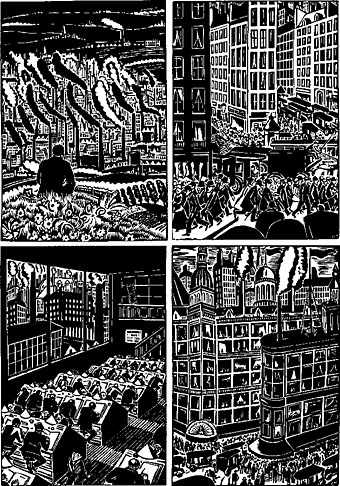
Frans Masereel - The City

Of the artists covered in the book, the most interesting were the Belgian Frans Masereel, the American Lynd Ward, and the Italian-American Giacomo Patri. All three worked with bock printing using wood and black ink. Masereel’s work is blocky and less stylized than the other two and seems to draw more inspiration from late 19th century graphic arts. His saw the modern world as brutal, dark and unforgiving to the less powerful:

Masereel’s depiction of the Western industrial world is so complete that his friend, writer Stefan Zweig, wrote, “Should everything perish, all the books, the photographs and the documents, and we were left only with the woodcuts Masereel has created, through them alone we could reconstruct our contemporary world.”

Lynd Ward - from Song Without Words
Lynd Ward’s work, while following thematically Masreel’s work, is centered in a mix of industrial arts, almost a futurist vision, an American as seen in the likes of Thomas Hart Benton, possibly cinema like Fritz Lang, and one can even see some of the ideas of the Mexican muralist Jose Clemente Orrozco. Using intricately carved wood blocks, he presents an America in the midst of turbulent economic times, filled with strikes, gaunt men in gaunt and defeated men, but also includes in a mid-century ethic that praised the industrial worker energetic, almost neo-Gothic images of men working amongst the dehumanizing machinery. His work is the perfect graphic aesthetic of the era, one that mixes criticism of capitalism with a celebration of industry and the worker who keeps it running.

Giacomo Patri’s work follows in the tradition of Lynd Ward, but begins to add text into scenes so that the reader has more ways of putting the story together. Again his drawings are a mix of the industrial and the energetic, but he focuses more on the individual in everyday life, not abstract beings caught in a modern drama. Moreover, his work is less ornate and leaves the characters as the center piece, not the energy or emotion of Ward.

The drawings in Wordless Books still have a power that resonates, perhaps at times it is a distant power caught in a history now quite distant, but the images of humans against machines is still salient. Perhaps one must substitute Masereel’s  draftsmen in the City for workers in cubical, but it is still the idea, although a contemporary artist might paint it in Starbucks green. While Wordless Books lacks the complete stories these authors tried to tell, it is a great introduction and should make anyone interested want to search for more of these works.

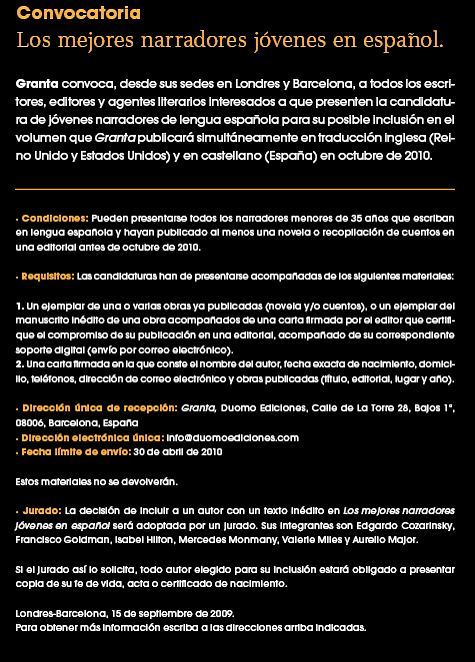
Granta to Publish Best Young Writers in Spanish in October 2010

Moleskine Literario notes that Granta has put a call out for contributions for an issue dedicated to the Best Young Writers in Spanish. It will appear in October 2010, with editions in both Spanish and English.  The complete announcement is below.