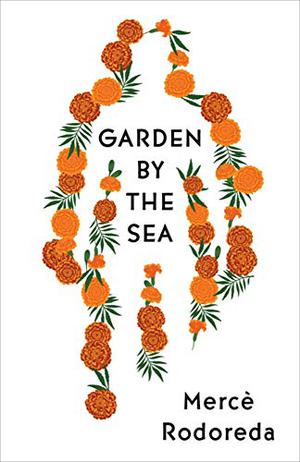
Garden by the Sea by Merce Rodereda – A Review

9781948830089
Garden by the Sea
Mercé Rodoreda
Maruxa Relanño and Martha Tennent, trans
Open Letter, 2020

Mercé Rodoreda’s work is marked by a concise style infused with a deep attachment to the natural world, one that is both emotionless and yet full of beauty. Open Letter has published four of her novels, Death and Spring, War, So Much War, Camelia Street, and the latest, Garden by the Sea, and each of them has been marked with the same disarming style. The first two are more allegoric, and the latter two more connected to the real world, that of Barcelona and near by. As a traditional story with an arc of action, Garden by the Sea is, perhaps, the most complete, which should not dissuade a reader one way or another as all her novels are magical.

The narrator is the gardener of a large home on the Catalan coast, just outside of Barcelona. It is a large garden and he is a consummate professional, so much so that he describes his plants in great detail. It is detail, though, that comes as dead pan, as if the narrator were a simple man (not uneducated) uninterested in gossip, emotion, or reflection. An example,

Senyoreta Eulalia fell ill. She kept the last letters from her husband under her pillow and she would read them from time to time. And apparently she wept all the salt from her body.

The last phrase is classic Rodoreda.

The story comes at you slowly, no foreshadowing, questions to be answered in the unfolding drama. It’s a dislocating style, one that in its simplicity allows for quiet observation and leaves the reader to puzzle out the gaps. The novel follows the intertwining lives of three families, two who come from humble circumstances and marry into money. It is the rare story where marring into money turns out well, and Garden by the Sea is no exception. There is a Gatsbyesque element to the novel. Yet where the narrator of The Great Gatsby is reflective, aware, the narrator here doesn’t seem to care one way or the other what happens to the families. Much of that comes from the class divide that runs throughout the book. The narrator is an employee, a long term one, but an employee just the same. He watches as the families struggle to recover and relive the past. Naturally, one can’t and the decisions that led to the wrong people marring are unrevokable. Instead, repeat themselves as farce, as arguments and drunken battles the narrator sees from a distance. It is a refreshing approach to a family story. The tragedy is there, but like the flowers in the garden it blooms, dies, and disappears back into  the dirt.

Emphasizing the past, is an older couple who raised the ill fated lovers. It is in their memories that we see the love that should’ve been. While the two rich families interact, they generally keep the gardener at arms length so we have no view into what is happening. Instead, the old couple keep the great romance alive and through them the gardener knows about it. Which leaves open the question that perhaps the marriages, and the untimely death of one of the characters, is not because of lost longing. That lost longing is only what a woman with a failing memory wanted. It makes the story, which otherwise seems straight forward, more complicated. Is this a romantic tragedy, or just one of the rich with too much time?

The richness of the language and intelligence of the story telling make Garden by the Sea  another welcome addition to the works of Rodereda in English.

Damned Souls by Dimiter Dimov – Love, War and the Plague

Damned Souls
Damned Souls
Dimiter Dimov
Sofia Press

It is one of those fascinating experiences of reading that let one enter into old political arguments, wander through them as if in an attic, and find among the detritus of so much misplaced, or misspent, analysis, otherwise quality writing.  Dimiter Dimov’s (Bulgaria, 1909-1966) writing is certainly marked by it’s time and in parts is not shy about them, yet underneath the cruft, the antiquated arguments that time has only made seem exaggerated, or, at least, mistargeted, is some solid writing. If one were to spend time wading in the intellectual past of the mid 20th century, Damned Souls is not a bad choice.

Damned Souls takes place in Spain right before the July, 1936 outbreak of the Spanish Civil War. Dimov spent considerable time in Spain between 1939-1946. I came across his name in Juan Eduardo Zúñiga’s La tierra será un paraíso (The Earth Will Be a Paradise). In that story he is working in a veterinary lab with Zúñiga and they find themselves planning to help Republican refuges to return to Madrid via clandestine methods. It comes to nothing, as does so much in Zúñiga’s post war Madrid, but what is evident is his deep admiration for Dimov.

At it’s core, Damned Souls is a debate between conservative religion and an open, an in some ways ideal, worker centered society. It was the crux of the Spanish Civil war, so the novel fits within that context. As a novel, though, Damned Souls has to make that case as forcefully as it can. Or at least, that is what Dimov tries to do. It makes for occasionally overwrought moments. At its best, Dimov captures the frustrations of his characters. The first third describes the harrowing drug addiction of Fanny, an English woman, who falls in love a reactionary Jesuit priest. The desperation and the lengths she goes to get her fix are some of the best writing of the book. He really captures the sad determination of an addict.

The rest of the book takes place in the  months before the war. Fanny, at that point not an addict, is the stereotypical upper class floater, more interested in having a good time than anything else. In a chance encounter she meets a Jesuit priest and falls in love with him. She begins following him around Spain, trying to get in his good graces. Finally, she lands at small town in northern Spain where he has set up a typhus hospital. He won’t accept her help, so she sets up a rival hospital. Next to it. As the outbreak spreads and more and more of the pueblo’s poor die futile deaths, it comes out that all the priest cares about is taking her money and reestablishing the Spanish empire. It’s that last bit that seems cartoonish, as if he could do it. Or perhaps it’s just the delusion that was at the back of Franco’s supporters. Because the arguments are so distant, it is hard to see them as real, even if they are the same ones in Doña Perfecta. Whatever the case, the descent of the hospital into disease is horrific, and, again, shows Dimov’s skill as a writer.

Ultimately, it is the Republican forces who take the camp over, and in a day remedy all the problems, delousing and burning all infect materials. It’s as if the old system was incapable, even when it tries to use modern methods, is incapable of helping the people. Dimov avoids any discussions of Republican politics, other than trad unions, but there is an undercurrent here that without knowing his work better, is hard to decide which way he is going. Is this socialist realism, or just an over exuberant anti-fascist? That aside, the debates are still present and would not feel as heavy handed if, and this is perhaps the biggest issue with the book, Dimov didn’t continually throw around generalizations, usually in the form, the Spanish are a nation of  fill in the blank.

Despite it’s flaws, Damned Souls is well written and should be read, not as a book about Spain, but as one author’s reaction to Spain and the Civil War.