Spanish Fever: Stories by the New Spanish Cartoonists
Santiago Garcia, ed
Fantagraphics Books, 2016, pg 283
There was a moment when I first began to read Spanish Fever I thought I had made a mistake: not another anthology of excerpts that propose to give you a sense of a writer’s work, but given the brevity of the sample all you get is sections of novels that don’t really say anything. Fortunately, Spanish Fever is better than that. Fist, the pieces are not excerpts. The selected pieces are self contained, almost short stories, and that gives a sense of completeness to the works. While many of the pieces are collaboration between writer and artist, especially older authors, it is critical to see an artist’s work as a whole.
While I’m familiar with recent Spanish history and how that has played out in literature, I’m less familiar with comics and graphic novels. The only graphic novel I’ve ever bought in Spain was actually Lebanese. The brief introduction from Santiago Garcia is quite helpful in showing how the transition from dictatorship to democracy actually slowed the development of the graphic novel. Tebeos, as they are called in Spain, were associated with the Franco regime, and in the 80s, despite the arrival of mature and irreverent comics, attempts to create graphic novels failed. Only in the last fifteen years or so have writers found success.
Of the writers included here, Poco Roca might be the most famous. His book Wrinkles about Alzheimer patients was made into a successful animated move. His piece here is Chronicle of a Crises Foretold, which describes the economic crash of 2008 and its effects. It feels as if it was an newspaper supplement explaining what happened. It is quite successful and the art is solid and his drawing of monopoly board is very effective.
Other writers of note were Jose Domingo’s Number 2 Has Been Murdered, which is one of the most stylistically drawn works. It is uses very precise angular drawings with stark contrasts between black and white. It is also one of the more sarcastic pieces, making fun of corporate culture. Javier Olivares Finland uses a an approach that is closer to Clowes, with a nice use of color and solid geometric lines. The story is meta and shows strong story telling skills. Both Max and Micharmut’s work eschew realism in narrative and are more symbolic. Max is the more famous of the two and his work is very recognizable. Gabi Beltran and Barolome Segui’s Mathematics is taken from another work and looks interesting. The piece stands on it own, but the stories of his childhood, if they are the same quality as Mathematics, have potential.
As usual, the number of women included in the volume is quite small. 4 out of 28 pieces are by women, which is a pretty bad ratio, especially given that there are many stories with women as protagonists. Ana Galvañ’s Horse Meat was better than I thought it would be. I’m not a big fan of the art, but the story two teenage friends who have the shape of horses was interesting.
It is a collection that is worth using as an entry in to the world of Spanish graphic novels.
Finally, the blog Historia y Comic is a great resource for finding comics, in Spanish, about history.

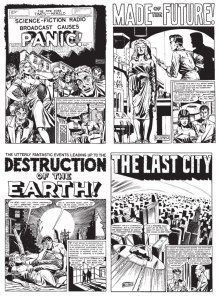 Time travel offers many opportunities for paradox and these stories are no exception. Made of the Future! is the best, and perhaps worst, of these. In the story a man stumbles on to a tour of New York given for people from the future. He sneaks along with them and in the future finds a place that makes instant wives. He brings here back to 1950 and enters bliss. But then she goes out for a walk and never returns and he realizes she must have ended up on the tour and never returned. Despite the leap in logic to her eventual fate, it has some nice touches, especially the notion what comes easily disappears easily. I called it perhaps the worst story because the sexual politics of the story are rather strange. The idea that you can just buy the perfect woman in the future is not a healthy prospect and once again turns women into commodities.
 Just in time for the 100th anniversary of World War I is Goddamn This War! by Tardi with chronology by Jean-Pierre Verney (translated by Helge Dascher). The book is a brief history of World War I that eschews plot or characterization and instead dwells on the massive incompetence and horrid logic of the war, using mounting barbarities as an indictment of the war. The book seems as if it is narrated by a soldier and in a way it is: the voice of the nameless, a kind of chorus, recounting pointless act after another. Told in little short vignettes that relate everyday life of the war, Tardi shows the pointless of it all. From relating the death of a man while doing his business to showing the graphic moment results of a shell landing in a trench to showing a snow covered field with blood leaking through. No moment of the grotesque escapes his vituperation and sarcasm. If you’re squeamish this is not a book for you; however, there is more here than just war porn. Tardi is reasonably effective in showing the low points of the war (mostly that’s what they were). The basic chronology and graphic depiction of it will give anyone reading this an excellent insight into the war. He does narrate the major events, such as when Italy enters the war or the Battle of Verdun is taking place, what interests him, though, is not the movement of troops or the political implications, but how little it matters. In addition to Tardi’s narrative there is a fine chronology of the war written by Jean-Pierre Verney. Like Tardi’s work it show’s just how badly run the war was and how unprepared the French and British were. The chronology and Tardi’s work make this anything but a typical work of military history. It seems more like the work of the German anarchist Ernst Friedrich’s Krieg dem Kriege (War against War!), published in 1924 and filled with images what really happens in war, the maiming, deaths, etc. It is in this focus on what happened, what the aftermath was like for those with facial wounds, what little support the disabled were given, that his book takes on its real power: the reminder that war is more than just movement of little ticks on a map.
 The
The By The Firelight