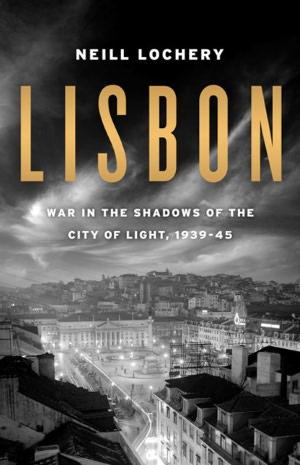
Lisbon: War in the Shadows of the City of Light, 1939-1941 – A Review

Lisbon: War in the Shadows of the City of Light, 1939-1941
Neill Lochery
Public Affairs, 2011, 306 pg

Lisbon: War in the Shadows of the City of Light will tell you just about everything you will ever need to know about Lisbon and Portugal during World War II. Perhaps, too much depending on you interests. Neill Lochery not only writes about the Salazar government at war, but about the intrigues and, in many ways, the gossip of those who passed through the city. The book is best at laying out Salazar’s plan to stay neutral and how he was able to play the two sides off of each other. As a man without any other goals than staying in power and making Portugal modern, he was able to sell tungsten to Germany without the least scruples in taking German gold (some of which the Bank of Portugal is said to have, Richsbank stamp and all). And with the allies, especially Britain which Portugal had long had alliances, he also sold materials for gold. As long as one side seemed more powerful than the other, he attempted to favor them more, short of joining the war. During the early years of the war he was quite welcoming to Germany, but he didn’t want to join the war, nor did he want Spain to invade. Spain had made several different plans to invade during the war, but Salazar was able to avoid it. He was always cautious, and even in 43 when Germany didn’t look as strong as it had, he delayed granting access to the Azores to the Allies.It is in the context of the scheming man that Lochery notes that any good that came out of Portugal’s neutrality during the war came about because it suited Salazar or he had no control over it. The Jewish refuges are a case and point. While Salazar didn’t kick Jews out of Portugal, he also didn’t want to grant them entry visas. It was his diplomatic officials early in the war who disobeyed orders and were able to allow Jews to escape through Lisbon.

Lisbon itself was a reflection of Salazar. It was full of spies, refugees, and people taking advantage of the situation. With all the refugees and the limited transportation options out of the country many were stranded there and had to do what ever it took to get out. For the rich such as the Gugenhiems, the Duke and Duchess of Windsor, and Hollywood stars like Leslie Howard they stayed in the best hotels and lived a life that had nothing to do with the deprivations of the war. It is here, in the more biographical sections, that the book suffers a bit. Not that it is badly written, it just isn’t that interesting to me. Especially, the part about the Duke and Duchess of Windsor. At least I know now how self-absorbed he was but other than that I don’t really care. There are definitely some sections one can skip over.

It is an interesting book, but for me only half of the book was interesting. But if you are interested in the history of Portugal during the war you can’t go wrong with this book.

The Guardian Reviews Purgatory by Tomás Eloy Martínez

Tomás Eloy Martínez’s last book Purgatory  has been published. “It sounds like another good book. The Guardian has the review:

A superb political reporter, Martínez perfected in his novels the blending of strict journalistic fact with the devices of fiction. He said that he had learned the craft when, in the late 60s, the exiled dictator Juan Domingo Perón summoned him to his Spanish estate to help him write his memoirs which, as the young journalist quickly realised, were largely fictitious. The result of the experience, published in the mid-80s, was The Perón Novel. It was followed a decade later by his masterpiece, Santa Evita, which García Márquez, usually reticent in his praise, said was “the novel I’ve always wanted to read”. The posthumous publication of Purgatory shows a writer at the height of his craft, and is a fitting conclusion to the work of one of Latin America’s most remarkable novelists.

New Cuentos para el andén Featuring Stories from Luis Mateo Díez, Jesús Ortega and Matías Candeira

A new issue of Cuentos para el andén is out, featuring stories from three authors I have never heard about: Luis Mateo Díez, Jesús Ortega and Matías Candeira. The last issue was enjoyable and I liked the idea of supporting short stories with a free quick read magazine.

The Shape of EBooks in Spain

Below is a brief outline of the state of the ebook industry in Spain. While it is moving slowly, there have been some big agreements recently that will shape the future of the ebook there. Consumer access to the books, though, remains limited. It will be interesting to see how this works versus the Amazon model, especially now that Apple has entered the game. (The article comes from La Nacion in Argentina and is translated via Google Translate with my corrections).

Is the Spanish publishing industry diving into digital waters? Not really. A few weeks ago in Madrid it announced the upcoming launch of Libranda, a distribution platform for digital books led by Planeta, Santillana and Random House Mondadori. The initiative promises to expand the catalog of electronic books in Spanish: eleven publishers will make their digitized collections available to libraries. For now, however, the reader does not have direct access to the platform. It is not a minor detail: the publishers chose not to neglect the channel now accounts for 90% of its business, and so launched a project that is more a defensive strategy than a full exploitation of the advantages of the digital ecosystem.

While they can not buy and sell ebooks directly through Libranda, readers and authors will benefit of the final price of electronic books which will be 30% lower than the paper copy, and the authors will receive 20% of the selling price , twice as much as they receive a paper copy.

Until the arrival of Libranda, the great platform of electronic books in Spanish was to be TodoEbook, which brings together more than 400 small and medium-sized Spanish publishers, offering 20,000 titles, mostly from collections and nonfiction works whose rights are in the public domain. Now, between the two platforms have 95% of the supply of ebooks in Spanish.

The expanding market for electronic books will result in the growth of eReaders, a scene now dominated by the Kindle, but seriously threatened by Apple’s IPAD. While the latter is more than an e-book reader, a fact revealed when its launch shook the foundations of the emerging ebook industry. According to a recent survey, 60% of Americans heard about the IPAD while only 37% of the Kindle.

On this side of the ocean, Musimundo opened the first shop that sells electronic books in the country. Built on Bibliográfika platform that integrates bookstores and publishers for printing, distribution and marketing of books on demand, now offers an extensive catalog of 20,000 books.

[tweetmeme=http://wp.me/plDex-xz]

Mexico’s Bestsellers for 2008

The LA Times has a list of Bestsellers in Mexico for 2008. Mostly they are are imports from the US (3 different Stefanie Myers books) and histories of Mexican Politics. Only one book really caught my eye and that is Jorge Volpi’s El Jardín Devastado.

A Spaniard in New York – La ciudad automática

Letras Libres has a review of what looks like a fascinating book. A Spanish reporter, Julio Camba, comes to 1930’s New York and writes his reactions to the the city and the depression. As the review points out, it would make a good contrast to Poet in New York by Lorca. Apparently he didn’t quite like the city nor America, but nerveless his impressions sound worth a read.

Good-Bye

Good-Bye
Yoshihiro Tatsumi

As often as I read graphic novels I often feel there is something lacking, the story perhaps, or maybe the characters, but I think it is the drawings themselves. They draw on traditions or images that once were pulp with little to say and the visual connection between the two weakens the power of the story. I know I had that feeling reading Will Eisner’s Contract with God, another early work in the genre. Tatsumi certainly has moments of visual power as you can see in the first story Hell, which takes place right after the bombing of Hiroshima. His drawings of the city leave a stark power that in later stories seems to more related to romance conics with their simple rendering of faces and expressions that become stand ins for complicated emotions that are difficult to express in 20 word bubbles.

Thematically, though, Tatsumi’s interest range from the complexities of the post war to frustration of everyday loneliness. Taken as a whole it creates a Japan that is not quite the miracle it seemed. Many Japanese have been left out: the veterans who survived the war but are scarred with old memories; old men who seem to be forgotten or lost in the new, hyper modern country; and the women who having ended up as hostesses, prostitutes, or attempted suicides, find themselves unable to break out of the roles thrust on them.

Of particular interest is Hell, a story that questions the sacredness of the victims. An army photographer takes a picture of a carbon shadow, one of those hideous legacies of the Hiroshima bombing. It looks like a son giving his mother a massage. The photographer sells the photo 10 years later and it quickly becomes a national symbol. But the photographer learns that it was really the son’s friend killing his mother for him. The son tries to blackmail him, but the photographer kills him so the image will keep its power. Unfortunately, they find the body of the son and the sweet narrative of a loving son looses its power. The photographer is haunted by the guilt of the crime from then on.

The story according to Tatsumi (in the interview in the back of the book) made a few people uncomfortable. However, it does question how a country creates hits symbols. Are they transitory as the story suggests? No one knew about the murder so the symbol of the mother and son still could have had the same power. It was not just the victim, but the context; or the projection of context, because the shadow only shows two figures. It is up to the reader to determine what they were doing. Tatsumi’s suggestion that not only ate the national symbols constructed, but they are constructions from one’s own perception gives Hell a weight its otherwise Telltale Heart like plot might weaken.

Hell, though, is thematically an exception to most of the stories, which are a mix of loneliness and sexual longing that show a troubled isolated society where sex is easily substituted for relationships. Its a melancholic almost nihilistic view and in Rash and Click Click Click it is taken to its furthest extreme when the protagonists contemplate suicide. Good-Bye, though, might best represent his view of the relations between men, women and families.

Mariko is a prostitute during the American occupation and her clients are all Americans. She has a steady American client who talks about marriage and love and seems to believe him. At the same time her father, a veteran who comes around for handouts, comes into the picture. He councils self control, but she has none and all he can do is slink off to bars and wonder how he ended up the way he has since it wasn’t his fault they lost the war. In the end the American goes home and she decides to get drunk. Her father comes around at the same time and tells her to sober up, but it only enrages her and she grabs him and forces him to receive her sexual motions until he ejaculates. Shamed he walks out of the room. She cries but says it is for the best. The last scenes are of him walking crowded street wondering when it will end, and of Mariko leading an American to her home.

The story creates a world where the traditional has been destroyed and what is left are the power relations: client to prostitute; father to daughter; shame to transgressions. Tatsumi si not only showing the legacy of war, but the movement away from the traditional pre-war Japan to the American influenced culture. At the same time, though, the power relationships have changed: American, youth, tradition, all in that order. While Tatsumi uses prostitutes as his symbol for this a little too often, it illustrates this dynamic quite well, much like Suzuki’s Gates of Flesh.