Moleskine Literario notes that Granta has put a call out for contributions for an issue dedicated to the Best Young Writers in Spanish. It will appear in October 2010, with editions in both Spanish and English. The complete announcement is below.
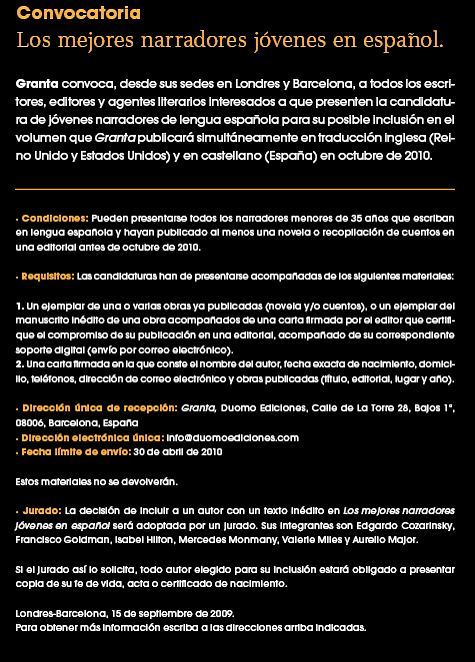
Moleskine Literario notes that Granta has put a call out for contributions for an issue dedicated to the Best Young Writers in Spanish. It will appear in October 2010, with editions in both Spanish and English. The complete announcement is below.
Javier Marias participated in a chat at El País and in the brief session he answered questions on language, his writing, and literature. There were several questions about his constant pessimism, especially in his weekly article in El País (something I long ago got tired of reading). One in particular wanted to know why he didn’t focus on other countries, but he said he knows Spain best and will stick to that. Continuing in his pessimistic way he made several mentions of the continued “deterioro del español de España” (deteriation of Spanish in Spain). To me it sounded just like a cranky old man when he was on that topic. Language changes and there is not point in complaining about it, but I think that is what he likes most to do.
About his writing he was asked in English language structures have crept into it and he said sometimes he does that to enrich his language, but only when it makes sense. He has begun a new book and the only thing he really knows is that it will be pessimistic, too. He is about half way through, but for the last year he has been on a book tour, something that he has found boring, and is looking to get back to his work.
Finally, he does know how to use a computer, he just doesn’t like to write his books and articles with a computer. And when asked the 3 best novels of the 20th century he said, Lolita by Nabokov, Light in August by Faulkner, and Catcher in the Rye by Salinger.
The Spanish poet Luis García Montero read at the University tonight (3/3/2010) to a packed room of students and academics. He read 8 poems from his body of work that the graduate students had translated into English. I’m not that familiar with Spanish poets and so had no idea what to expect, although I had seen his interview on El Público Lee. He is considered one of Spain’s best poets and is considered a realist poet who uses the elements from the everyday to express emotion or the experience of living. The poems that he read were very interesting and would be worth a return to. While he is a realist, the poems did have a good sense of imagery and didn’t slide into that reportage that is so real it describes nothing but itself and seems to afflict many of the American poets I’ve read and seen recently. Before each poem he explained where the ideas came from and they were often from the most basic experiences, but went beyond the moment he explained and captured something about modern living. The one I remember most was his poem to his mother. It was a reflection on the dreams she sacrificed to her family that in the era of Franco were not possible. And although he fought with her as young man who was experiencing the transition to democracy, he now sees her as someone who was so much more.
The blog Arabic Literature (in English) tipped me off to the Beirut based Samandal magazine of “Picture Stories from here and there.” While they don’t require the art to be from Lebanon or in Arabic or French, most of the writers and artists from the first four issues are from that region of the world. You can down load the first four issues of the magazine in pdf format. I looked through some of the issues and there was a wide range of stories and artistic styles that make the magazine a good read. Supposedly you can get issue from Forbidden Planet Comics in NY City, although it is not listed on their website.
I did a little reading (2 pages to be exact) of a story called Hostages last night at the Hugo House. There was an interesting collection of readers. One woman read a poem that didn’t really seem like a poem, but what was interesting was when she sang parts of it. It was a welcome change from some of the slow talking symbolists. At the opposite spectrum was the Mexican American comedian who gave us 5 minutes of funny stand up. He had great delivery and sure knows how to wait for the laughs. The reading series actually tends to always have a couple of really interesting presenters.
The Quearterly Conversation has just published its 19th edition. A few articles and reviews that look interesting:
By Jason Grunebaum
The Girl with the Golden Parasol follows Rahul, a non-Brahmin, who finagles his way as a student into the department of Hindi: one of the most corrupt in the university, and a “den of Brahminism.” He does so after falling utterly for Anjali, a Brahmin girl, who, through simple bad luck, could find a home in no other department. The narrative chronicles exactly how the powers-that-still-be in India have harnessed globalization to further consolidate power over language and culture at the most local of levels. It’s also a love story, and a tale of students protesting the corruption of the Indian university system.
By Patrick Kurp
In the popular mind Swift remains a one-book author, and even ambitious readers may be unaware he wrote poetry. But scholars have identified roughly 280 poems in English . . .
By Adam Gallari
Petterson, whose work calls to mind the reserved nature of such “masculine” writers as Knut Hamson and Richard Yates, makes a more difficult target than present-day male writers exploring the masculine question through worlds of hyper-violence and hyper-reality. They are the men at the bar talking a good fight, while Petterson is the guy in the corner.
Review by Stephen Henighan
Precise and dramatic yet suffused with a dreamy suggestiveness, Monsieur Pain is a real discovery and a substantial addition to the growing Bolaño library in English.
Review by Matthew Jakubowski
Jonke’s writing isn’t difficult, though his sentences can stretch on into multi-page masterpieces, and he’s a fan of word games and surreal imagery. But beneath these formal surfaces and experimental style (some have called Jonke a “text composer”), these stories are frequently tender and funny; for all the book’s curiosities and through-the-looking-glass moments, System proves Jonke was that rare thing: a huge, rebellious talent with tremendous heart.
Review by Geoff Maturen
Rex’s narrative structure—consisting of twelve “commentaries” written some time after the events have occurred, and addressed to J.’s former student Petya—offers an initial clue that it is not a straightforward novel. As becomes evident, J. is not really concerned with relating what has happened. Rather, he seizes upon the events as a series of “teaching moments,” ostensibly to instruct Petya, but, one suspects, really intended as a way for J. to come to terms with the trajectory his life has taken.
Review by Daniel Green
In his now posthumously released (and presumably final) novel, The Abyss of Human Illusion, Sorrentino again offers a relatively brief work (150 pages) built out of narrative fragments. As Christopher Sorrentino points out in his introductory note, the most obvious features of the novel’s formal structure are its division into fifty numbered sections.
Review by Salvatore Ruggiero
Evenson’s story collection has characters who try to dissociate themselves from their beginnings (or who have their beginnings redefined by others), who consciously neglect previous happenings and logical prognostications to believe what they want to believe to make the best of their situation at hand. They look at their past as a constellation, trying to fit the events in order so that it makes the now more palatable. It’s an unrealistic notion, but it’s one that is aptly accentuated by the gothic and grotesque nature of these stories.
Review by Gregory McCormick
In grappling with Peter Bush’s recent re-translation of Juan Goytisolo’s 1974 novel Juan the Landless, I kept wondering why we read at all. Goytisolo’s book is notoriously challenging: there’s no real punctuation save frequent colons, and the book is full of shifting protagonists and pronouns and constant pressure on the language, as though Goytisolo aims to make the text itself implode. So why do we read, and what can be said about a book seemingly created to subvert the entire act of reading?
Review by Karen Vanuska
What if your country was in a midst of a purge of all private wealth, yet all you longed to do was to get your hands on a million rubles and run off to Rio de Janeiro? Well, if you were affable and clever Ostap Bender, the hero of The Golden Calf, you would scheme your way into a fortune.
Review by Michael Moreci
When it comes to the elusive concept of authorship, there’s no shortage of reference points. From Harold Bloom’s The Anxiety of Influence to Jonathan Lethem’s “The Ecstasy of Influence,” the definition of authorship is both a polarizing and fascinating topic. In his debut novel The Lost Books of the Odyssey, Zachary Mason takes this debate a step further by conjuring a set of interpretations to a story whose authorship has sparked many academic studies: Homer’s Odyssey.
Interview by Matthew Jakubowski
I looked up—there was Jonke at the bus stop. And he got on the bus. And I thought, “OK, he’s going to sit next to me.” I know it. And he did. He sat right next to me. And it wasn’t a very crowded bus. And I thought, “OK, you’re never supposed to talk to strangers in Europe—I’m doing it.” So I just said, “You’re Herr Jonke, I believe?” And he said, “Yes, why?” And I said, “Well, I’m writing a scholarly article on you.” He said, “You have to be from Great Britain because nobody from the United States knows who I am.”
Interview by Annie Janusch
“No U.S. publishing house has brought out a single living Hindi novelist in translation in more than a generation.” Hindi translator Jason Grunebaum discusses the state of Hindi writing, language, and publishing—and what American readers are missing out on.
A new Words Without Borders featuring international poetry was published today. Featured just in time for the upcoming appearance in Seattle of Luis García Montero is one of his poems.
The excellent blog Arabic Literature (in English) turned me on to this site. It is a graphic novel about the aftermath of the Iranian election in 2009. Written by a Persian (American) writer, an Arab artist and a Jewish editor it and “Zahra’s Paradise weaves together a composite of real people and events.” It comes out Mondays, Wednesdays and Fridays in installments of one four to six page panel, which in itself I like. There is something about stories that are published serially that makes the experience of reading them interesting. There are only a few installments, so it is a little difficult to tell how good it is going to be, but a first read it is interesting. I’ll be curious to see how the art evolves, if at all during the run. I imagine it is a difficult task to create the same characters week after week in the same style.
You can start at the beginning here, or go to the most recent episode.
Zahra’s Paradise isn’t just a cemetery where the world comes to an end. It’s also a womb, a garden, where the world is reborn. Sure, Neda is dead, Sohrab is dead, Mohsen is dead, and they’re all buried in Zahra’s Paradise. But just as there is death, so there is life and light bursting out of their shadow. Their virtual reflection, wrapped as fictional characters, allows us to raise our own imaginary army to intervene in history in real time.
Zahra’s Paradise is a wall drawn around the constitution of Iran’s children. Initially, I wanted to avoid grief by taking refuge in farce. The events in Iran, the protests, broke through. Every day, we’d catch glimpses of Iran’s youth (anyone under eighty), their faith, dreams, courage and cool, breaking out through an electronic wall. But their story appeared as fragments scattered across the face of time. Zahra’s Paradise is the garden where we’ve tried to piece together the fragments, and put a name and face to the story. Mehdi.
 By The Firelight